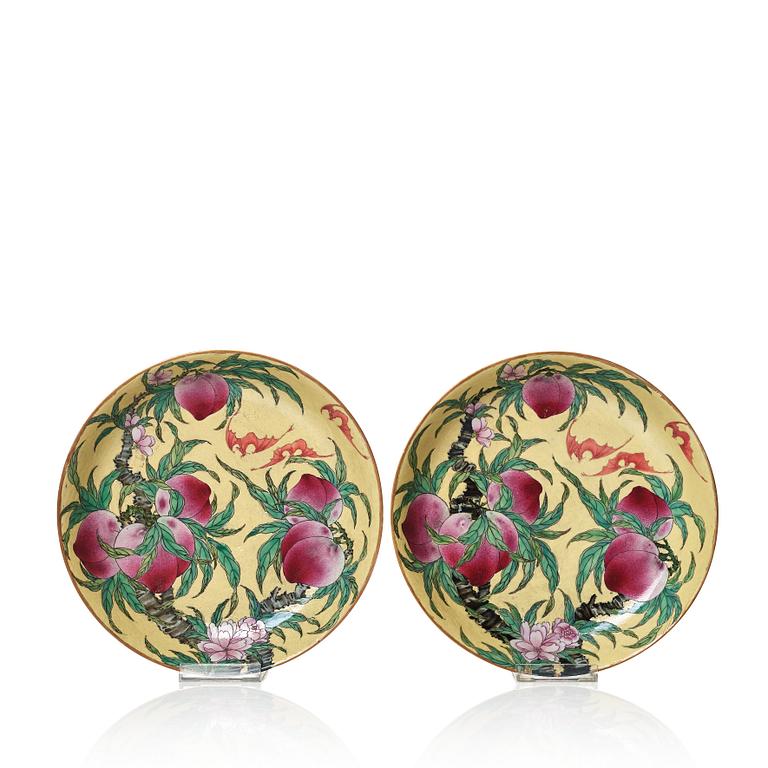
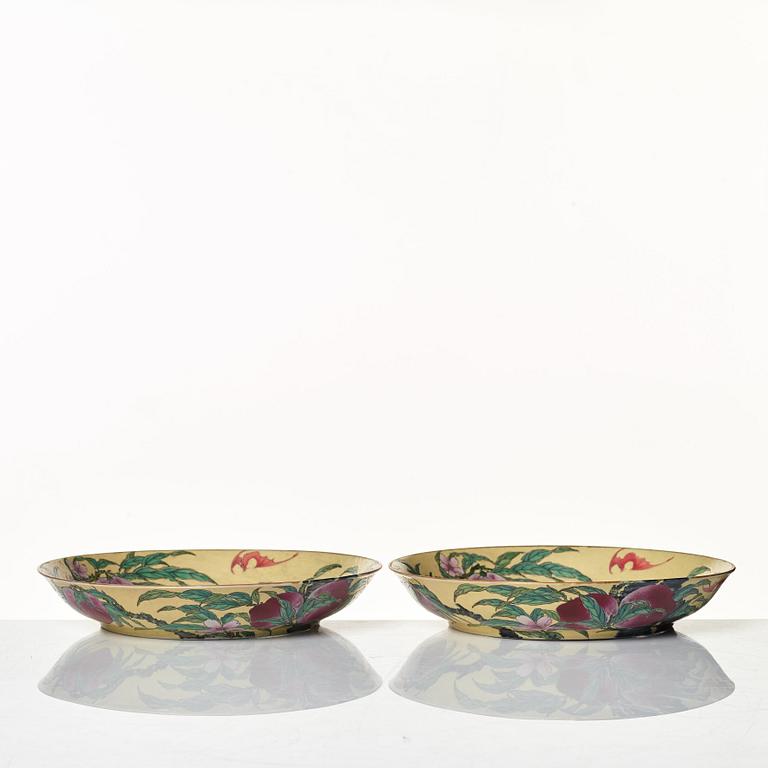
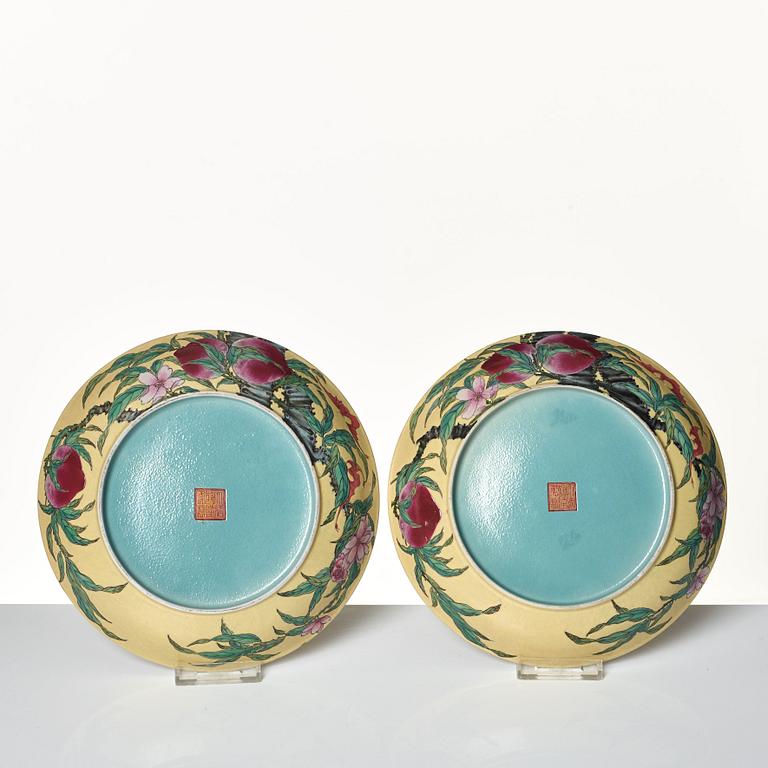
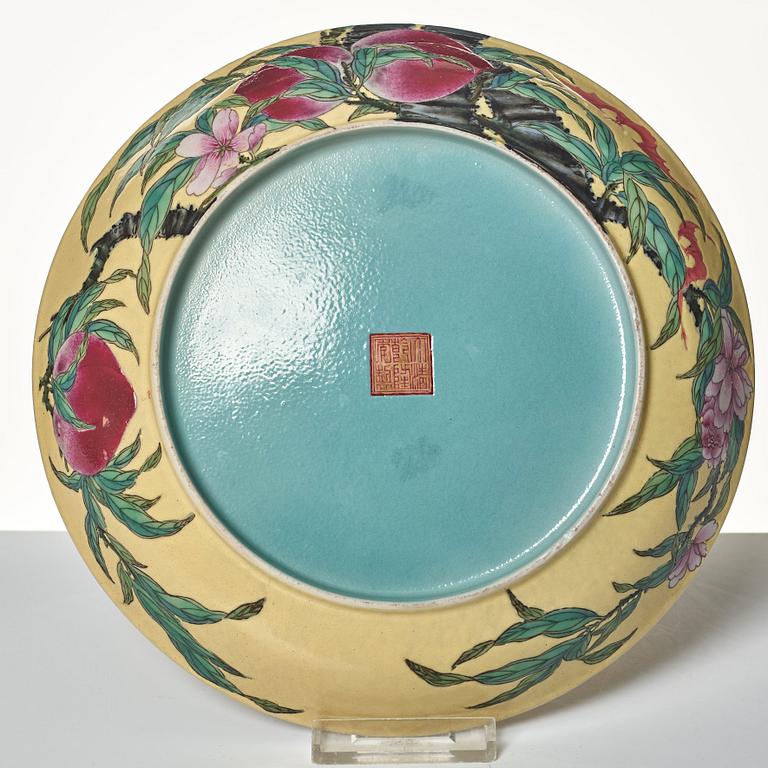
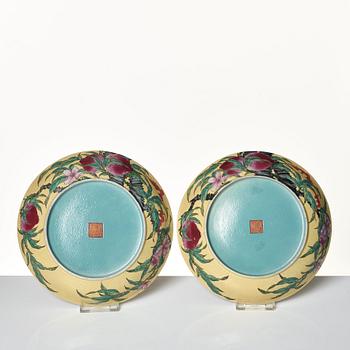
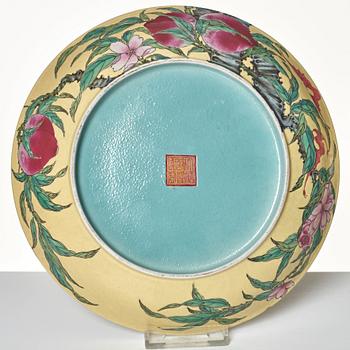
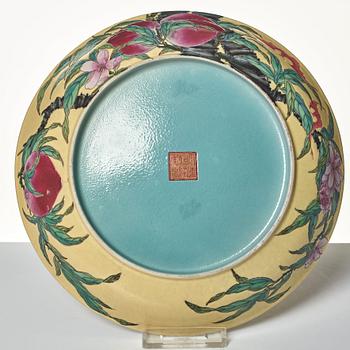
Faten har dekor i famille rose paletten av nio mogna persikor, (sex på framsidan och tre på baksidan), samt fem fladdermöss, (tre på framsidan, två på baksidan). Persikorna varierar i färg från rosa till grönt. Blommorna är målade i pastelfärger. Dekoren fortsätter över kanten in på baksidan av brämet, allt detta mot en gul grund och förgylld kantrand, samt turkos botten. Diameter 24 cm.
Slitage.
Proveniens
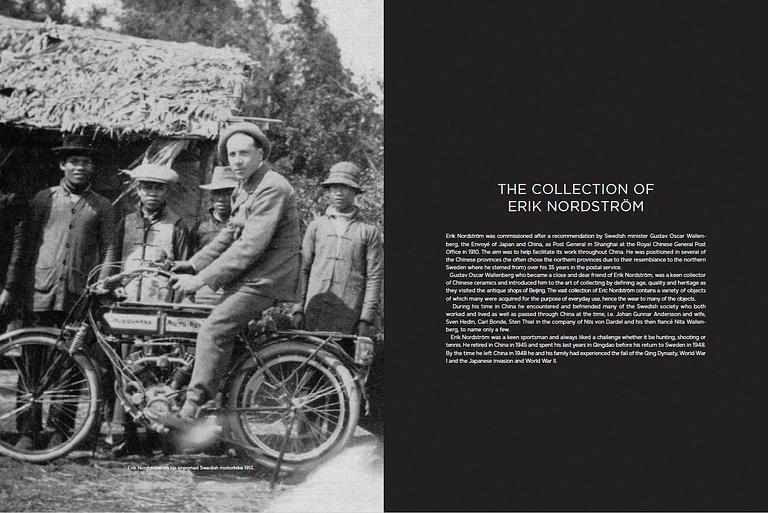
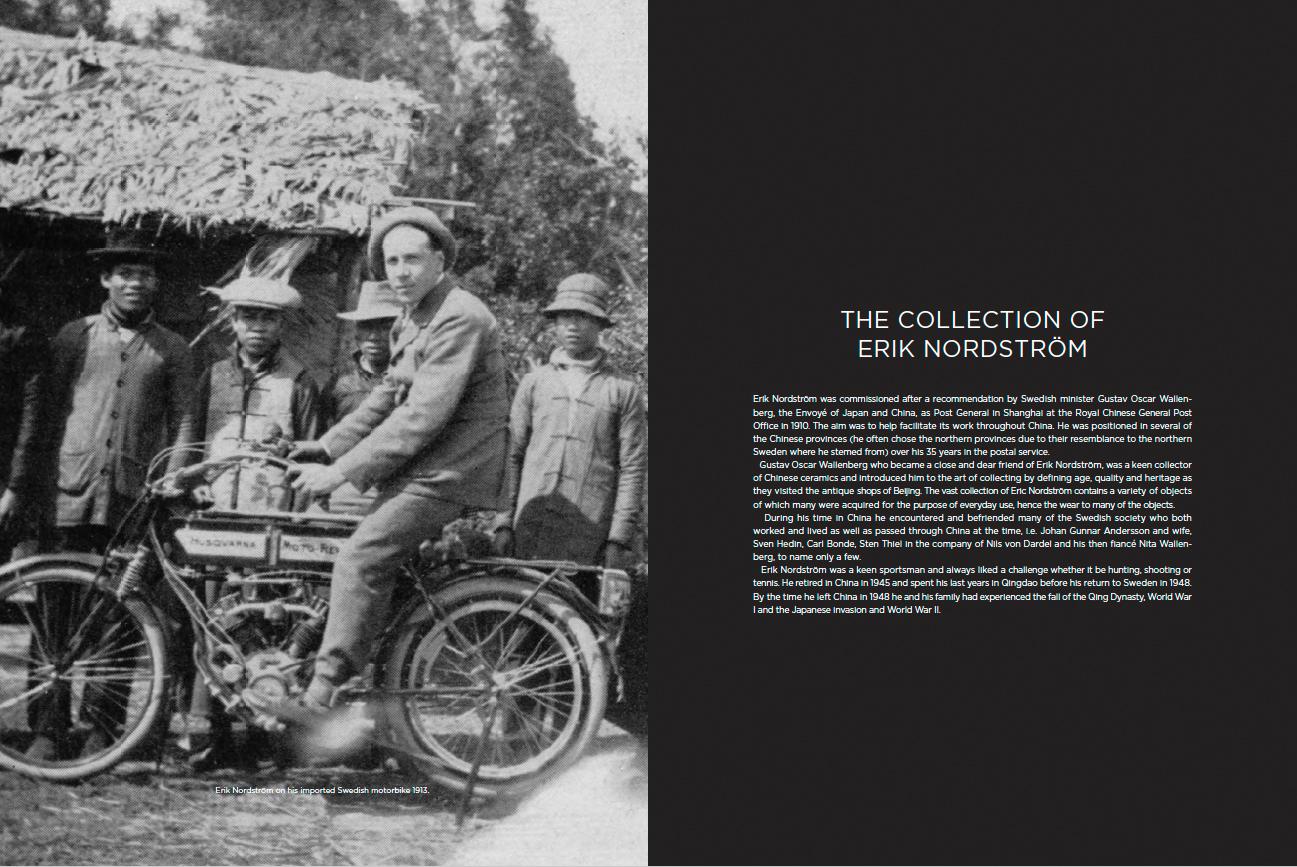
The Collection of Erik Nordström (1884-1971)
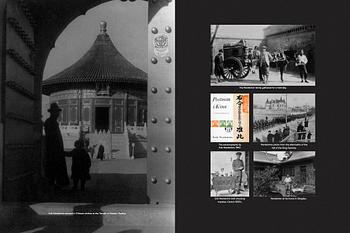
Erik Nordström was commissioned after a recommendation by Swedish minister Gustav Oscar Wallenberg, the Envoyé of Japan and China, as Post General in Shanghai at the Royal Chinese General Post Office in 1910. The aim was to help facilitate its work throughout China. He was positioned in several of the Chinese provinces (he often chose the northern provinces due to their resemblance to the northern Sweden where he stems from) over his 35 years in the postal service.
Gustav Oscar Wallenberg who became a close and dear friend of Erik Nordström, was a keen collector of Chinese ceramics and introduced him to the art of collecting by defining age, quality and heritage as they visited the antique shops of Beijing. The vast collection of Eric Nordström contains a variety of objects of which many were acquired for the purpose of everyday use, hence the wear to many of the objects.
During his time in China he encountered and befriended many of the Swedish society who both worked and lived as well as passed through China at the time, i.e. Johan Gunnar Andersson and wife, Sven Hedin, Carl Bonde, Sten Thiel in the company of Nils von Dardel and his then fiancé Nita Wallenberg, to name only a few.
Erik Nordström was a keen sportsman and always liked a challenge whether it be hunting, shooting or tennis. He retired in China in 1945 and spent his last years in Qingdao before his return to Sweden in 1948.
By the time he left China in 1948 he and his family had experienced the Chinese revolution, World War I and the Japanese invasion and World War II.
Utställningar
The nine peaches correspond to auspicious wishes for longevity, while the five bats are a pun for five kinds of good fortune. The design peaches and five bats is common on imperial porcelains of the Qing dynasty.
För konditionsrapport kontakta specialist









Andra har även tittat på