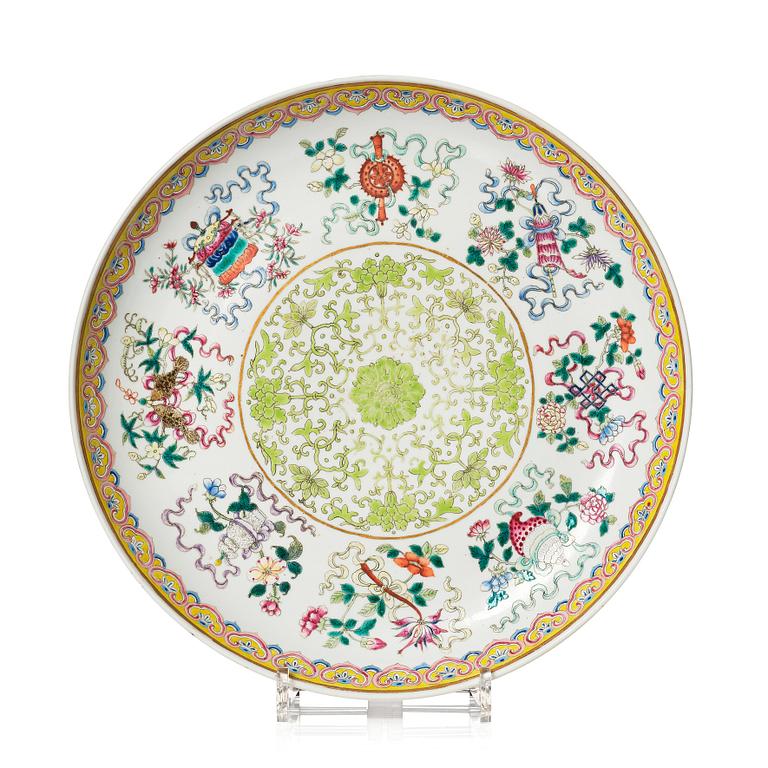
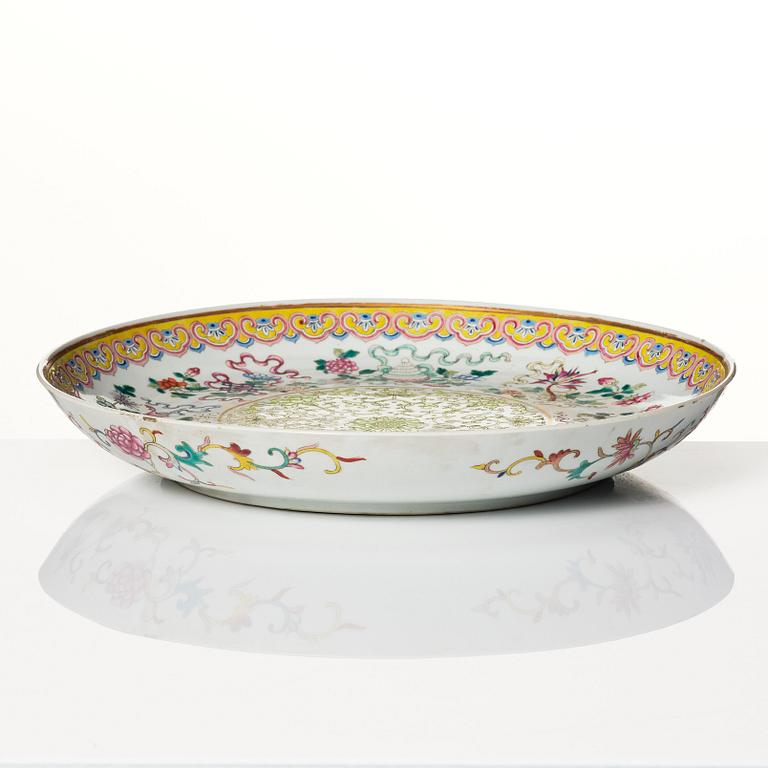
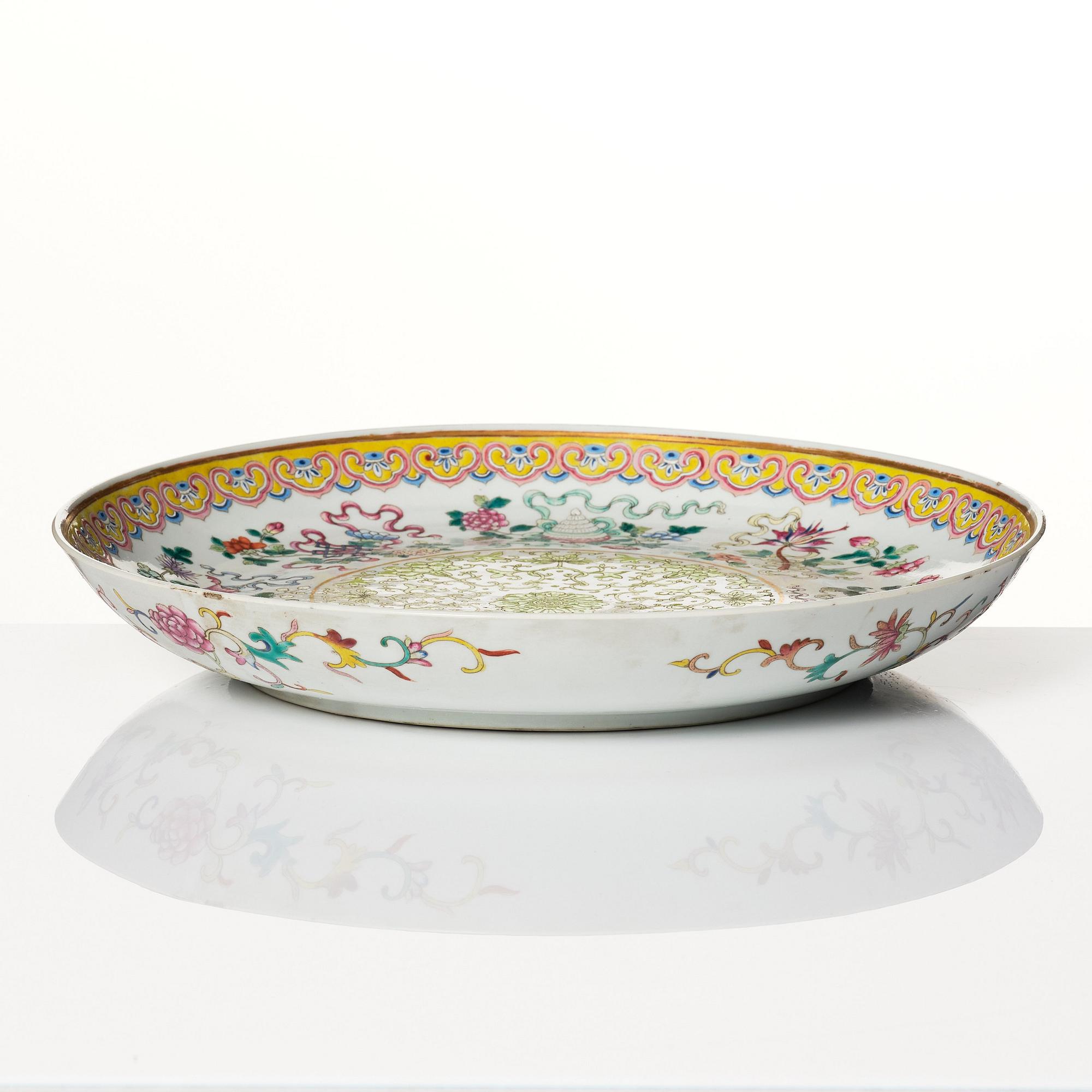
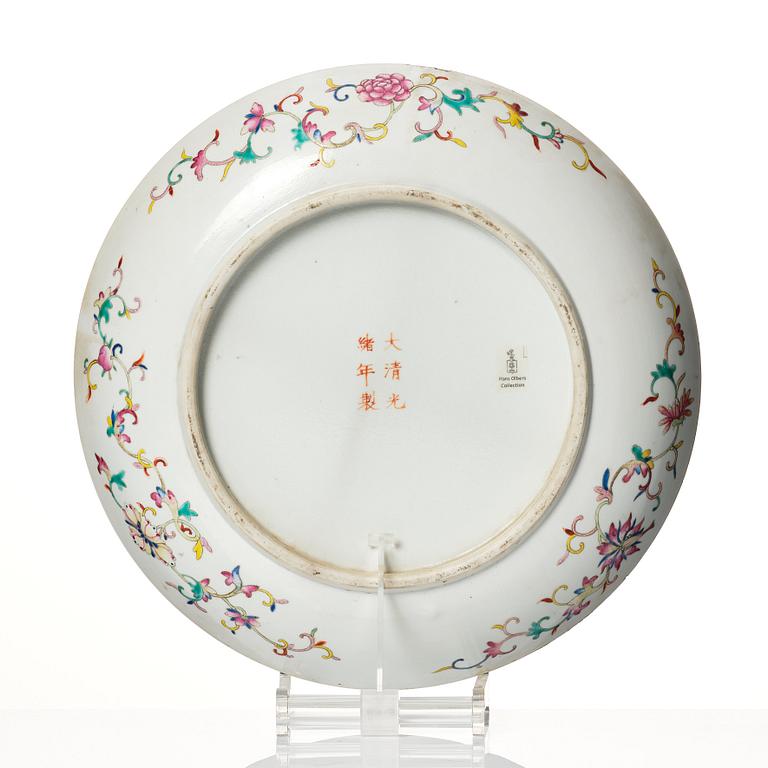
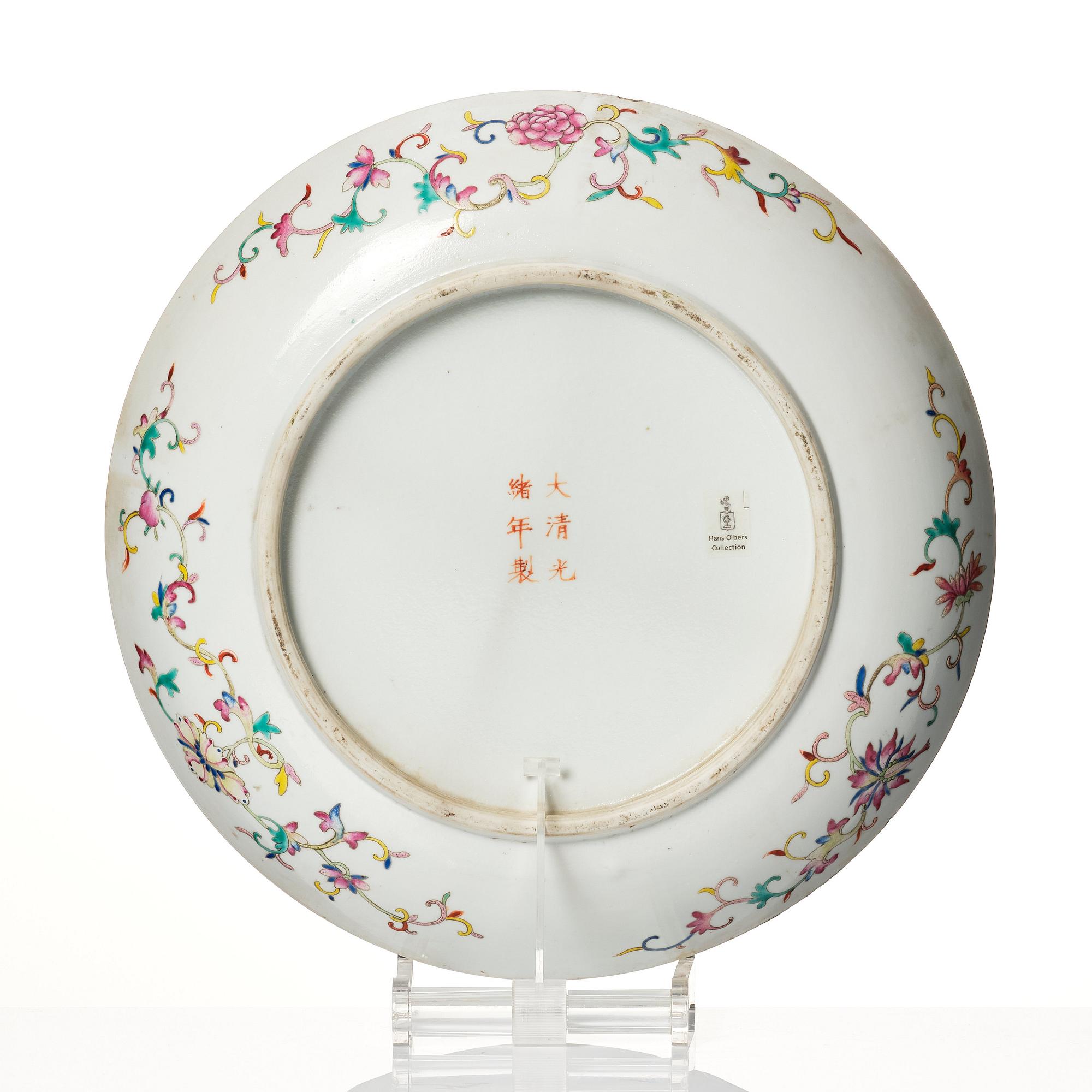
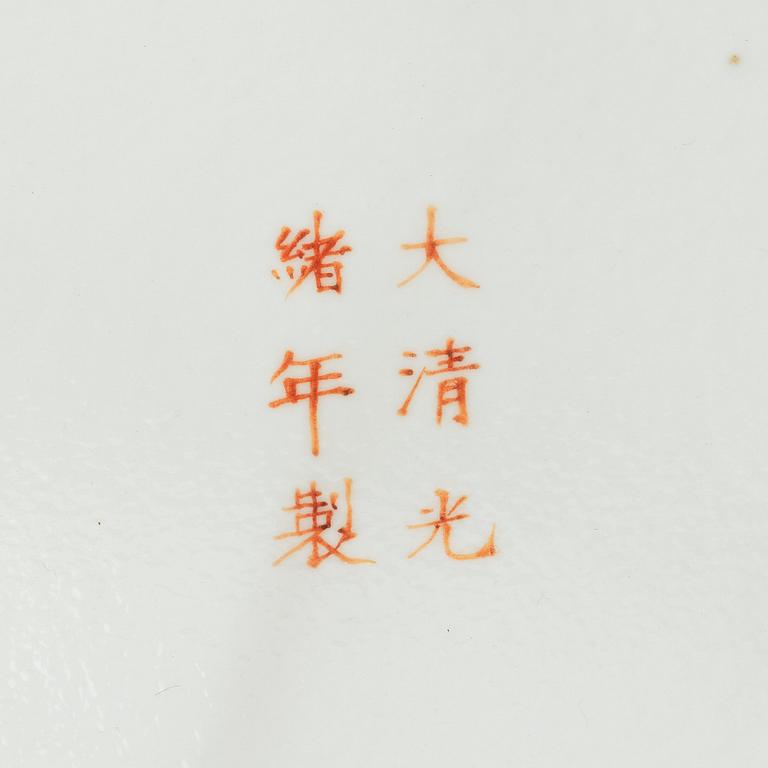
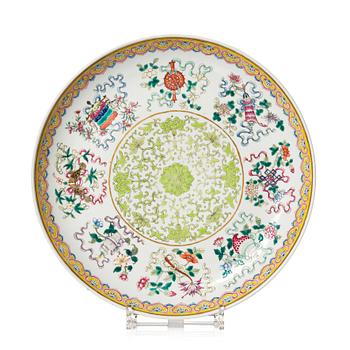
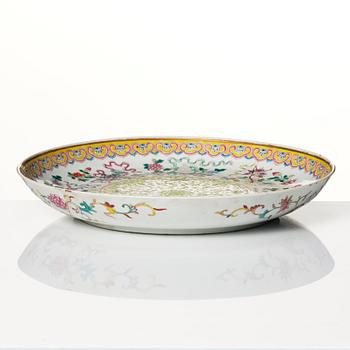
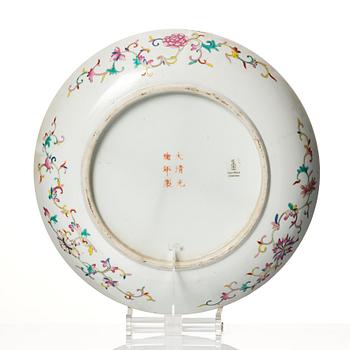
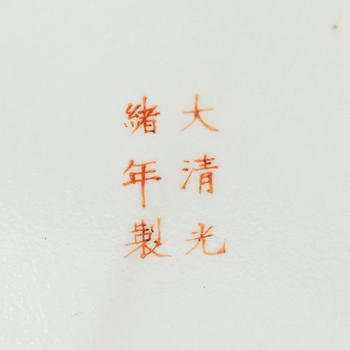
Dekor i famille rosefärger, centralt med en rundel med en fortlöpande lotusslinga i ljust grönt. Runt om detta de åtta buddhistiska elementen, s.k. bajixiang. Baksidan med sigillmärket i rött, samt brämet med tre växtslingor. Diameter 34 cm.
Glasyrnötning vid kant.
Proveniens
From the Collection of Hans Olbers (1932-2020), Djursholm, Sweden. Thence by descent.
The Olbers family were active members of the Swedish East India Company during the 18th and 19th Century. The most renowned member of the family is presumably Levinius Olbers (1725-1804), who participated in a total of 12 trips to China, several as commander/captain. The trips were adventurous, and he survived no less than three shipwrecks. Growing up in a family with so much history with the East India Company, it became natural for Hans Olbers to have a great interest in Chinese Works of Art. Throughout his professional life as a businessman he had most of Asia as his field of work.
Utställningar
Compare; Sothebys, CHINA / 5000 YEARS
1 December, 2022. New York. Lot no 619.
Compare also; One at Denver Art Museum; Gift of May Wilfley in memory of her parents, A. R. Wilfley and Addie M. Wilfley. Inventory no 1974.53. Due to the marking of the dish it is thought to be comissioned by dowagar empress Cixi (TSUH-she) (1835-1908) for use in the Palace for Gathering Elegance, one of her palaces in the Forbidden City.
Compare also, one inte Musee Guimet, Paris. Inventory no G 3374 (+). Collection Ernest Grandidier.
Litteratur
A similar dish of this large proportion is illustrated by Peter Lam in Imperial Porcelain of Late Qing from the Kwan Collection, Art Gallery, The Chinese University of Hong Kong, 1983, no. 125, p. 124.
The imagery on Chinese decorative arts is often imbued with wishes of good fortune, long life, prosperity, and many children. The Eight Buddhist Emblems that are depicted on this dish were popular decorative elements during the Qing Dynasty, when this dish was made. The eight emblems are: the Wheel of Law, a conch shell, a victory banner, an umbrella, a lotus flower, a vase, a pair of fish, and an endless knot.
För konditionsrapport kontakta specialist



Andra har även tittat på