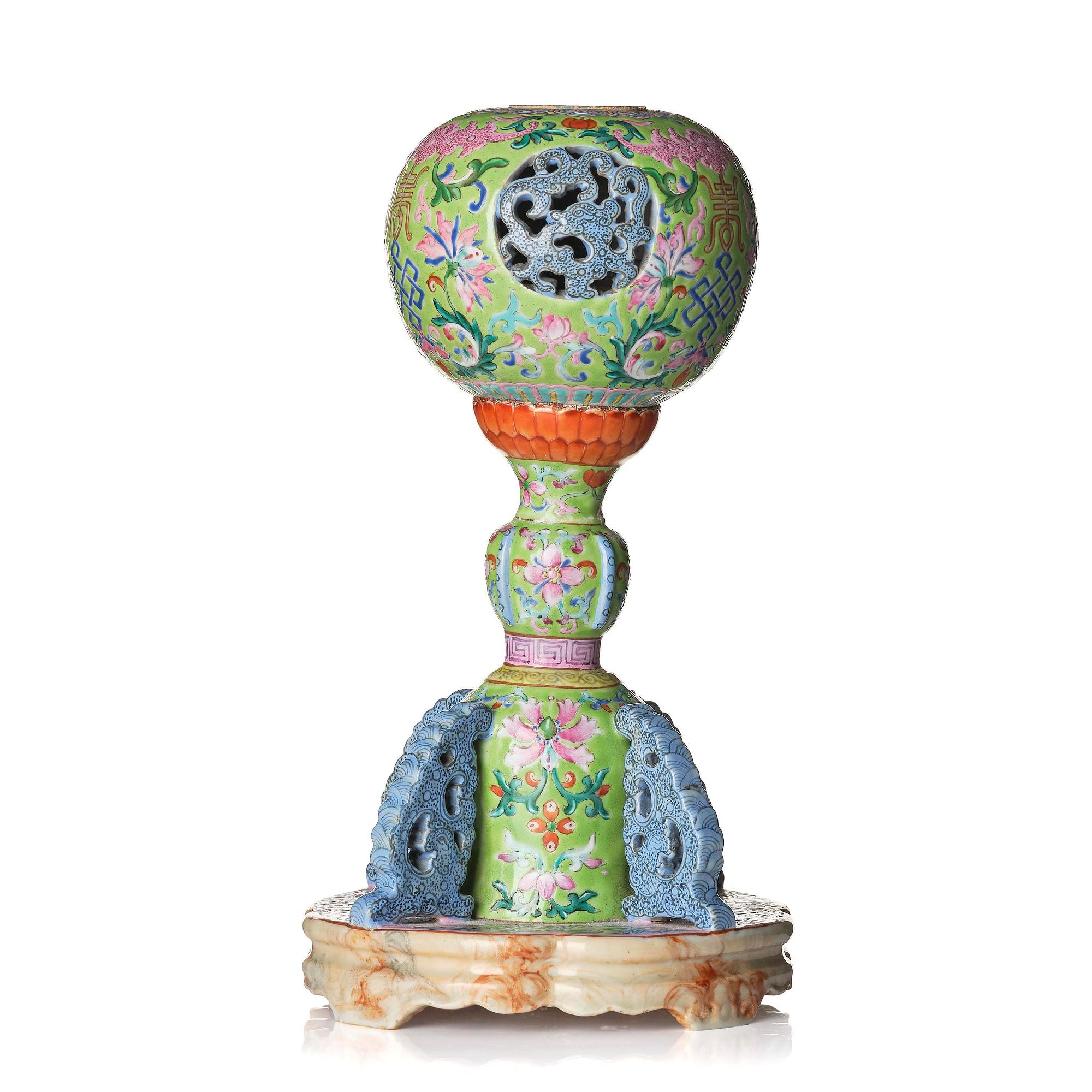
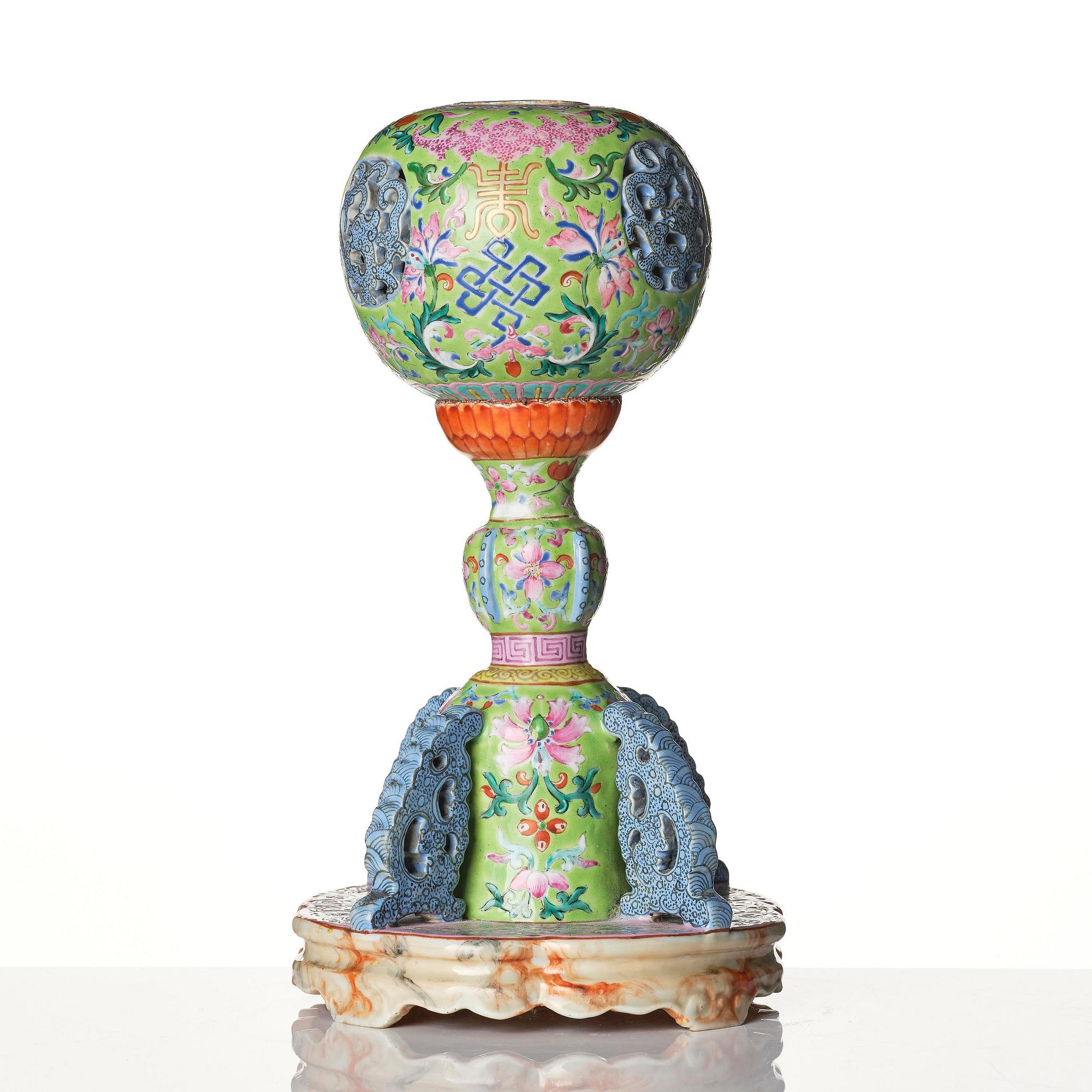
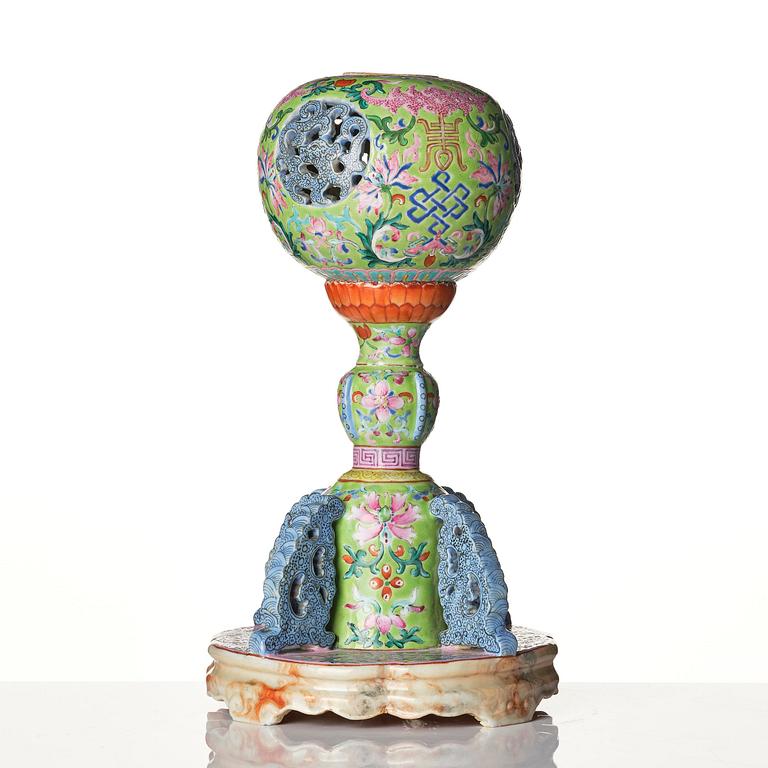
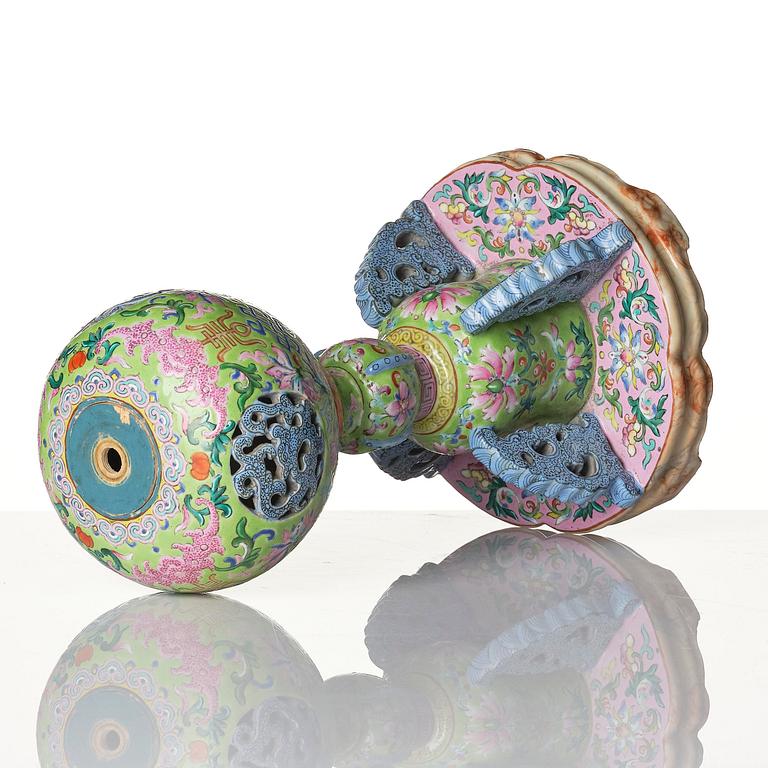
Det övre globformade partiet är dekorerat med fyra genombrutna partier med chilongdrake medaljonger allt mot en äppelgrön grund dekorerad med lotuslingor, fladdermöss och lyckotecken. Den klockformade foten har fyra genombrutna stödben som vilar på en sockel dekorerad i s.k. faux bois och lotus mot rosa grund. Höjd 27 cm.
Del saknas överst. Nagg. Lagning.
Proveniens
A Swedish private collector.
Utställningar
Compare a similar sold at Christies, lot 278, 7 Nov 2017 Live auction 13982,
Fine Chinese Ceramics & Works of Art.
Compare a similar turquoise-ground hat stand dated to the Qianlong-Jiaqing period (1736-1820) sold at Christie's London, 11 May 2010, lot 261, and a yellow-ground 'nine dragons' hat stand dated to the Daoguang period (1821-1850) sold at Christie's London, 8 November 2016, lot 80.
Övrig information
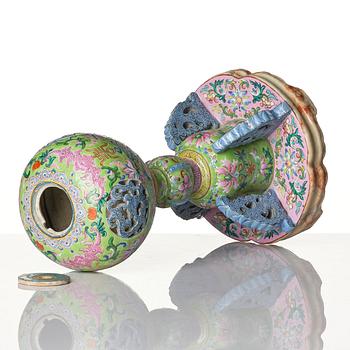
Hat stands for the Imperial Court were made in a variety of mediums, from jade to zitan, to lacquer and porcelain. Porcelain was a perfect medium, allowing the potter to craft the vessel to perfectly suit its purpose. As may be seen in the present lot, the uppermost spherical section was used as a vessel for perfumed contents, such as fragrant flowers or incense, to pleasantly scent the hat and surroundings through the four reticulated 'bat' medallions. The cover was cleverly made with a mechanism to lock it to the globular section.
The Qing Court Collection, in the the Palace Museum, Taipei, includes seven similarly modelled famille rose hat stands.
För konditionsrapport kontakta specialist











Andra har även tittat på