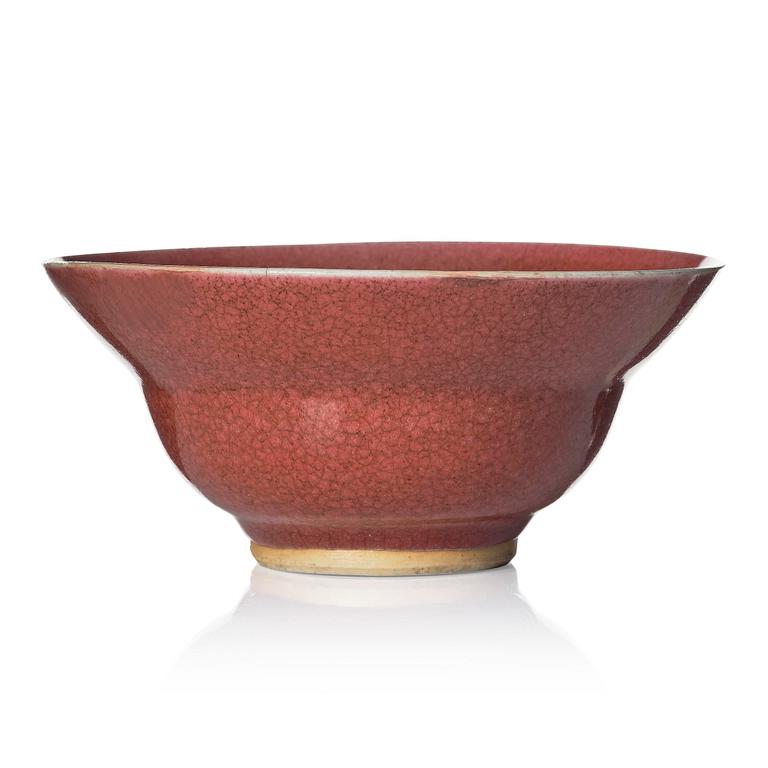
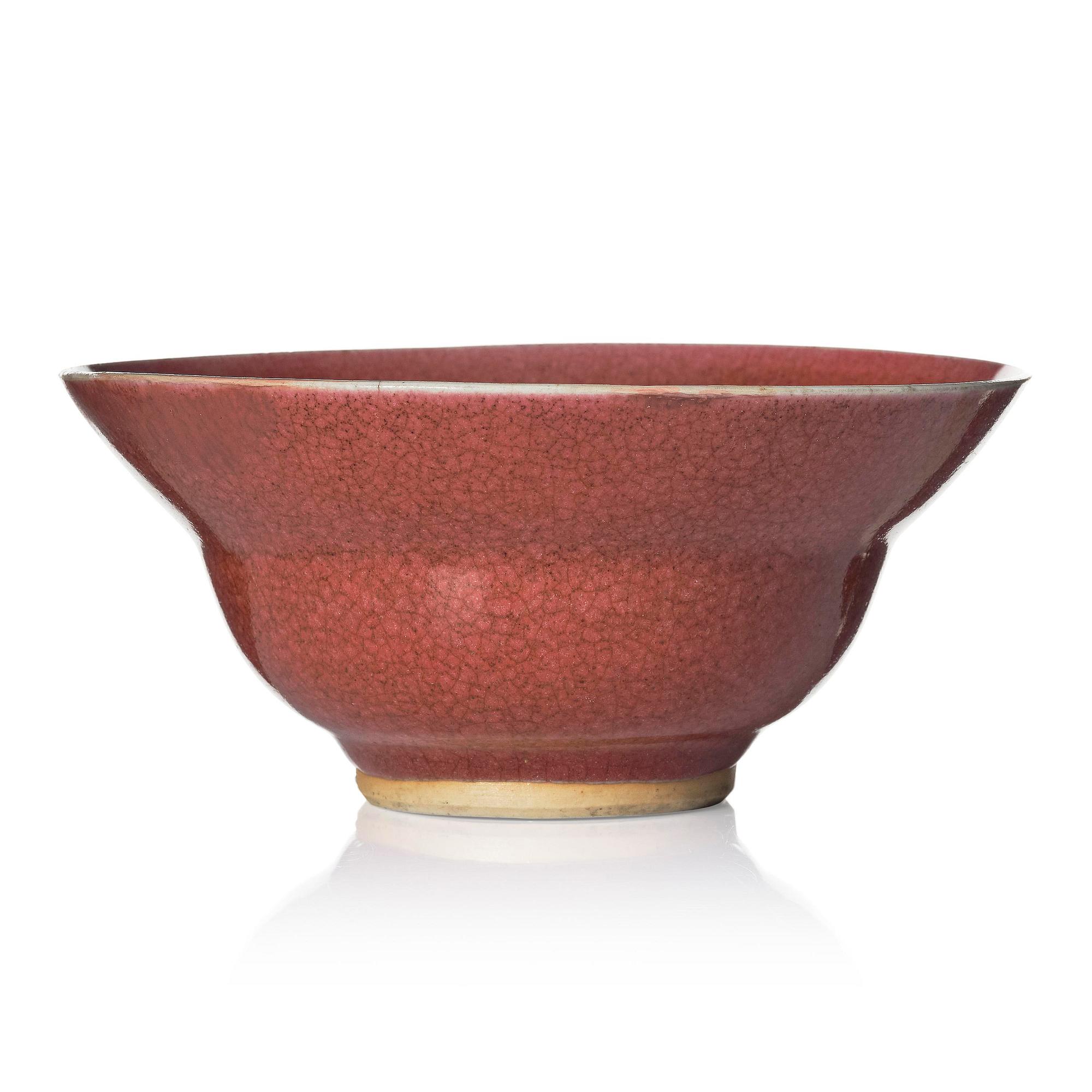
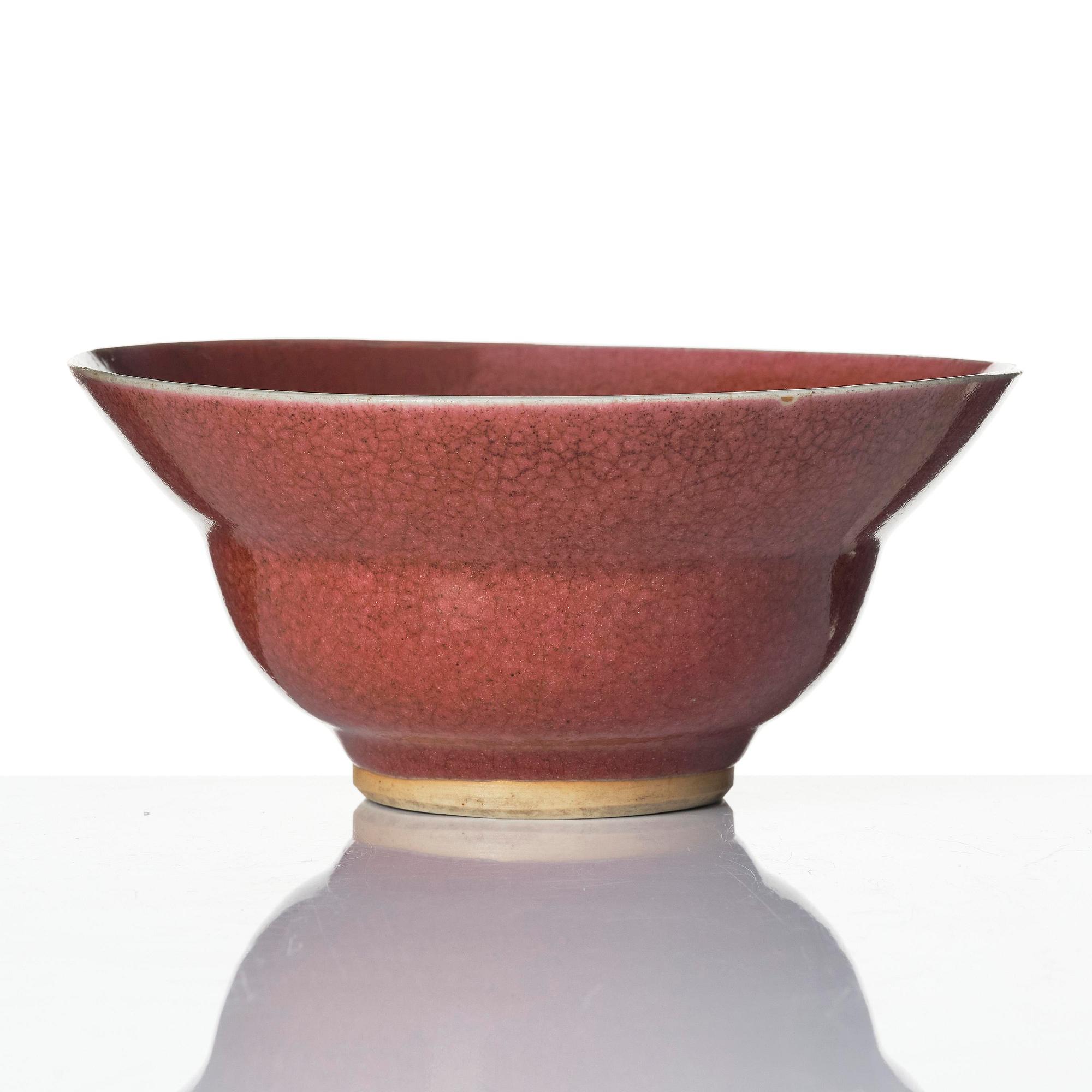
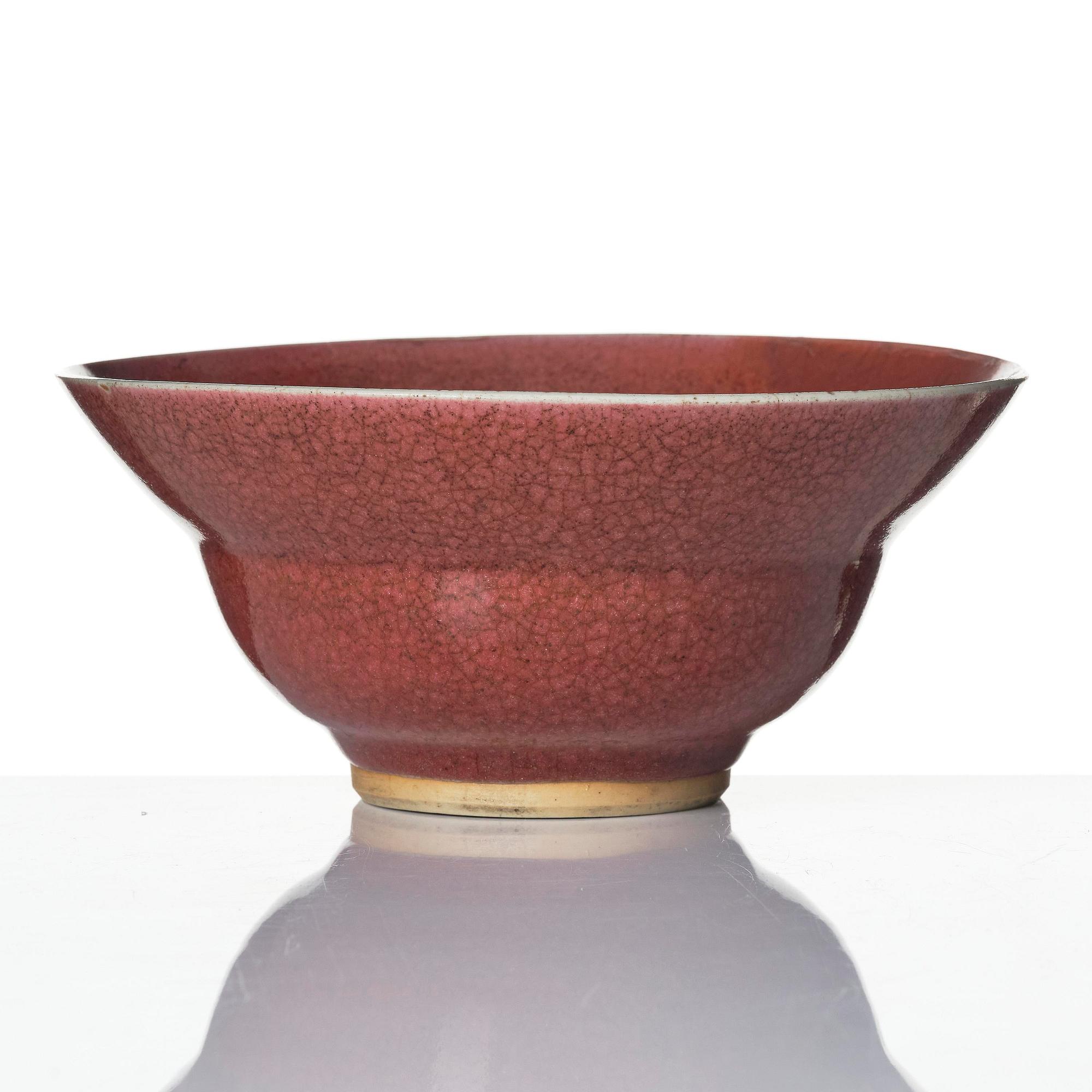
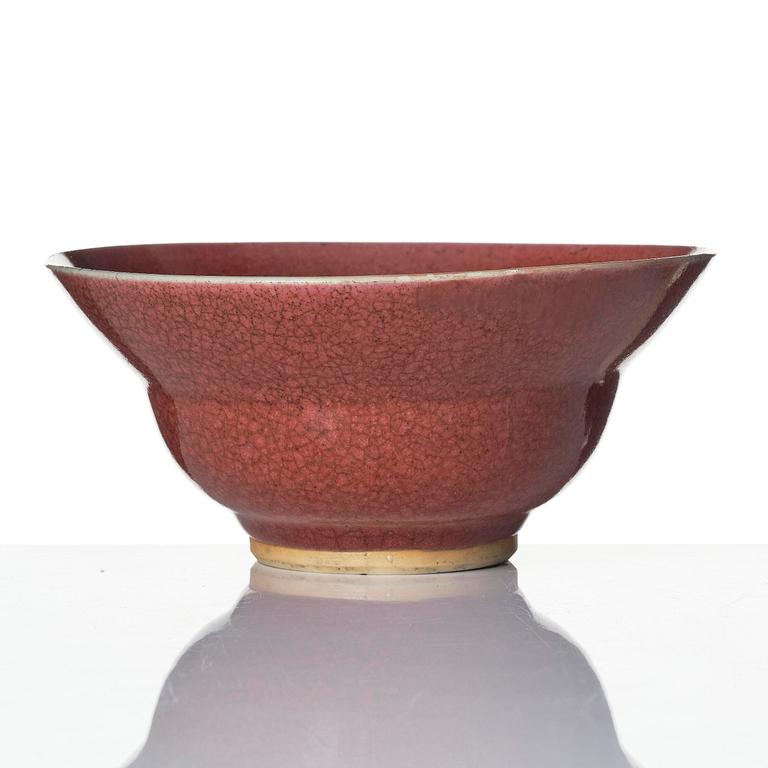
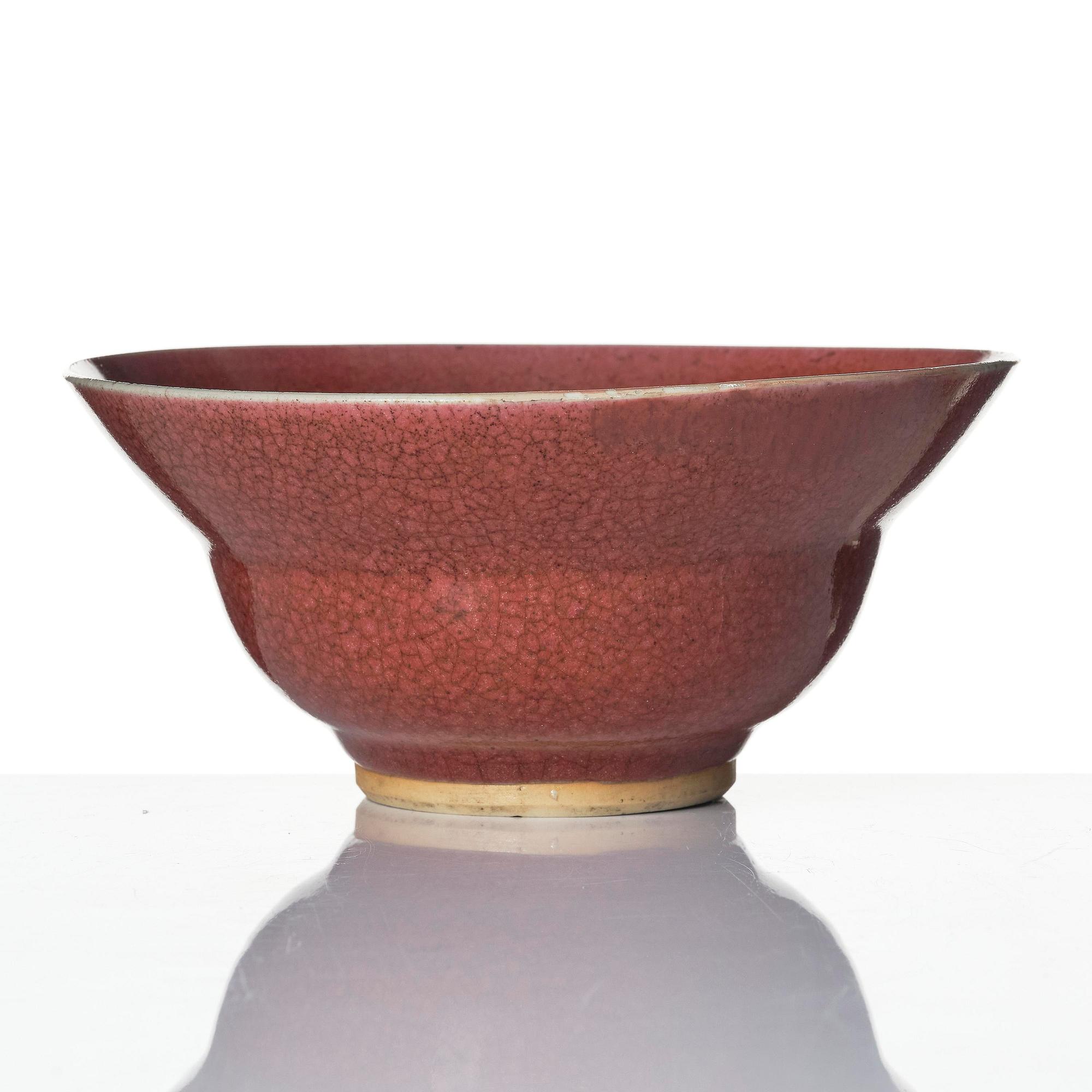
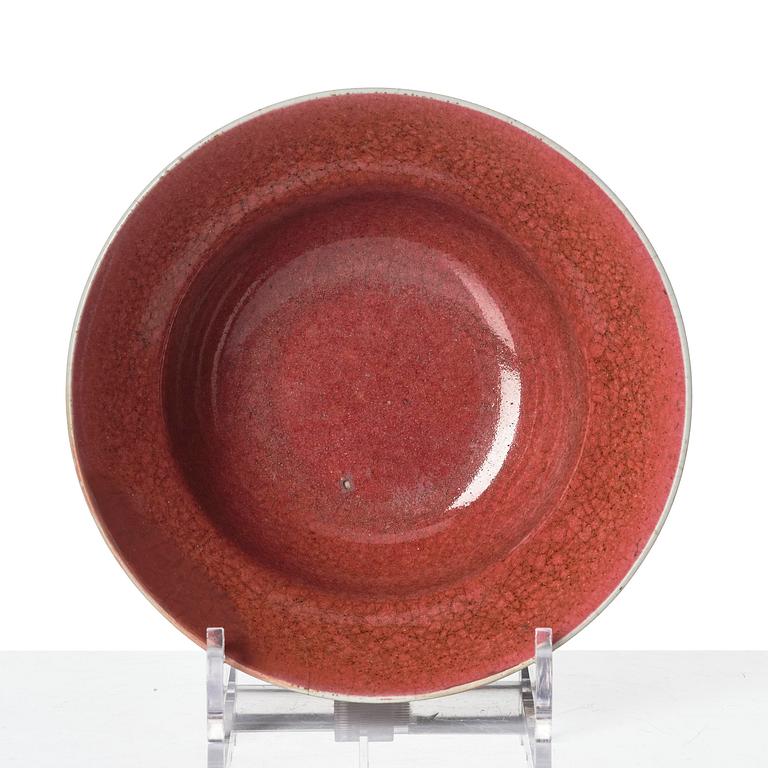
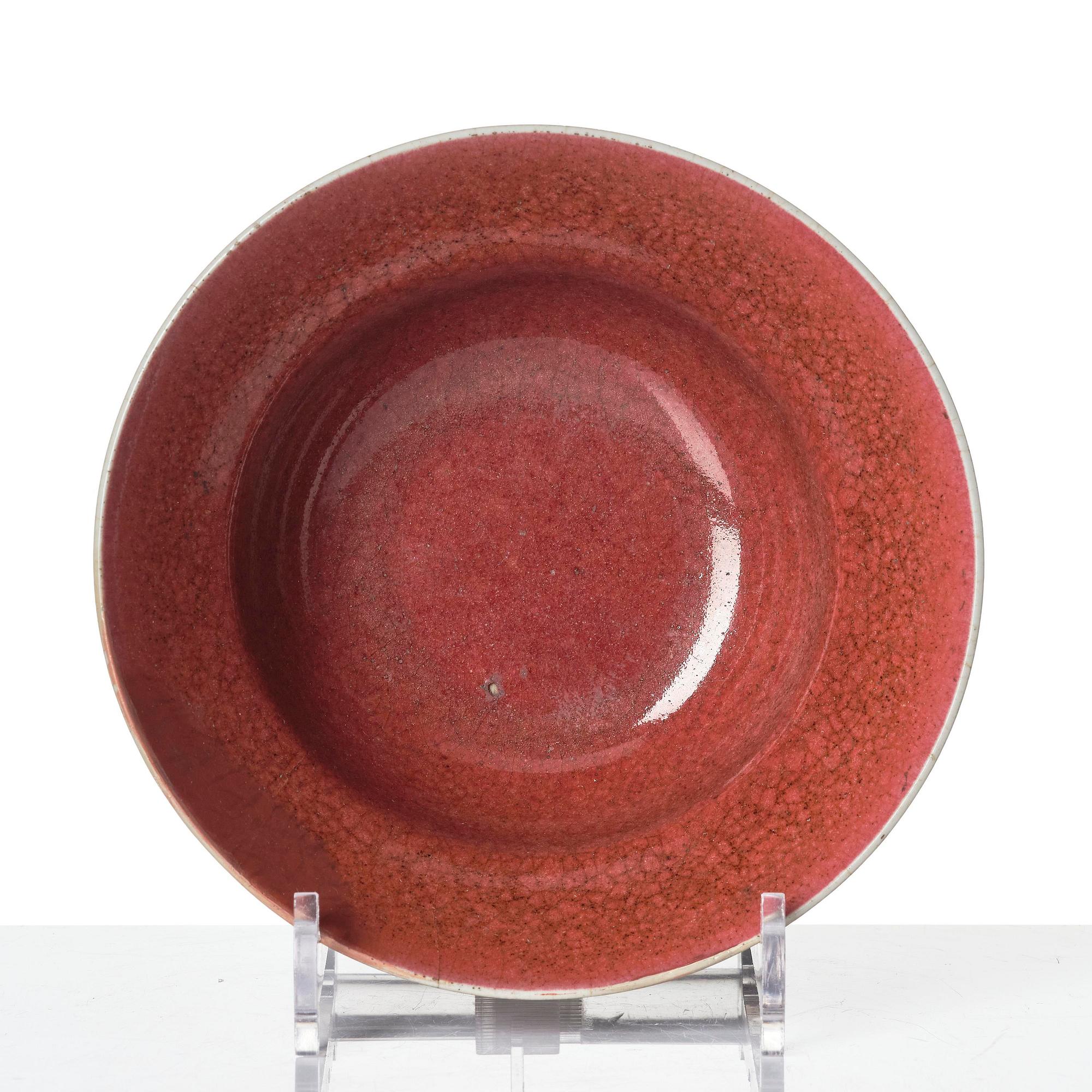
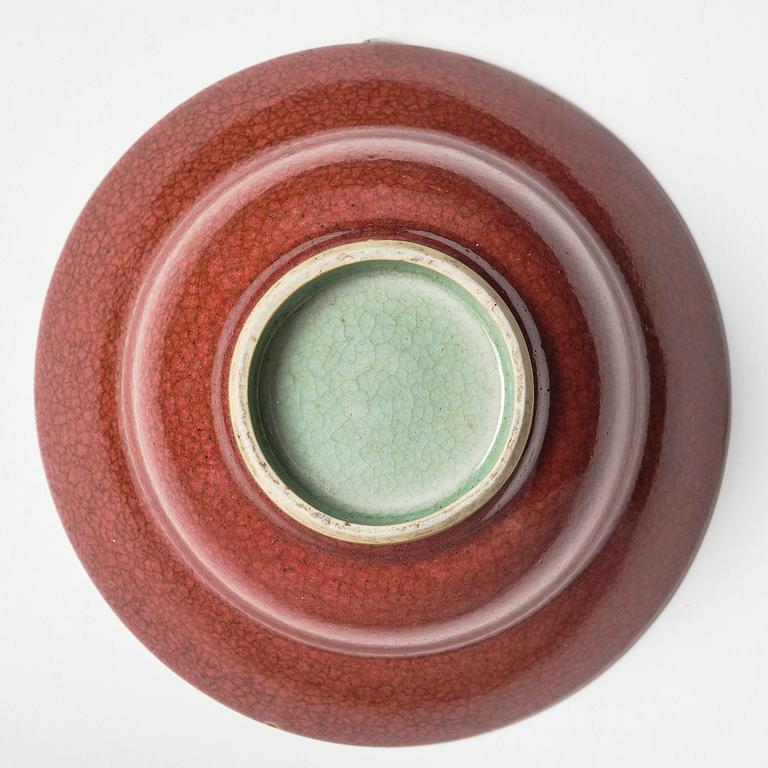
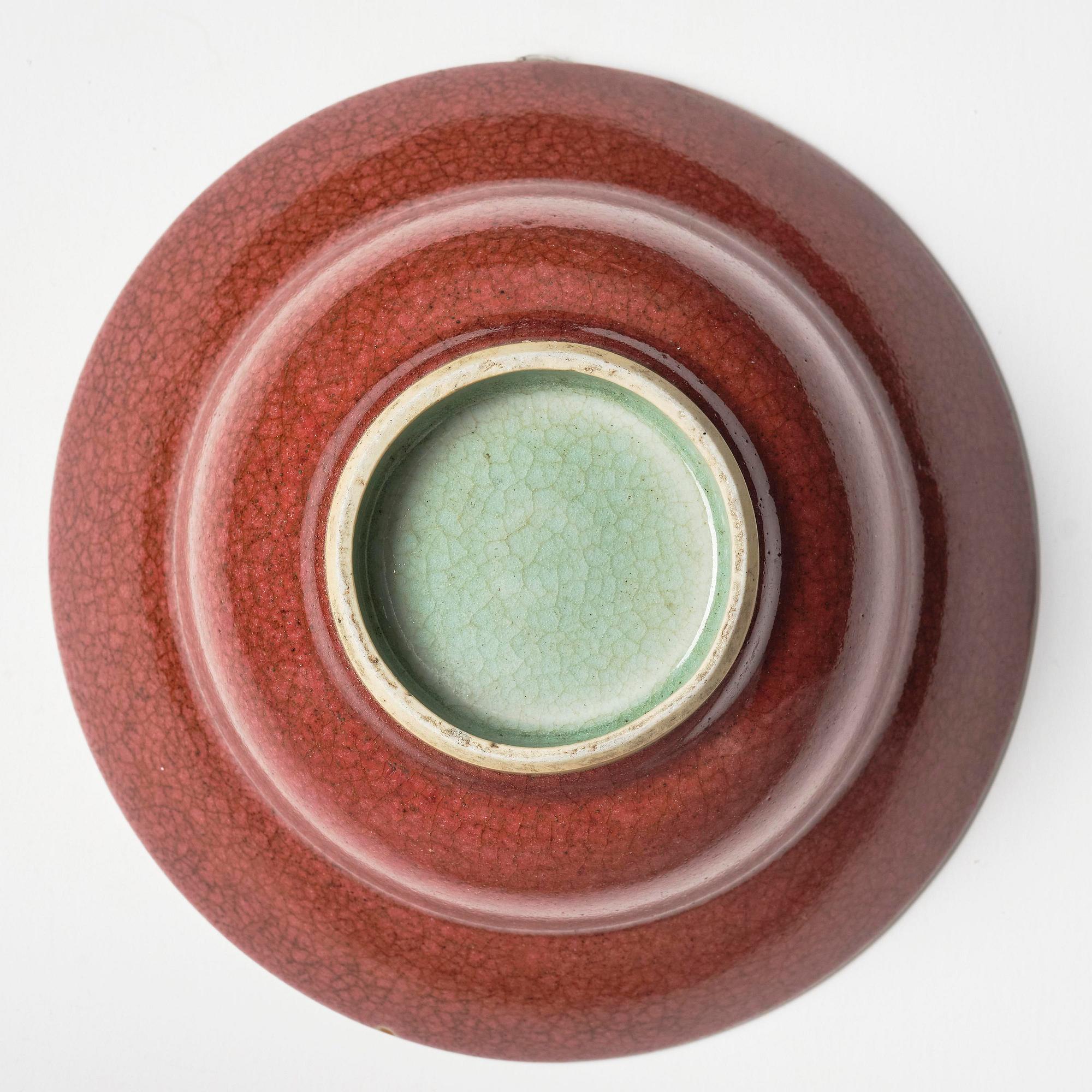
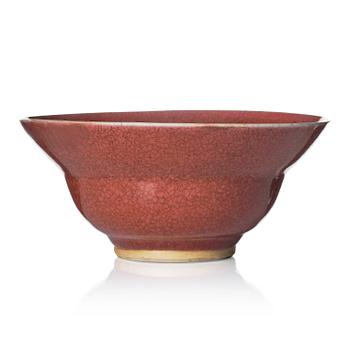
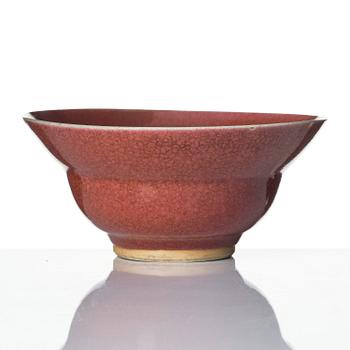
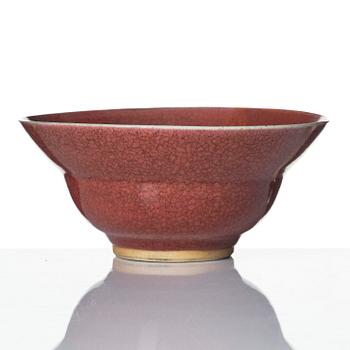
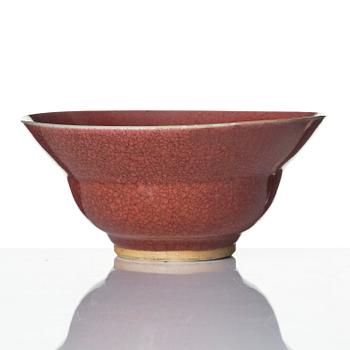
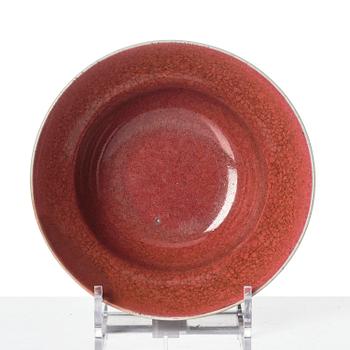
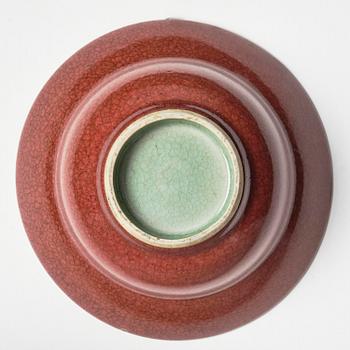
Rundade sidor med utvikt bräm, glaserad i en röd färg som bryter mot vitt vid kanten. Diameter 19 cm. Höjd 8,2 cm.
Kantlagning.
Proveniens
Gustaf Oscar Wallenberg (1865-1937), Stockholm, and thence by descent within the family.
Gustaf O. Wallenberg was a Swedish businessman, diplomat, and active politician. He was the son of André Oscar Wallenberg, founder of Stockholm Enskilda Bank (today's Skandinaviska Enskilda Banken, known as SEB). After a career in the Swedish Navy, he turned to the business world and was active in improving the transoceanic shipping industry.
Wallenberg was Sweden's Envoy to Tokyo between 1907-1918. In April 1907 he travelled to Beijing to amend the Treaty of Canton (1847) between Sweden-Norway and China and to establish diplomatic relations between Sweden and the Qing Court. As the Swedish Envoy Extraordinary and Minister Plenipotentiary at the Court of Peking, he successfully negotiated and signed with Lien Fang, the Guangxu Emperor's High Commissioner Plenipotentiary and Senior Vice-President of the Wai Wu Pu, the Treaty of Amity, Commerce and Navigation, between Sweden and China, which was signed in Beijing on 2 July 1908, with an additional article signed on 24 May 1909.
The collection was acquired between 1907 and 1918 when Wallenberg was the Swedish Envoy in Tokyo, and possibly during his diplomatic service in China. Documents preserved at the Museum of Far Eastern Antiquities in Stockholm demonstrate the importance of Gustaf Wallenberg and his extensive connections with the Qing government to the Swedish engineers and businessmen who were in China during this period, such as Johan Gunnar Andersson, Osvald Siren, Orvar Karlbeck, Erik Nordstrom and many more.
Gustaf Wallenberg was the grandfather of Raoul Gustaf Wallenberg (1912-1945), an architect, businessman, and diplomat.
Utställningar
Compare a bowl of this type in the Musee Guimet, Paris, Inventory no G 1954.
Compare also a bowl of this type in the British Museum, Museum number
PDF,C.511.
Compare also a bowl of this type in the Metropolitan Museum of Art, New York, Credit Line “Purchase by subscription, 1879”. Object Number 79.2.793.
Compare a matching pair sold in these rooms, Bukowskis Important Winter Sale 669 lot 1015, 12 December 2025.
Litteratur
Margaret Medley, 1973 ”Illustrated Catalogue of Ming and Ch'ing Monochrome in the Percival David Foundation of Chinese Art” p.61, no.C511.
Rosemary Scott, 1989 “Illustrated Catalogue of Ming and Qing Monochrome Wares in the Percival David Foundation of Chinese Art” p.62, no.C511.
Övrig information
The skills used to create these extraordinary red glazes were lost in China from the mid-fifteenth century until they were rediscovered in the late seventeenth and early eighteenth centuries. The glaze has ‘crept’ at the rim of the dish to reveal the pure whiteness of the porcelain body and the rim is bound in copper.
För konditionsrapport kontakta specialist

Andra har även tittat på