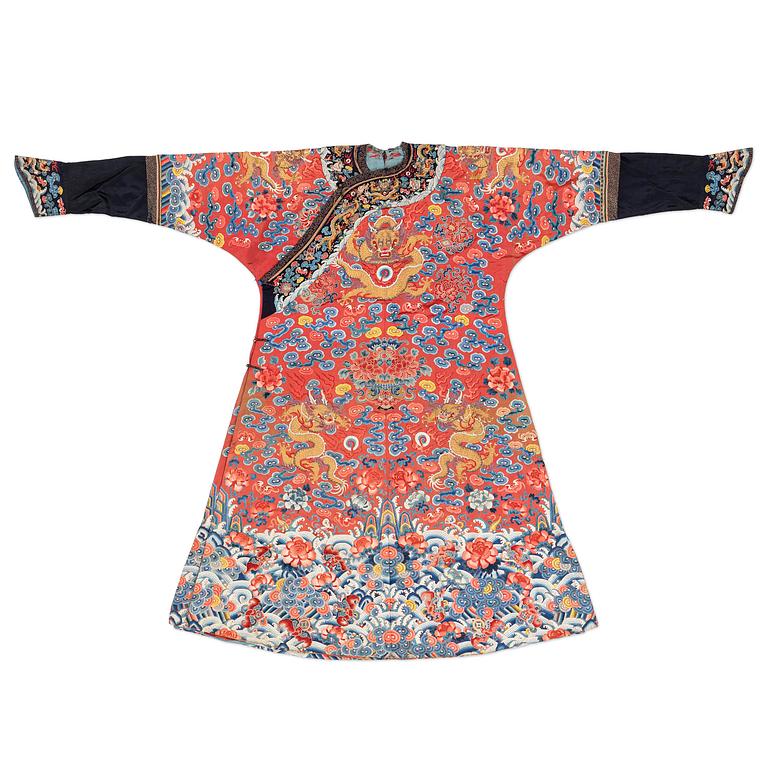
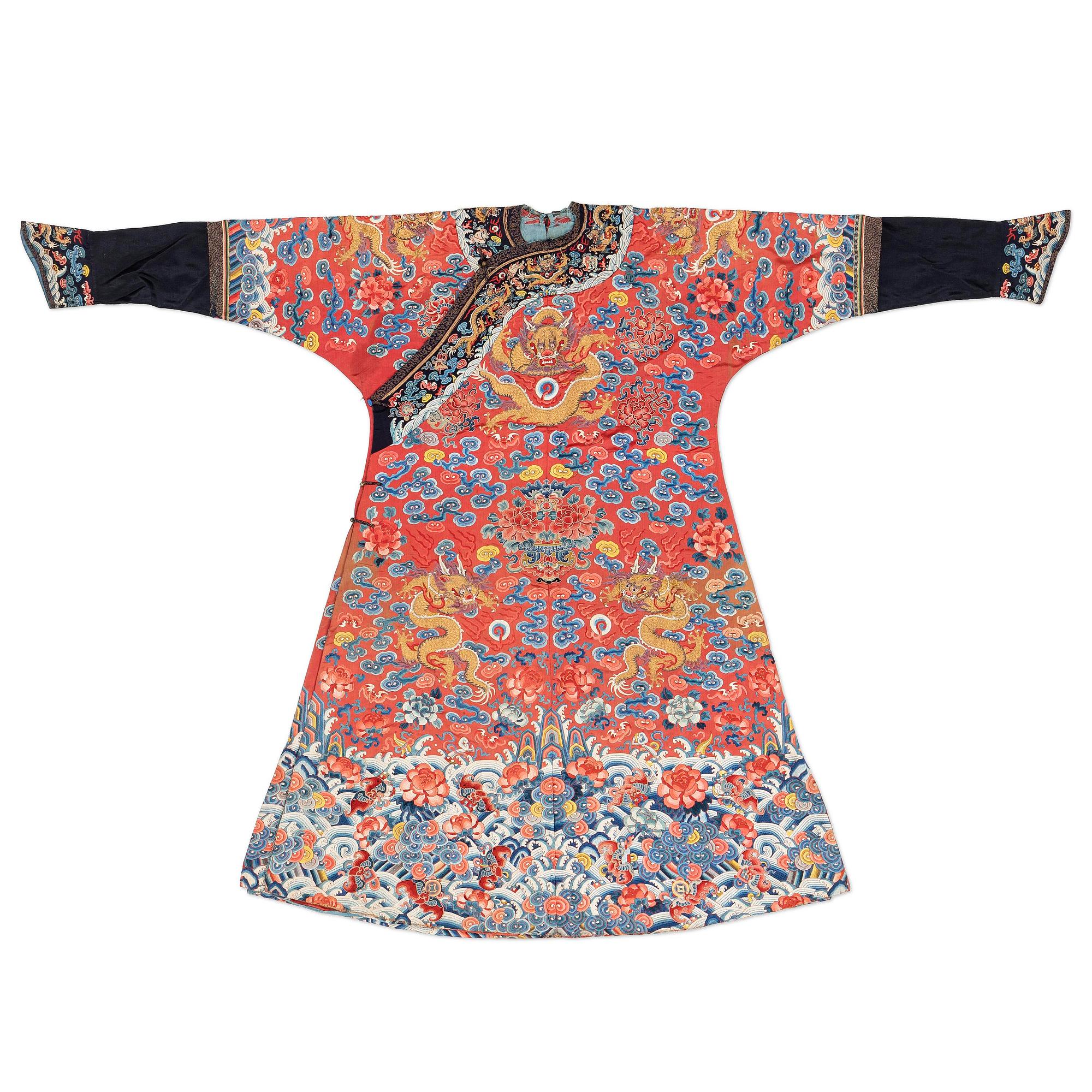
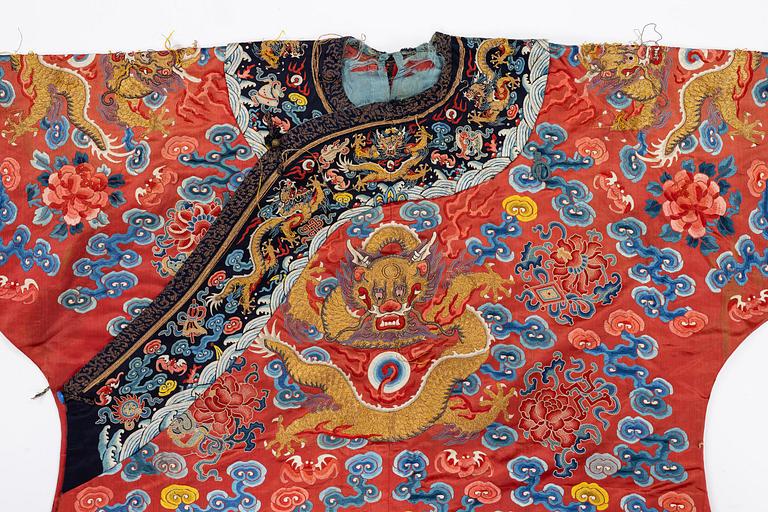
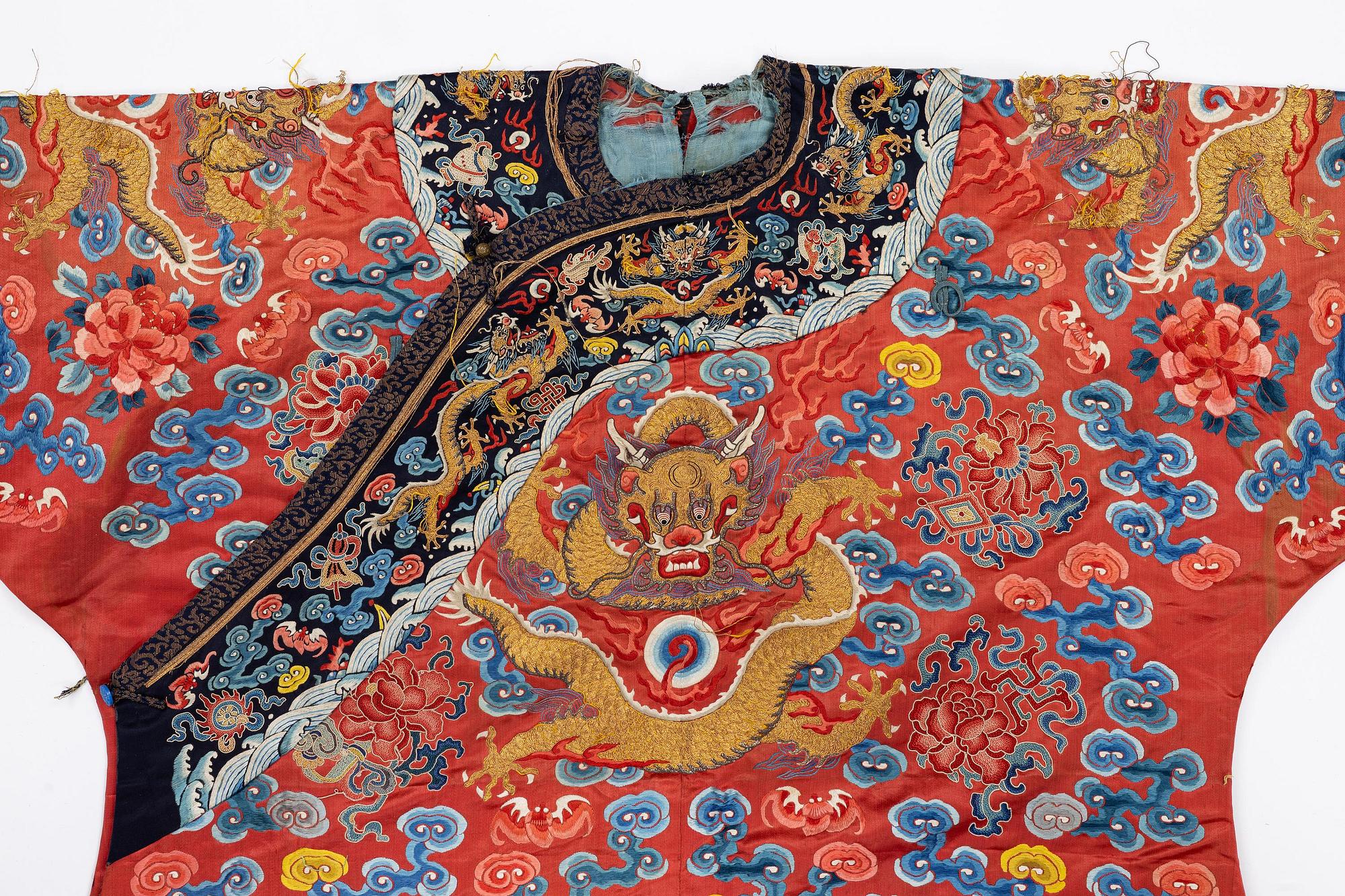
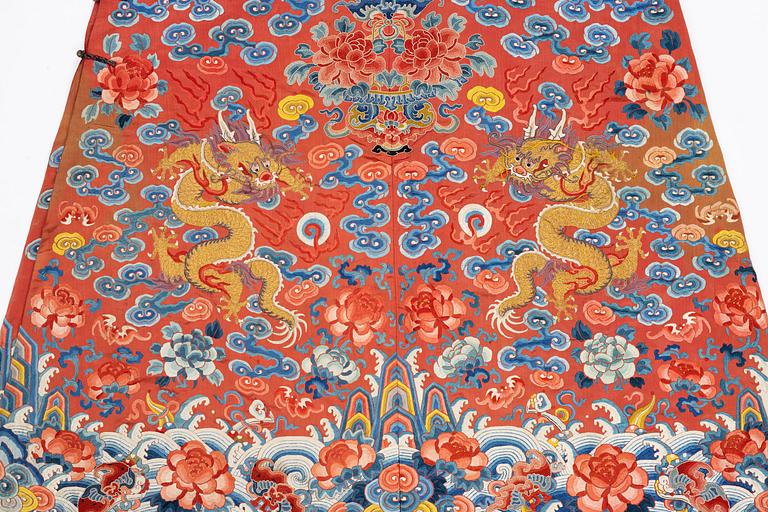
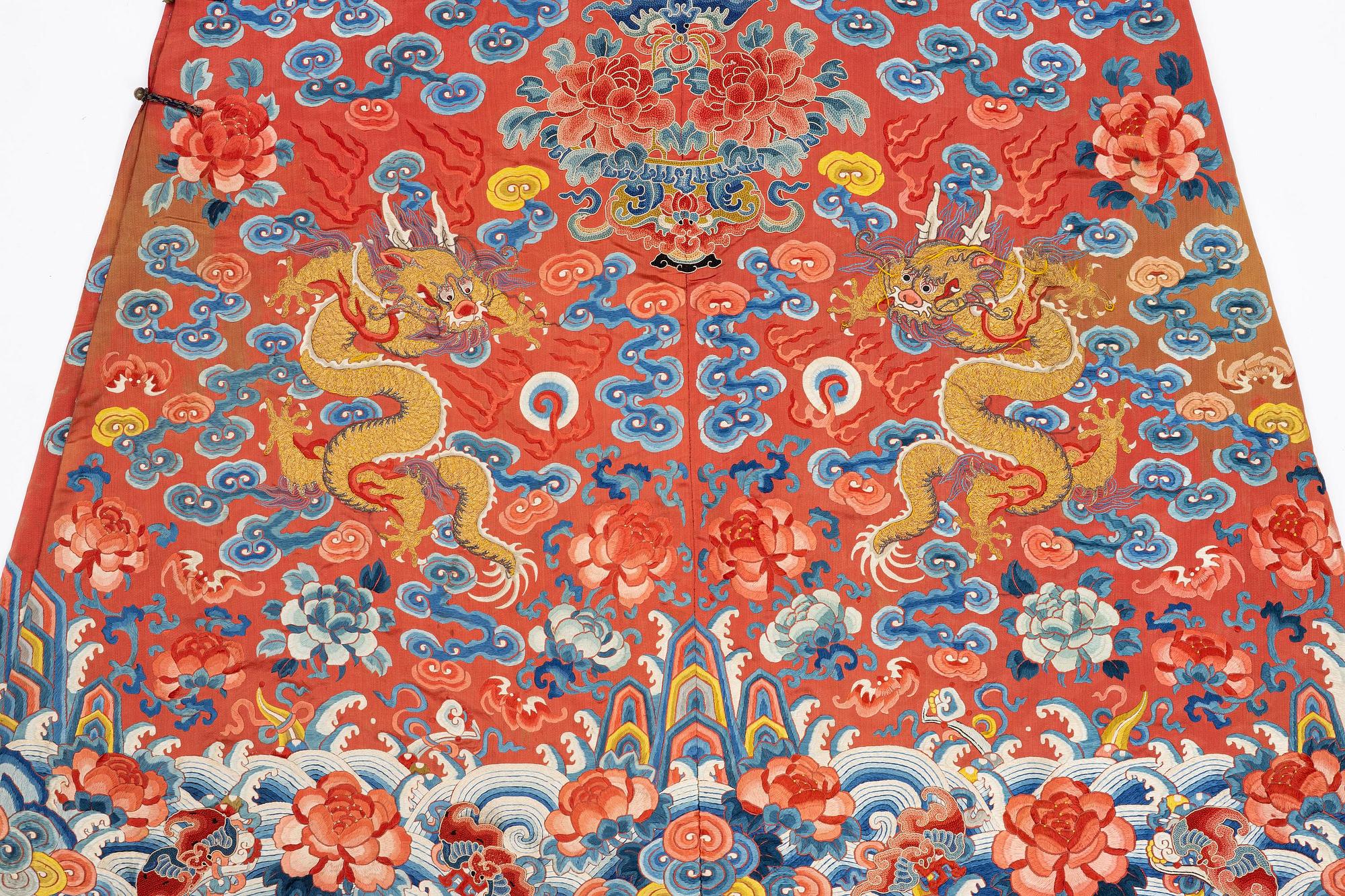
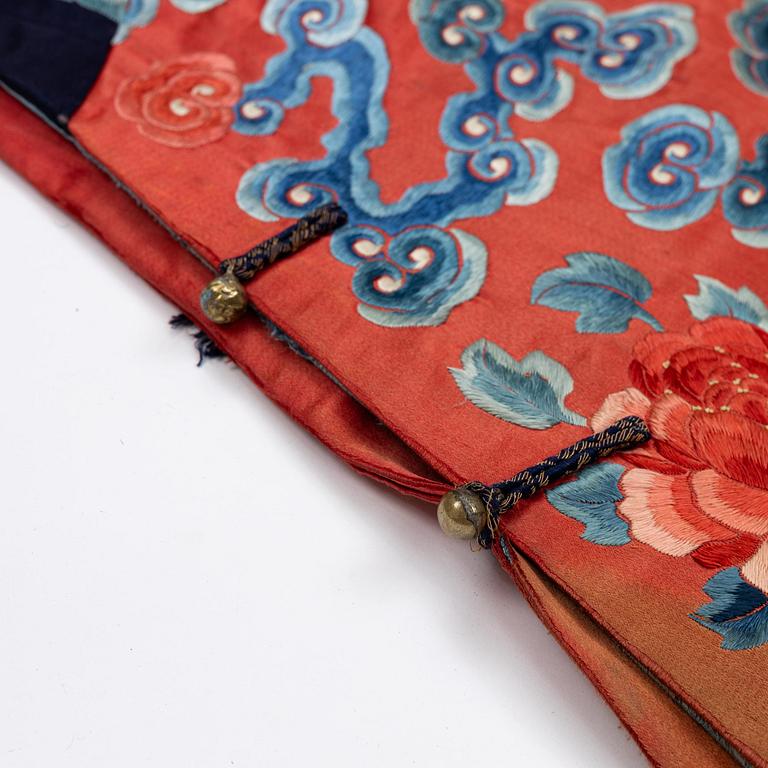
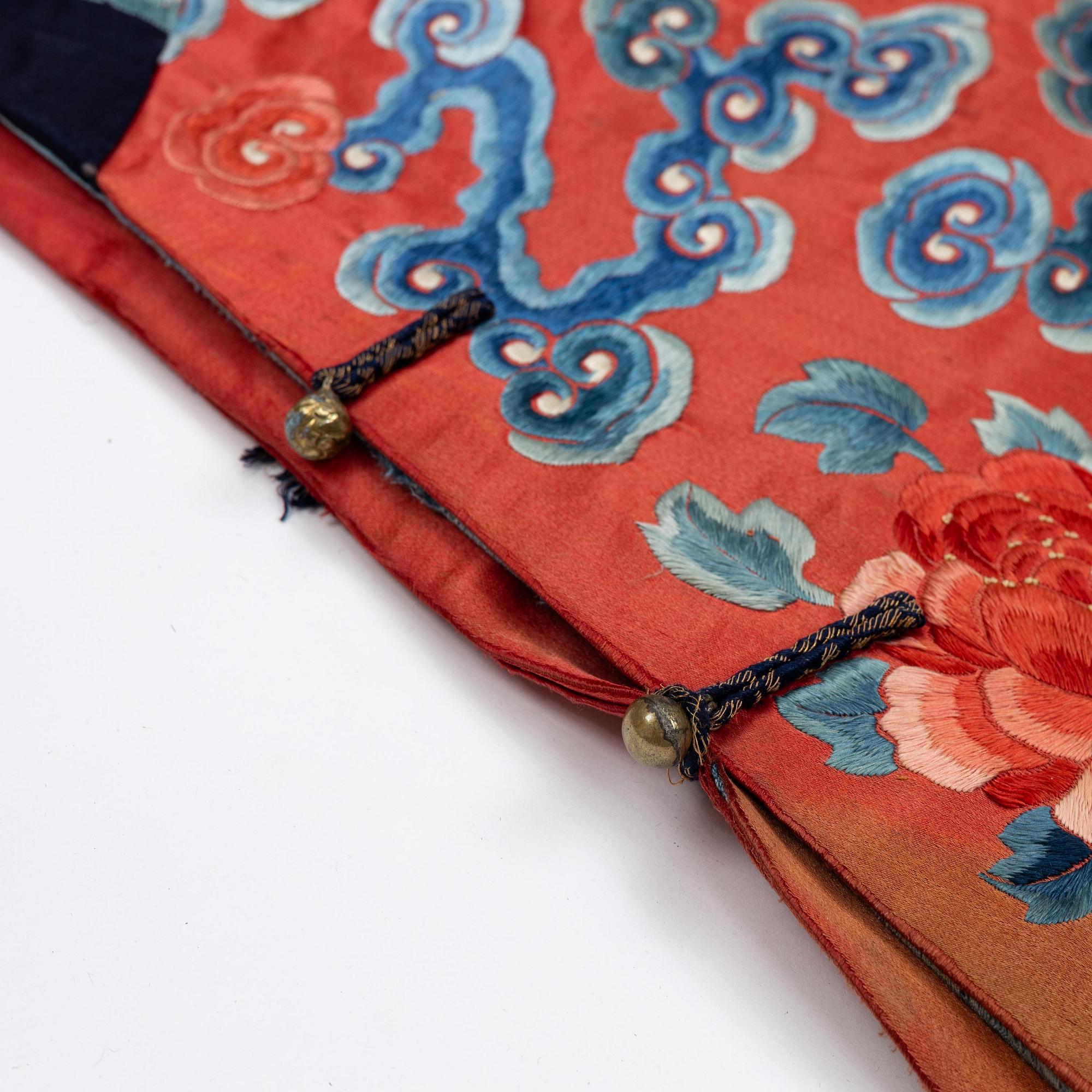
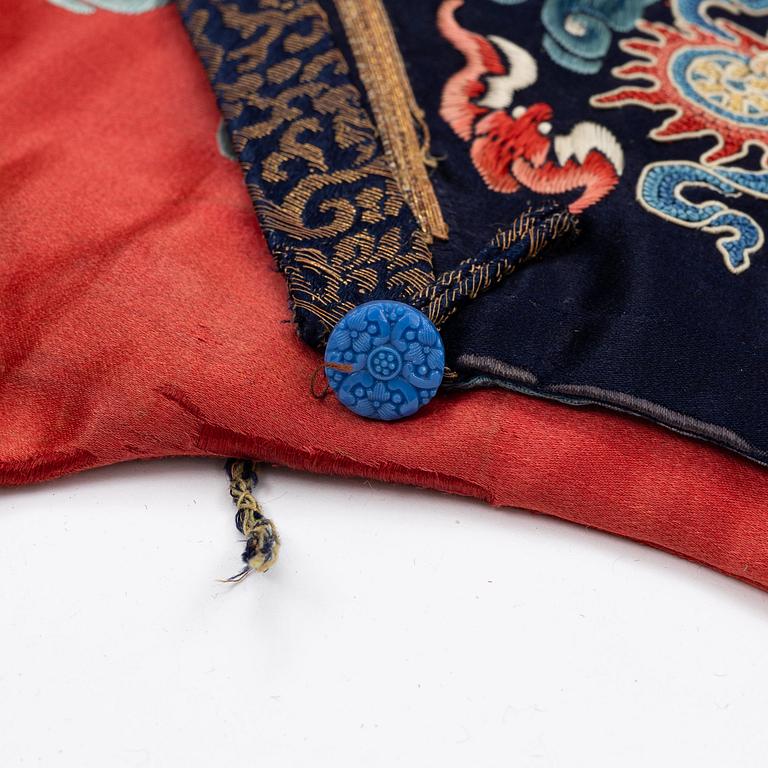
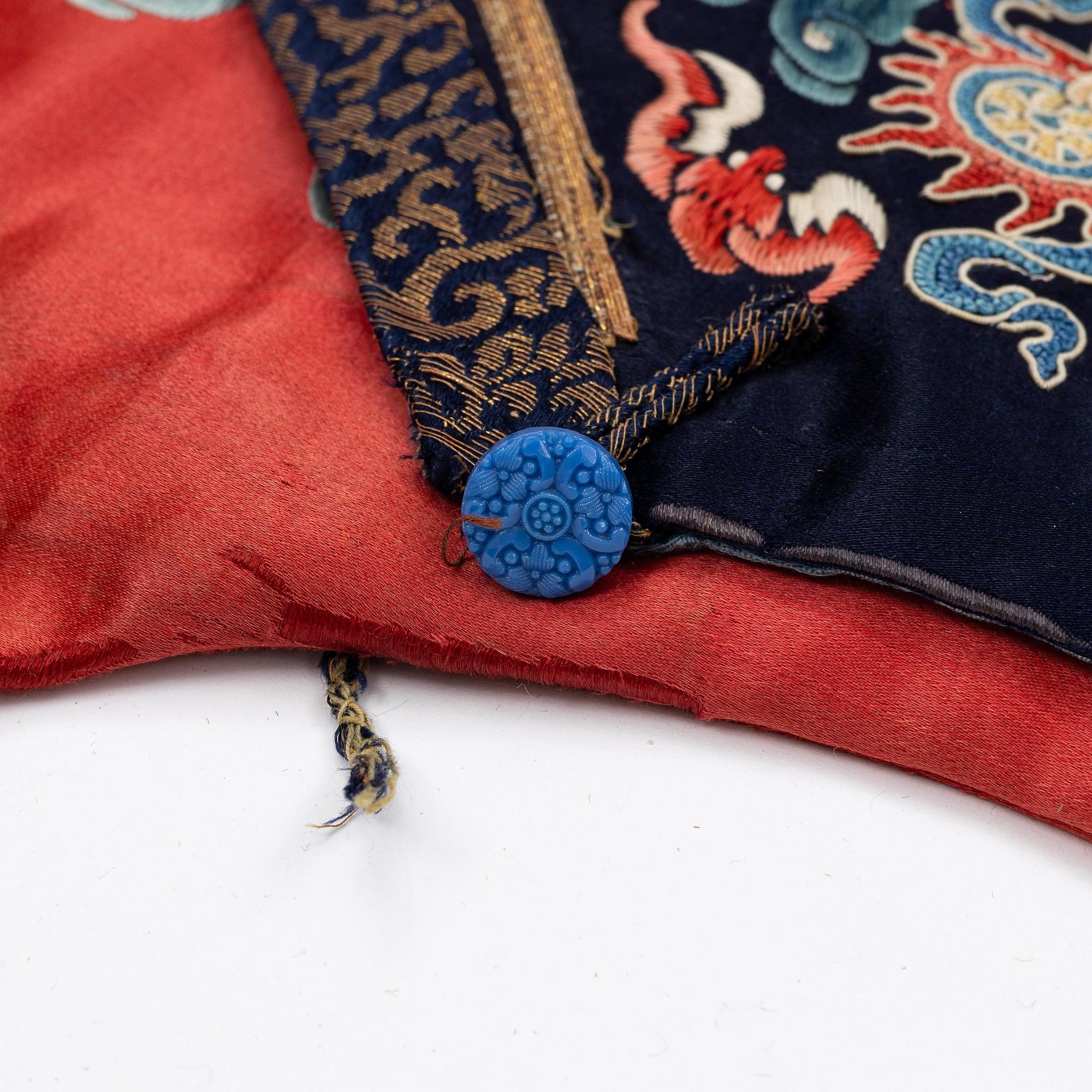
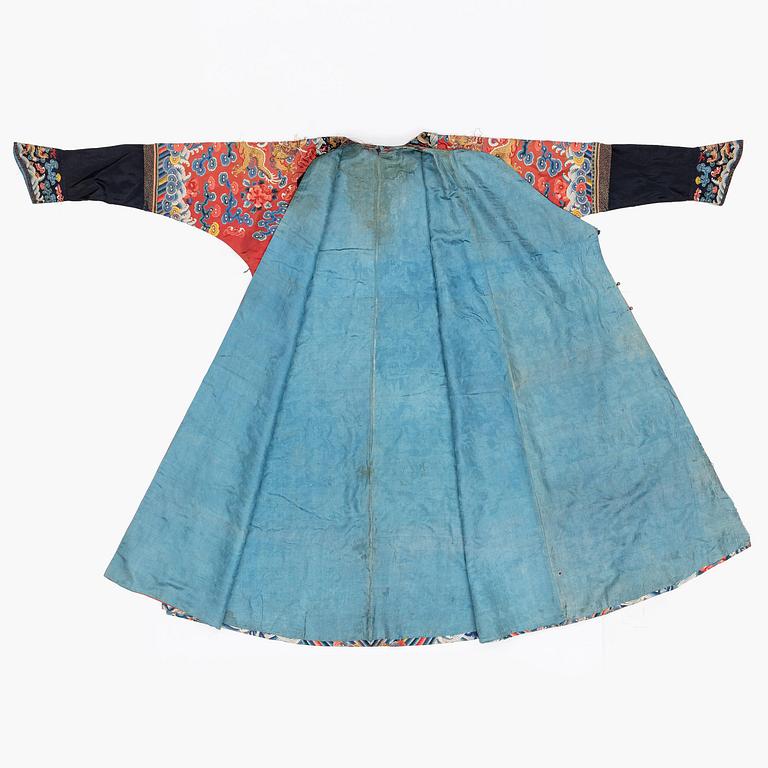
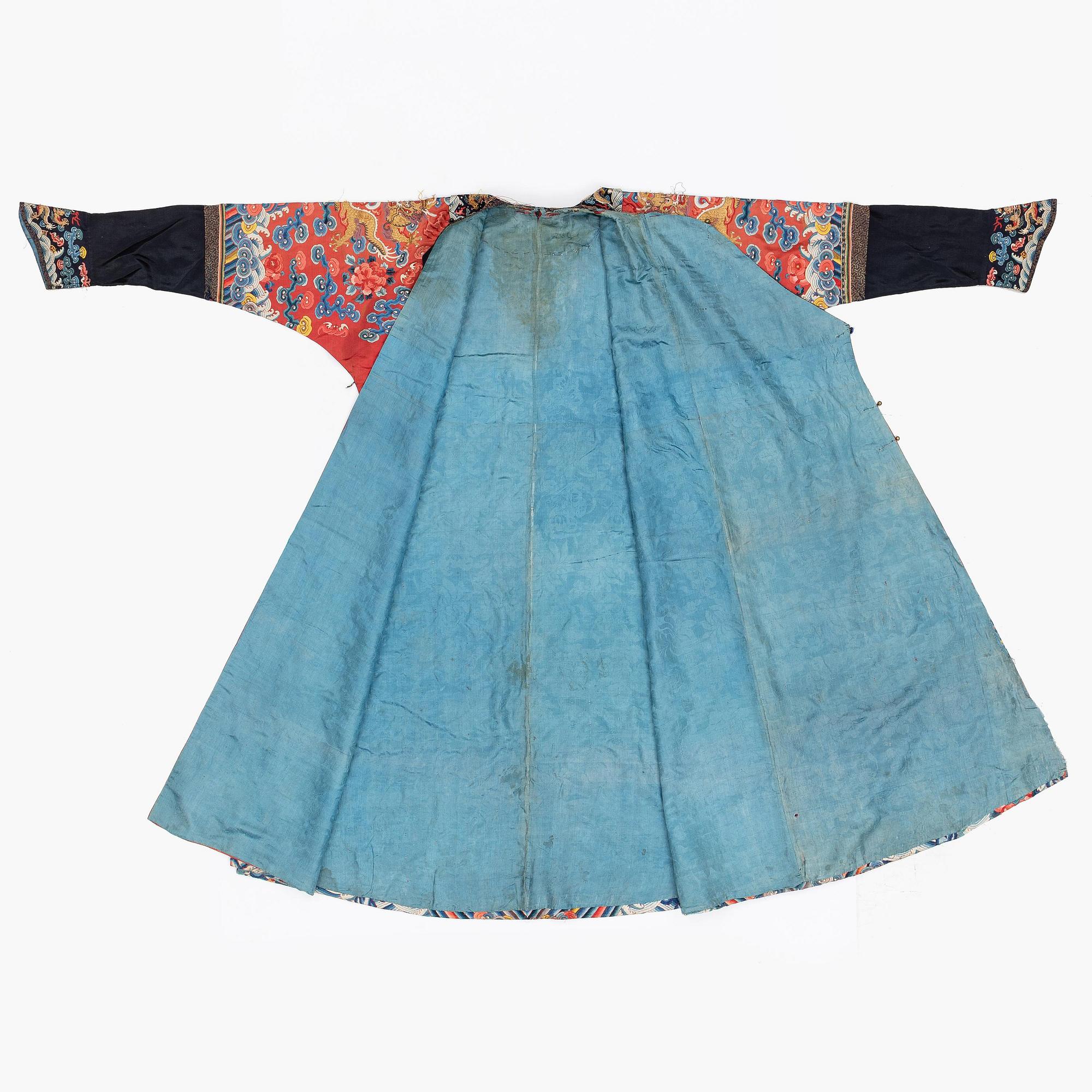
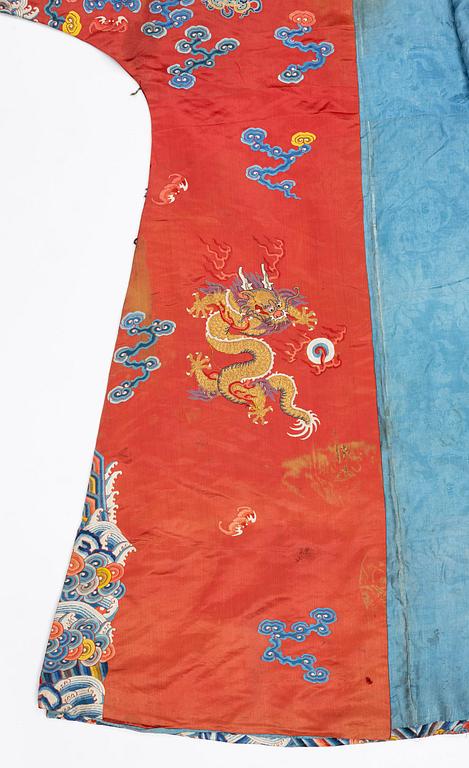
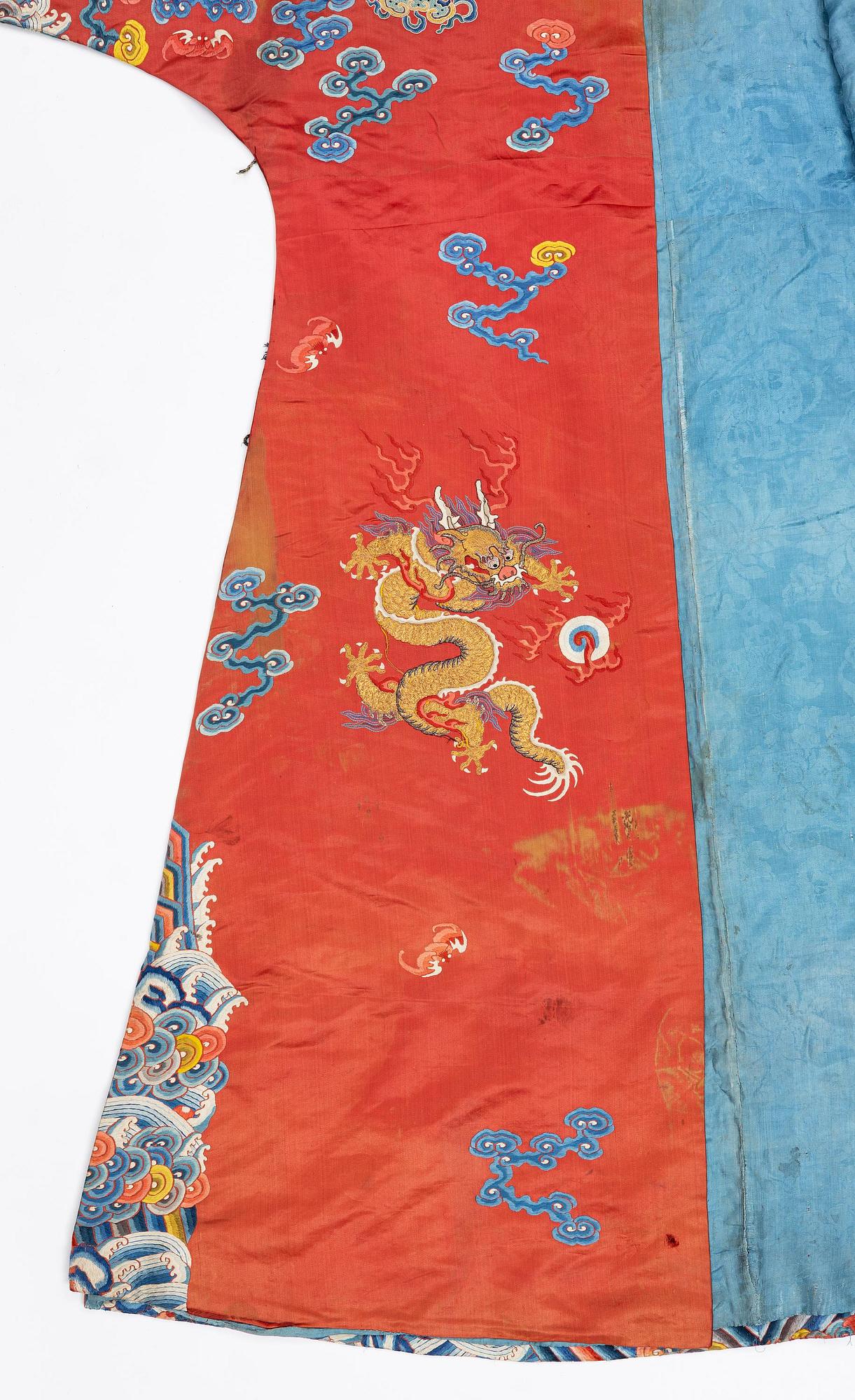
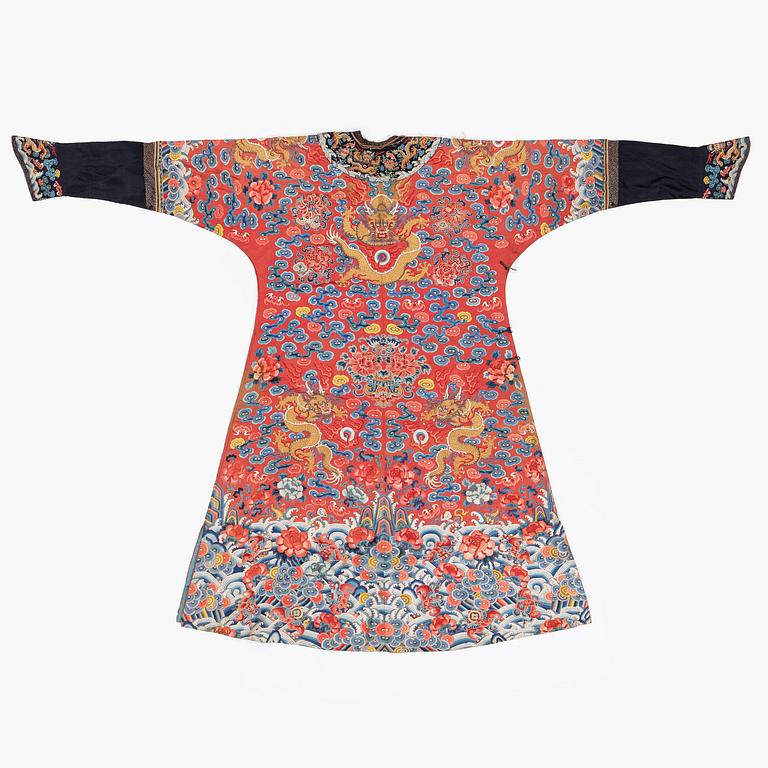
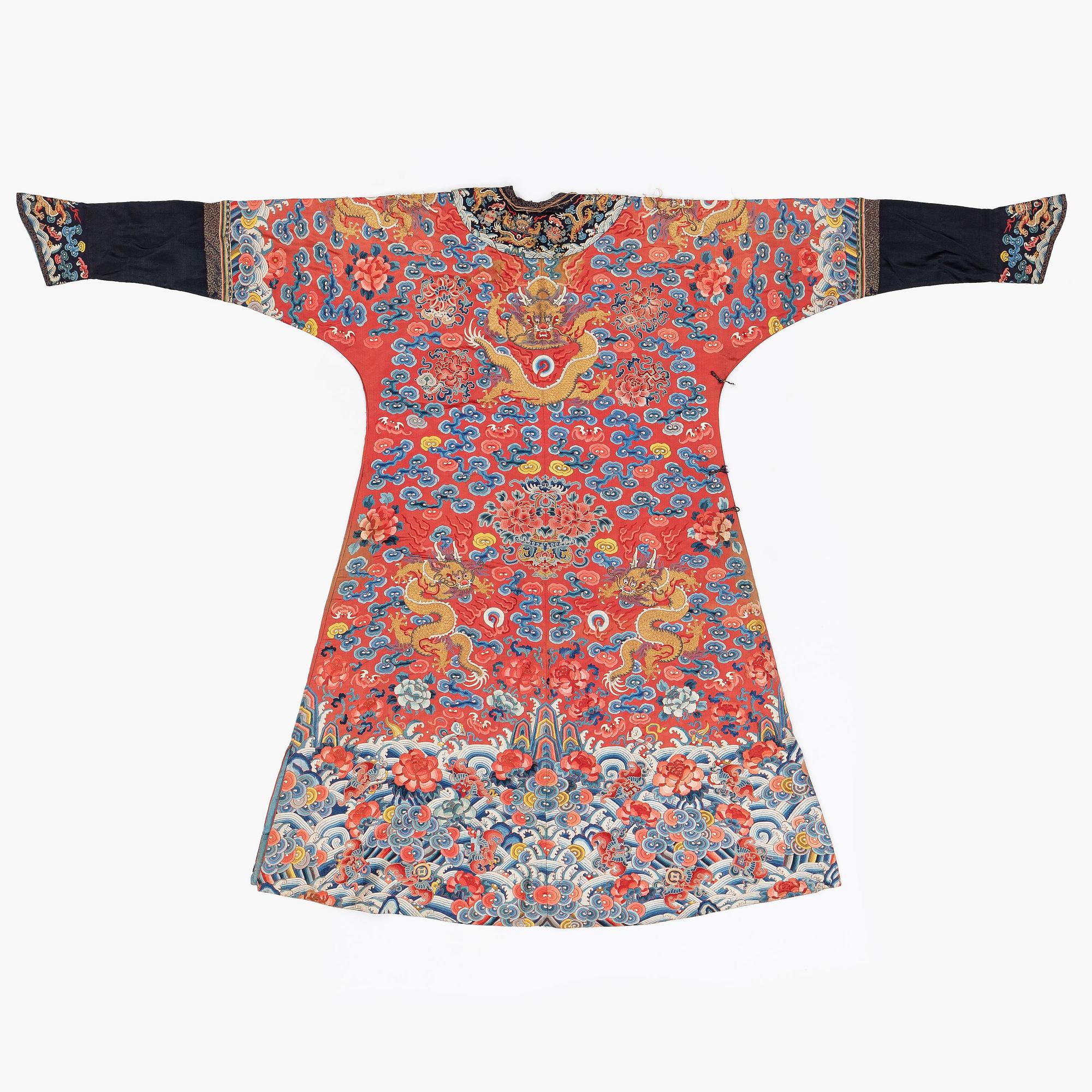
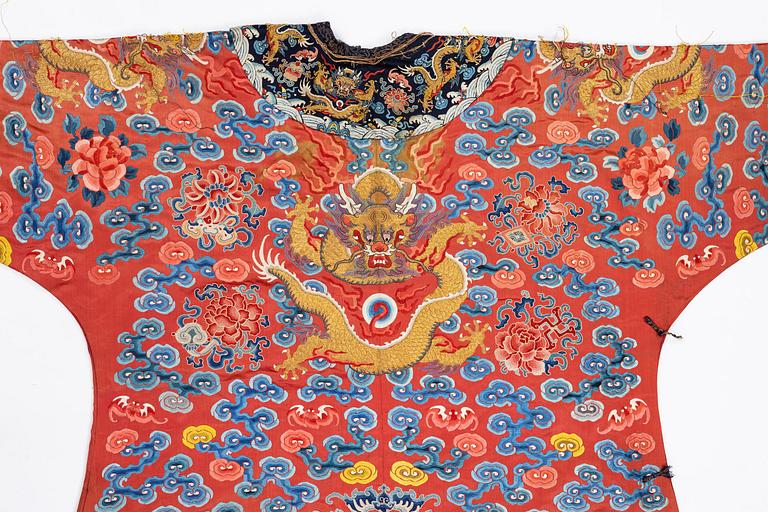
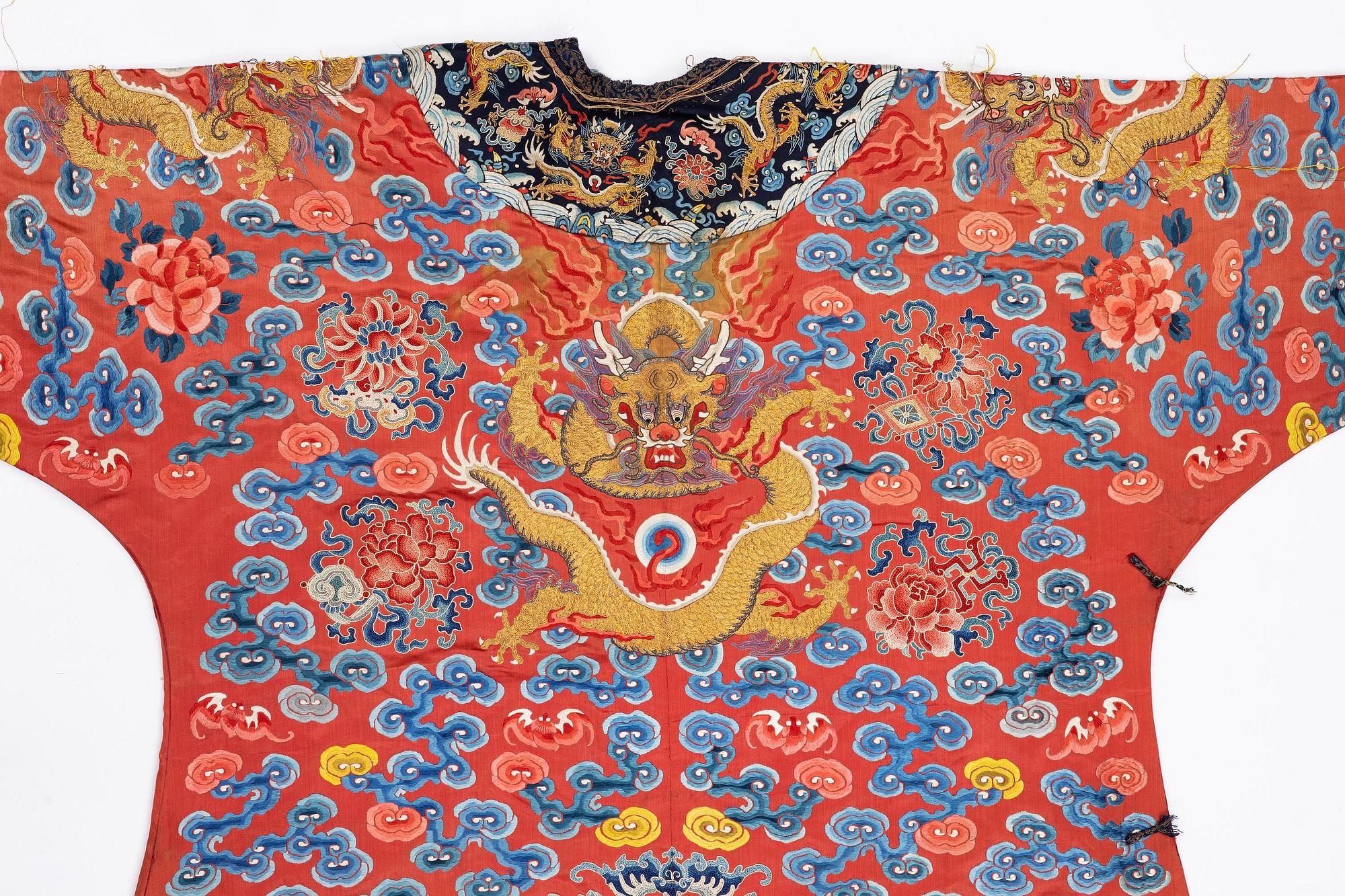
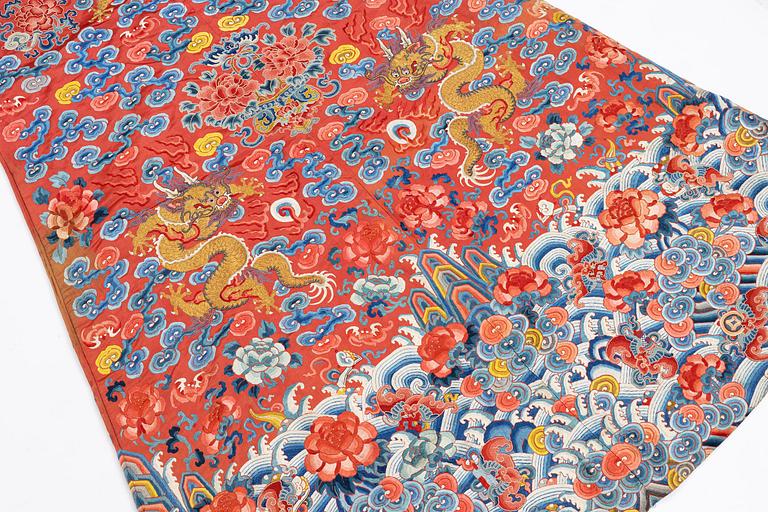
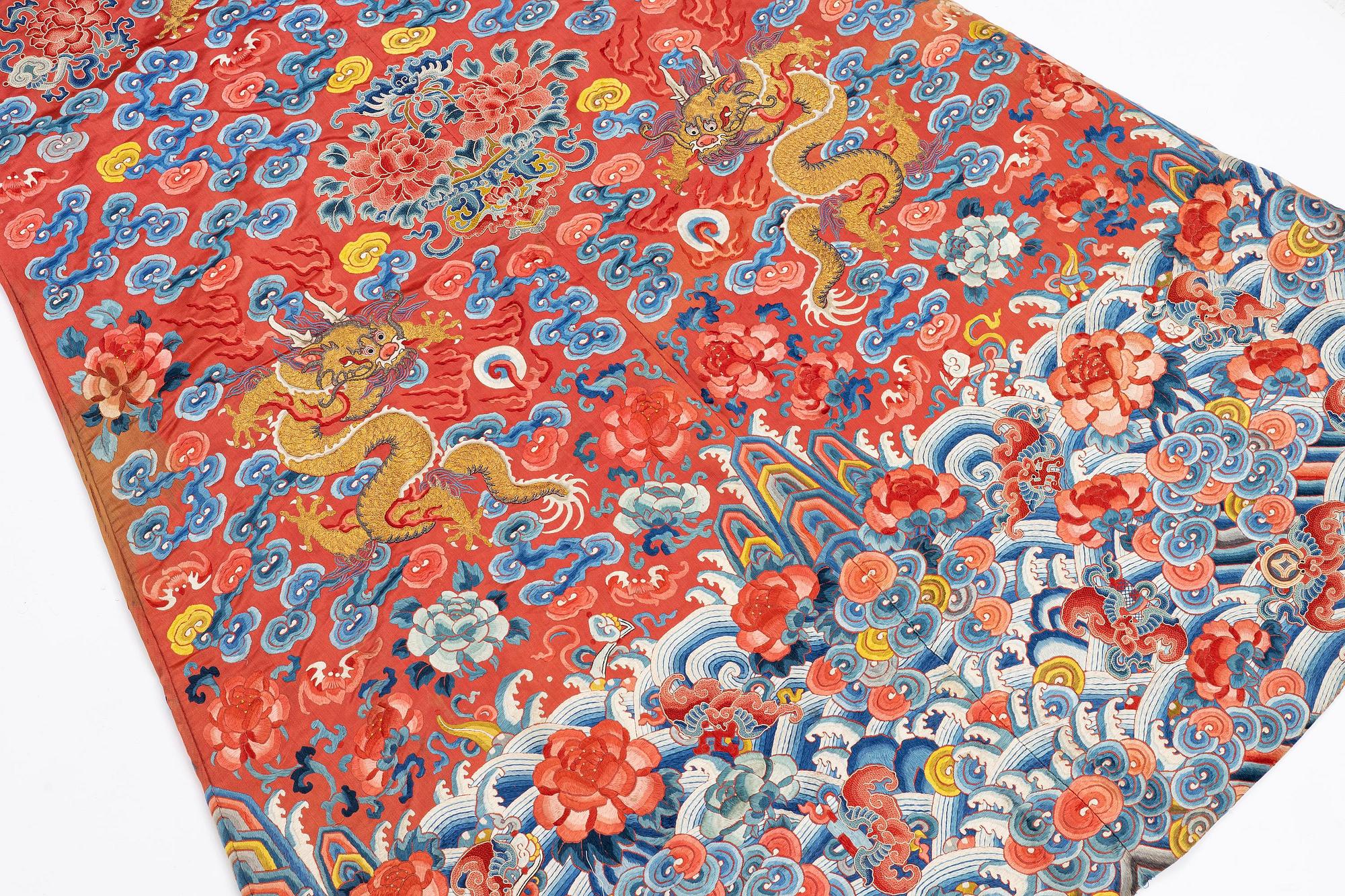
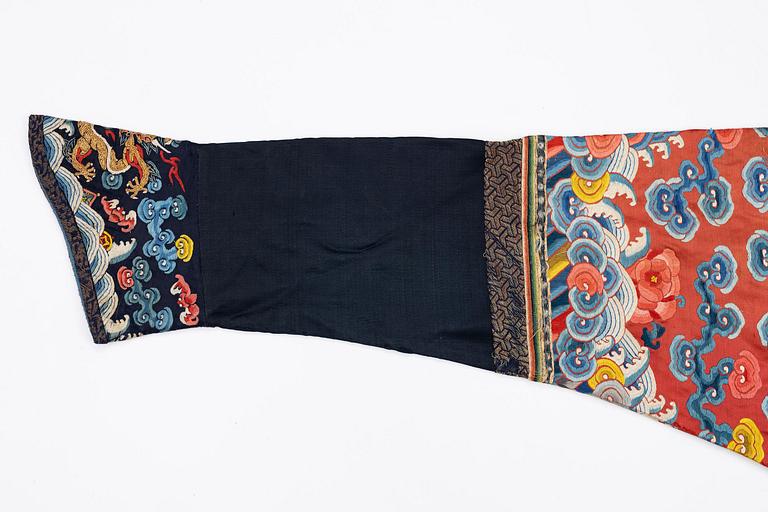
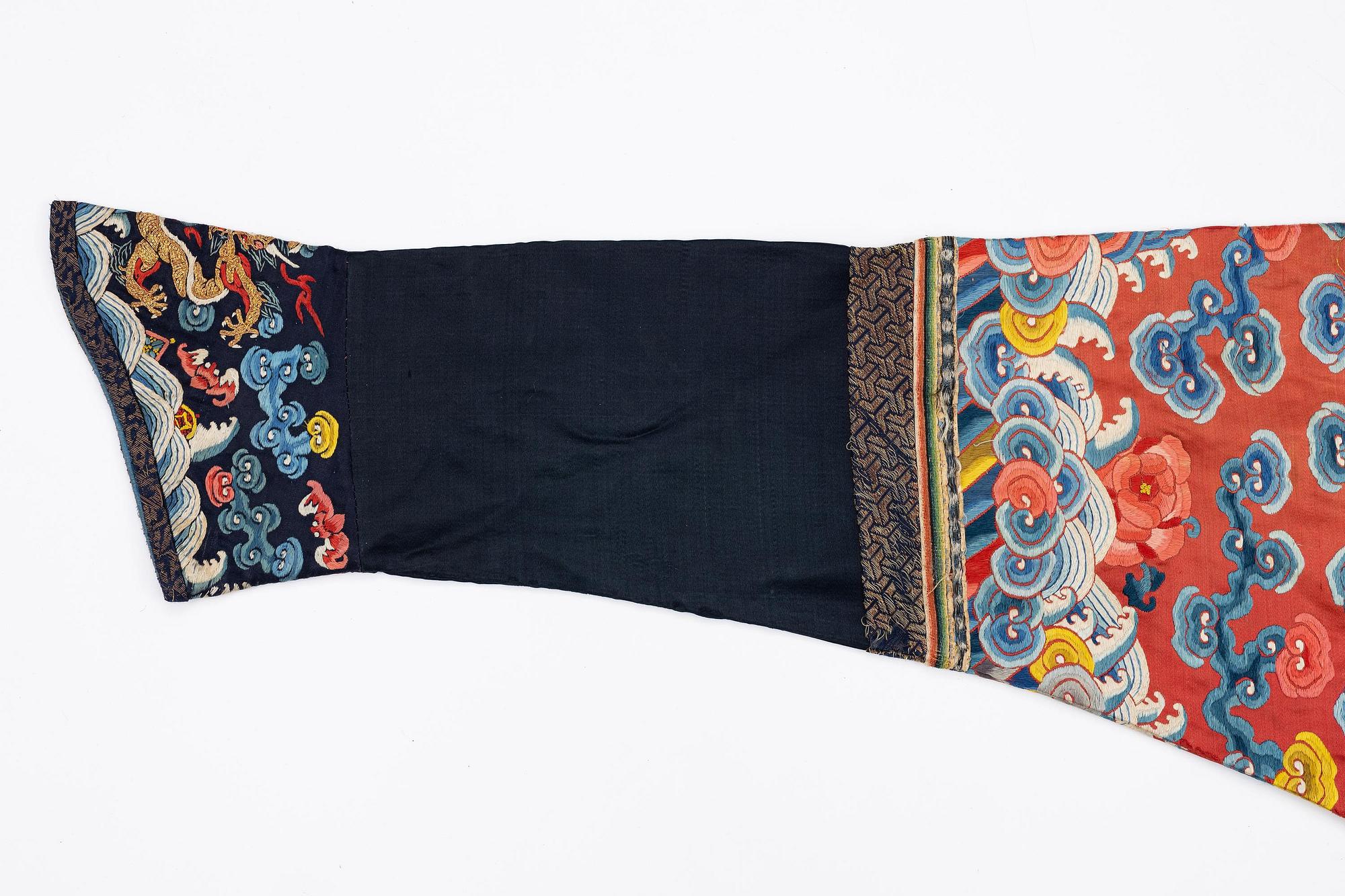
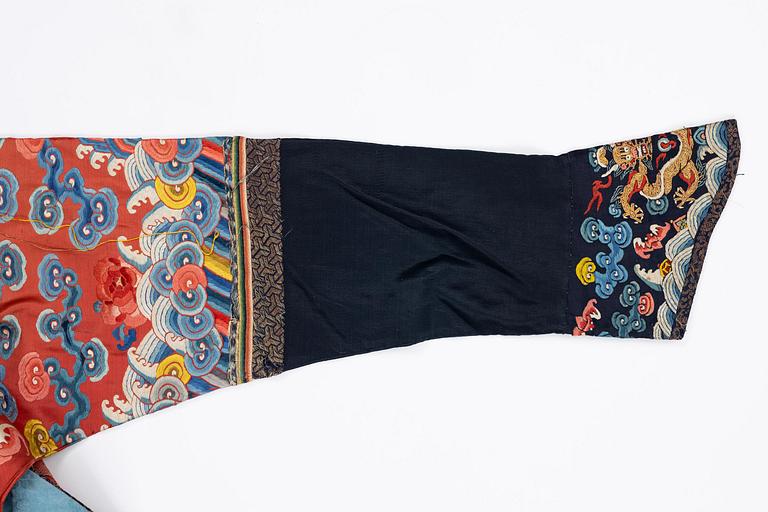
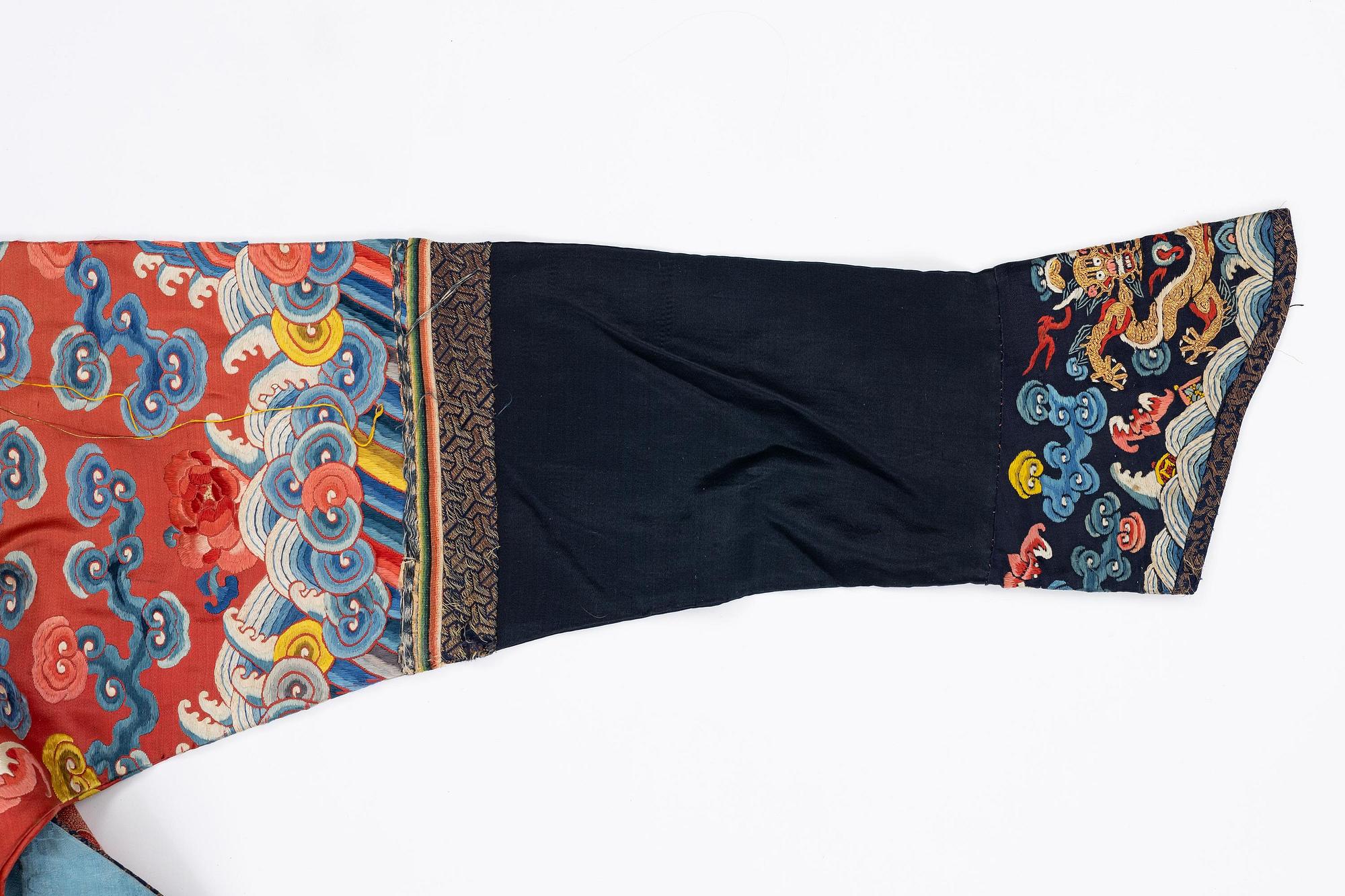
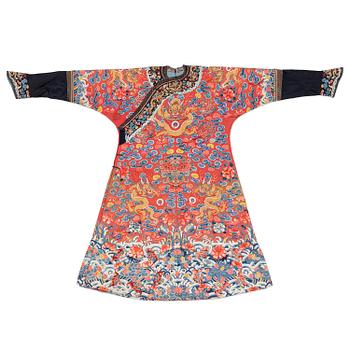
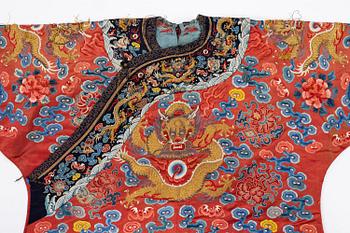
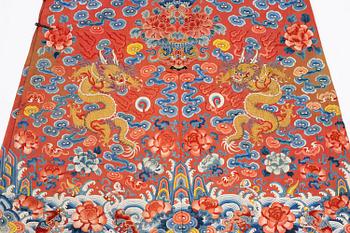
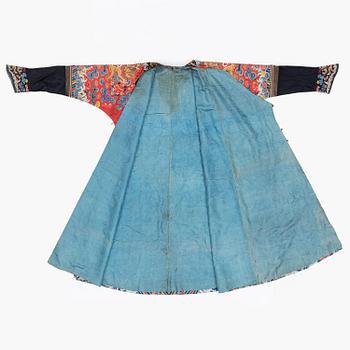
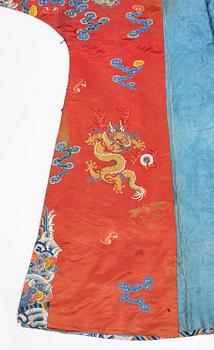
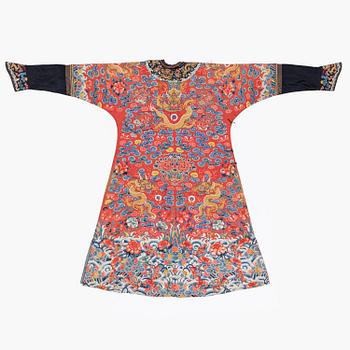
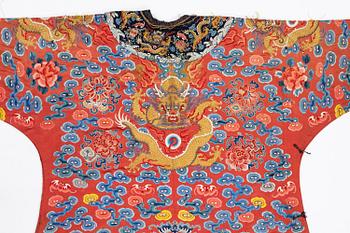
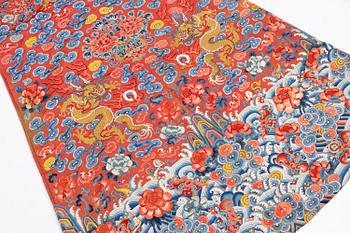
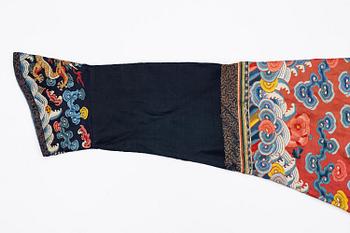
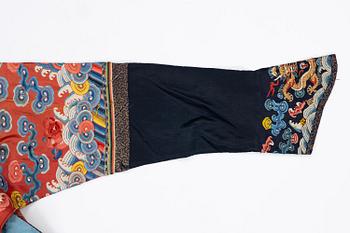
Avbildandes nio femkloade drakar som jagar den flammande pärlan bland molnformationer. Den nionde draken bakom knäppningen. Broderad i guld, siden och så väl den s.k. peking knot/forbidden stich. Blått sidenfoder. Längd rygg 140 cm, längd arm till arm 193 cm.
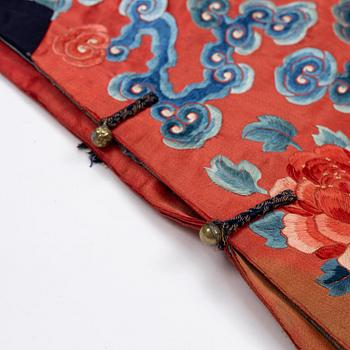
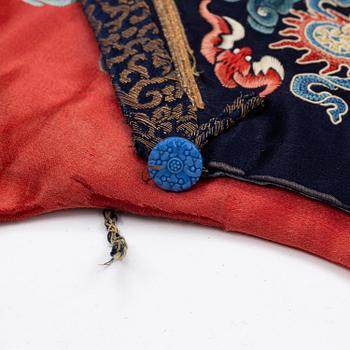
Slitage, fläckar, några lösa trådar.
Proveniens
From the Collection of Jenny Fridström, aquired around 1902, she lived with her husband in Patse Bolong, inner Mongolia during the years 1902 and 1921 were they worked as Missionaries.
Adorned with five-clawed dragons, a symbol reserved for use only by the imperial family, this robe, of semi-formal design, would have been a remarkable sight when worn as part of a festive occasion. Though bright yellow robes worn by the emperor and duller yellow and blue pieces worn by princes and lesser members of the imperial family respectively are well attested, it is rare to find a robe of this bright red colour. An auspicious colour associated with fire and good fortune, red clothing was (and continues to be) worn on festive occasions including weddings and birthdays.
Utställningar
Compare, lot no 121, Sothebys, Arts d'Asie, 14 June 2024.
Compare lot 434, Bonhams New Bond Street London, Live auction Fine Chinese Art, 6 November 2014.
Litteratur
Women played only a marginal role in the Qing dynasty court and government. As such, opportunities to wear formal dress, such as chaofu or dragon robes, were minimal, and surviving examples are particularly rare. Unlike those worn by men, women’s dragon robes had no front and back vent.
Övrig information
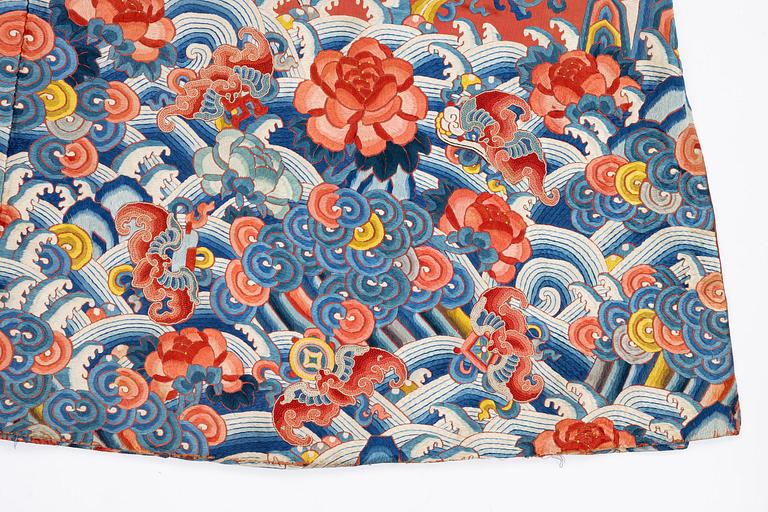
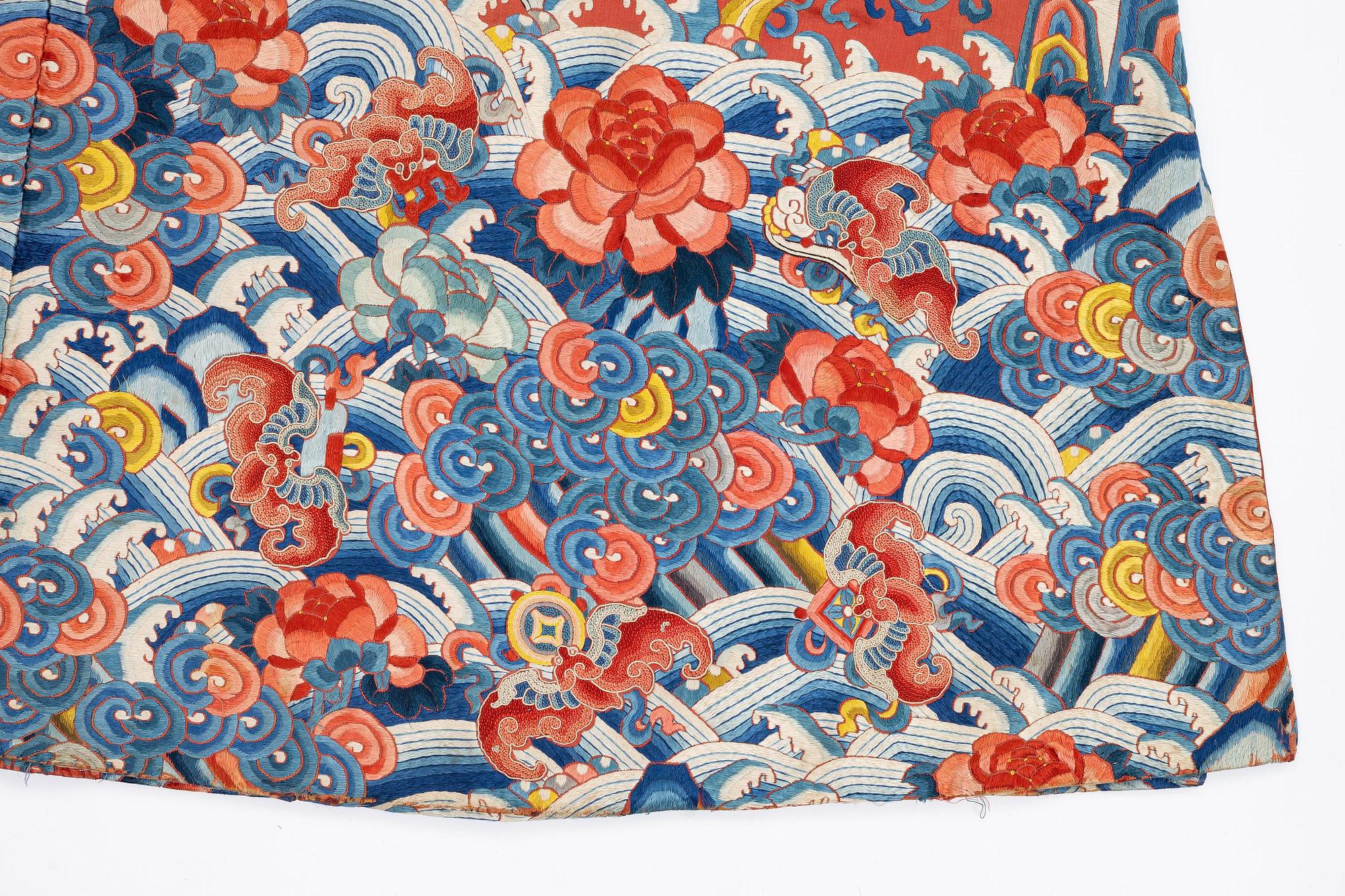
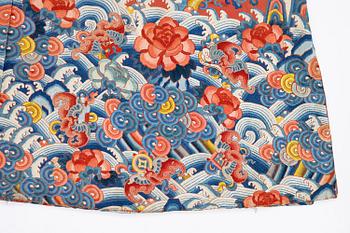
The décor on this jifu, (吉服, literally, 'auspicious' dress), or longpao, (龙袍, [imperial] dragon robe) follows the standard Qing disposition of five-clawed dragons (long, 龙) amid clouds across the entire surface of the garment. The standing water (lishui, 立水) border at the hem features piled wind-swept waves on which float the Eight Buddhist Symbols ( ba jixiang, 八吉祥), symbols for the Eight Precious Things (ba bao, 八宝), the attributes of the Eight Daoist Immortals (ba xian, 八仙), large peony blossoms, and several motifs that function as rebus. The term 'hurricane waves' was coined by Alan Priest in the 1940s to describe this variation of lishui, which first appeared on some jifu robes during the first quarter of the nineteenth century. The dragons, as is typical, are depicted with couched gold-wrapped threads while the rest of the embroidered decoration uses colored floss silk. However, what is remarkable is the choice of embroidery stitches for executing these colored silk elements.
The embroidery here also employs a single stitch commonly known in the West as 'pekin', 'peking', or 'pekinese' stitch, (Beijing zhen, 北京針). It is also known as lasuo xiu (拉锁绣, literally 'zipper stitch').1 It is a composite stitch involving two elements: a row of closely spaced back stitches and a second element interlaced in continuous loops moving forward two and back one through the previously laid down back stitches. It is time-consuming and requires consistent, exacting skill to maintain the proper tension and spacing of each parallel row of back stitches and well as rigorous consistency in placing the interlacing elements.
The exclusive use of beijing zhen or lasuo xiu stitching on a court dragon robe remains a puzzle.
För konditionsrapport kontakta specialist

Andra har även tittat på