
Important Spring Sale presenterar Joachim Beuckelaer | 10–12 juni
En fiskmarknad vid Antwerpens stadsport
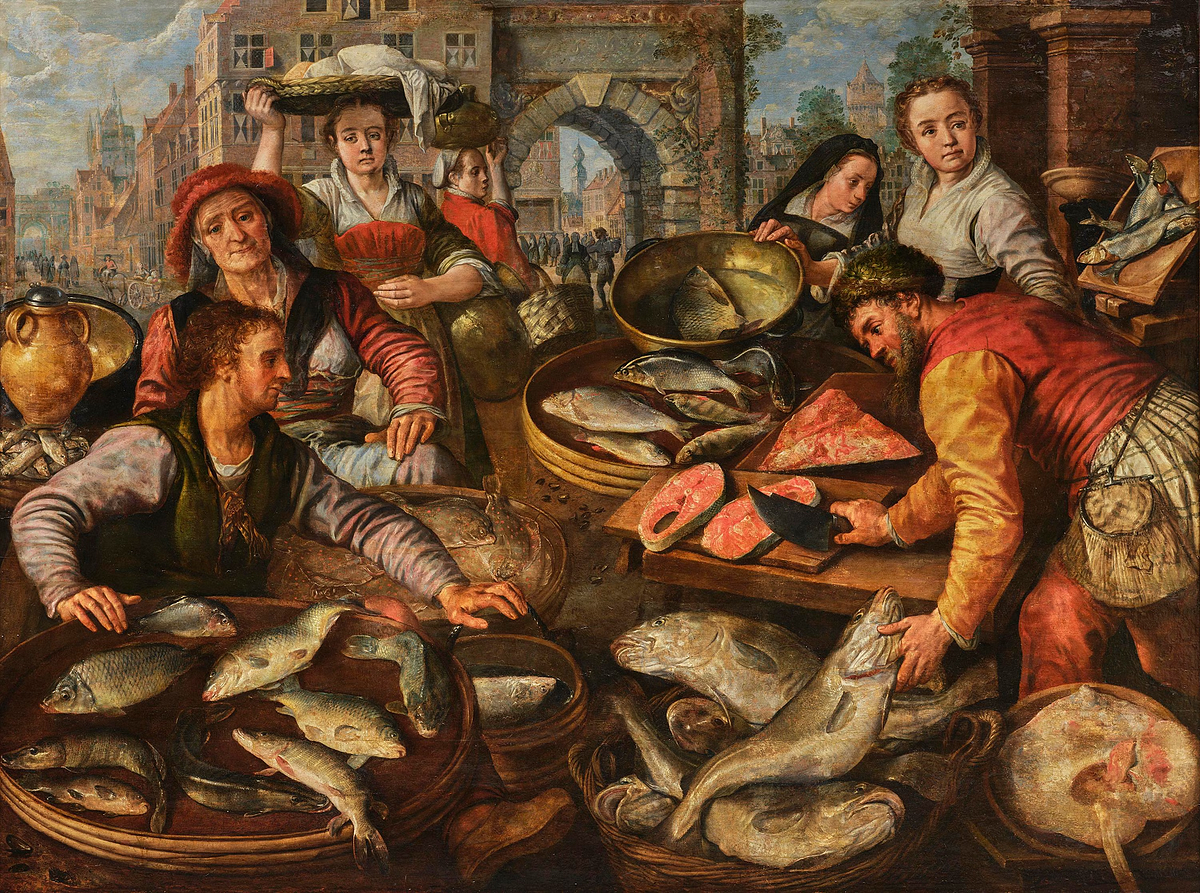
This impressive painting, which has remained in the same family for over a century and was only once on public display in Malmö in 1926, has so far been little studied.
Over the years it has only been seen by Görel Cavalli-Björkman who published it in 1986 following the exhibition Brueghels Tid Nederländsk Konst 1540-1620 in the Nationalmuseum in Stockholm in 1984/5. Lorne Campbell cautiously published it on the basis of the old 1926 photograph, as ‘free copy’ of the painting of the element of Water now as part of the series of the Four Elements in the National Gallery, London.
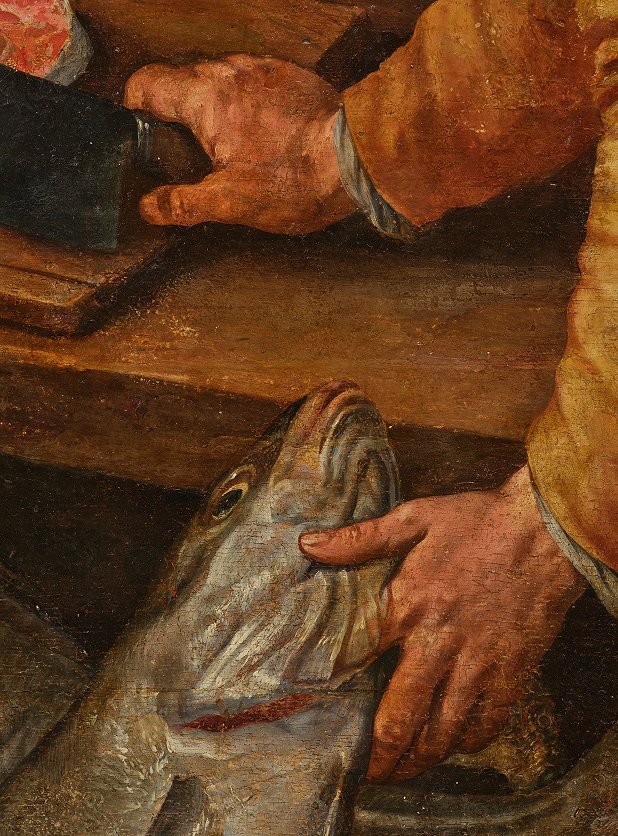
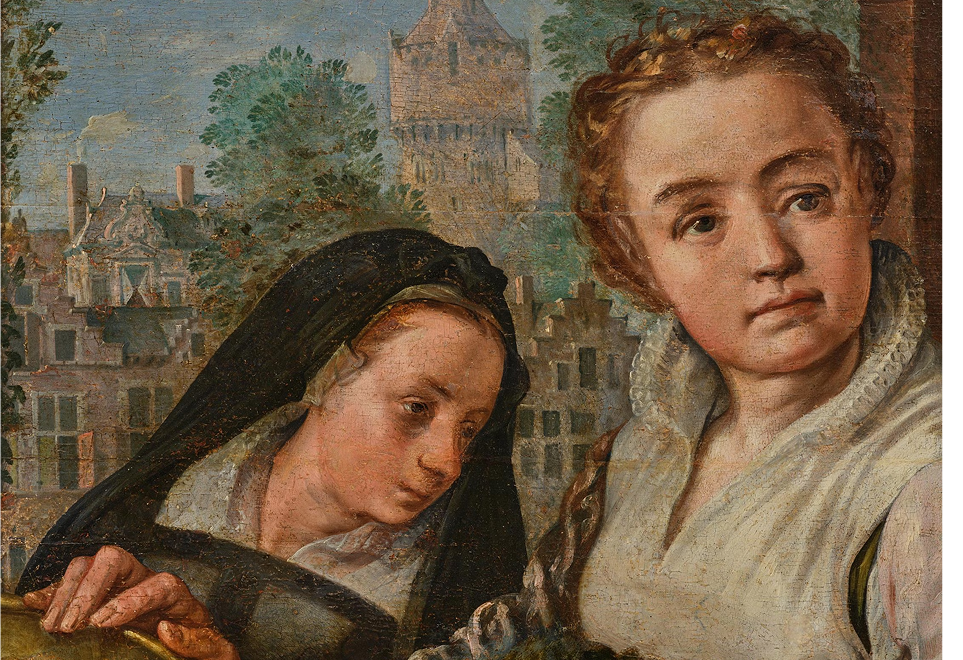
The recent reappearance of the painting allows to reestablish the status of the painting as a fully autograph and independent work by Joachim Beuckelaer and to assign it its rightful and important place within the oeuvre anticipating the London series. It not only shows Beuckelaer’s characteristic carefree and rapid economic painterly style in details such as the shiny appearance of the fishes, the fine modeling of the faces, hands and costumes as much as in the masterful rendering of light and shade and its warm colors, but also confirms in its characteristic sketchy and free style of under-drawing and paint contours, recently visualized by infrared reflectography (see images), also visible with the naked eye in passages such as the beard of the fish-seller on the right and in the hands, as much as in the pentimenti in the eyes of the woman with the black veil upper right, the salmon steak and the bag of the fish-seller on the right among others, to be the result of a throughout creative process.
Utropspris: 2 500 000 - 3 500 000 SEK
Vardagar kl. 11–18
Helger kl 11–16
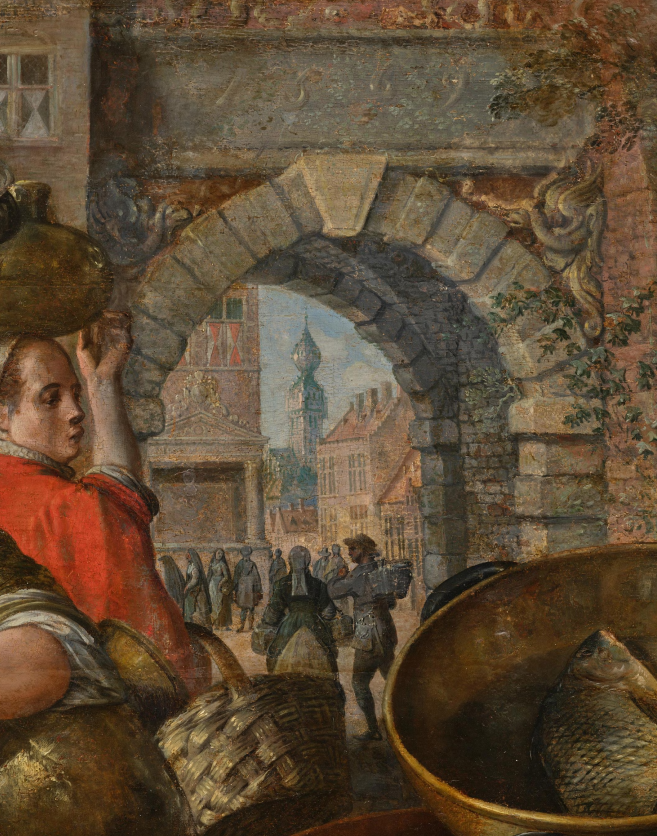
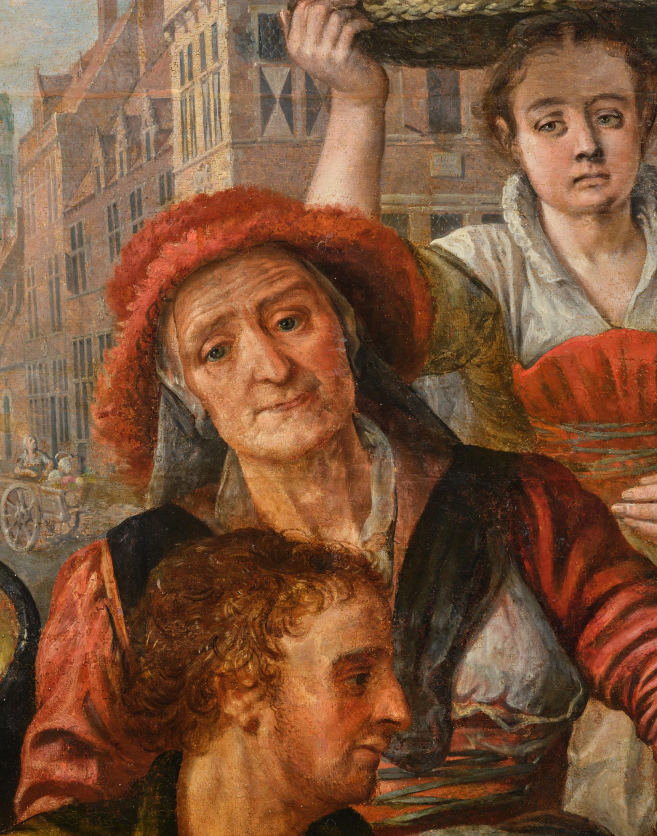
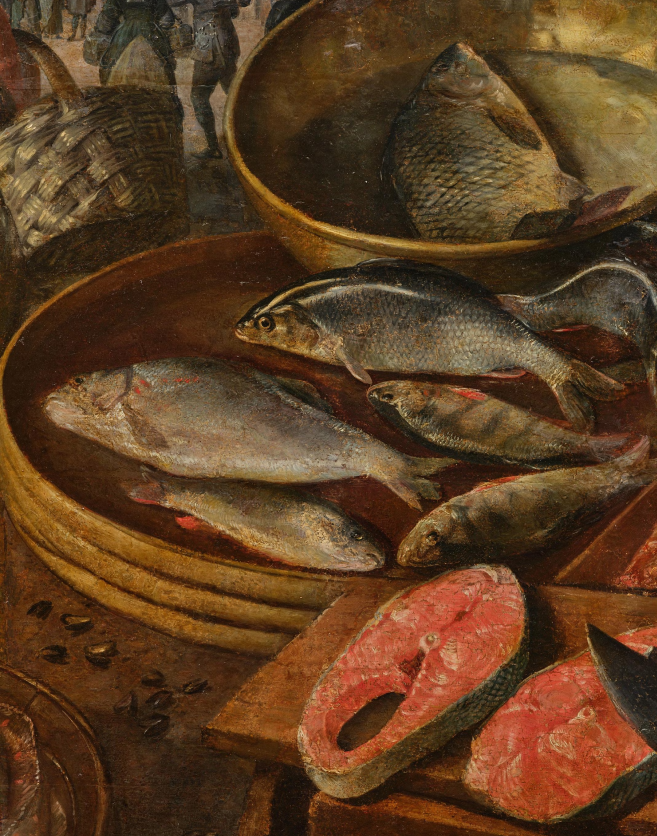
Dated 1569, the painting is an addition to the series of hitherto known fish markets, of which the earliest interpretations date from 1568 (private collection; J. Muylle, “Joachim Beuckelaer: het markt- en keukenstuk in de Nederlanden: 1550-1650”, 1986, cat. no. 6) and the last from 1574 (KMSKA, Antwerp; Muylle, op.cit, cat. no. 13) and fits seamlessly into the chronological sequence by its format and use of large figures in close up and the realism of the fishes. The composition shows close affinity with that of the painting of the element of Water, also from 1569, in the National Gallery in London. It uses the same arrangement of barrels, plates and slabs of which the fishes tumble onto the spectator, but other than that there are various notable differences in the grouping of the figures and the number of the fishes: for example in the present painting the elderly woman in a red hat on the left is accompanied by the young fish-seller with curly hair who in the London painting finds himself on the right and looks onto the spectator. Instead on the right in the present painting a somewhat elderly fish-seller wearing a hat is about to clean for the customer beyond the large codfish which he grasps with his left hand, as he bends forward. The most notable difference between the two however is in the background, as the present painting depicts a view of apparently contemporary Antwerp, with the Rodepoort visible on the far left, whereas in the London painting the Miraculous Draught of Fishes is seen through the gate in the center.
The changes visualize Beuckelaer’s artistic dedication to the subject of the market scene which, with other secular subjects, had been introduced by Pieter Aertsen in the 1550’s. Especially after Aertsen’s final departure to Amsterdam in 1563, Beuckelaer appears to have embarked on the ambition to develop the new genres into high end products for the free market. He thereby over the years gradually enlarged the formats, strived to further sophistication by high quality of execution and variation and contributed to the genre by introducing the new theme of the fish market.
Probably working with a large collection of drawings at hand, Beuckelaer appears not to have relied on specialized assistants nor on the use of cartoons for the execution of his paintings. Technical research of Beuckelaer paintings, carried out by Margreet Wolters of the RKD and published in her unpublished dissertation of 2011: “Met kool en crijt’: de functie van de ondertekening in de schilderijen van Joachim Beuckelaer”, have confirmed Beuckelaer’s free and creative approach to his art. Her research confirmed that preliminary drawing becomes less important over the years to give way to the spontaneous and free style which was Beuckelaer’s hallmark, already confirmed by Carel van Mander’s when he stated:
‘Aertsen made him [Beuckelaer] develop the habit of painting everything after life; vegetables, fruit, meat, fowl, fish, and such like thing; by repeatedly doing this he became so sure in mixing colors that in that respect he became one of the most excellent masters executing his works with great skill, as it were without effort, so that they have a very fine appearance’.
The changes between the London painting and the present one appear foremost to have been intended to give the composition more perspective clarity. Indeed, in the London painting and also in that of the fish market with Ecce Homo of 1570 in the Nationalmuseum in Stockholm the transition between for- and backgrounds is more gradual, while in the present painting the market does not spaciously connect with the background view. From this feature and as the execution of the London painting as part of a series stretches over the years 1569/70, the current painting must anticipate the London painting rather than that it follows it. A simultaneous execution of both paintings such as has also been suggested for the market scenes of 1563/4 in the Musée des Beaux-Arts, Valenciennes and Gemäldegalerie Kassel (J. Muylle, op. cit., p. 116, cat. no. 2 and fig 1), may not be ruled out either as here too the paintings are executed on different supports, the London painting being on canvas and for export to Italy and the present painting on the more common oak panel for a collector at home.
Beuckelaer’s compositions have been subject to debate on whether they contain a hidden meaning, whereby the fish markets in particular were suspected to contain hidden sensual messages. Here the two ostentatious salmon steaks in combination with the fish-seller grasping the cod may perhaps have been pins for an underlying erotic narrative. Alternatively, the scene might as well have just been intended to display the richness of nature in the variation of the fishes and to give pleasure to the spectator to identify the species by their accurate rendering.
Joachim Beuckelaer på Important Spring Sale
Förfrågningar och konditionsrapporter