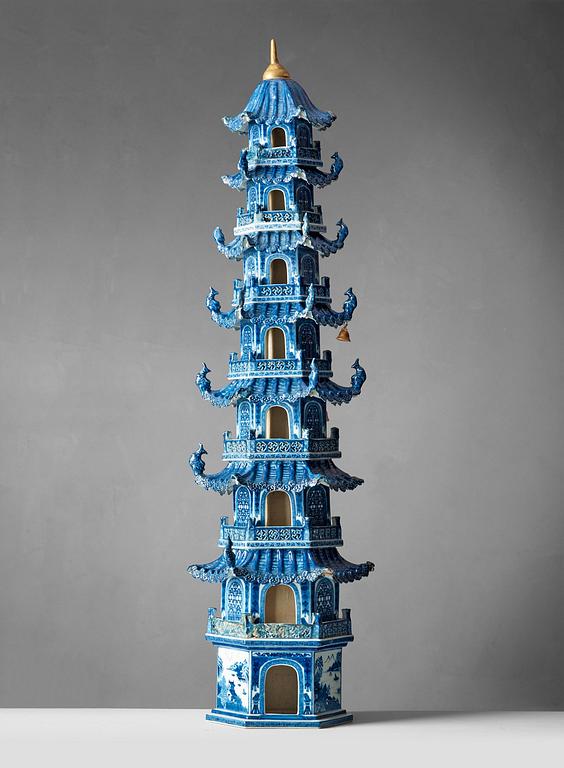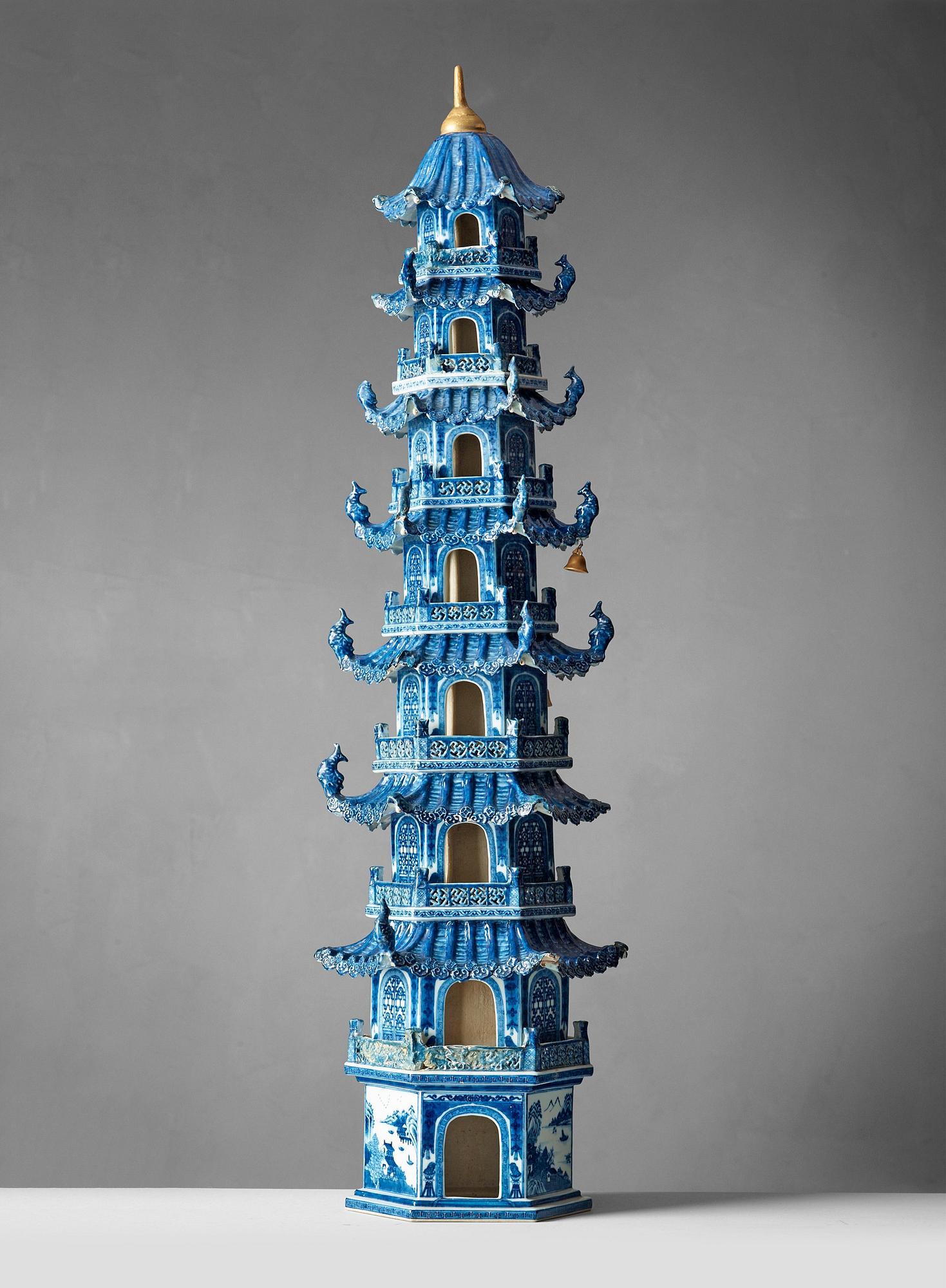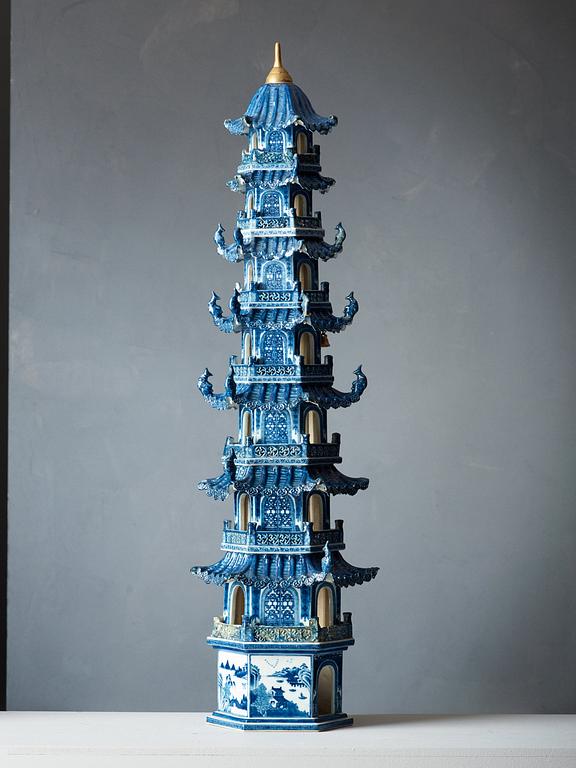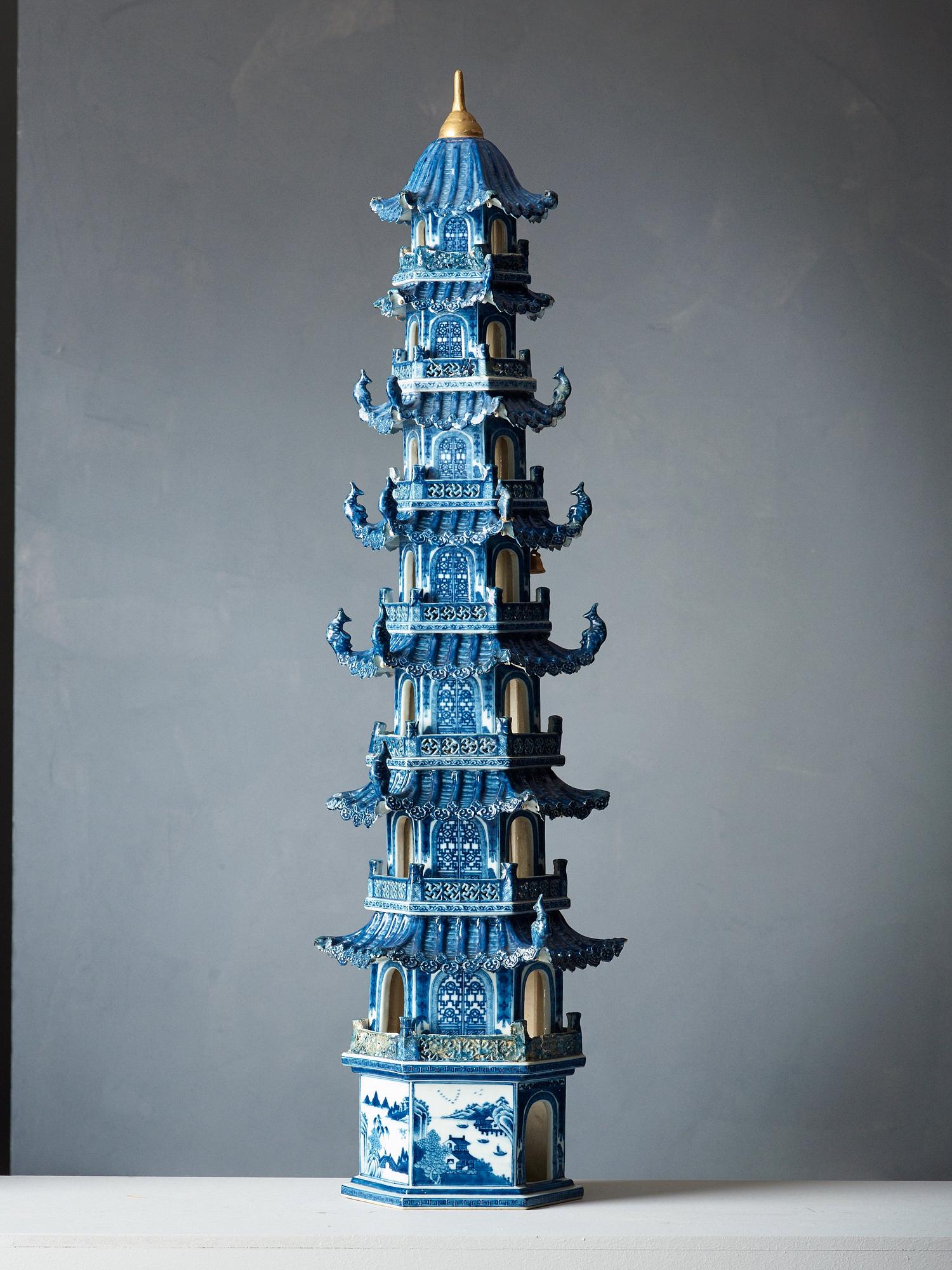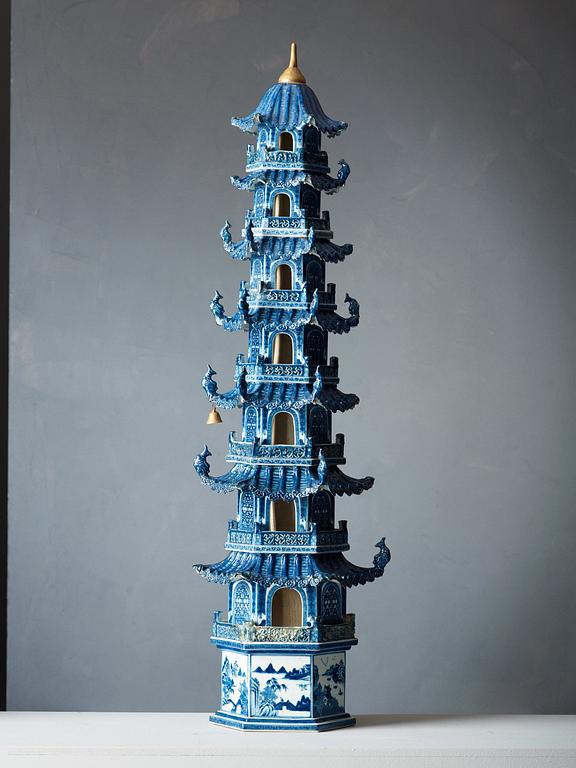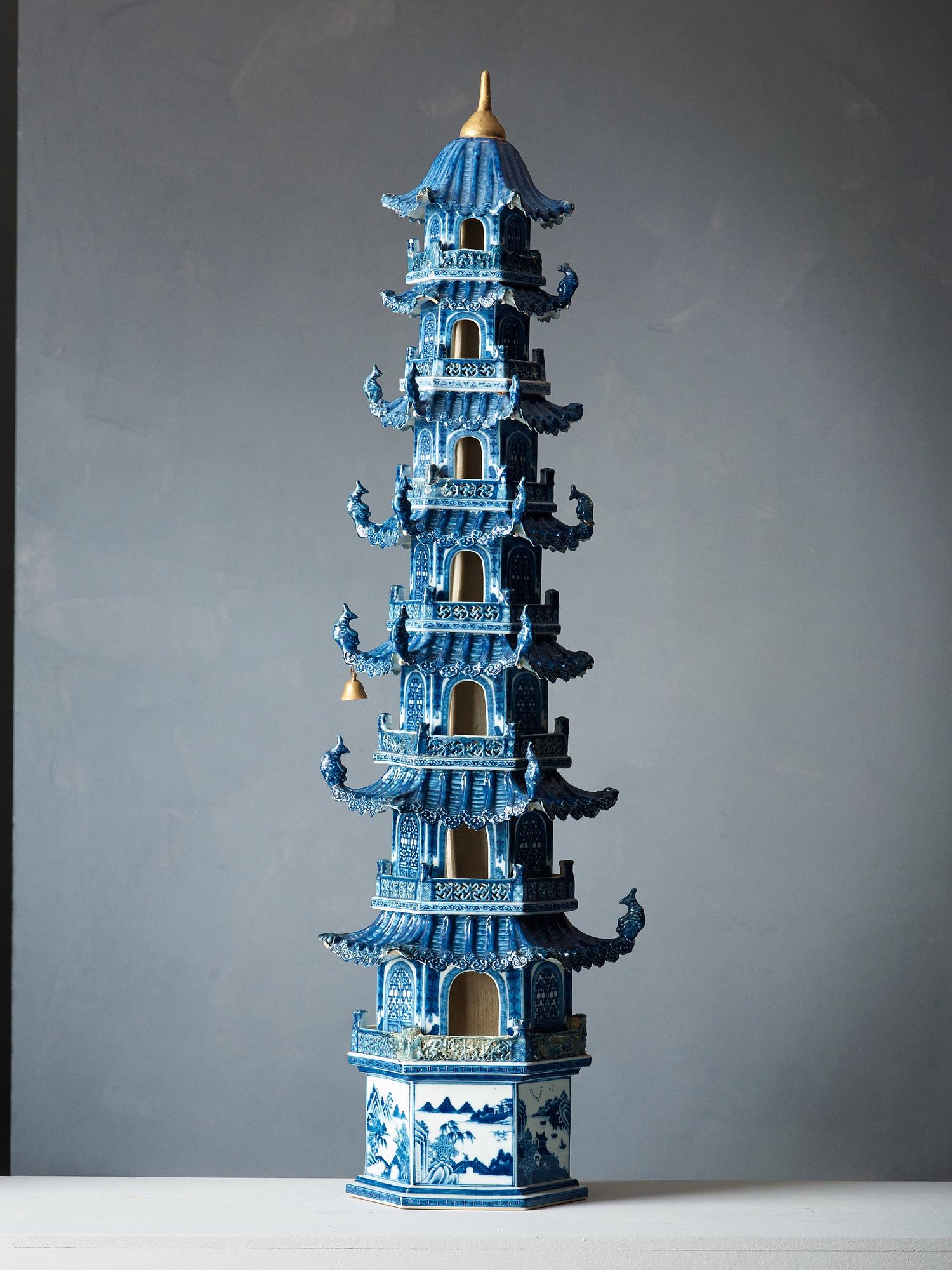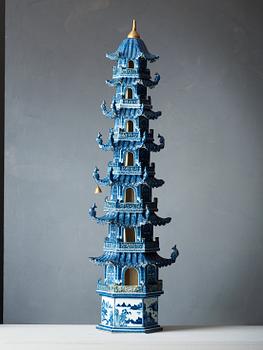
The pagoda comprises eight hexagonal tiers, supported on a sturdy hexagonal stand which is painted in underglaze blue with landscape scenes. The tiers, which graduate in size, and are decorated in underglaze blue, have three arched apertures forming doors alternating with similarly-shaped 'closed' doors. The pagodas are further embellished at each corner of the roofs with leaping carp. Height 92 cm.
Damages, restorations, parts missing.
Alkuperä - Provenienssi
The Ekman family, Gubbero (demolished in the 1920's).
Näyttelyt
Compare similar pagodas in the collection of the Victoria & Albert Museum, London and the Peabody Essex Museum, Boston.
Kirjallisuus
N. Pearce in 'A Chinese Export Porcelain Pagoda in the Victoria and Albert Museum', Orientations, October 1987, Vol. 18, No. 11, p. 38.
William R. Sargent, Treasures of Chinese Export Ceramics from the Peabody Essex Museum , Yale University Press , 2012, pp. 152-4. Details from du Pont Daybooks, in the Winterthur Archives.
Muut tiedot
The famous Porcelain Pagoda of Nanjing, the Bao'en Temple Pagoda, built on the orders of the Ming dynasty Yongle Emperor to honour his parents in the early 15th century, was a source of wonder to Chinese who saw it, but also a source of amazed admiration to European travellers from the 17th century onwards. The pagoda was often listed in the 19th century as one of the Seven Wonders of the World, until it was finally destroyed during the Taiping Rebellion in 1854.
Porcelains of the huge size of the current pagoda models were difficult and very costly to make, and were extremely rare. However, they were greatly prized by European royalty. The British Prince of Wales (later King George IV, 1820-1830) purchased similar pagodas in 1804 and 1817 for his extravagant and exotic Royal Pavilion at Brighton.
Lisätietoja ja kuntoraportit

Tietoa ostamisesta