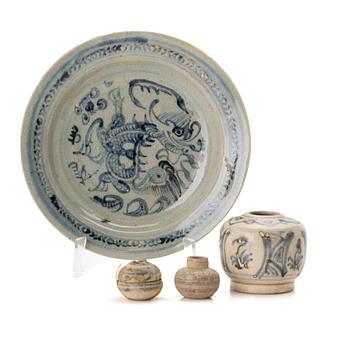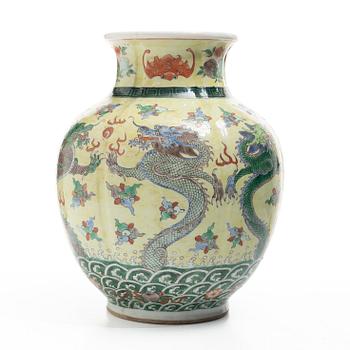
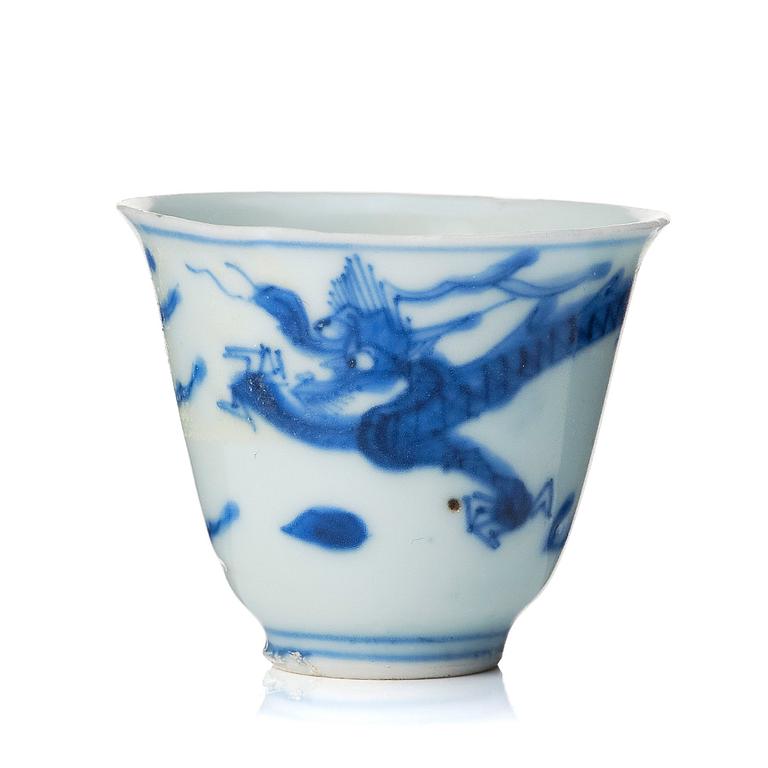
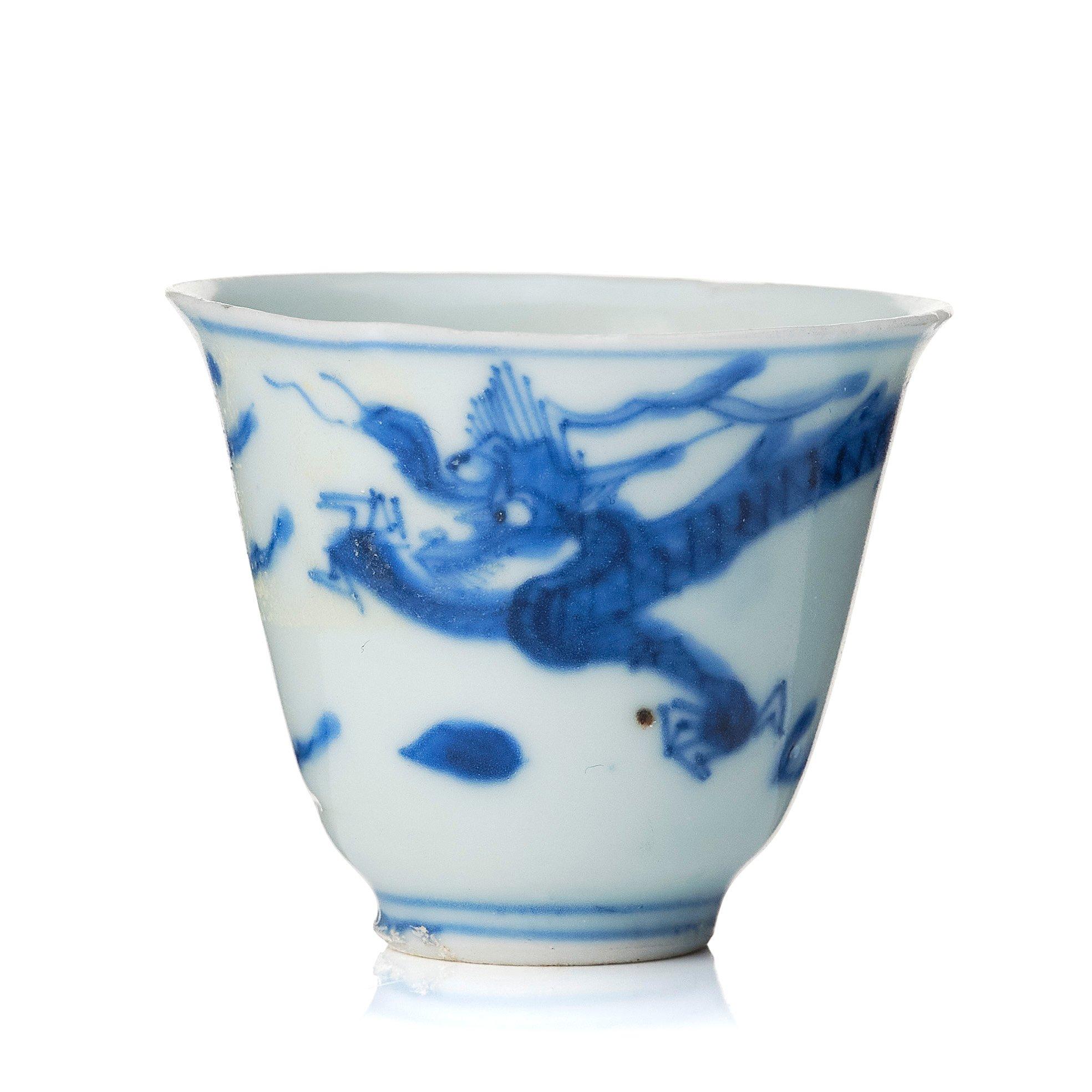
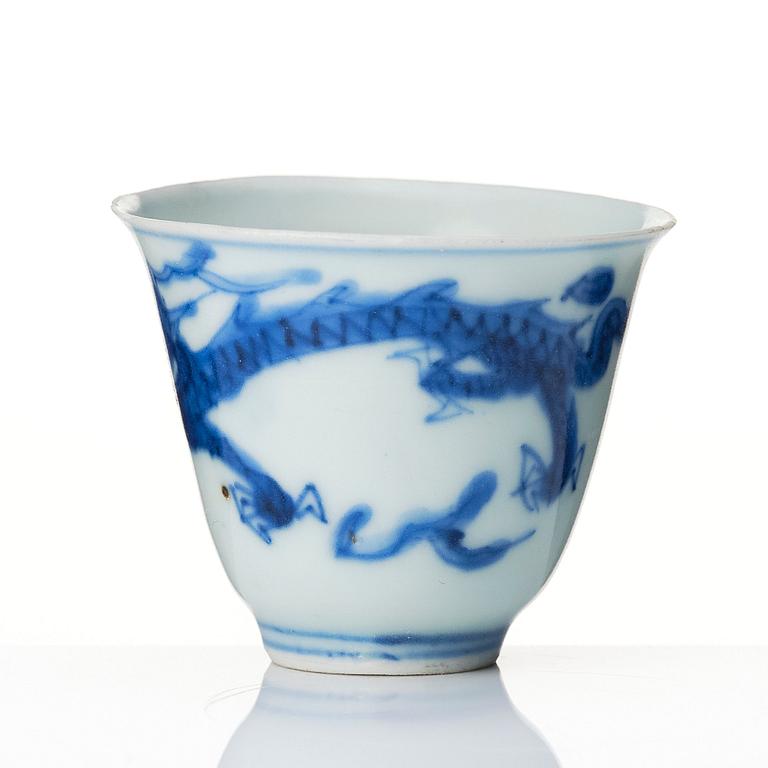
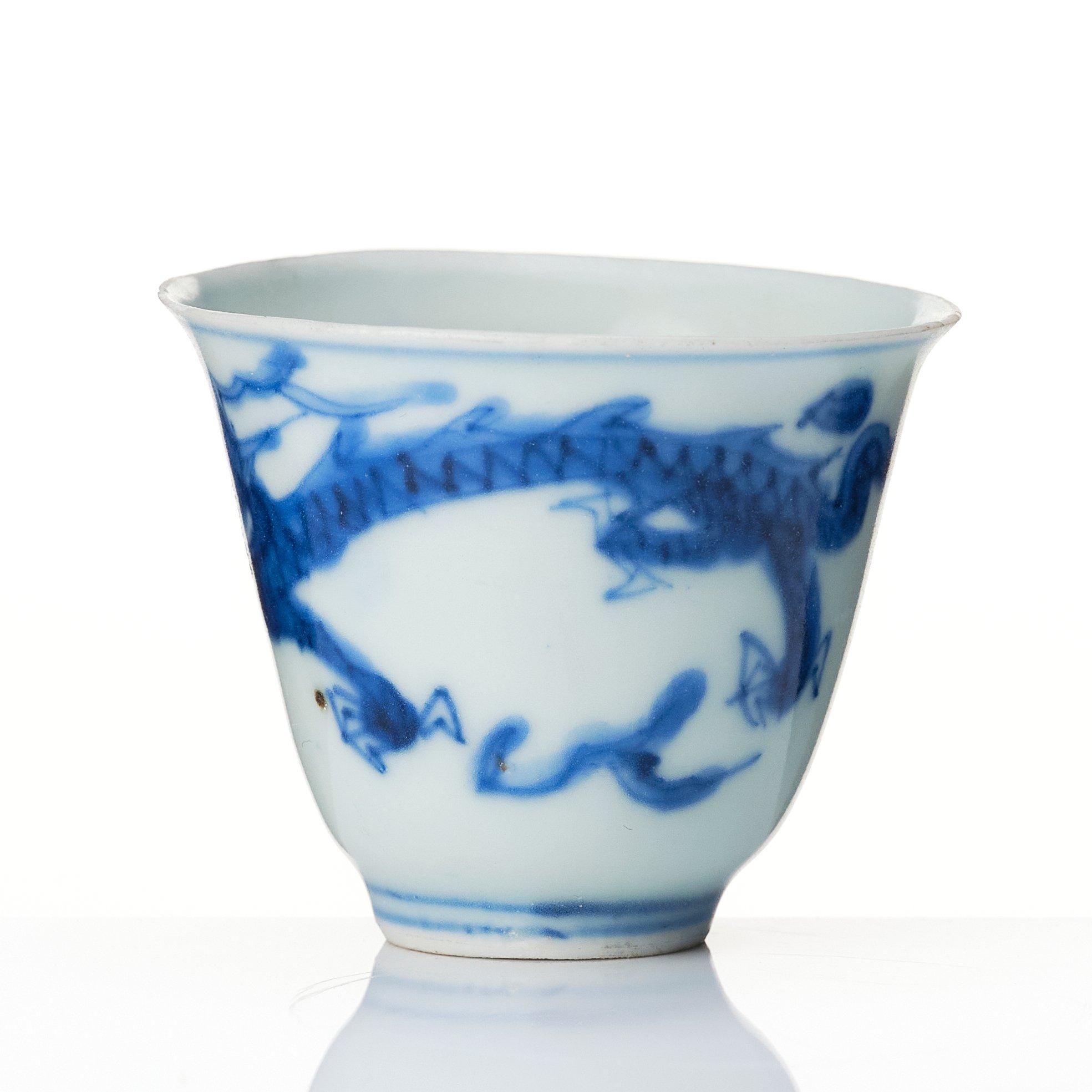
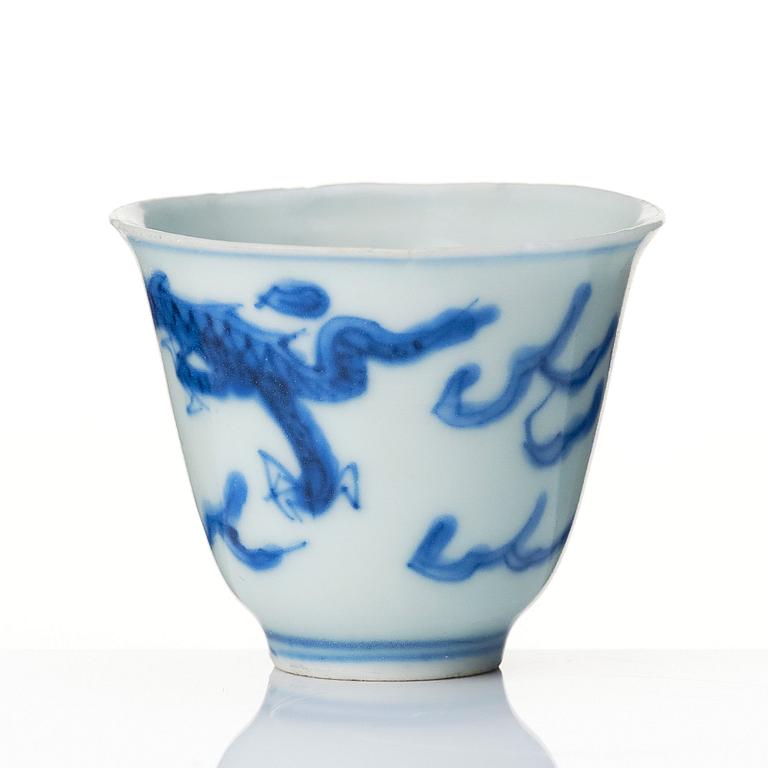
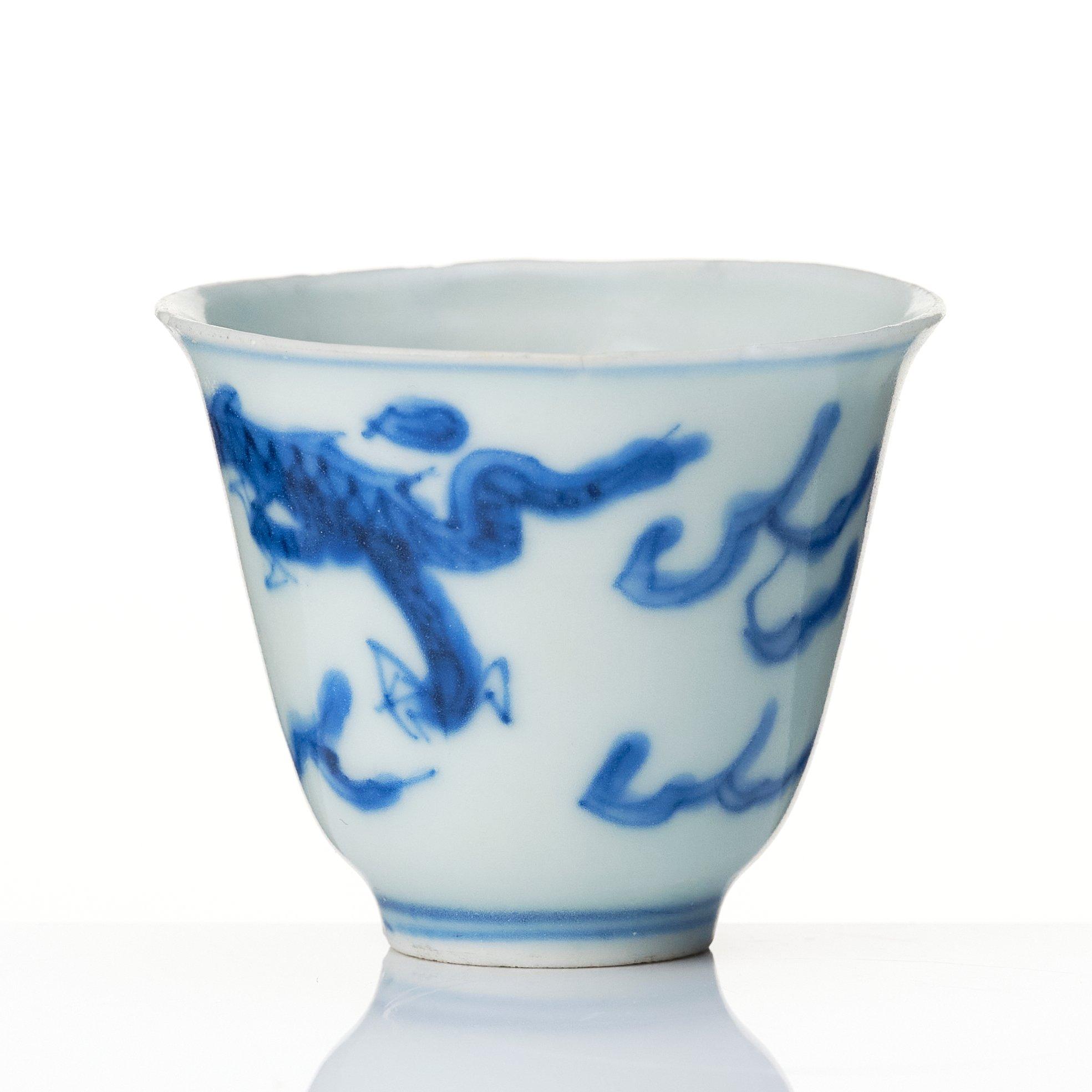
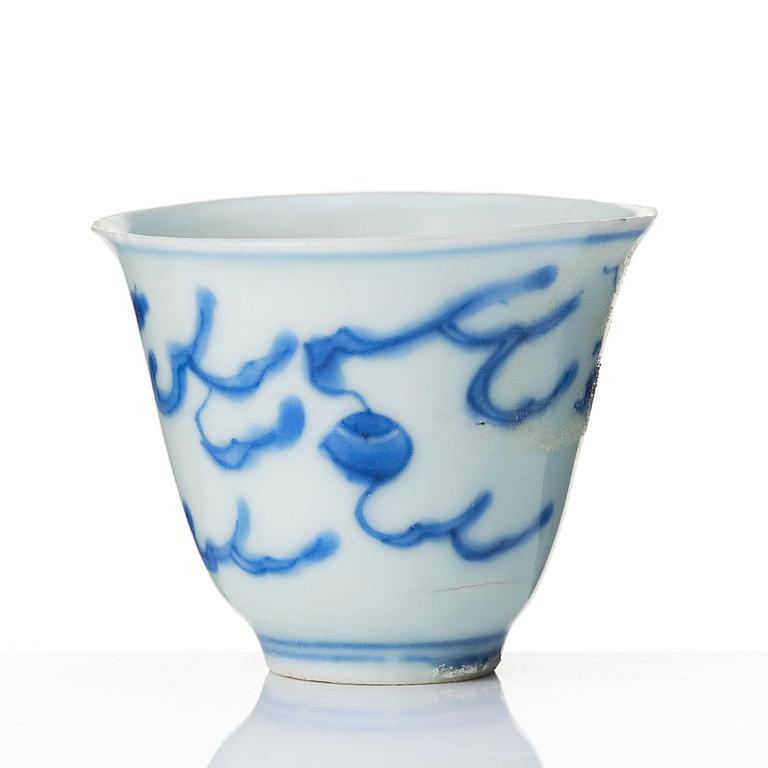
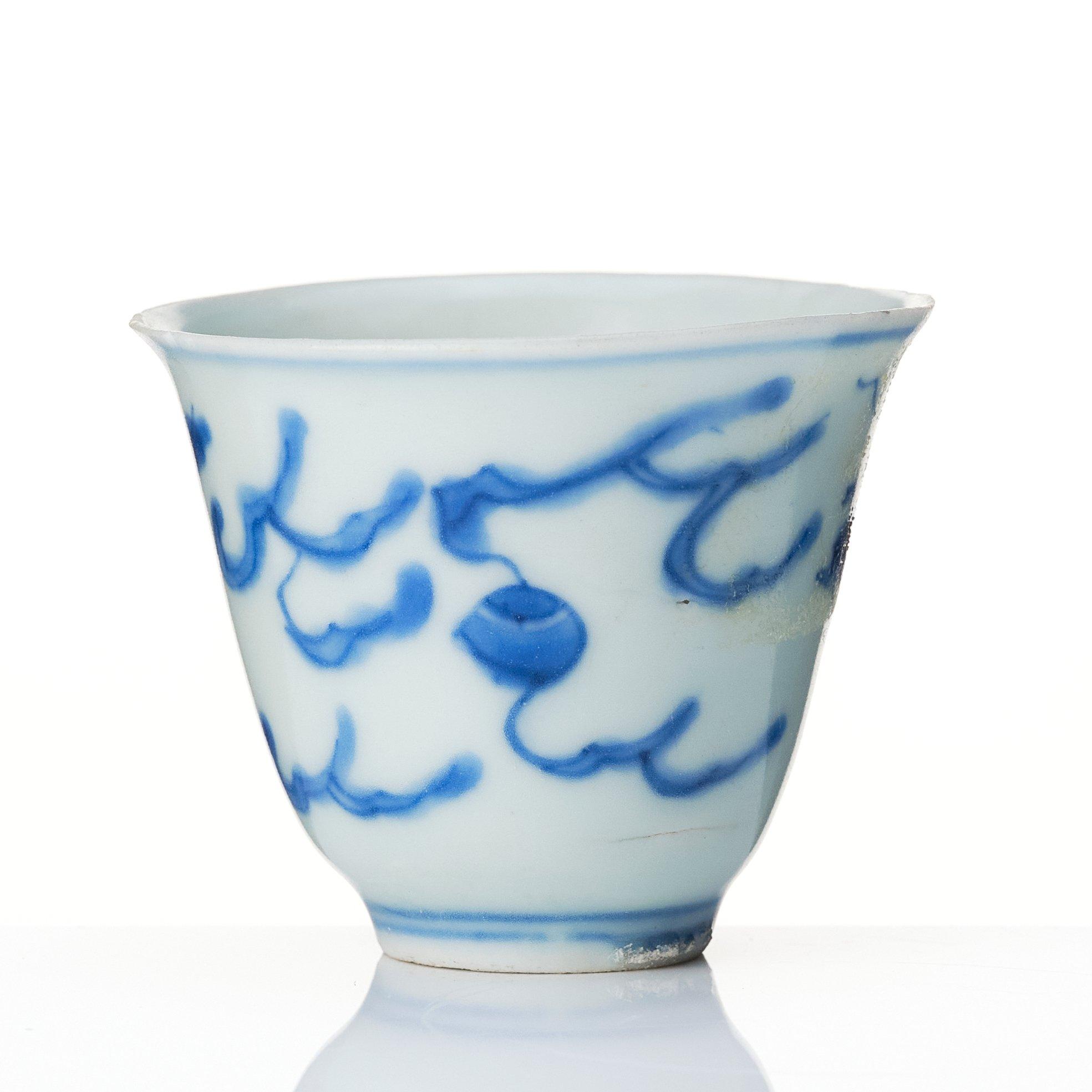
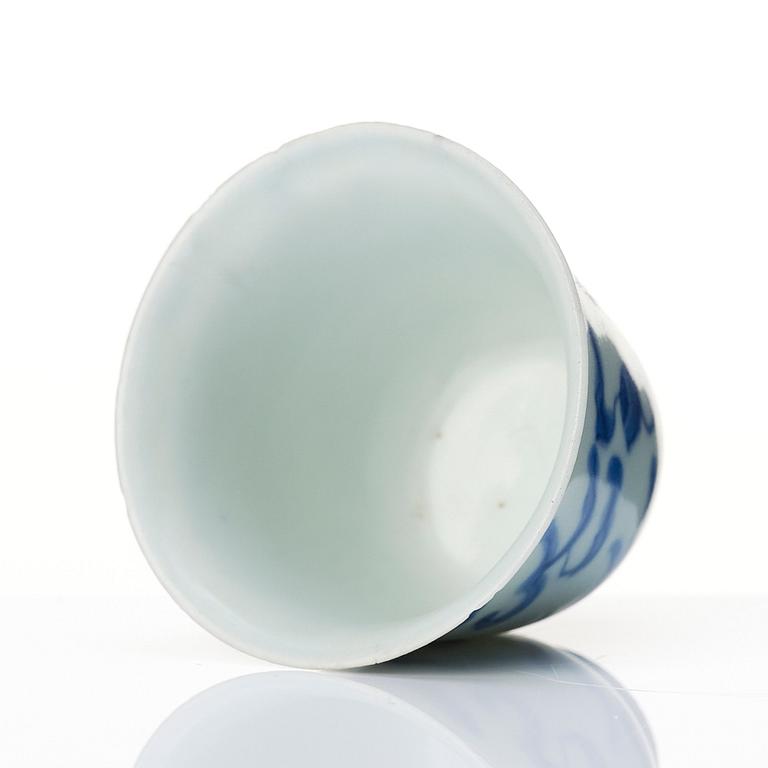
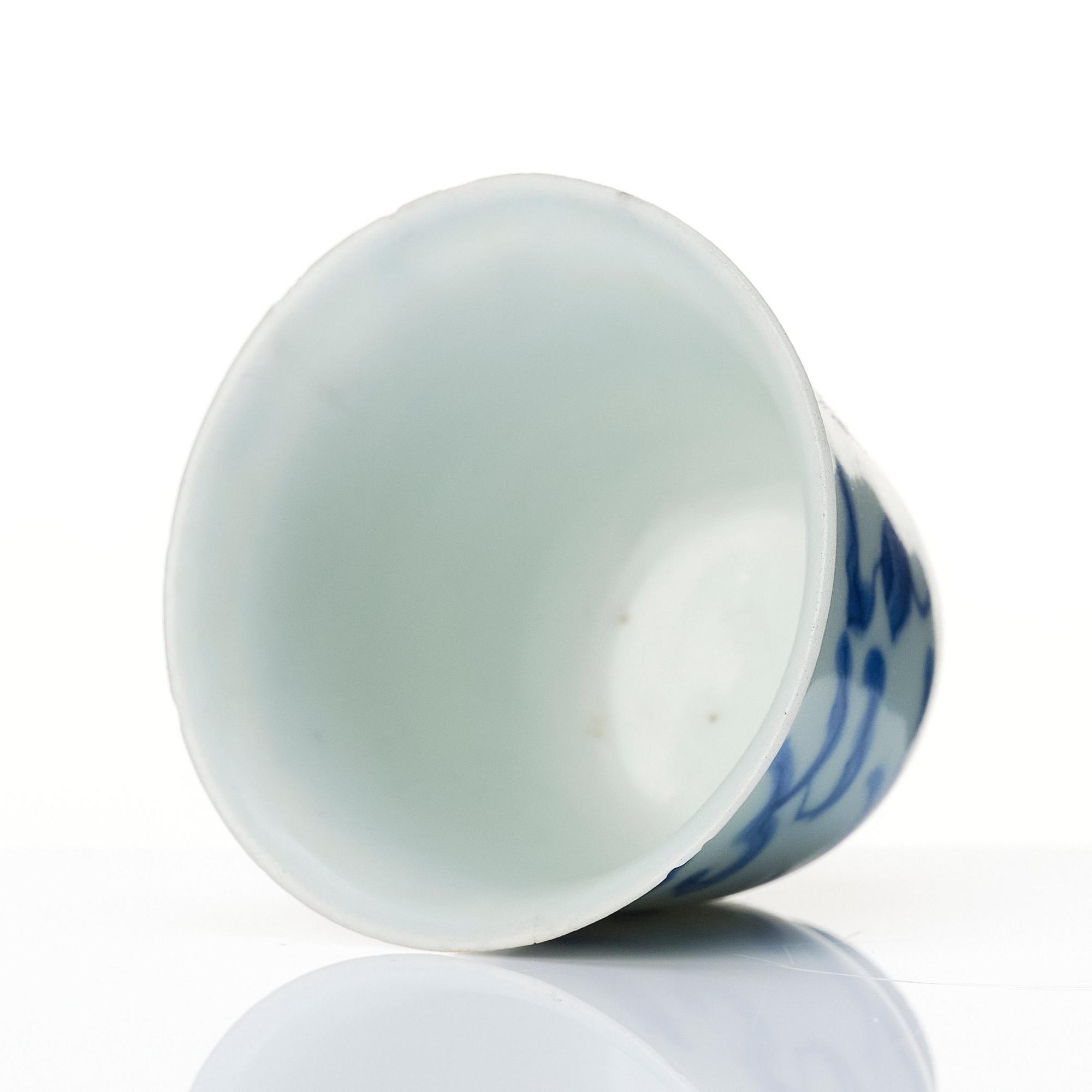
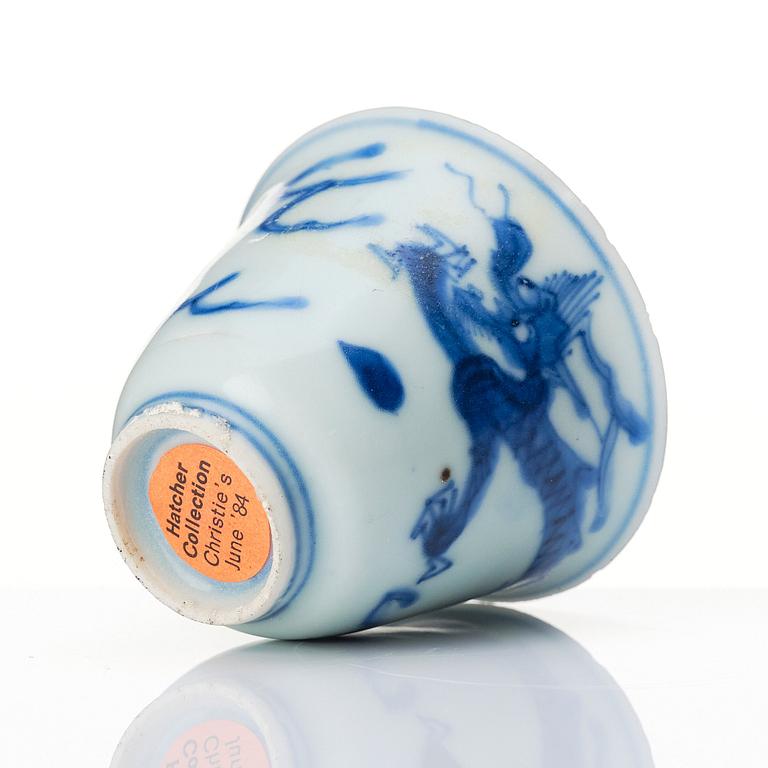
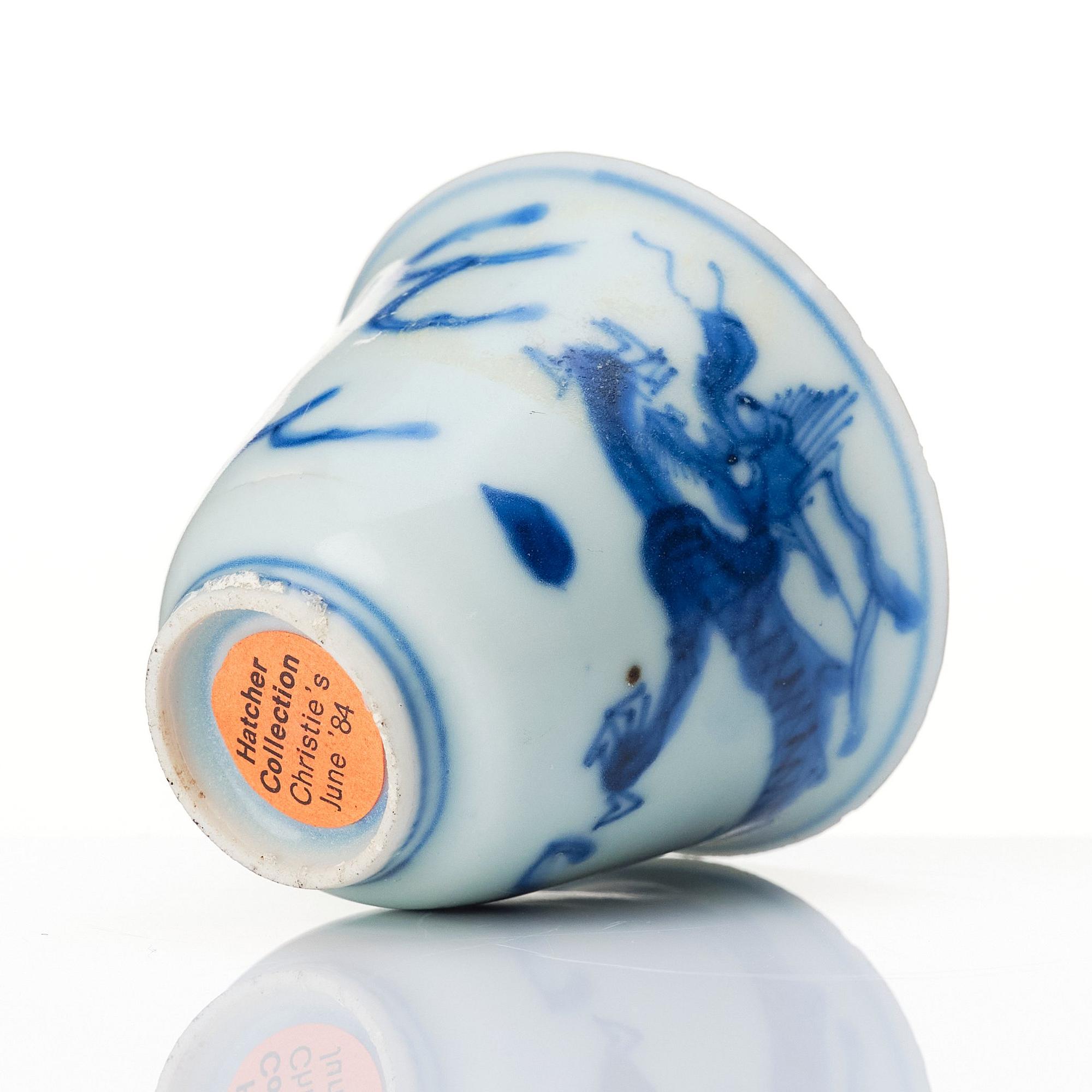
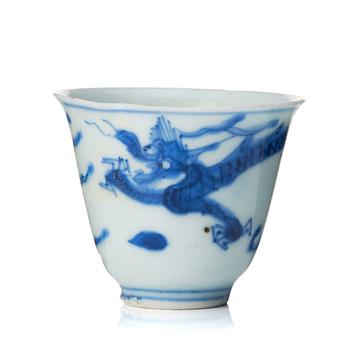
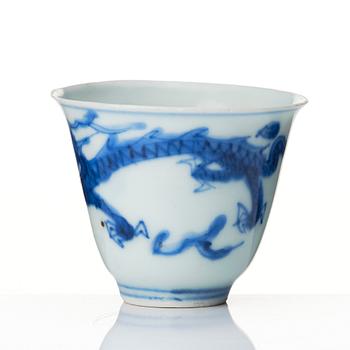
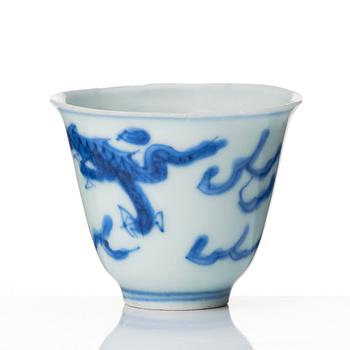
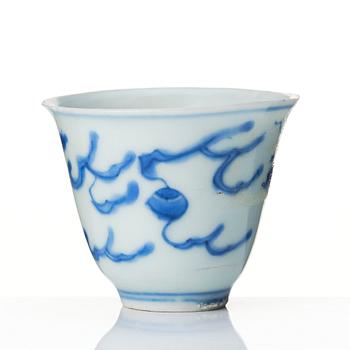
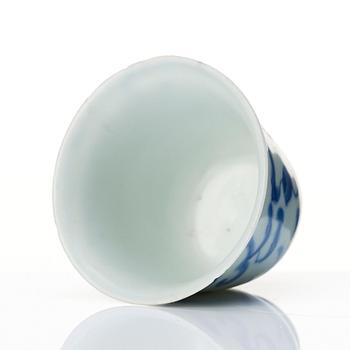
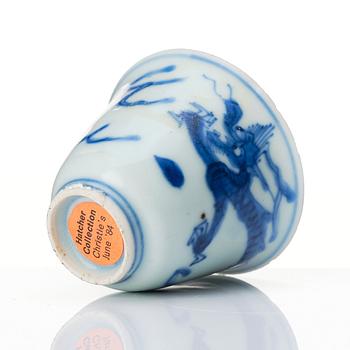
Decorated in underglaze blue with a four clawed dragon chasing the flaming pearl amidst cloud formations. Height 4.2 cm.
Wear.
Alkuperä - Provenienssi
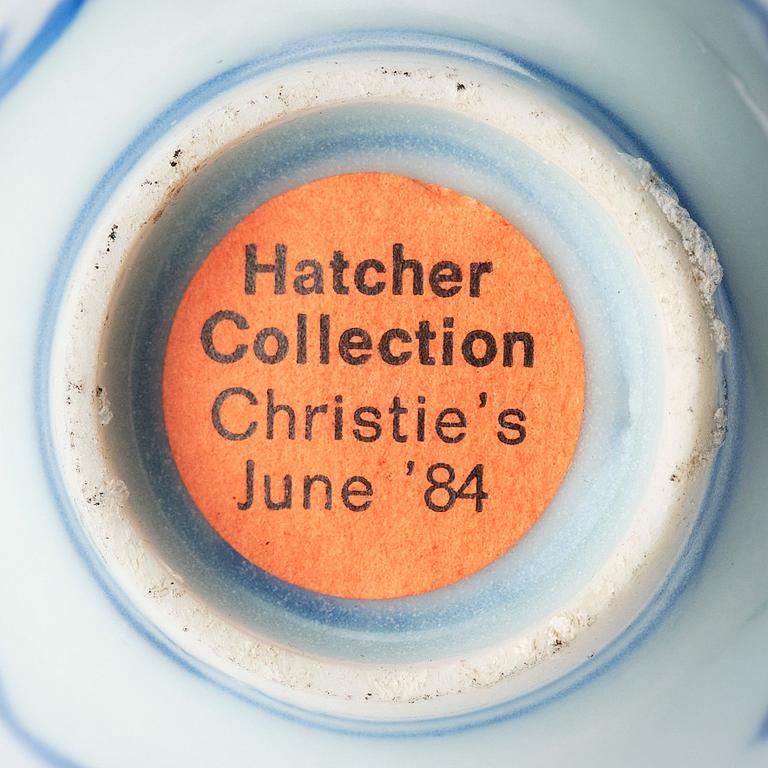
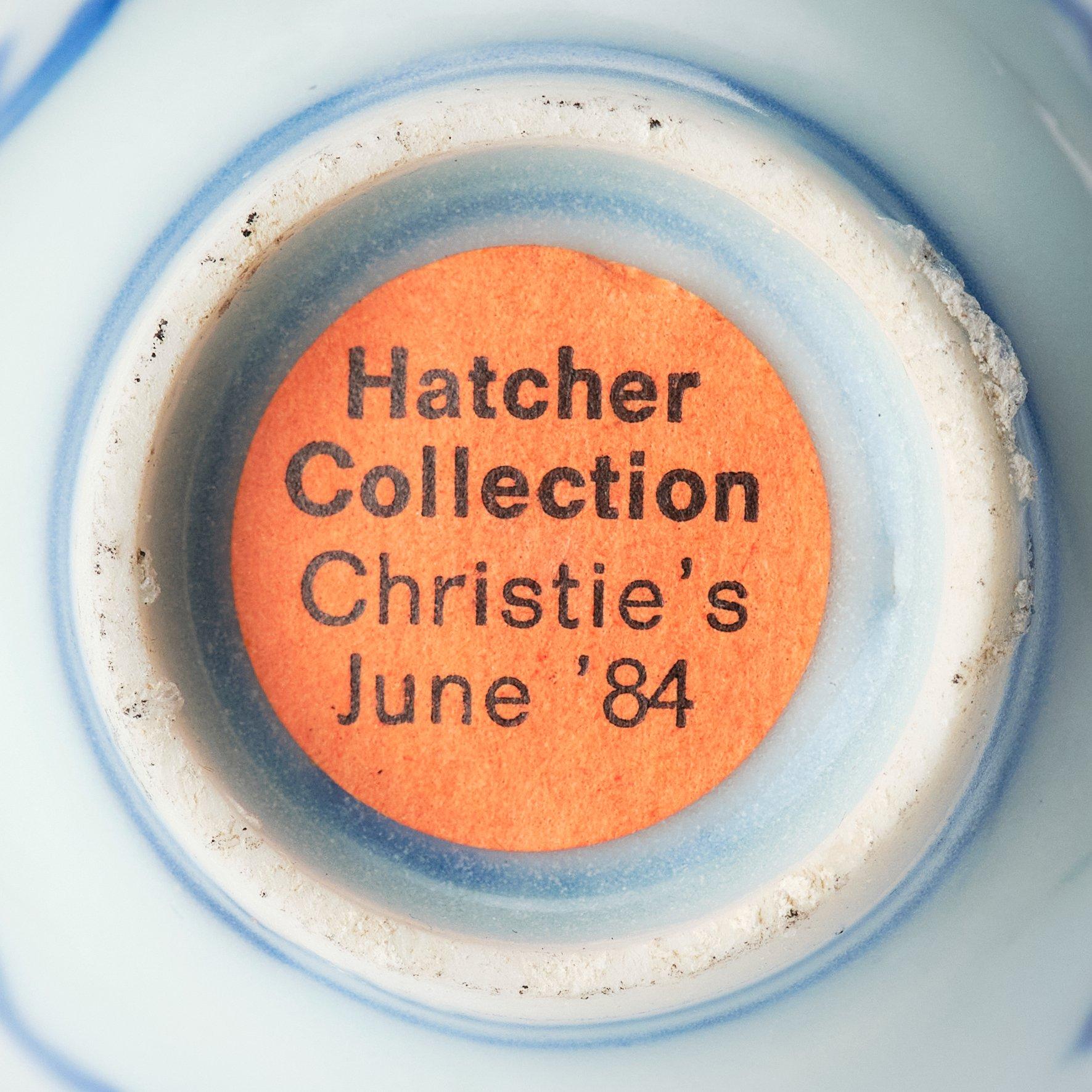
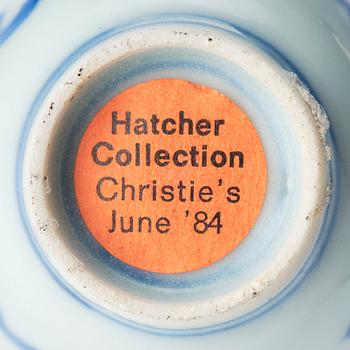
The Hatcher Collection, Christie's June 1984.
The wares discovered in the early 1980s in the ‘Hatcher Cargo’, named after the Captain who made the discovery, now serve as important benchmarks for the dating of 17th-century Chinese porcelains. The cargo of the ship included some 25,000 pieces of porcelain, mostly blue and white wares from Jingdezhen, but also examples of celadon wares, Dehua wares, polychrome wares and provincial blue and white wares. Several thousand of these were sold in a historic sale at Christie’s Amsterdam in 1984, from which all of the 'Hatcher’ pieces in the Curtis Collection were purchased. (fig. 1) Because no trade records exist to identify the ship and hence the destination to which it was headed, scholars needed to use a combination of deductive reasoning and knowledge of the porcelain trade at the time to date the wares salvaged from the vessel. While the Dutch East India Company (VOC) used Chinese junks to transport cargos from Taiwan to Batavia, the diversity of the wares in the 'Hatcher’ wreck indicates that the ship was probably headed for wholesale markets in Batavia or Bantam.
Kirjallisuus
Colin Sheaf and Richard Kilburn, The Hatcher Porcelain Cargoes, The Complete Record, London, 1988, p. 30) Sheaf and Kilburn take a step-by-step process to deduce that the ship most likely sunk between 1643 and 1646. The inclusion of two covers for ovoid jars (similar in shape to the lot 3513) bearing inscriptions and a cyclical date corresponding to the spring of 1643 indicates that the vessel sank no earlier than the spring of 1643. The authors also note that because of the internal unrest in China at the time, trade was significantly disrupted at the fall of the Ming dynasty and studies of VOC records show that by 1646 the Manchus were preventing the free movement of trade and shipments out of Jingdezhen. The authors conclude that it is therefore very likely that the Chinese junk known as the 'Hatcher Cargo' must have sunk sometime in the years between 1643 and 1646. In her article, “Transition Ware Made Plain: A Wreck from the South China Sea" (Oriental Art, Summer, 1985).
Lisätietoja ja kuntoraportit

Tietoa ostamisesta
Muiden katsomia kohteita