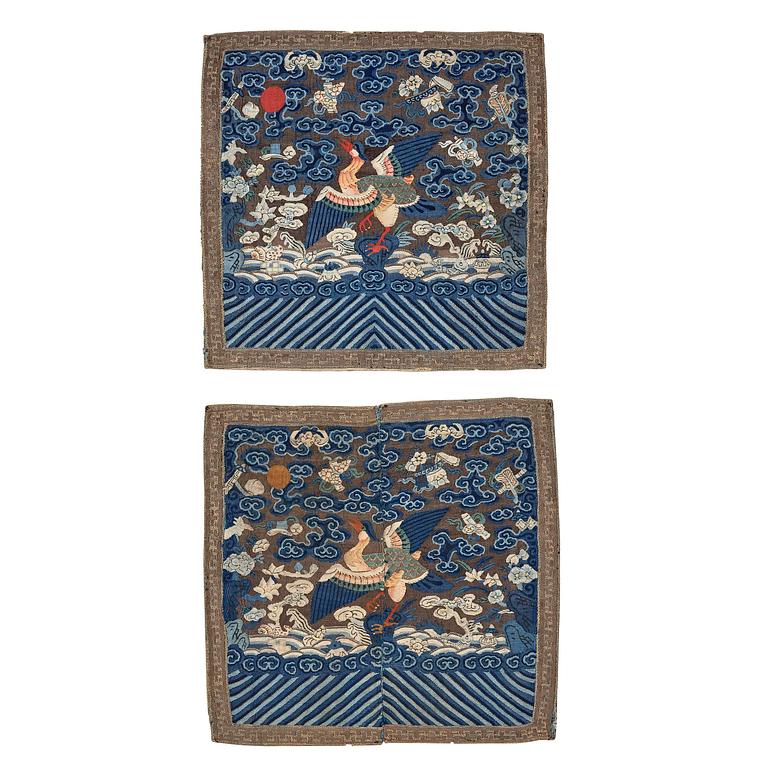
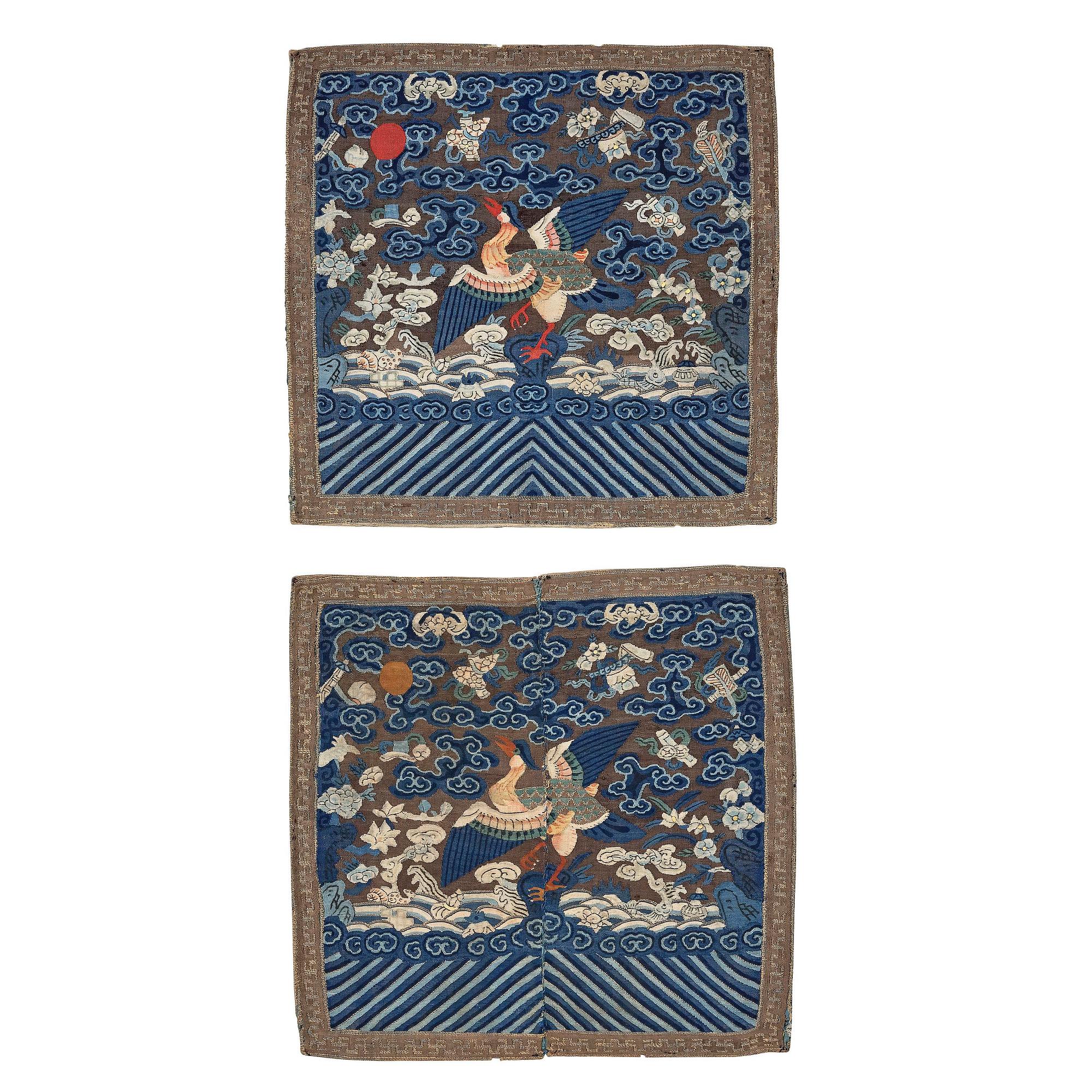
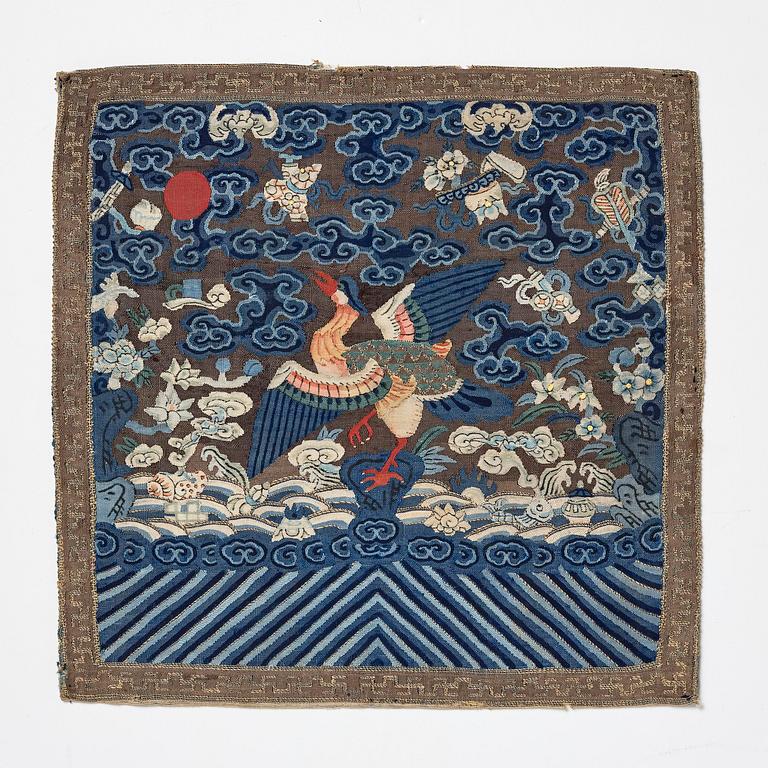
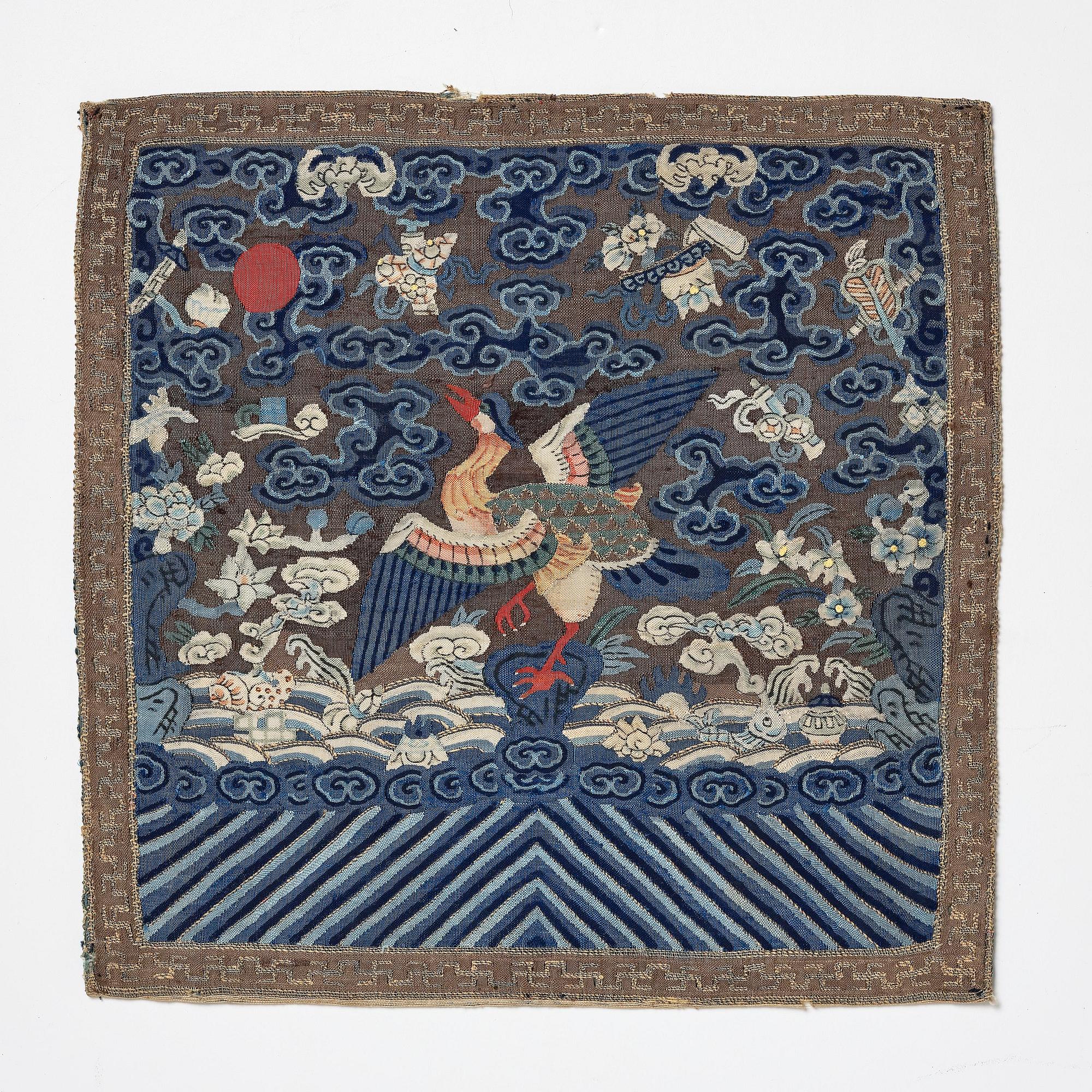
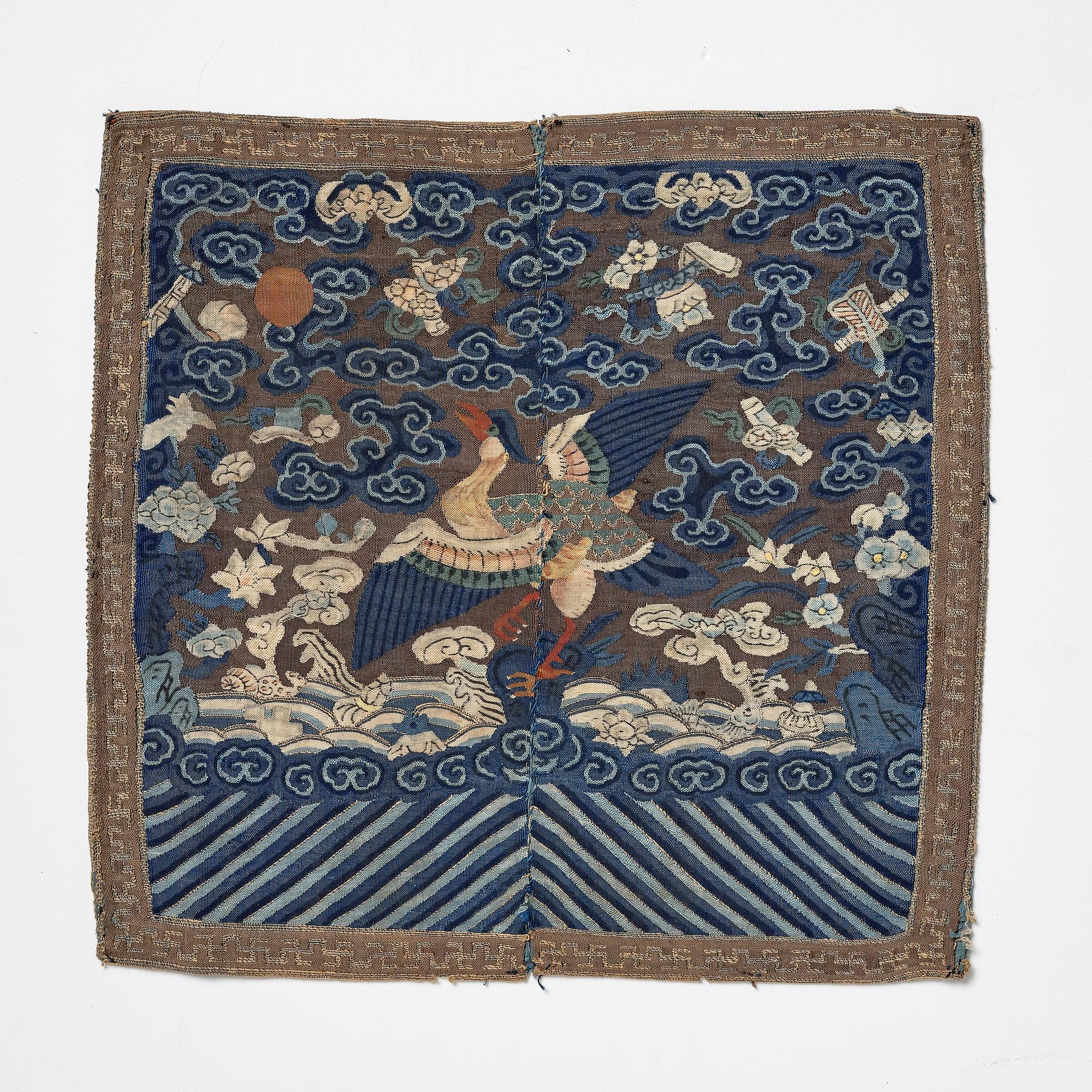
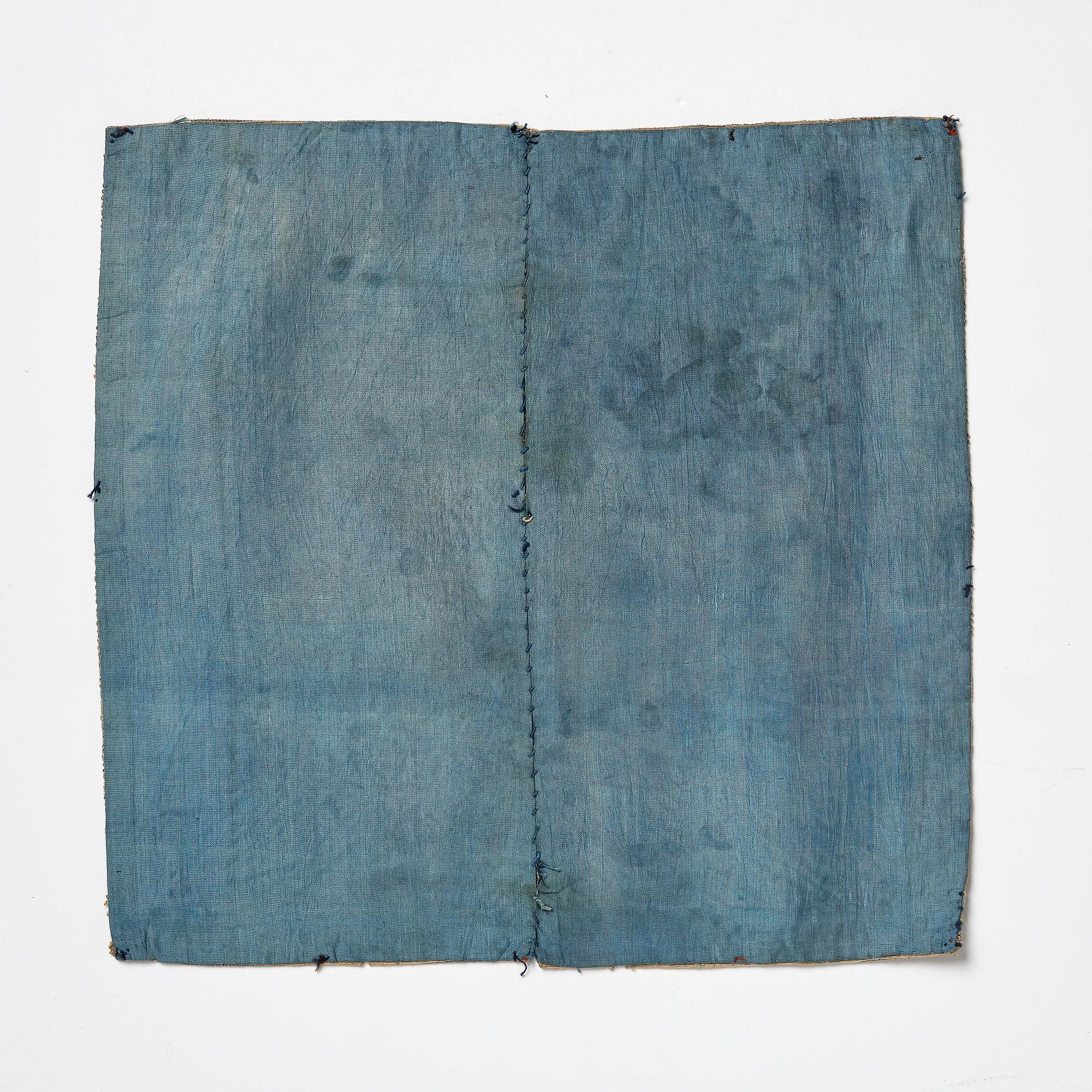
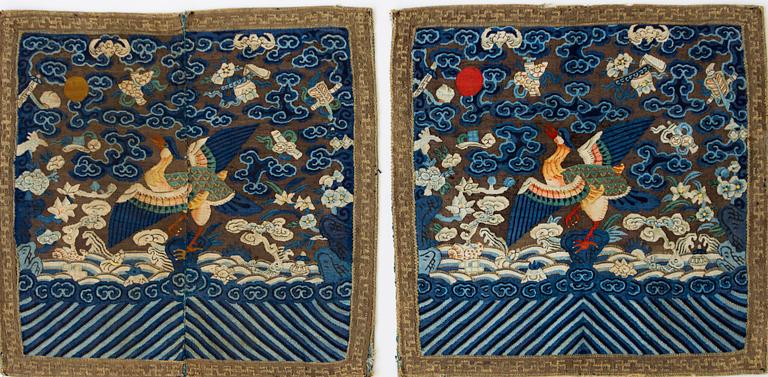
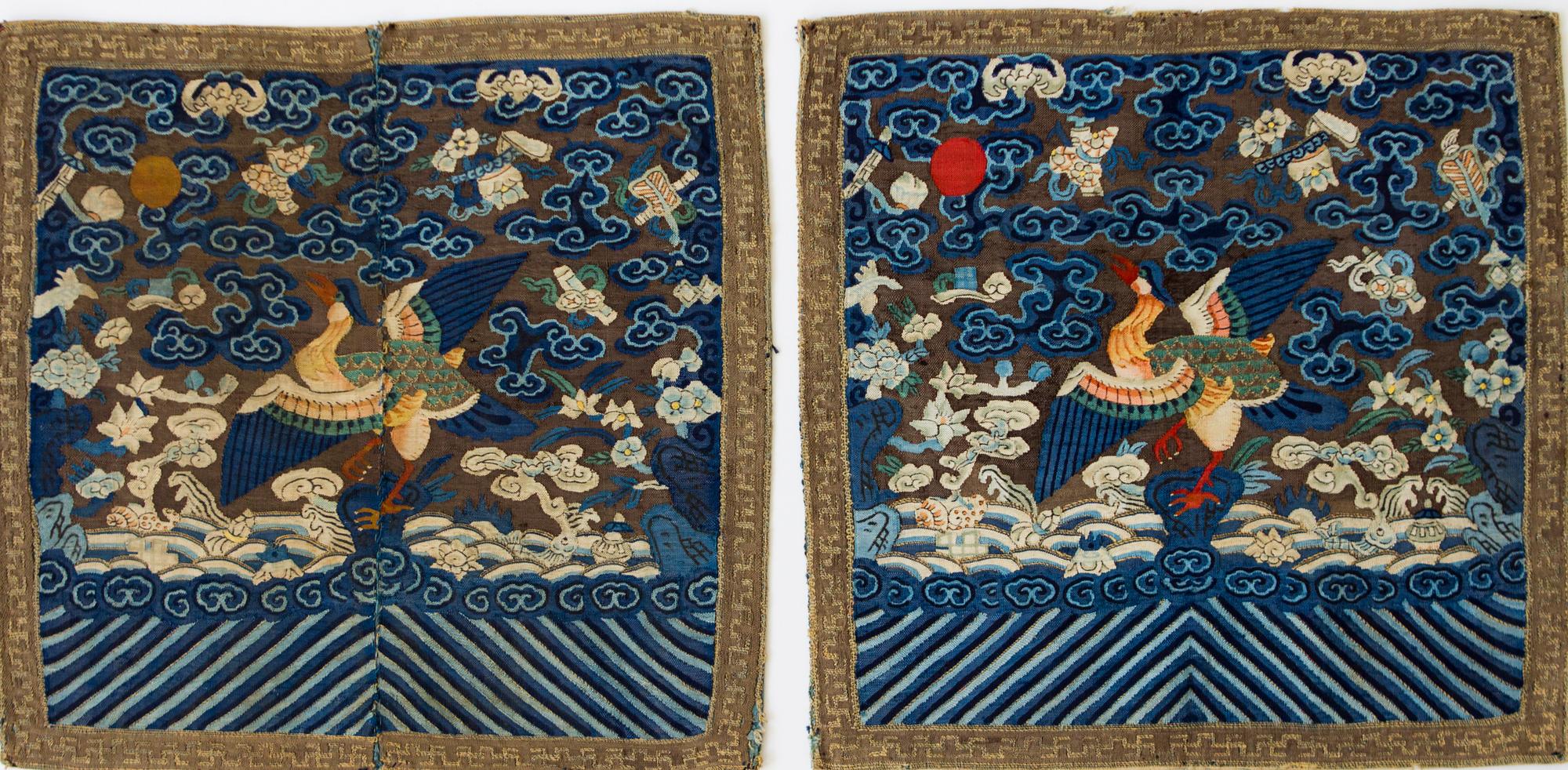
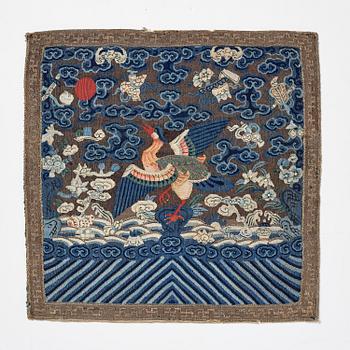
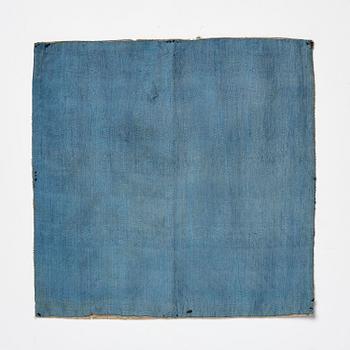
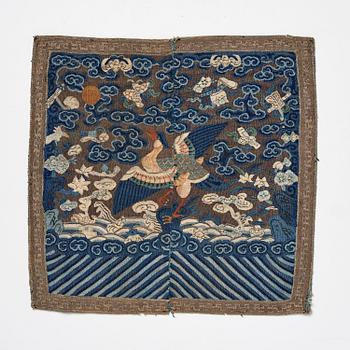
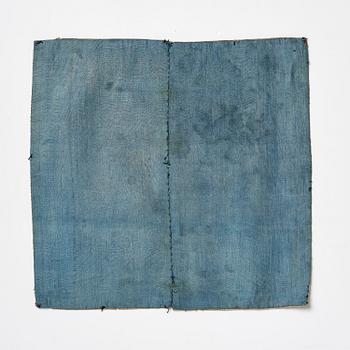
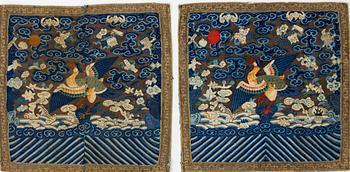
The Seventh Civil Rank badge. Each woven in the center with a mandarin duck alighting on a rock emerging from water motifs as it faces the sun, surrounded by ruyi-shaped clouds, the wufu and Eight Buddhist Emblems (bajixiang), as well as peony and narcissus spouting from rocks, all in bright tones of blue, red, pink, green and white on a dark ground within a swastika lined border. Lined in blue silk. Measure 29,5x29 cm.
Wear.
Alkuperä - Provenienssi
Purchased at Christies, Sale 5497, lot 565, 14 May 2010.
Property of a private Finnish Collection.
The collection was formed between 1980-2020, the collector has had an interest in China and Chinese Works of Art since childhood, growing up in Beijing. He returned to China in grownup years for work, he came to live in China altogether more than 40 years. His love of China, and Chinese works of art is mirrored in the collection and being an academic collector, he never got tired of learning more about the subject by studying literature, attending lectures, visiting museums, auction houses and befriending curators from Peking, Hong Kong, London, Paris, and Stockholm. The collection consists of both Chinese ceramics and textiles, This being part 2, a part of the textile collection.
Kirjallisuus
Illustrated Precedents for the Ritual Paraphernalia of the Imperial Court, published in 1759, tells us much about how Court attire was regulated by imperial decrees. The Chinese tradition of wearing rank badges (buzi), also known as Mandarin squares, to demonstrate civil, military or imperial rank began in 1391 during the Ming Dynasty (1368-1644), and continued throughout the Qing Dynasty (1644-1911).
These insignia were sewn onto or woven into the wearer’s garments to indicate their rank. Civil officials wore insignia with different bird species corresponding to their rank, while animals denoted military officers.
The fall of the Qing Dynasty in 1911 brought an end to rank insignia.
Muut tiedot
A badge featuring a bird identified the wearer as a civil official. To attain such a position required years of intense study, so birds may have been selected because of their literary associations. Each rank was represented by a different species, and while there were slight variations over time, by the Qing Dynasty the order from highest to lowest was: crane, golden pheasant, peacock, wild goose, silver pheasant, egret, mandarin duck, quail and paradise flycatcher. Civil officials sat on the emperor’s left at court functions, so their rank birds faced right towards him.
While it may be easy to tell a duck from a goose in real life, identifying different species on rank badges can be difficult. Birds are shown in similar poses, are of similar size and are placed on grounds of similar decoration, which had slight variations from period to period.
Certain species, such as peacocks, can be identified easily because of the distinctive eye design on their feathers. For the more difficult varieties, look at the form of the head and neck and the shape of the tail feathers. For example, the first-rank crane typically has a rounded head topped by a red cap, while the silver pheasant worn by fifth-rank civil officials has distinctive long, scalloped or serrated tail feathers.
Lisätietoja ja kuntoraportit

Tietoa ostamisesta

Muiden katsomia kohteita