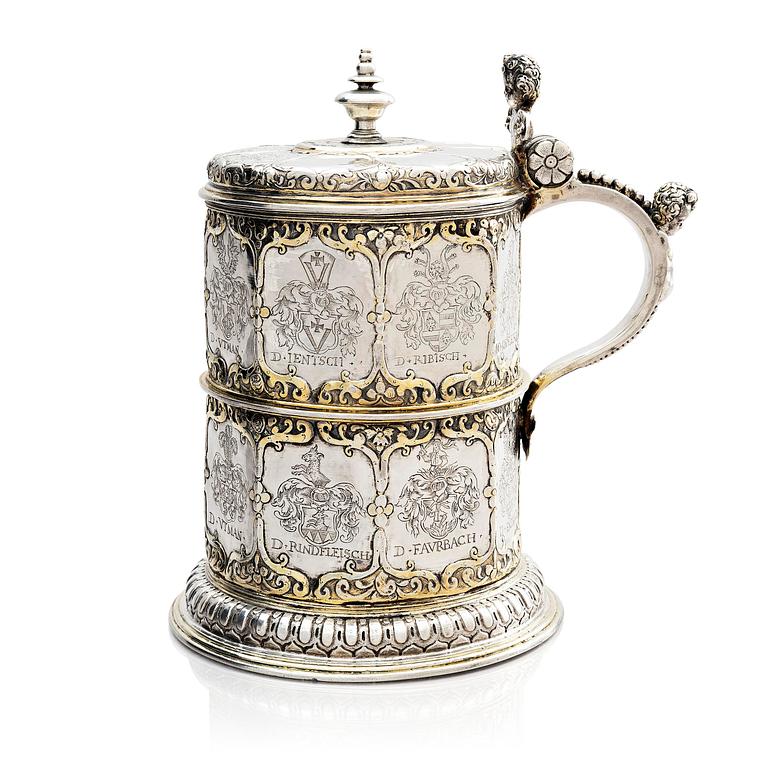
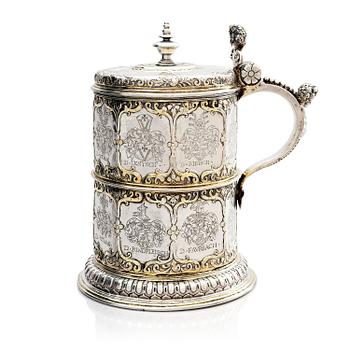
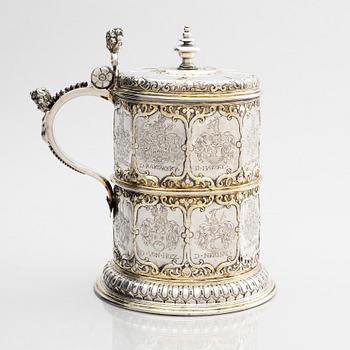
A fine 17th century German parcel-gilt silver tankard, mark of Augustin Heyne, Breslau/Wrocław, active 1571 or 72-1601.
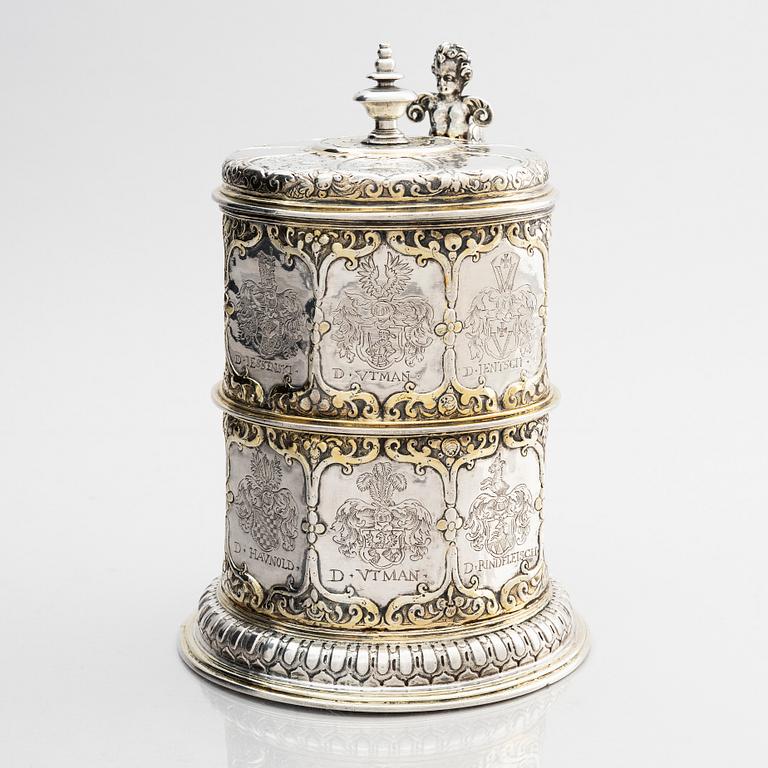
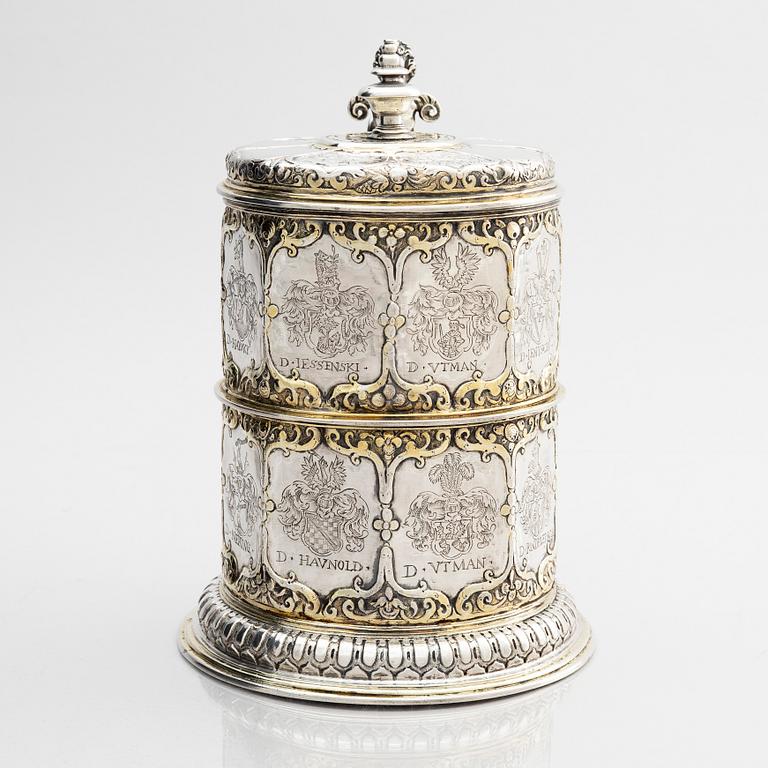
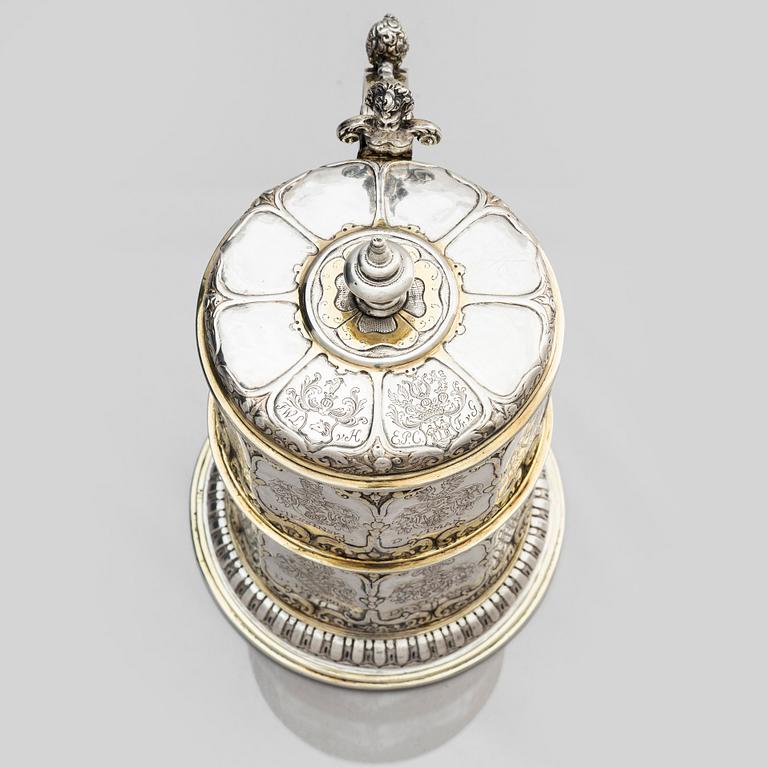
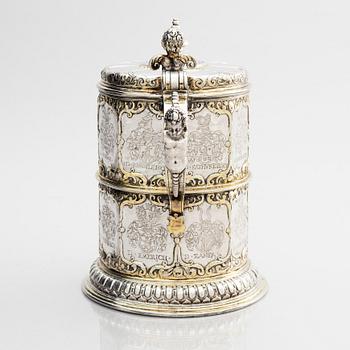
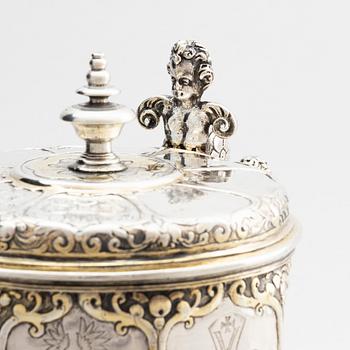
Faceted sides on a circular foot, an upturned handle with two putti and pearlstring, hinged lid, partly gilt, engraved coats of arms framed by gilt foliate decor, domed foot partly gadrooned. Height 17 cm (20 cm including thumbpiece). Weight approx. 885 g.
Kirjallisuus
Erwin Hintze, “Die Breslauer Goldschmiede”, Breslau, 1906, see hallmark illustrated no. 57 (plate III).
Marc Rosenberg, “Der Goldschmiede Merkzeichen”, volume 1, Frankfurt am Main, 1922, see hallmark illustrated no. 1400, p. 284.
Christian Gündel, "Die Goldschmiedekunst in Breslau", Berlin 1940, see Breslau mark at p. 20 and the master listed at p. 36 and cf. stamp on the depicted tankard; 'Tafel 37'.
Muut tiedot
A Renaissance Tankard in the Service of Power and Fellowship
The parcel-gilt silver tankard featured in the auction was crafted between 1598 and 1601 by the goldsmith Augustin Heyne, who was active in Breslau (present-day Wrocław, Poland, then under Habsburg rule) between 1571/72 and 1601. Encircling the body of the tankard is a parade of sixteen engraved coats of arms that bear witness to the most powerful families of the city and Silesia during the late 16th century.
In Renaissance Breslau, power rested with an exclusive circle of patrician and merchant dynasties—the so-called council families (Ratsgeschlechter)—from which the city council was recruited. Several of the families represented on the tankard, such as Rindfleisch, Haunold, Ribisch (Riebisch), Utman, and von Uthmann und Schmolz, belonged to this upper echelon. Much like those used by guilds and fraternities, a tankard of this kind functioned as a ceremonial welcoming vessel (Willkomm) at banquets and council gatherings. Having one’s coat of arms engraved was a way to cement one's place and loyalty within the community.
In addition to the local council families—which also include Jentsch (Ientsch), Emmerich, von Holtz, and Feuerbach (Fauerbach)—the tankard bears the arms of learned and internationally renowned families from across the Habsburg Empire: Zathureczky (Sathuretzky), Rakovszky (Rakowsky) (the family of the poet Martin Rakovszky), and Jeszenszky (Iessenski) (the family of the physician Jan Jesenius). Three shields—Haysky, Zaner, and Nering—still remain to be definitively identified.
An intriguing detail for those interested in heraldry is that the coats of arms for both Haunold and Jeszenszky are engraved in reverse. In earlier times, this was not uncommon; occasionally it occurred because the goldsmith worked from a template that was inadvertently reversed, though in heraldry, mirroring (known as courtoisie) was also used deliberately to have the charges on the shield turn inward toward a central focal point or place of honor on the object. Furthermore, the lid features two unidentified shields with initials, likely added by later owners who passed this treasure down through history.
Lisätietoja ja kuntoraportit

Mitä kuljetus maksaa?
Toimituksen voi tilata vain ottamalla yhteyttä osoitteeseen specialdelivery@bukowskis.com.
Tietoa ostamisesta










Muiden katsomia kohteita