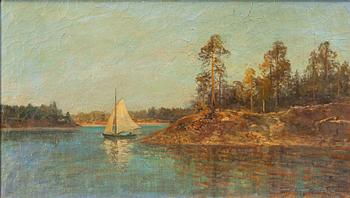
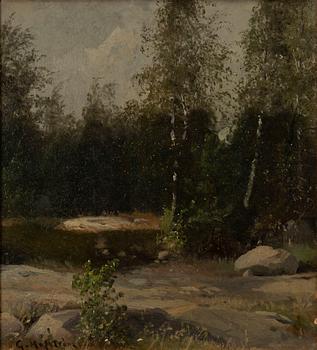
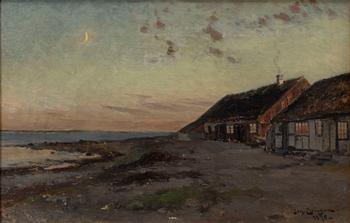
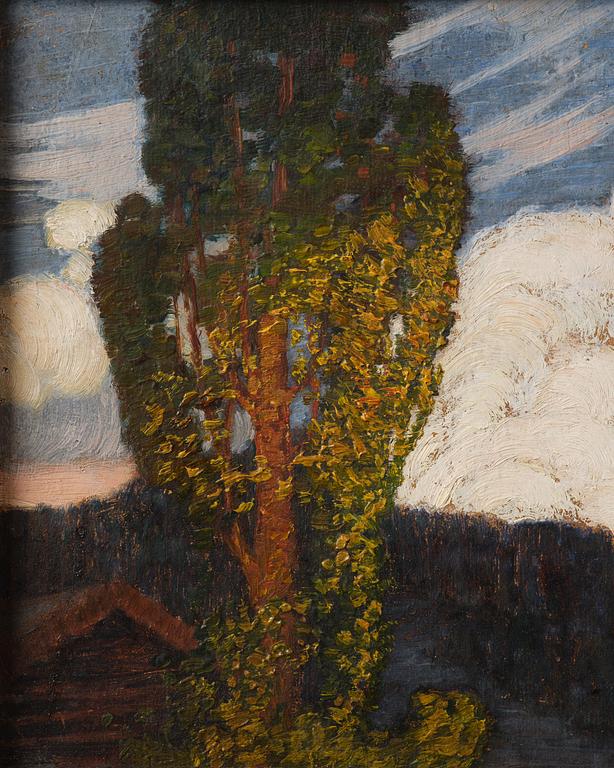
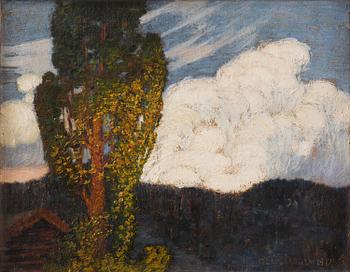
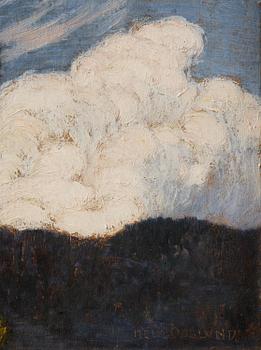
Helmer Osslund (Ruotsi, 1866-1938) "Junimoln (Motiv från Jerfsö)" (June Clouds, Motif from Jerfsö)
"Junimoln (Motiv från Jerfsö)" (June Clouds, Motif from Jerfsö)
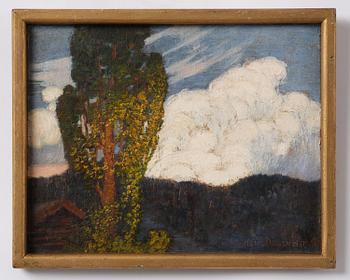
Signed Helm Osslund. Oil on panel, 23.5 x 28 cm. Original frame.
Alkuperä - Provenienssi
Senior Director Axel Gavelin (1875-1947).
His son professor Sven Gavelin (1909-1991).
His son Civili Engineer Peter Gavelin (born 1945).
Näyttelyt
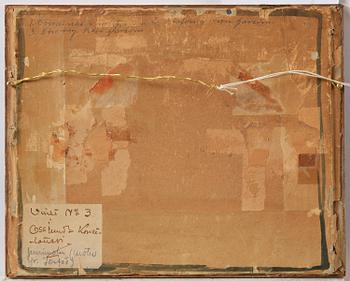
Helmer and Elis Osslund’s art lottery, 1902, no. 3.
Muut tiedot
This picture, painted at the end of June 1900, constitutes the only known landscape painting by Osslund painted in Järvsö in the province of Hälsingland where he resided for about nine months from the end of June 1900 until March 1901.
Osslund spent Midsummer Day 1900 with Anders Zorn in Mora in the province of Dalecarlia, whom he previously had met in Paris in 1896. Osslund had made his way north in stages. His travel funds were exhausted when he arrived in Järvsö. The innkeeper refused lodging, but through the intervention of County Commissioner Källbom, Helmer was given lodgings until he found cheap accommodation with a blacksmith. Järvsö became his permanent address until the spring of 1901. As Palmgen & Granberg have pointed out, Osslund's painting during this period takes on a distinct national emphasis and a more synthetic form, probably a result of his contact with the Artists' Association. The color scale has become darker and more somber, the lines more undulating and the atmosphere more dramatic. Despite the small formats, the paintings give a monumental impression. Only a few paintings from Osslund's stay in Järvsö are today known, and then exclusively portraits of the local population.
From the spring of 1898 to December 1899, Osslund had stayed in Fränsta by Ljungan and the village of Liden by the Indalsälven in his home province Medelpad. The following spring he sent some small paintings to the banker and art benefactor Pontus Fürstenberg in Gothenburg. Impressed by what he saw, Fürstenberg contacted the leaders of the Artists' Association's school, Karl Nordström and Richard Bergh whom asked Ossund to send them samples of his work. In a letter to Osslund on December 10, 1899, Karl Nordström writes:
Vårt enstämmiga omdöme om dem är, att det ej finnes någon anledning betvifla edra konstnärliga gåfvor, att ni äger ett godt och redan utvecklat färgsinne, naturkänsla och - liksom de flesta nordbor - föga känsla för valörer (Our unanimous opinion about you is that there is no reason to doubt your artistic gifts, that you possess a good and already developed sense of color, a sense of nature and - like most northerners - little sense of denominations.)
In his letter Nordström mentions the association's school and its goal to awake in the younger generation a sense of what is truly Swedish, "our temperament, our character, our climate." He asks Osslund to tell him about himself and encourage him to contact Fürstenberg for him to assist Osslund financially. From Richard Bergh, Osslund received a certificate that he had been offered a free place at the Artists' Association's school during the spring of 1900 and from the beginning of February Osslund participated in the school's teaching.
Due to poor finances the majority of Osslund’s work painted around the turn of the century are small in size. Osslund usually painted his landscape paintings plein air, often on greaseproof paper which was cheap and easy the carry. In connection with the retrospective exhibition of Osslund's paintings at the Academy of Fine Arts in 1938, art historian Ragnar Hoppe wrote:
”Det finns på utställningen en hel rad sådana [små] täta, koncentrerade verk, fulla av poesi och stark upplevelse och målade med en glans och en brio, som äro avundsvärda.” (“There is a whole series of such small dense, concentrated works in the exhibition, full of poetry and strong experience and painted with a brilliance and a brio that are enviable.”)
During the summer, Osslund sent a large painting "Summer Evening in Liden, Indalsälven", as well as 14 smaller "pieces" to the Gothenburg Art Salon. In January 1901, he had the remaining paintings sent to the director and founder of the Cultural History Society in Lund, Georg J:son Karlin, and asked him to exhibit them and, if possible, sell them. When Osslund offered the large painting, priced at 400 kronor in Gothenburg, for 100 kronor, it was bought by Karlin. The reason why Osslund more or less gave away the painting was that his sister Hulda Åslund had been struck by the epidemic of the time, tuberculosis, and had sought help from doctors at the privately owned Mörsil sanatorium. The cost of medical care became expensive and she asked her brothers for help. In 1901, an exhibition of Helmer's works was spontaneously and provisionally arranged at the officers' mess at the Royal Västernorrland Regiment, in Sollefteå. It did not bring in much income, but the artist came into contact with officers interested in art, who became models or students. Thanks to his childhood friend the banker Emil Snellman, who found buyers for several of his works amongst his clients, Osslund was able to send money to Hulda in Mörsil at Christmas 1901. In February 1902, Elis received a worried letter from her brother, "everything goes wrong, it's terribly difficult to sell anything. You have to almost lie down on your knees and beg to make the smallest sale - And then it is Hulda too”. Hulda owed the doctors at the Mörsil sanatorium "a pretty good sum". Helmer suggested that they should organize an art lottery and in that way try to raise money for her. The brothers would together offer 40 works of art as prizes and 500 tickets would be sold for 2 kronor per ticket. The present work was one of the paintings that Osslund included in the lottery. At Christmas 1902, Hulda fell acutely ill. She died on March 21, 1903.
Lisätietoja ja kuntoraportit
Mitä kuljetus maksaa?
Tietoa ostamisesta





Muiden katsomia kohteita