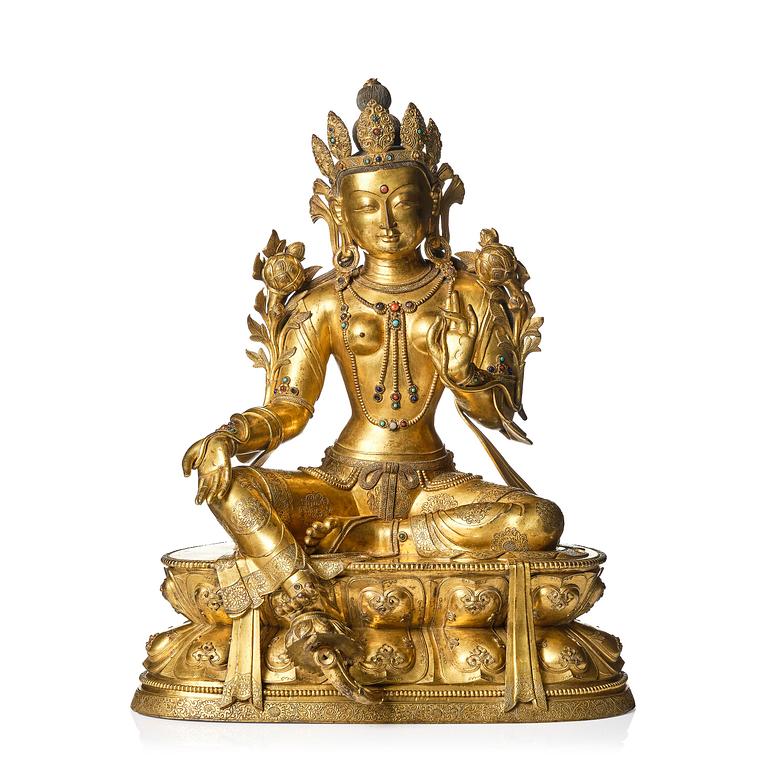
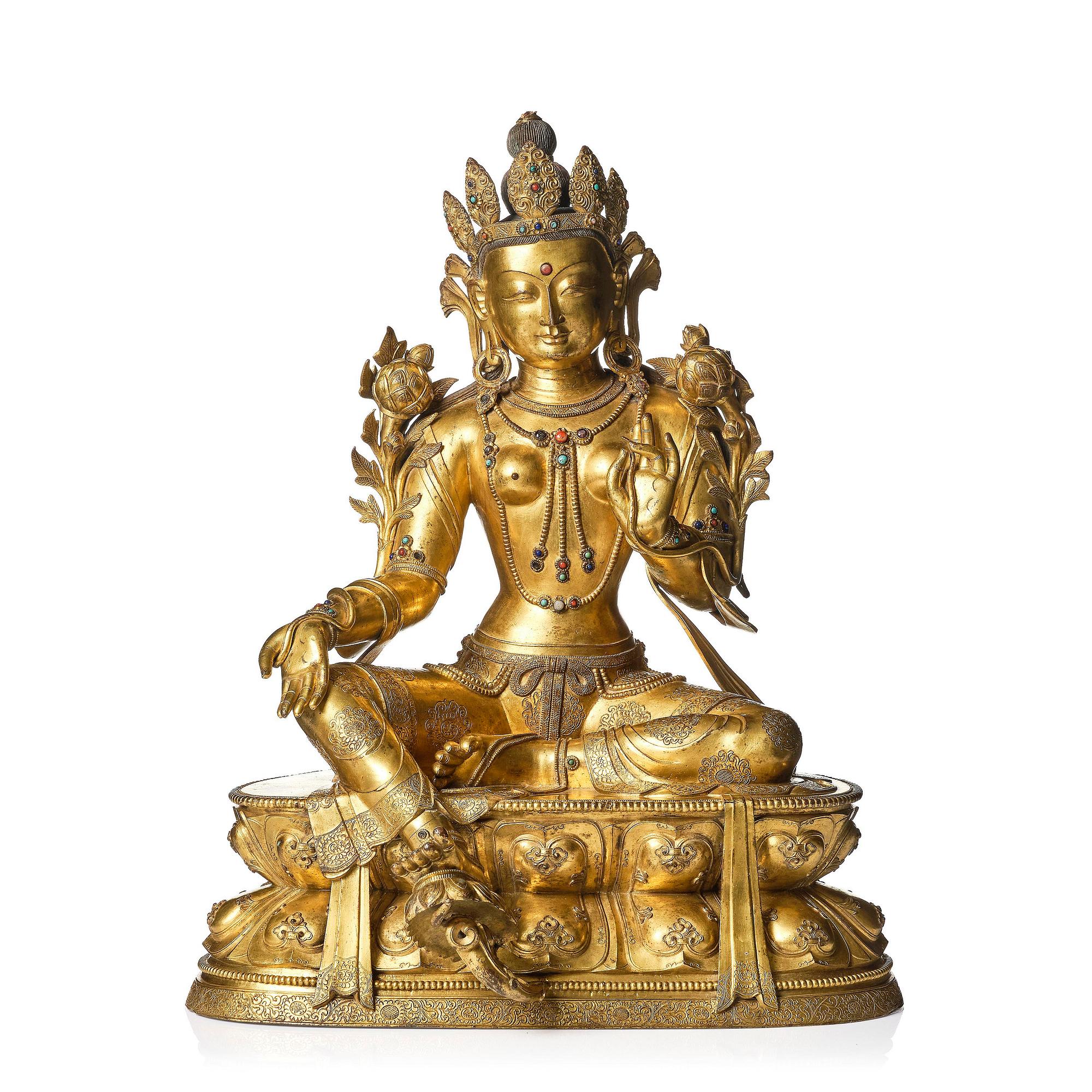
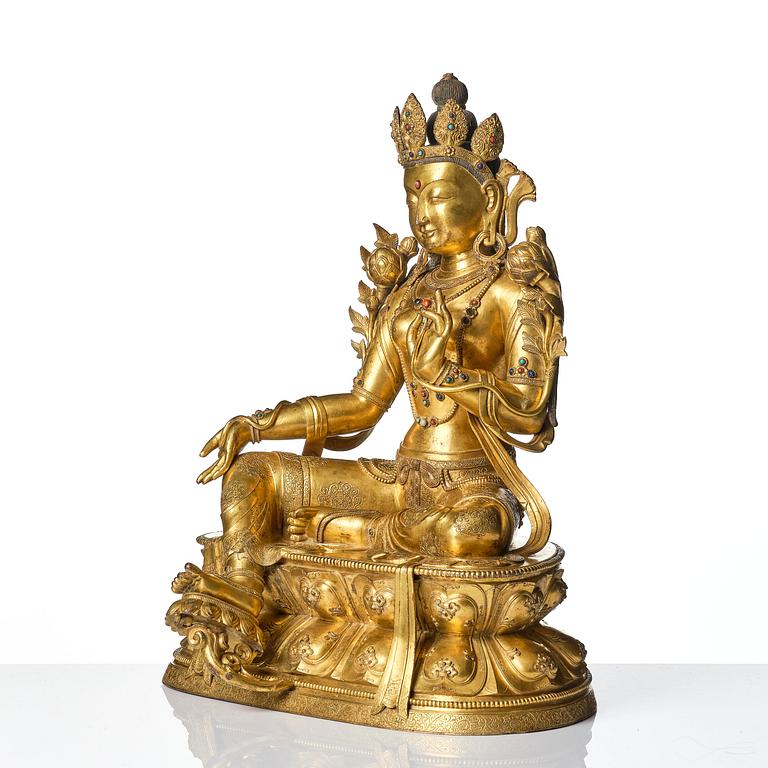
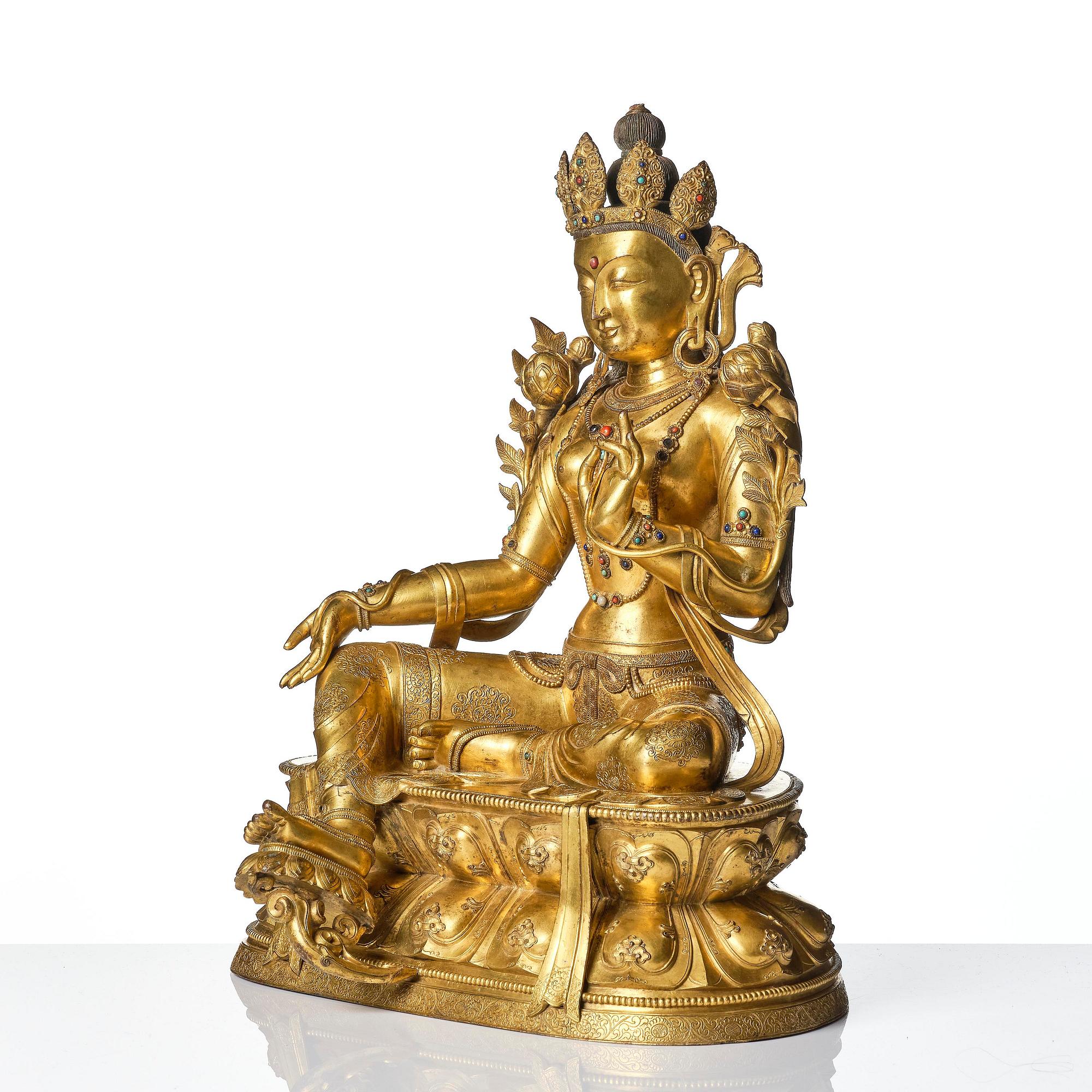
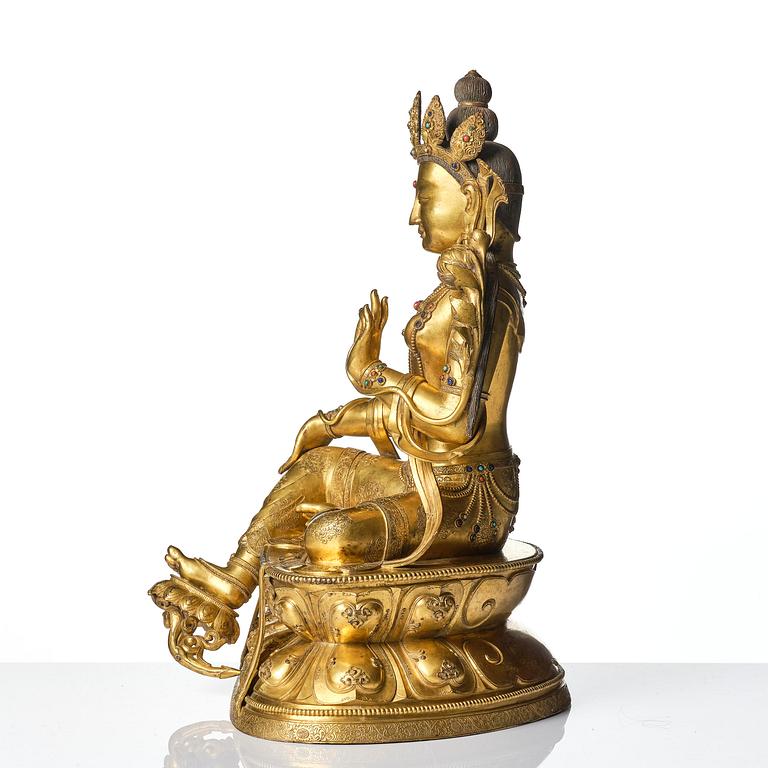
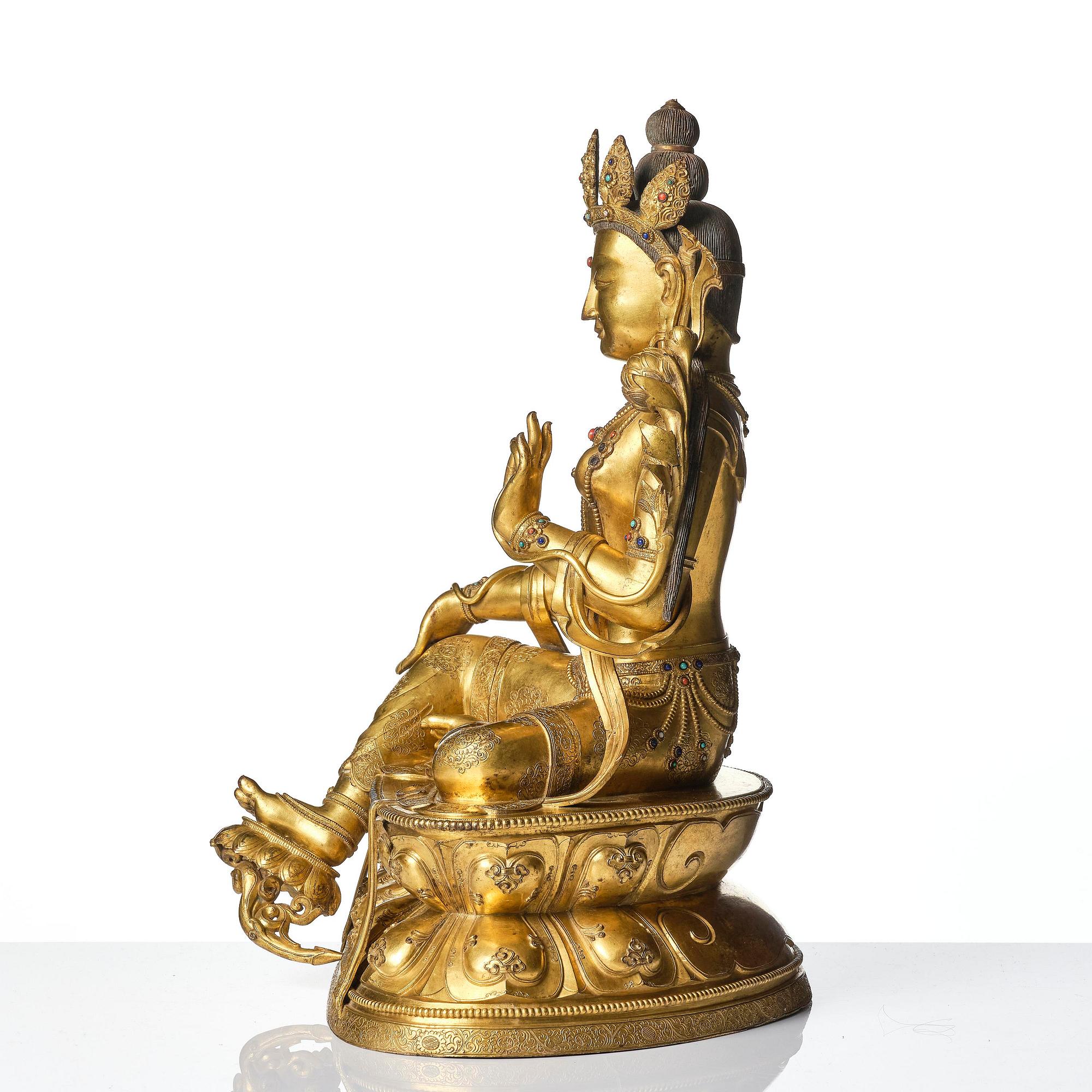
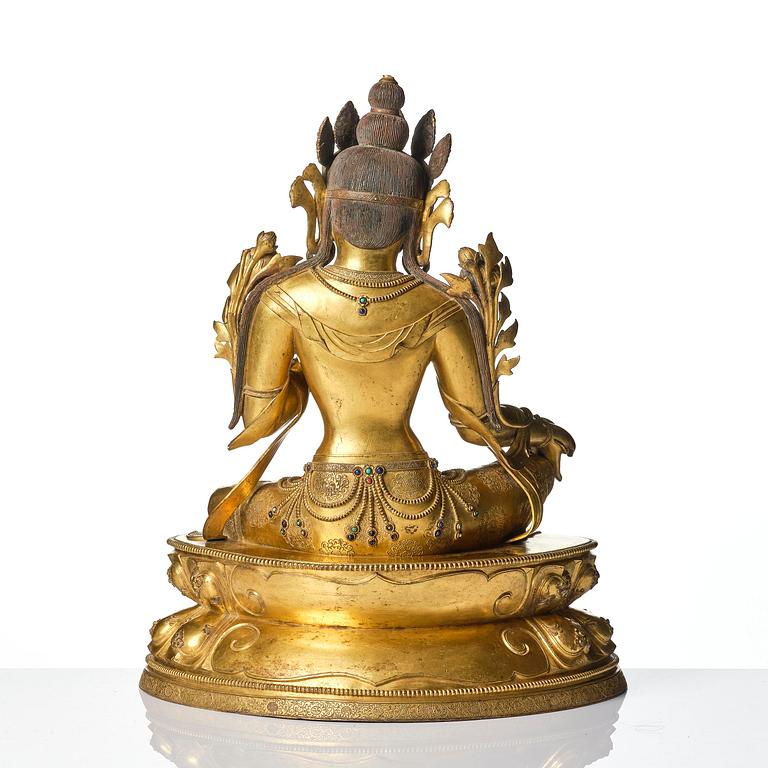
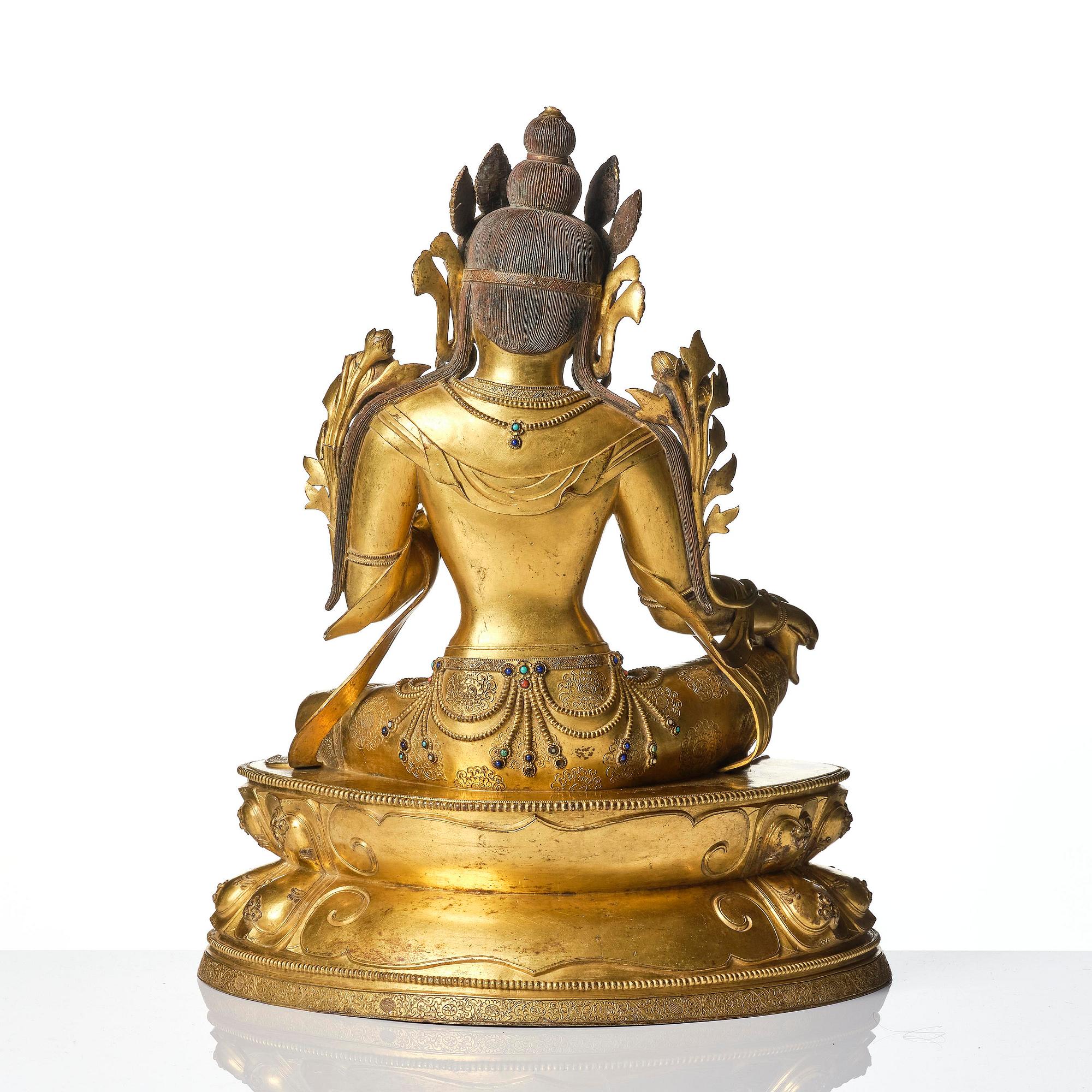
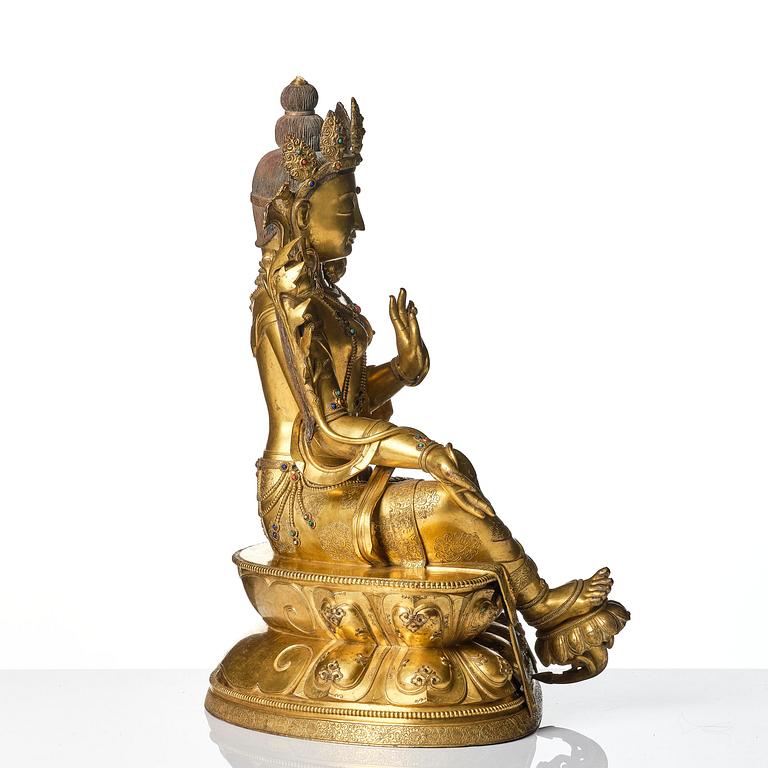
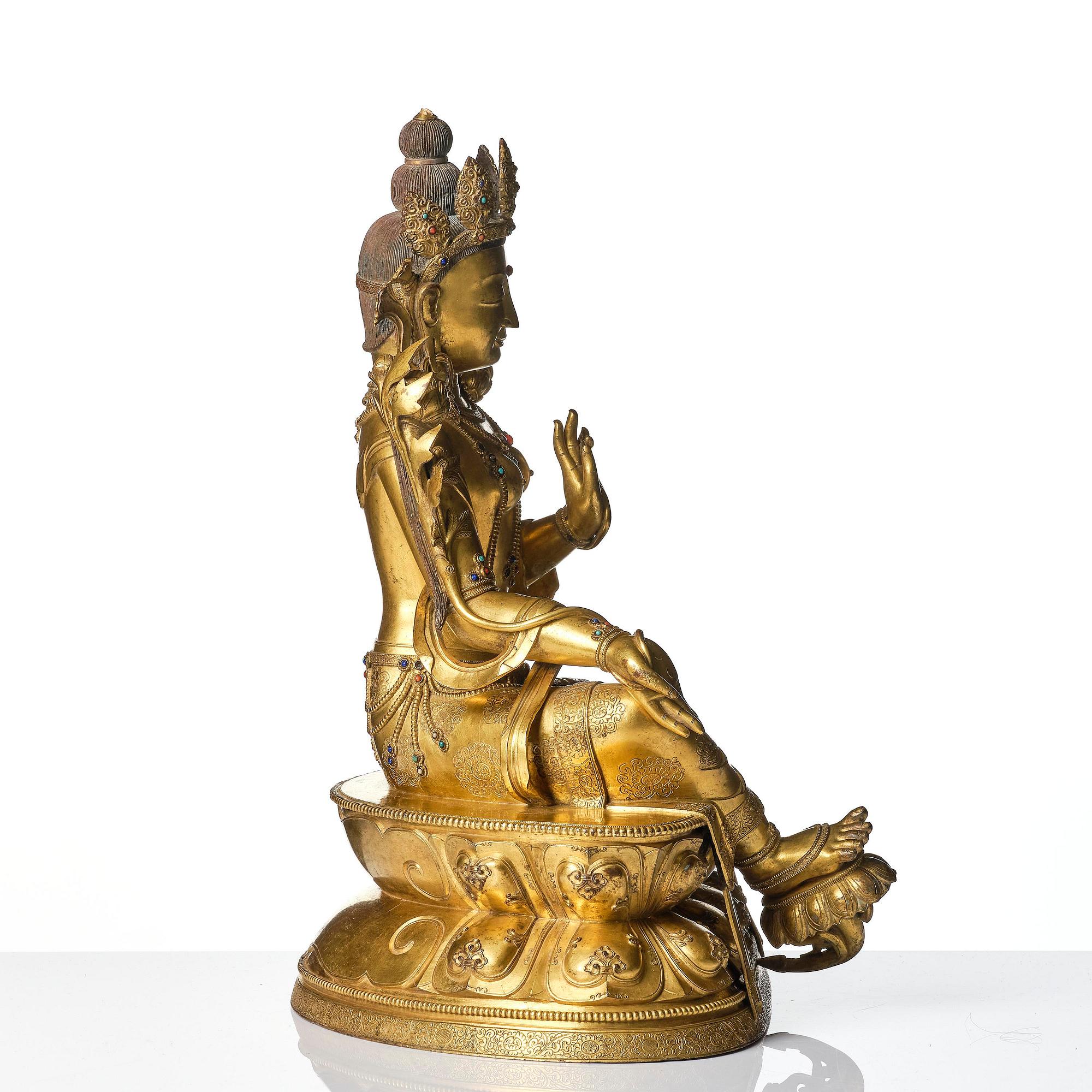
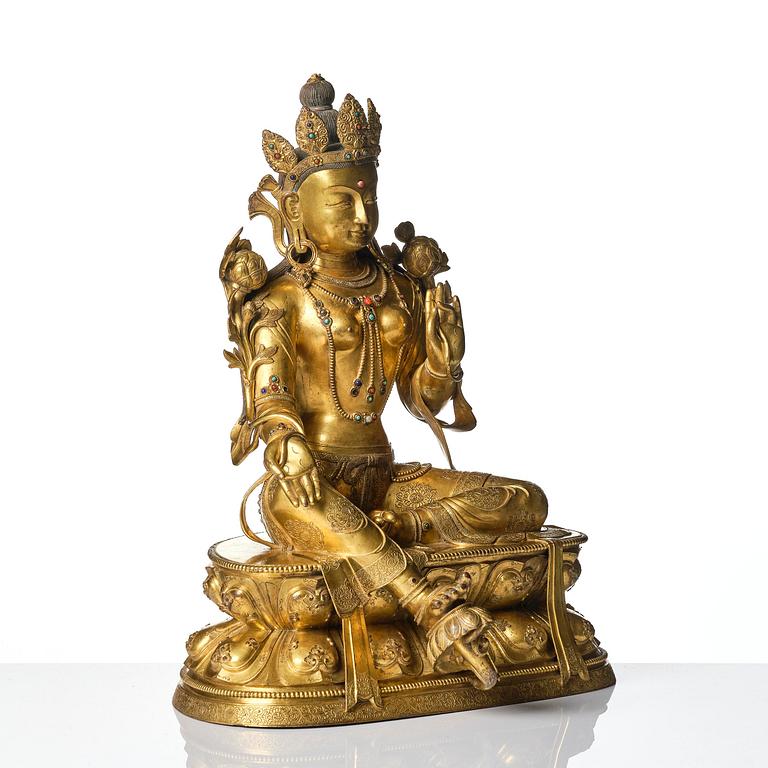
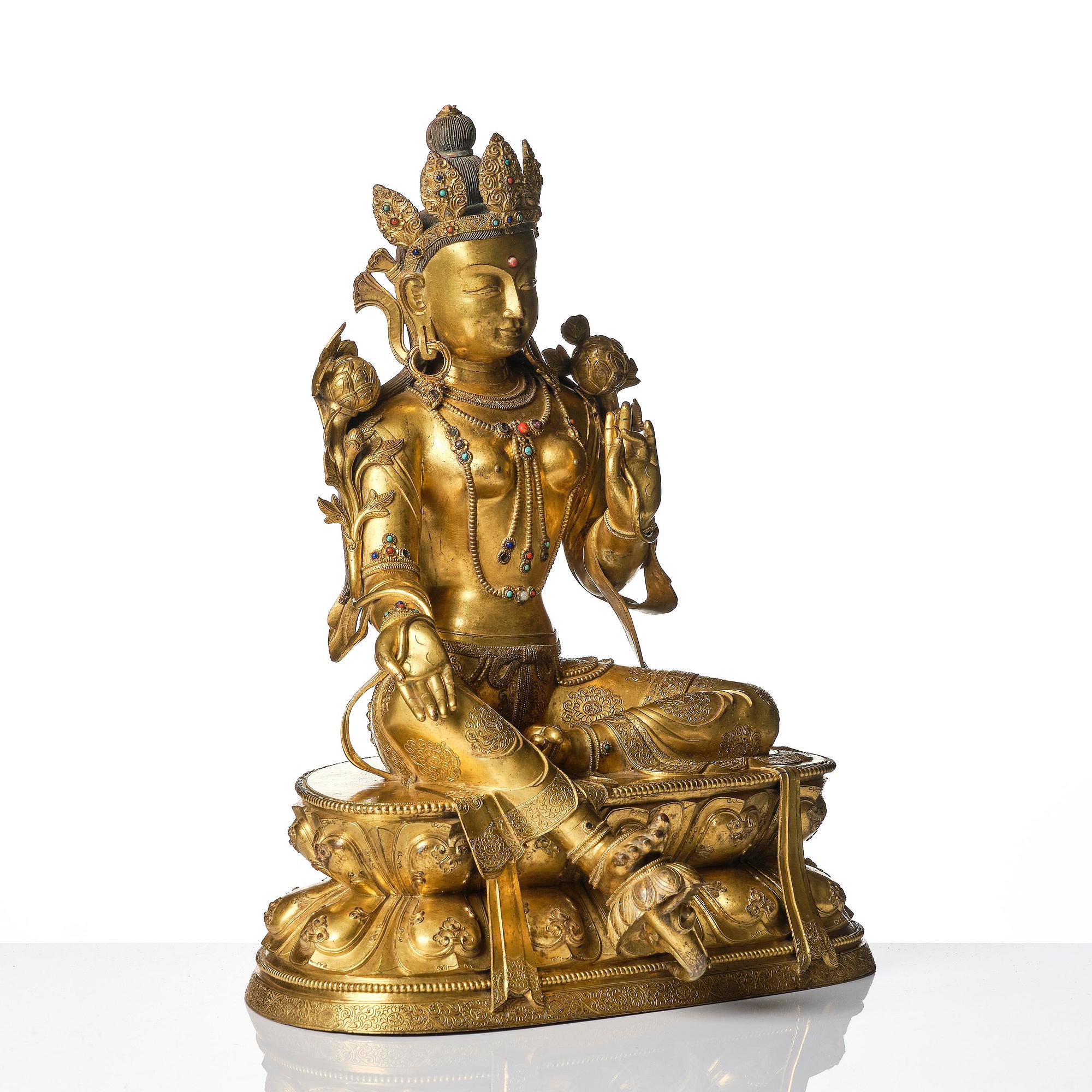
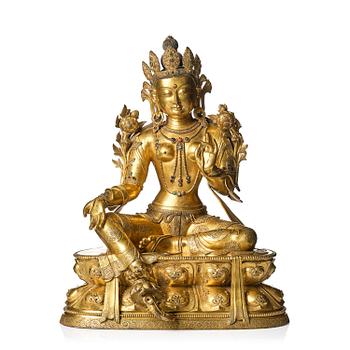
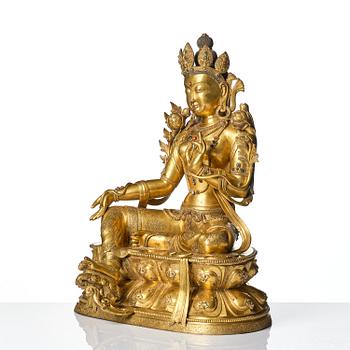
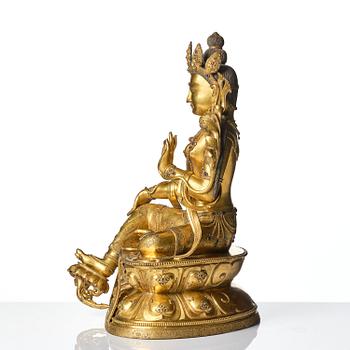
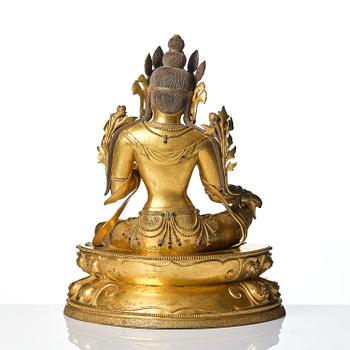
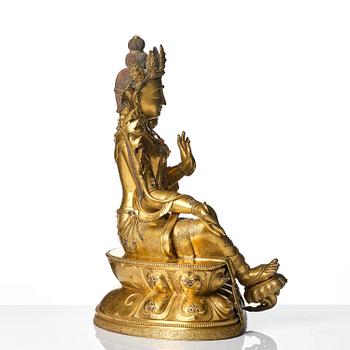
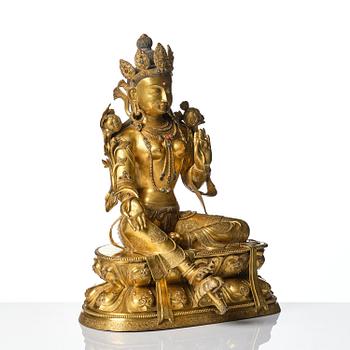
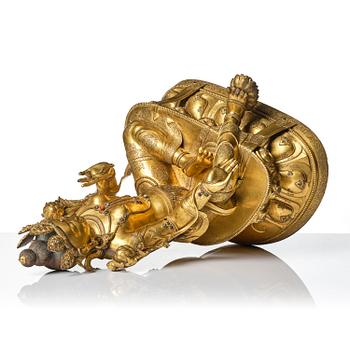
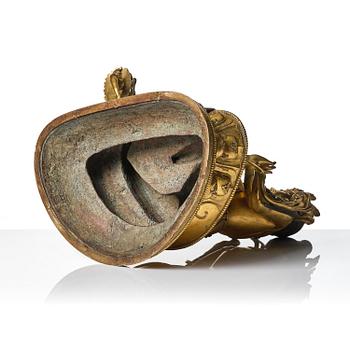
A large gilt bronze figure of Tara, Tibeto-Chinese, Kangxi, early 18th century.
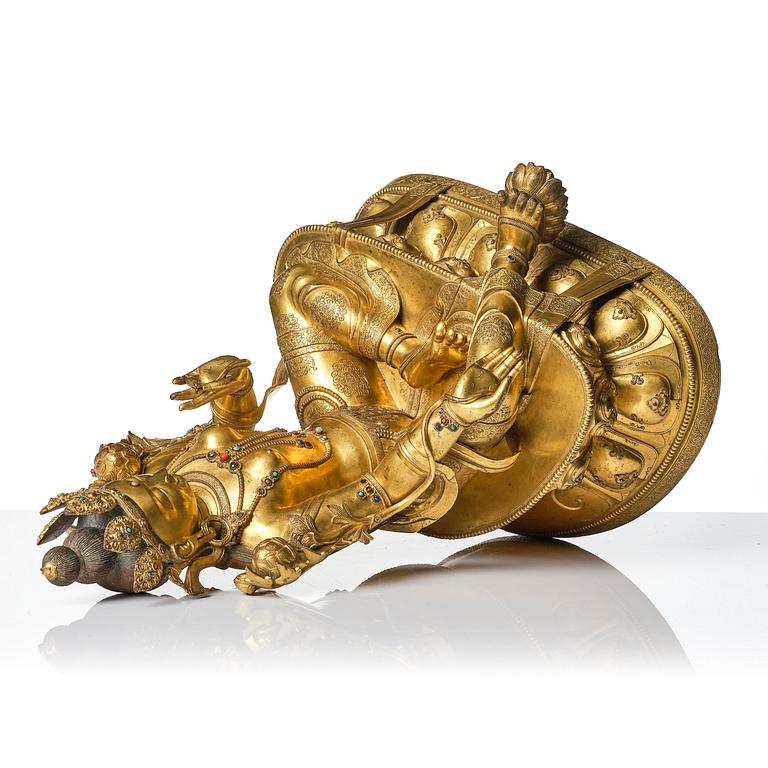
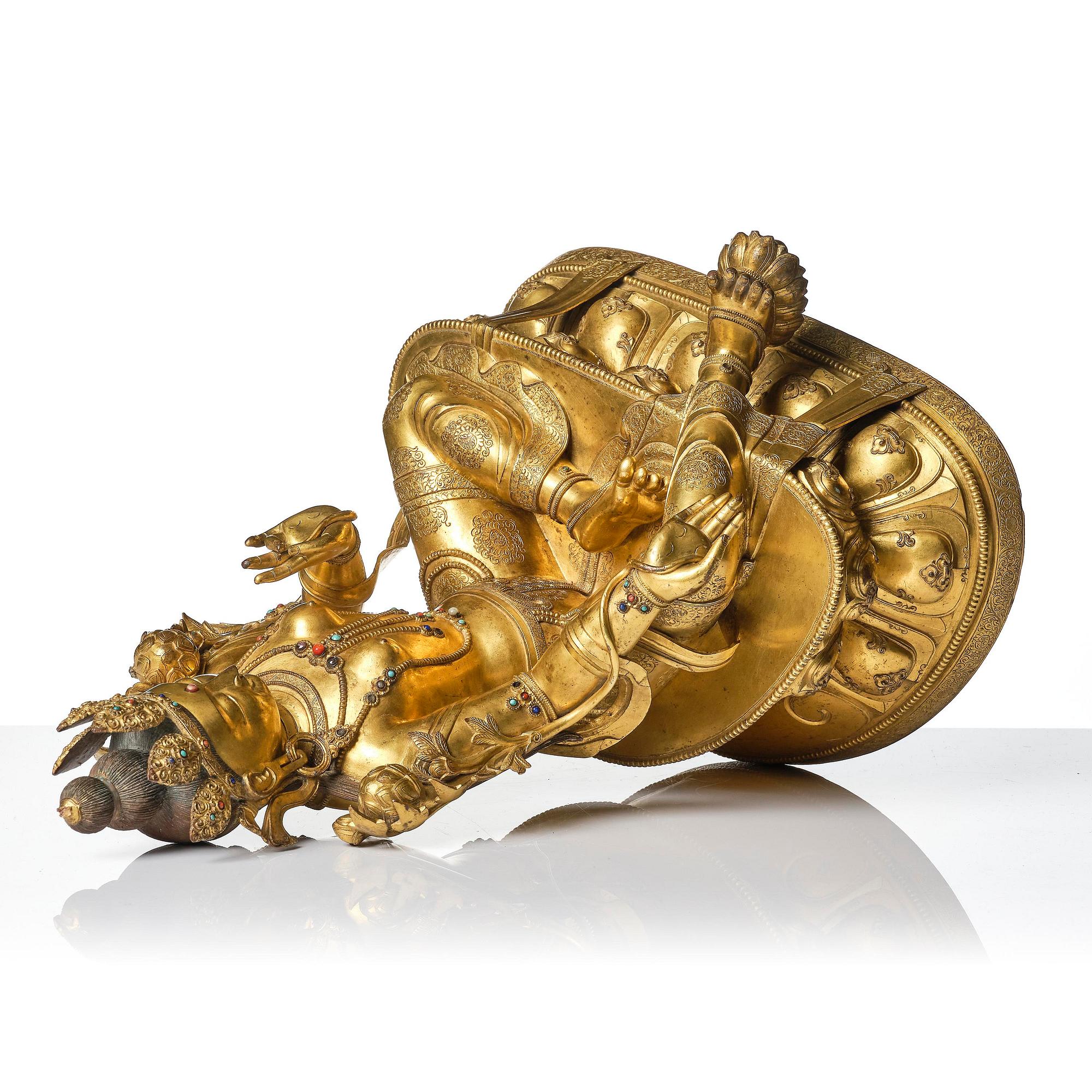
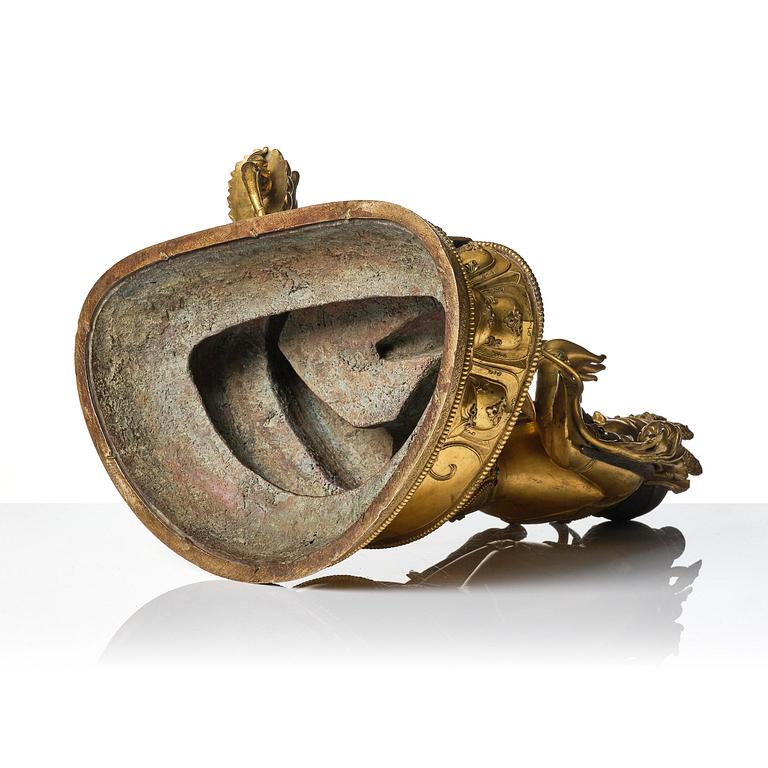
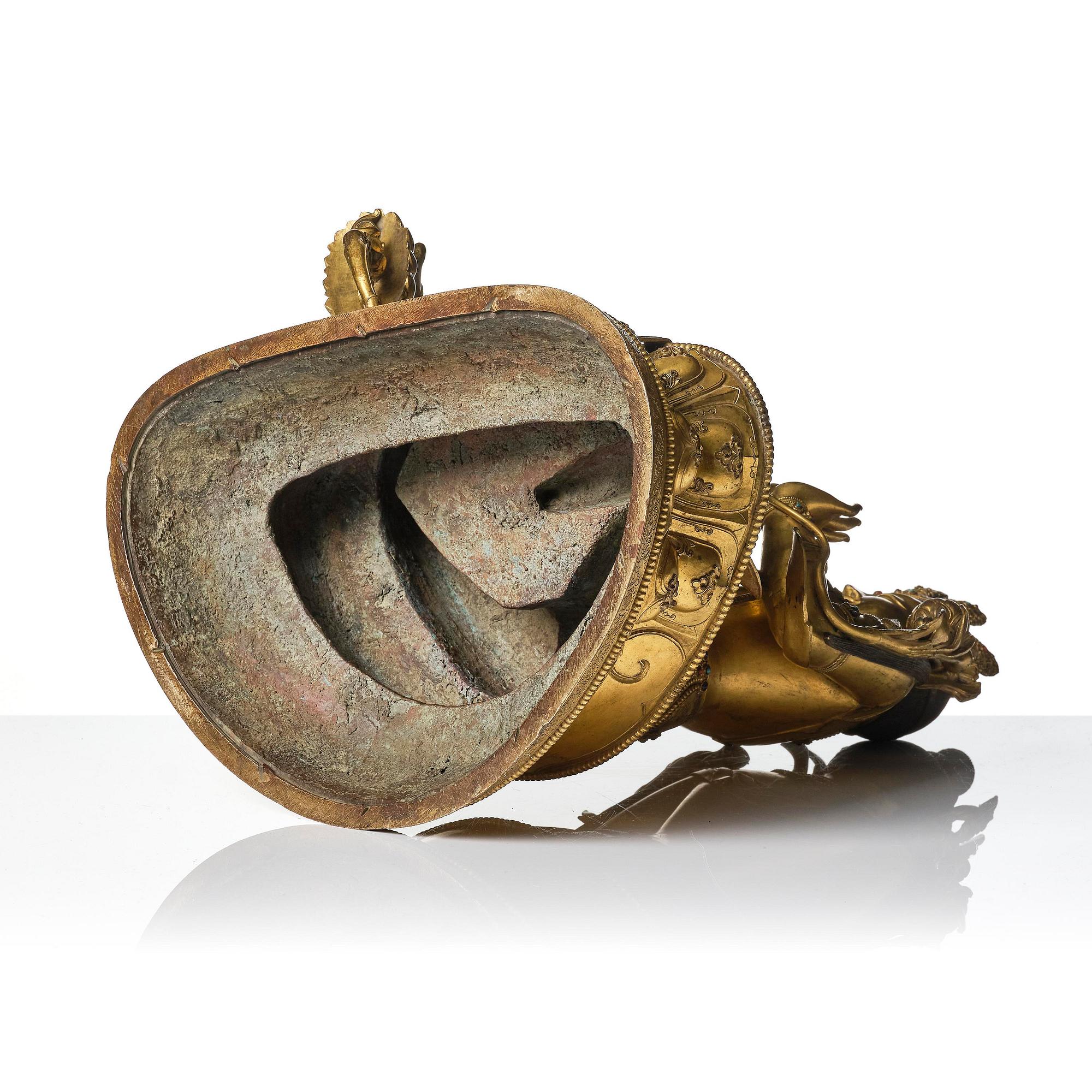
Finely and heavily cast seated in lalitasana on an elevated double-lotus base with incised floral bands, her right foot resting on a separate padma issuing from the base, her hands in varada and vitarka mudra holding lotus stems rising up to flank her shoulders, wearing a long flowing dhoti incised with fine floral patterns within and a sash across her shoulders tied above her waist and swirling down to the side, her face with a benign expression flanked by disk earrings inset with turquoise and coral, surmounted by a foliate tiara, chignon. Vague traces of paint to the hair. Bejeweled with turquoise, coral and lapis lazuli. Height 42 cm. Weight 18.1 kilogram.
Two breaks, top knot and a leaf. Loss of stone inlay.
Alkuperä - Provenienssi
According to the consigner, purchased privately from a private collector in Uppsala who aquired it from the collection of Axel Benzler.
Axel Benzler graduated in Stockholm 1911 from the Frans Schartau handelsinstitut (a predecessor of todays Stockholm School of Economics).
Having studied Russian, he travelled to St. Petersburg the same year to work for a local company. It was the beginning of frequent travels between Sweden and Russia. Pre-revolution Russia was in the 1910s a significant market for the Swedish export industry, making up for 31% of the total export. Besides St. Petersburg, Axel Bentzler also spent time in Moscow between 1914-1916 before returning to now Petrograd 1916-1918.
During his time in Russia it is believed that Axel Benzler mainly focused on import trade of food and timber, the timber for making matches. His father was a successful food retailing merchant in Stockholm. During the Russian revolution Axel returned to Stockholm where in 1921 he made contact with the “Swedish King of matches”, Ivar Kreuger. Kreuger himself had a prominent business importing aspen timber from Russia for his match making company in Sweden, STAB (Svenska Tändsticksaktiebolaget).
Kreuger hired Axel Benzler to be his man in Petrograd and to negotiate with the new Soviet leadership. The purpose was to get a monopoly of the Soviet production of matches and securing the important import of aspen. During this time Axel Benzler called himself Axel Ivanovitch to have a more Russian personation. To earn respect as a foreigner he had his office located in the Swedish consulate in Petrograd/Leningrad and a dacha in the countryside.
STAB:s Russian affairs came to a stop in 1929 when Stalin decided to stop all export of aspen timber from the Soviet Union. To be able to confiscate Axel Benzler’s assets, he was accused of tax-offenses by the Soviet government. His long experience of negotiating with Soviet officials had been his lifeline. Benzler left Russia in 1929.
After the death of Ivar Kreuger in 1932 and the collapse of his business empire, Axel remained in the timber importing business. He worked in many countries and lived through both allied bombardment and the Red Army invasion of Danzig in 1945. During his time in Danzig he also changed his surname from Johansson to Benzler. In 1944 Axel and his brother started the transmission company Benzler & Co which still exists today as part of an international business group.
His extensive collection of Russian Art and Applied Arts is a token of his affection for the great Eastern neighbour.
Lisätietoja ja kuntoraportit
Mitä kuljetus maksaa?
Toimituksen voi tilata vain ottamalla yhteyttä osoitteeseen specialdelivery@bukowskis.com.
Tietoa ostamisesta
Muiden katsomia kohteita