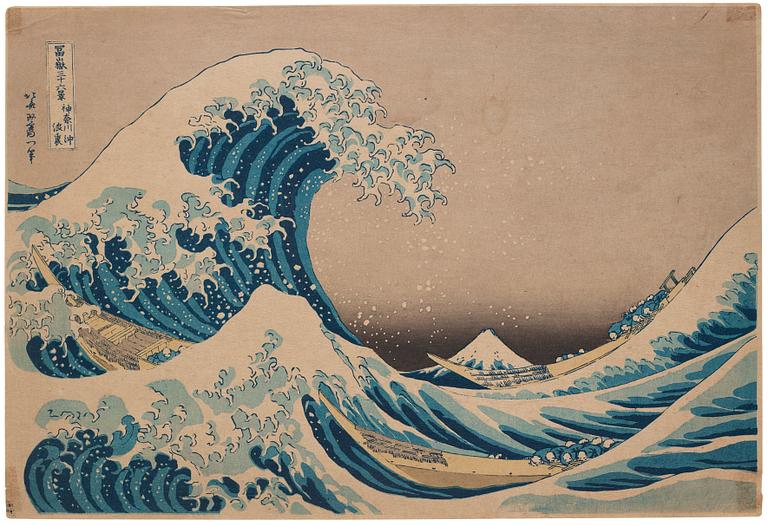
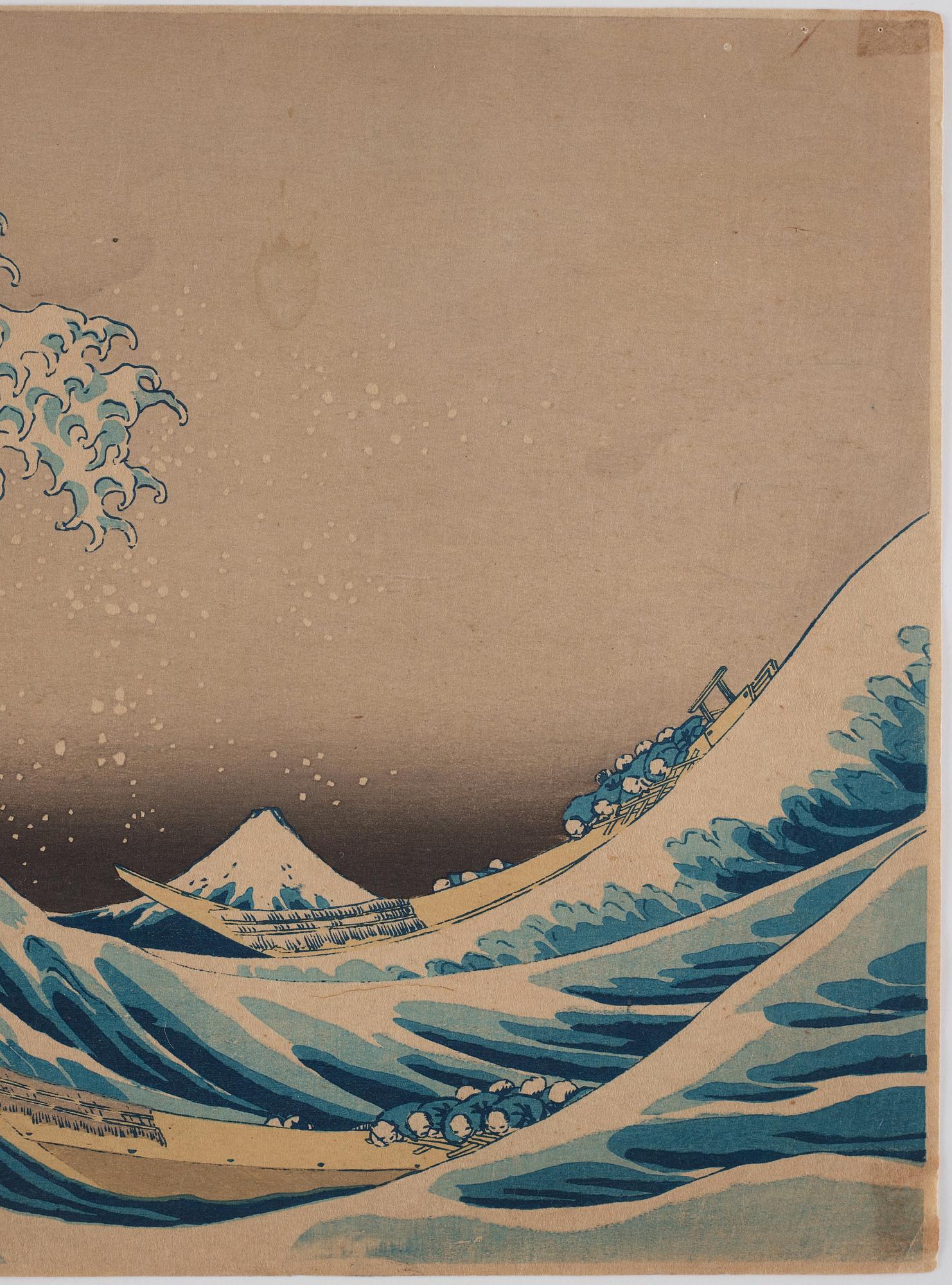
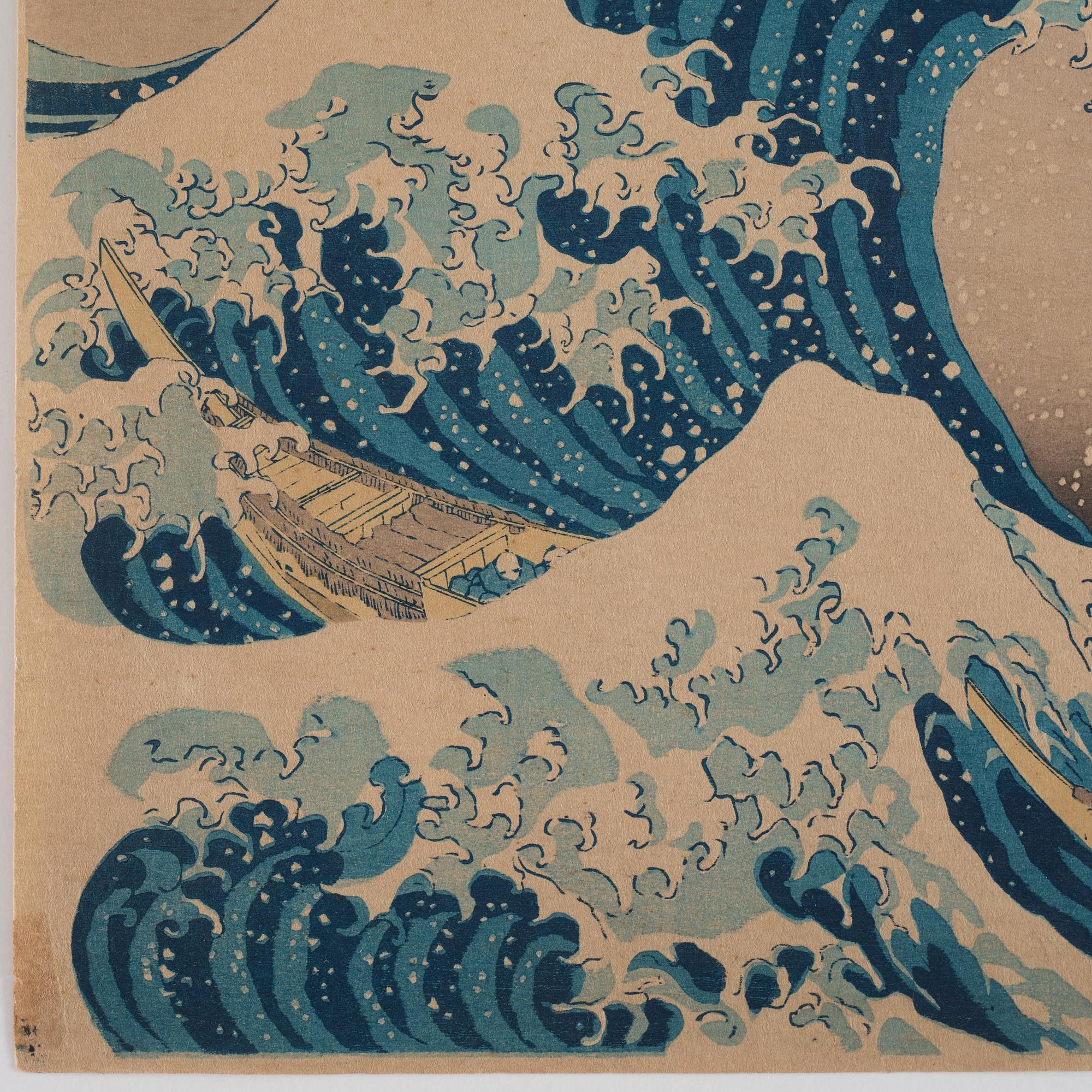
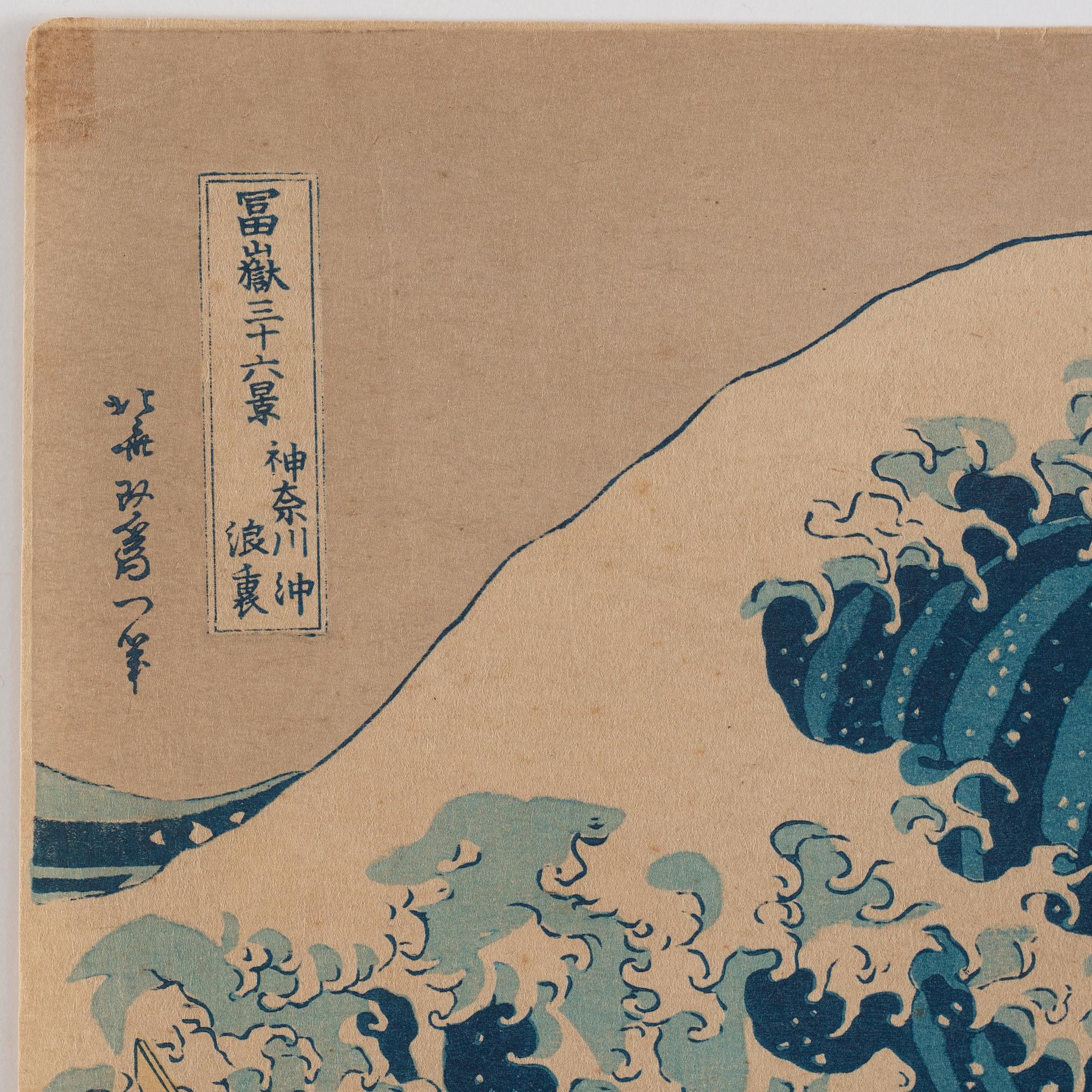
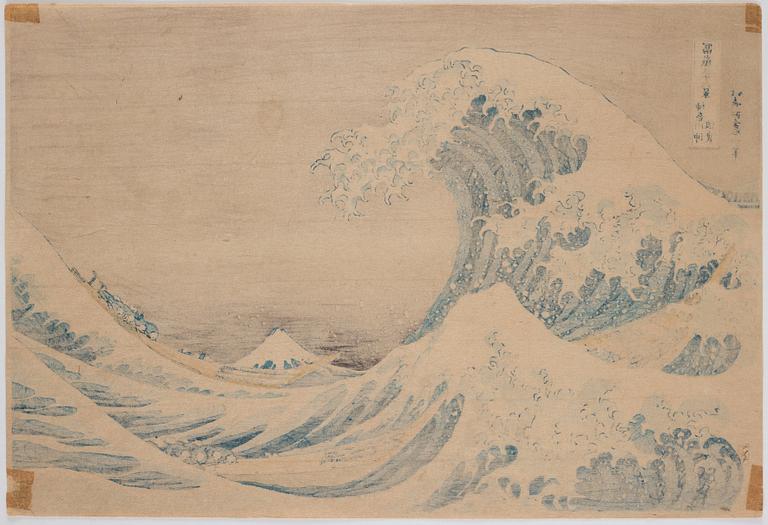
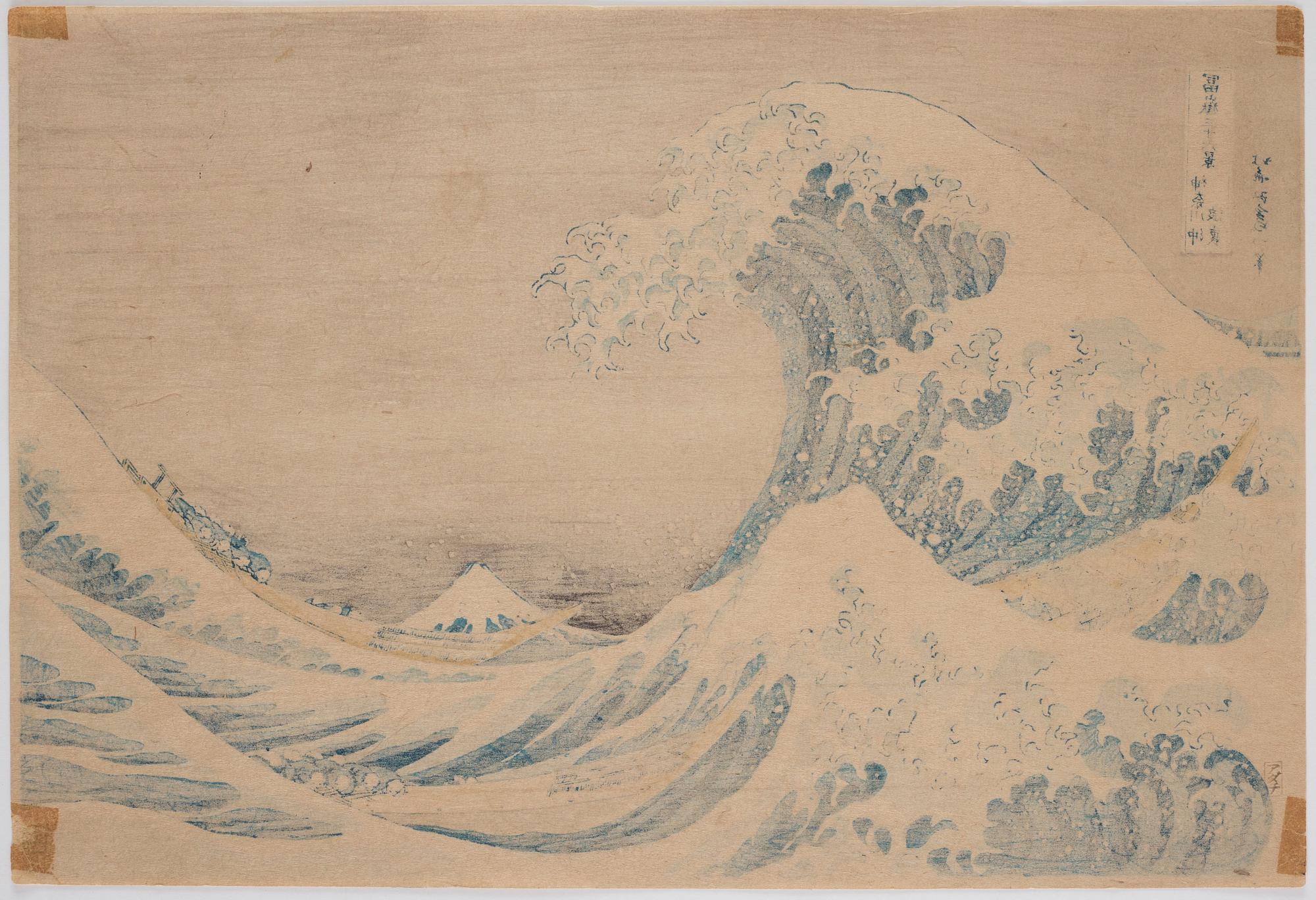
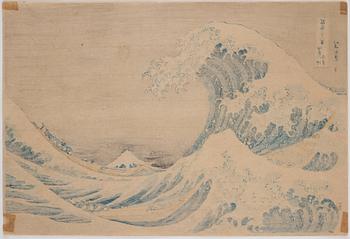
After. Under the Wave off Kanagawa (Kanagawa-oki nami-ura), also known as The Great Wave (神奈川沖浪裏), later publication.
Woodcut (oban). Measurement 37.5x26 cm.
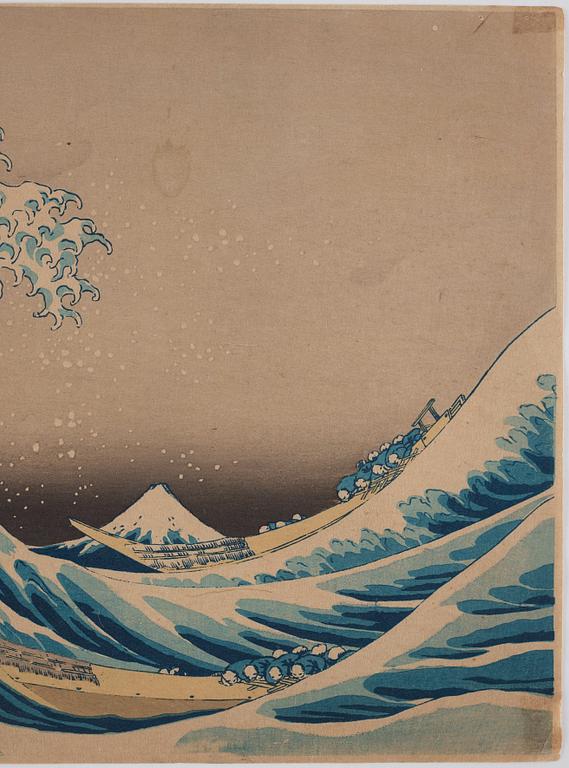
The ‘Great Wave’ dwarfs Mt Fuji. Spray falls from the tentacles of the wave like snow on to the peak. The whole picture is orchestrated to pay homage to the steadfastness of the sacred mountain. Three swift boats (oshiokuri), delivering fish to market in Edo, head directly into a great storm wave out at sea off Kanagawa. The oarsmen crouch forwards, ready to battle heroically with the elemental power of the ocean.
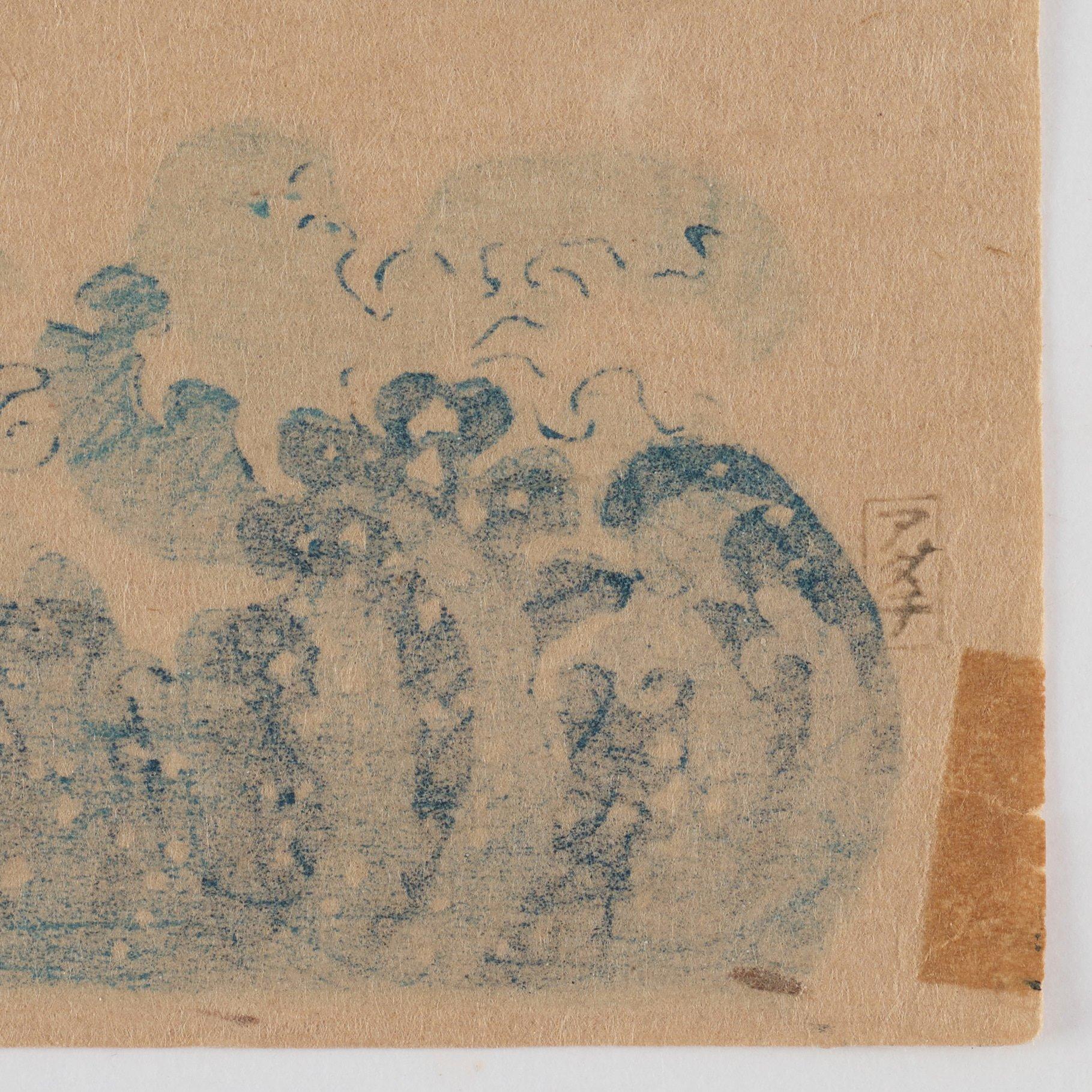
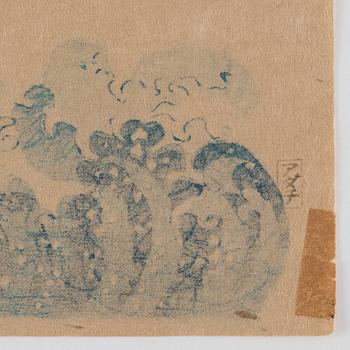
The stamp to the back indicates that it could be a reproduction ukiyo-e from publisher Adachi founded in 1925. It could also be an owner's mark.
Holes, stains, wear, tape residue.
Täydennyslista
The stamp to the back indicates that it could be a reproduction ukiyo-e from publisher Adachi founded in 1925. It could also be an owner's mark.
Näyttelyt
The print is in numerous museum collections including the Museum of Fine Arts, Boston, accession no. 06.1283, the Metropolitan Museum of Art, accession no. JP2569, and the British Museum, accession no. 1937,0710,0.147.
Compare the print in The Art Institute Chicago. Credit Line Clarence Buckingham Collection
Reference Number 1952.343.
Kirjallisuus
For comprehensive discussion of this print design, see Timothy Clark, Hokusai's Great Wave (BMP, 2011).
Muut tiedot
The Great Wave off Kanagawa is set at Kanagawa-juku (juku means relay station in Japanese), one of the stations on the Eastern Sea Route, called the Tokaido. Tokaido, meaning ‘close to the coast,’ is an extremely important route from the Edo period (1603-1868 AD), connecting major cities of Kyoto in the West and Edo (modern day Tokyo) in the East. It is much more crowded than inland Nakasendo, and the Central Mountain Road connecting the same cities. Groups of travelers and merchants went up and down this route each night, resting at a juku equipped with stables, room and board. The stations on the road, as well as checkpoints, are government controlled. In total, there are fifty-three stations on the Tokaido, each of them about a day’s march apart. Kanagawa is the third station from Tokyo.
Tietoa ostamisesta








Muiden katsomia kohteita