
Ola Billgren
”Monolog”
Ola Billgren achieved his breakthrough in the 1960s as one of the leading representatives of Swedish New Realism. His early painting is characterised by an almost photographic way of seeing, in which reality is presented through fragments and carefully selected details.
This objective approach has clear connections to the ideas of the French writer Alain Robbe-Grillet, who likewise sought to distance himself from a romanticised view of artistic creation. During the 1970s, Billgren’s expression changed as the human figure became more central in his work.
Weekdays 11 AM – 6 PM
Weekends 11 AM – 4 PM
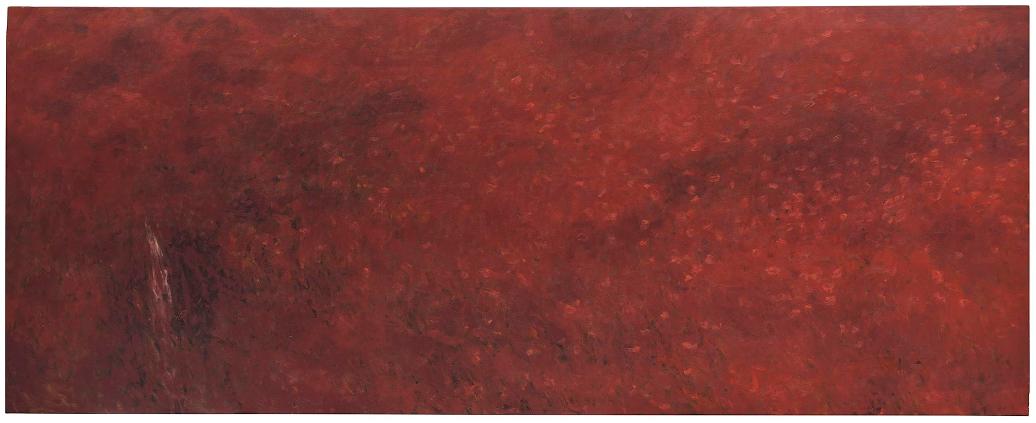
In the transition to the 1980s, he abandoned the realistic mode of expression and instead developed a freer, more colour-based painting, which he himself termed “romantic landscapes”. This shift followed an artistic crisis and resulted in a more abstract visual world in which colour took on an increasingly dominant role. The colour red in particular became central, something that can be traced from “Miss in April” (1966) and further in works such as “Procession” (1987) and “Seville Morning” (1989).
This development reaches a peak in “Monologue”, a monumental painting in which the red colour dominates the entire pictorial surface, creating an intense and immersive experience. When the work was shown at the Gothenburg Museum of Art in 1997 and later at the Sundsvall Museum, it attracted considerable attention. In the catalogue, the painting is described in detail:
“The painting is relatively unknown, created roughly ten years before the red period of the 1990s, at a time when Billgren’s painting was more non-figurative. The canvas has the grand format of 1.5 by 4 metres and is filled from edge to edge with a dark, blood-suffused hue […]. Of the motif, however, only a certain ambiguous spatiality remains, something that gives a sense of an intimate natural scene, a thicket, foliage – or perhaps a more ground-level panorama (scattered with poppy-red patches)? Individual flowers or tufts of grass cannot in fact be distinguished, and the experience does not primarily concern an external landscape.”
The quotation highlights how the painting balances between representation and dissolution. Billgren often used a technique in which he first painted the motif and then drew a metal scraper across the wet paint, blurring details and instead creating a more immediate, physical presence. The viewer is drawn into the depth of the colour and encounters an image that is as much an experience as a depiction.
The red colour in these works has been interpreted as strongly charged with bodily and emotional meanings. In Anne Ring Petersen’s book Måleri/Paintings, she describes this significant period for Billgren: “the saturated redness and body-sized formats carry distinctly corporeal associations with the rich emotional register of passion, euphoria, eroticism and aggression. But they also evoke lovingly enveloping maternity, life-giving force and, more broadly, an original state of unity: the unborn child’s symbiosis with the mother, blissfully unaware of the first separation that entry into life entails, and equally unaware of the final separation that is life’s inevitable end.”
Ola Billgren at Contemporary Art & Design
Enquiries and Condition Reports