Modern Art & Design presents Fernand Léger | May 20–22
"Composition à l'oiseau, esquisse"
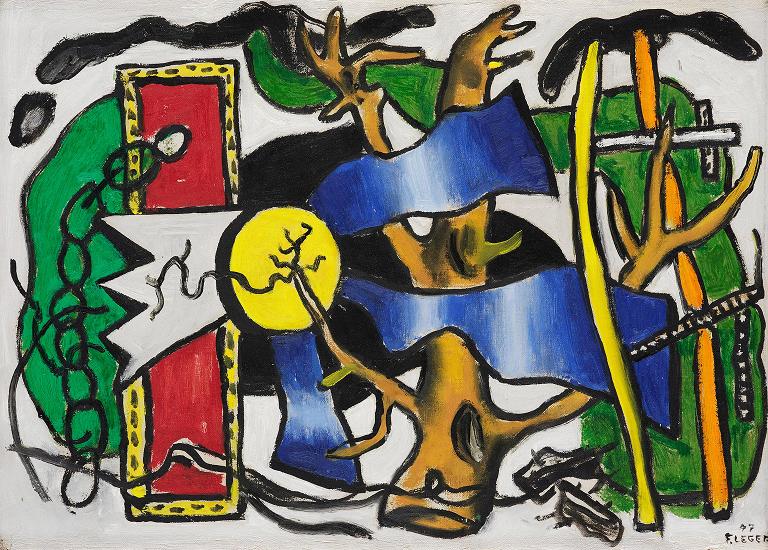
Fernand Léger moved throughout his artistic career between the abstract and the figurative. In the foremost of his works, he achieved a synthesis between the two poles, of which the auction's painting "Composition à L'oiseau" is a refined example.
The painting was executed in 1947, when Léger had recently returned to Paris after spending five years in exile in America during World War II. The country in the West had made a strong impression on him, both the pulsating and vibrant New York with its countless advertising and neon signs, but also the countryside had inspired him—particularly the small village of Rouses Point near the Canadian border, which Léger often visited. Despite this, the return to France resulted in a renewed love for his homeland, and Léger was filled with an enthusiastic belief in the future. In 1946, he described his feelings in an article in Arts de France: "I want to tell what I felt in returning to France, the joy I have had in rediscovering my country... I assure you that the people have made a great advance in France. I assure you that a magnificent evolution has come about... I have faith in France."
Fernand Léger wanted to contribute to the reconstruction of his homeland through his art after World War II, and the coming years would be very productive for him. Alongside his painting, he worked during this time in a number of different techniques, including ceramics, sculptures, glass, and mural paintings. He also reopened his own art school, Atelier Fernand Léger, which attracted many young American artists due to the reputation he had established in the country. Among the students were Kenneth Noland, Sam Francis, and Richard Stankiewicz.
Estimate: 3 000 000 - 4 000 000 SEK
Weekdays 11 AM – 6 PM
Weekends 11 AM – 4 PM
"I want to tell what I felt in returning to France, the joy I have had in rediscovering my country... I assure you that the people have made a great advance in France. I assure you that a magnificent evolution has come about... I have faith in France."
Despite the many projects, Léger continued intensely with his painting, which during these years is characterised by a freer and more organic expression. The geometric forms now take a back seat to more representational elements, often drawn from nature and its surroundings. In 1950, he explained his art with the following words: "The plastic life, the picture, is made up of harmonious relationships among volumes, lines, and colors. These are the three forces that must govern works of art. If, in organizing these three elements harmoniously, one finds that objects, elements of reality, can enter into the composition, it may be better and may give the work more richness."
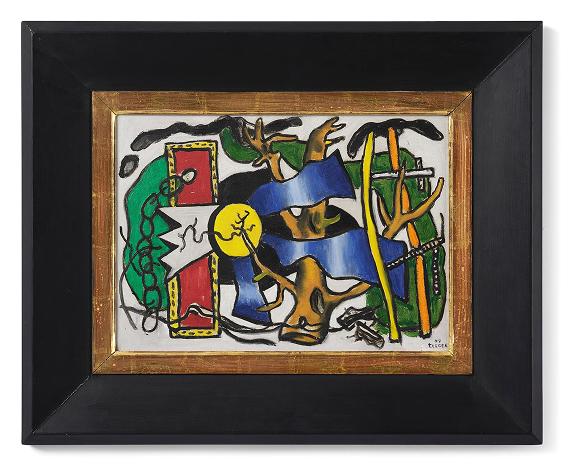
It was during this time that Léger, in contrast to the period after World War I, realised that humanity had lost contact with nature and had become a prisoner under the power of the machine. This led him, in the late 1940s, to seek inspiration away from the modern city and draw more and more motifs from the countryside, which is reflected in the auction's "Composition à L'oiseau." The painting is filled with bright and lively colours that are enhanced against its cool and neutral background. The artist has here combined purely abstract and floating forms with the outstretched branches of a tree, resulting in the boundaries between reality and fantasy dissolving. Léger often executed his motifs in several versions, which allowed him to explore the relationship between colour and form through small variations. The motif of the current painting recurs in two paintings, both executed in 1947, "Composition sur fond Jaune" and the larger "Composition aux deux Oiseaux." In the latter, which is part of the collections of the Johannesburg Art Gallery in South Africa, Léger has placed two flying doves, the symbol of peace, which have given the composition its title.
"Composition à L'oiseau" is a exquisite example of the closeness and love for nature that permeated Fernand Léger's art at the end of the 1940s and shows how the artist made colour, form, and line harmonise into a vibrant and organic whole.
Fernand Léger at Modern Art & Design
Enquiries and Condition Reports