Important Winter Sale presents From Falk Simon’s Collection | December 9–11
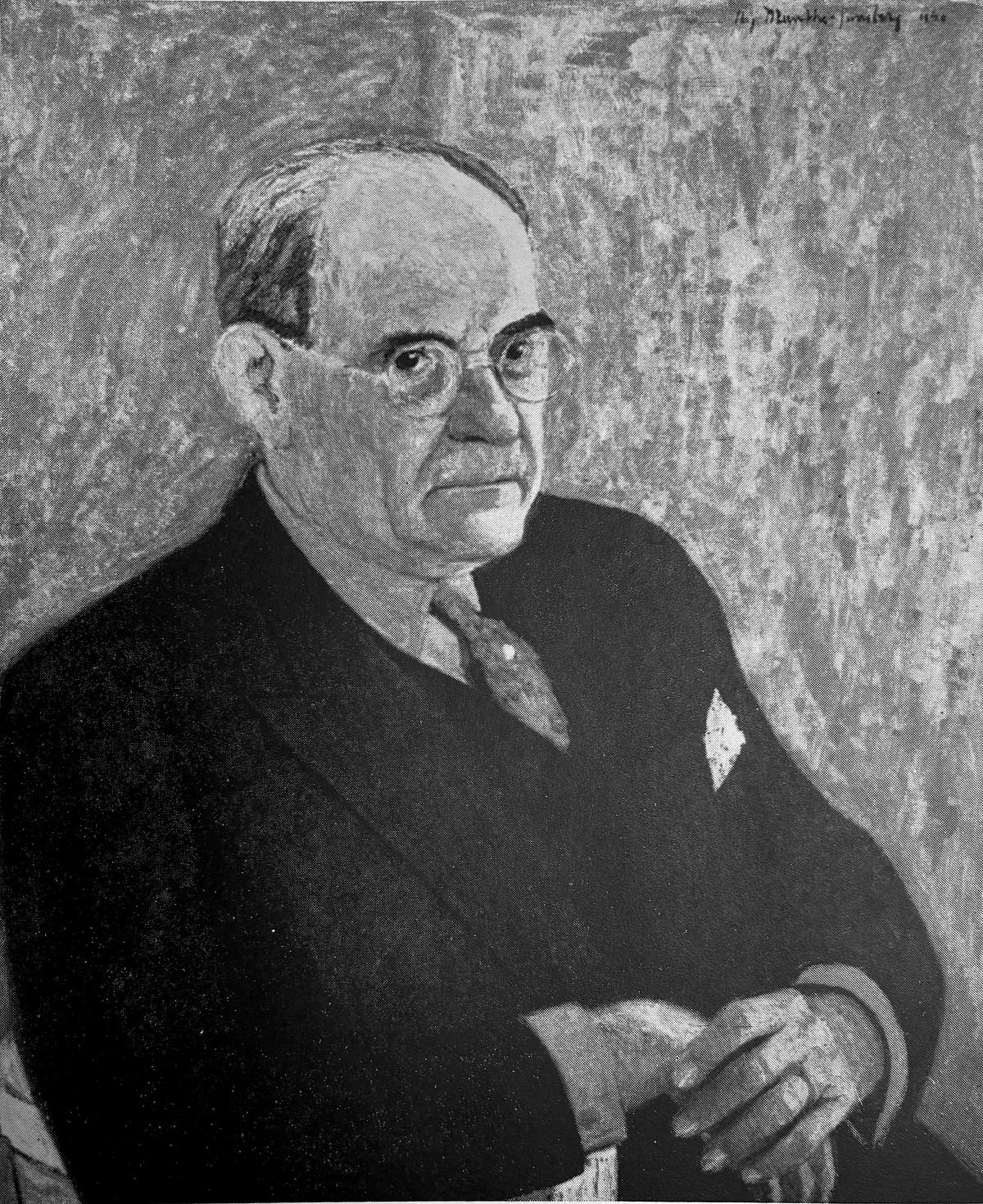
Director Falk Simon (1874–1957) was one of Sweden’s foremost and most distinguished collectors of decorative arts, silver and fine art during the first half of the 20th century. Bukowskis is delighted to present, in this auction, a selection of objects from various periods, drawn from Falk Simon’s highly personal collection. Works of art from the collection are included under catalogue numbers 814–816 and 818–820.
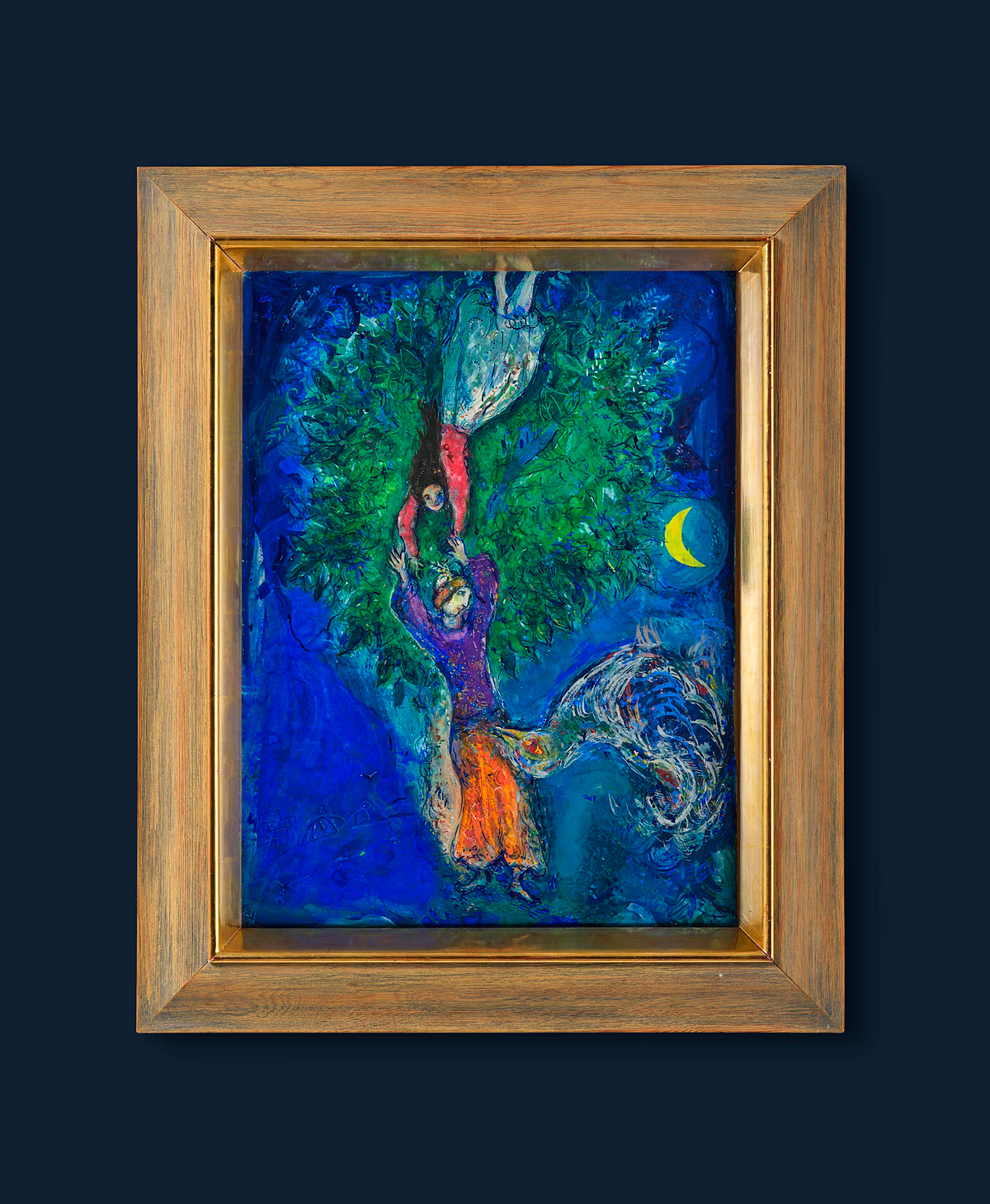
Like shimmering gemstones, the two magnificent gouaches by Marc Chagall, executed in High Falls, New York, in 1946, radiate brilliance. The complete suite comprises thirteen gouaches inspired by the Oriental folk tale One Thousand and One Nights. The art historian and Chagall expert Franz Meyer described the series as “a suite of gouaches ranking among the most outstanding works he created in the United States”. The original gouaches served as models for the celebrated lithographic suite One Thousand and One Nights, published in 1948.
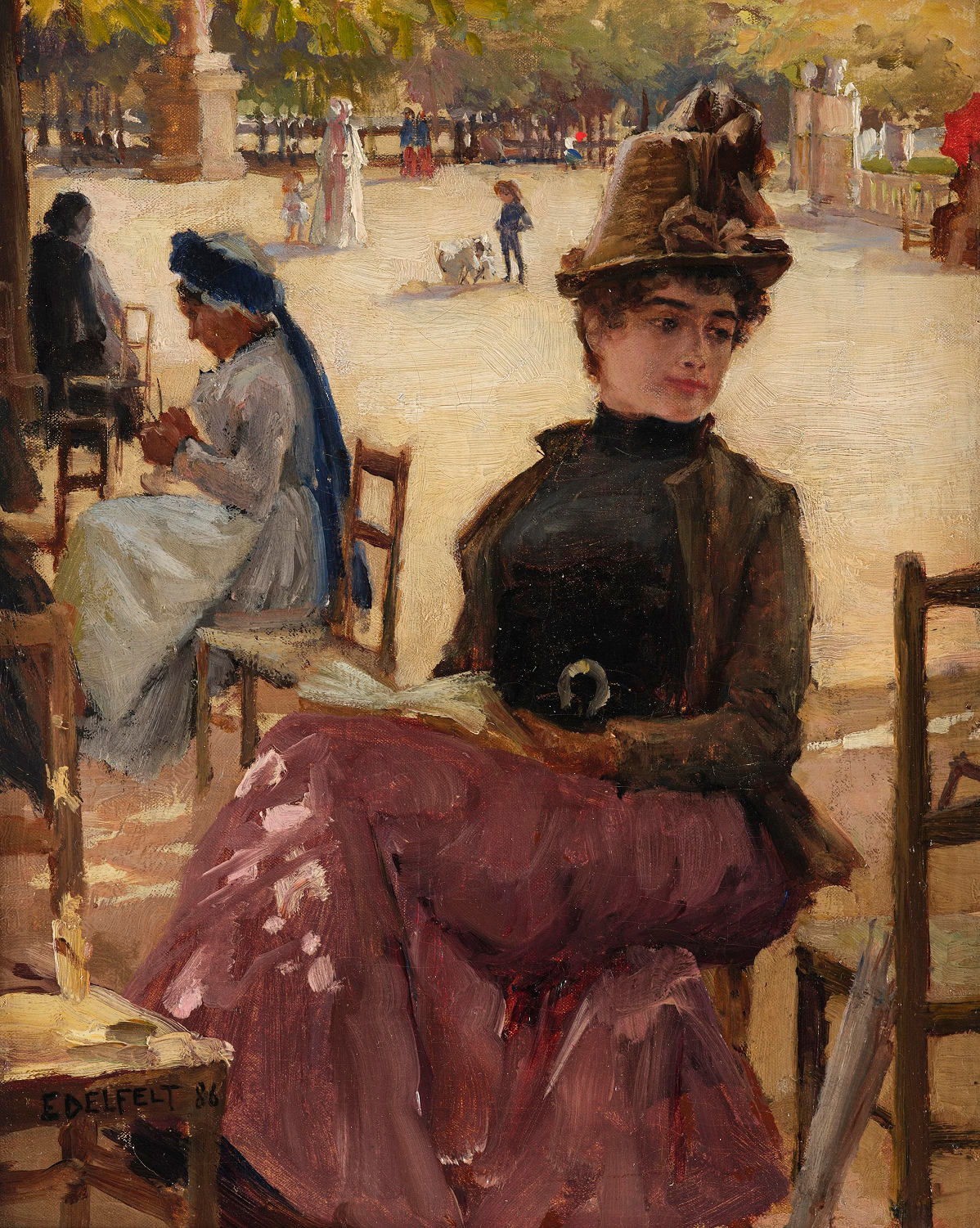
A small oil painting by Albert Edelfelt, executed in Paris in 1886, is a charming preparatory study for the larger painting In the Luxembourg Gardens, now held in the collections of the Ateneum Art Museum. Camille Pissarro’s Débardeurs – Charbonniers à Rouen is characteristic of his depictions of manual labourers in the late 19th century. The dark palette and interplay of light and shadow heighten the sense of the arduous nature of their work.
Falk Simon himself was active in Gothenburg and took a keen interest in the younger, vibrant artists of the Gothenburg Colourists movement, represented here by two works by Ivan Ivarson.
Weekdays 11 AM – 6 PM
Weekends 11 AM – 4 PM
Falk Simon was a distinguished Swedish businessman, art collector and patron of the arts, based in Gothenburg. Initially, his collecting interests centred primarily on high-quality decorative arts, particularly antique silver. Over the years, his passion for collecting evolved to encompass fine art and sculpture by artists of his own time.
Falk Simon was a frequent visitor to exhibitions of contemporary art and made almost all his acquisitions independently. Works were often purchased directly from the artists themselves, or acquired through some of Sweden’s most established art dealers, including Svensk-Franska Konstgalleriet, Bukowskis, Färg och Form, Fritzes and Stenmans in Stockholm, and, in later years, Börjessons Konsthandel in Gothenburg. Falk Simon maintained close ties with the contemporary art scene and was always keen to discover new talent.
His collection soon came to be regarded as one of the most distinguished in Sweden. It brought together Swedish and international artists and spanned several artistic periods. In 1955, a catalogue of the collection was compiled, featuring everything from important works by 19th-century painters to young Swedish Expressionists, represented by several of their most significant works. The collection attracted considerable international attention, notably for Pablo Picasso’s The Blue Stocking, painted in 1903, and Marc Chagall’s thirteen gouaches comprising the suite One Thousand and One Nights.
Falk Simon’s deep interest in art was passed on to his daughter, Greta Falk-Simon (1907–2004), who trained as an artist and married the painter and draughtsman Stig Munthe-Sandberg (1903–1950). A considerable number of paintings by Greta and her husband, Stig Munthe-Sandberg, were included in Falk Simon’s collection.
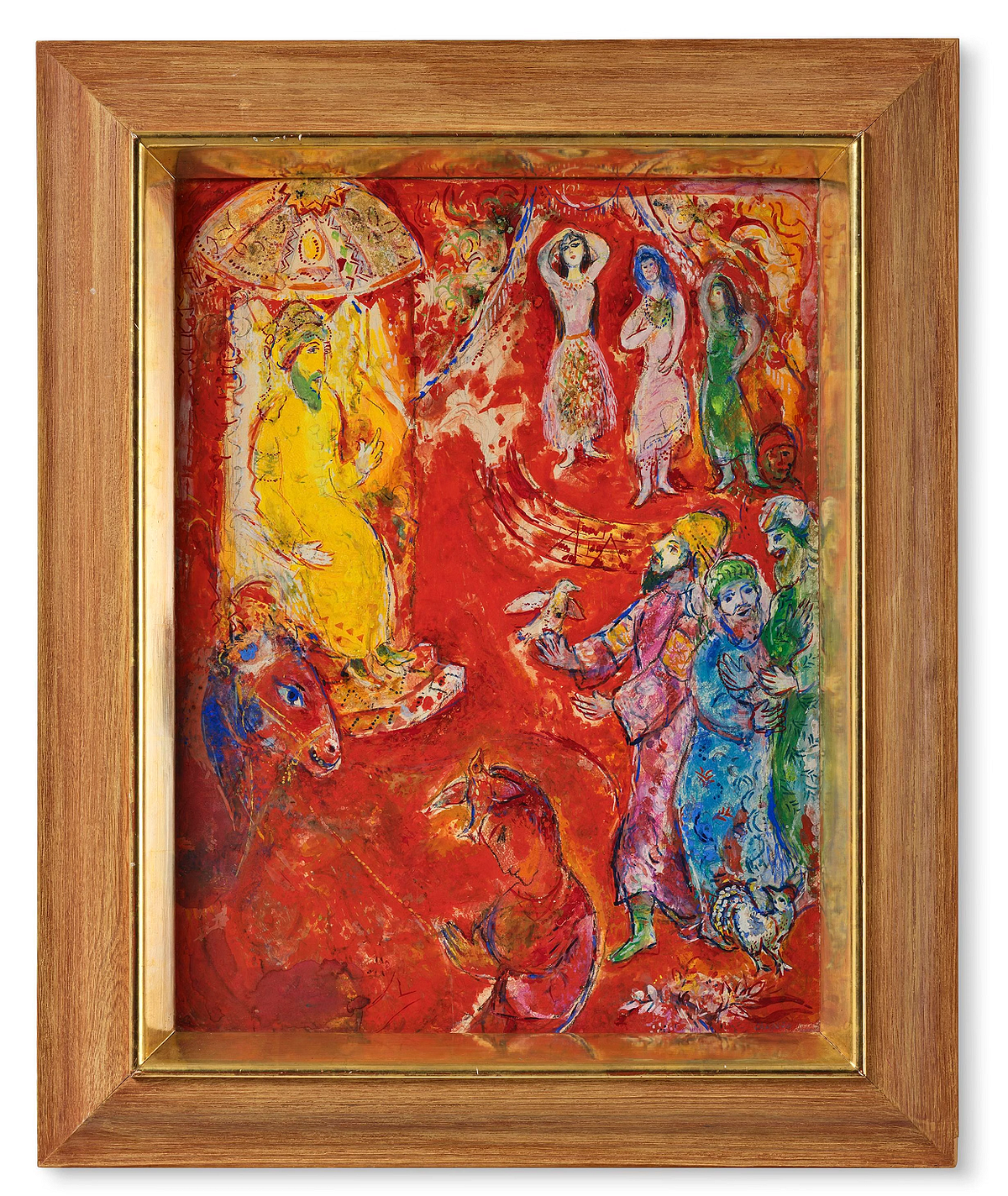
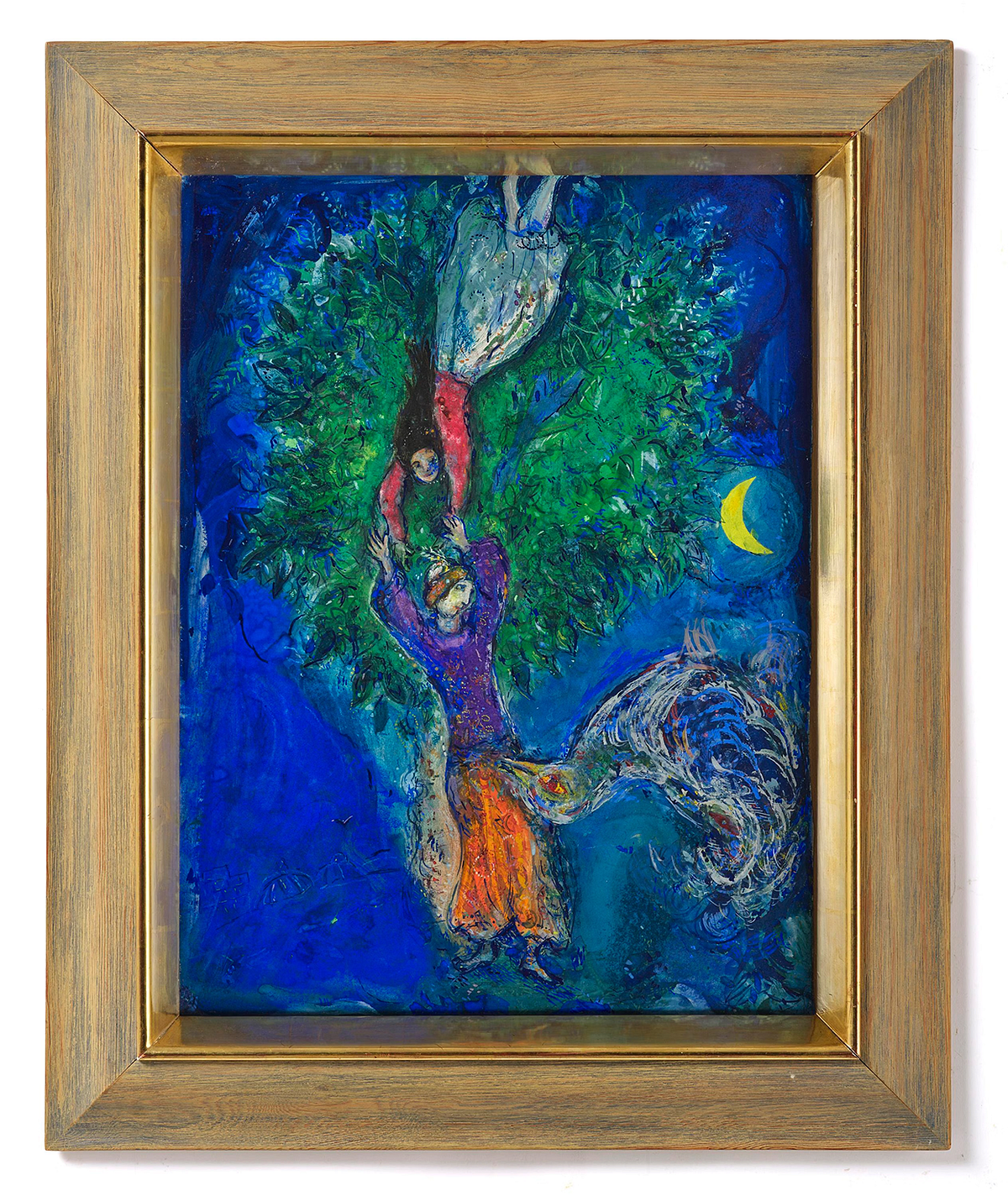
Marc Chagall – High Falls, New York and ”Four Tales from the Arabian Nights”
In 1946, during his exile in High Falls, New York, Marc Chagall created thirteen gouaches inspired by The Arabian Nights (One Thousand and One Nights). The series ranks among the most significant works of the artist’s American period. The art historian and Chagall expert Franz Meyer described the suite as “a series of gouaches ranking among the most outstanding works he created in the United States”.
The two works offered in this auction belong to this exceptional suite and illustrate the tales Julnar the Sea-Born and Her Son, King Badr Basim of Persia (No. VI) and The Tale of the Ebony Horse (No. X).
On 23 June 1941, Marc Chagall arrived in New York with his wife Bella and their daughter Ida, having fled occupied France via Marseille and Lisbon. The family had been offered refuge in the United States following an invitation from the Museum of Modern Art (MoMA). In New York, Chagall renewed his connections with Fernand Léger, André Masson, Piet Mondrian and André Breton, as well as the art dealer and gallery owner Pierre Matisse, son of Henri Matisse.
Following Bella’s sudden death in 1944, Chagall suffered a profound personal crisis and virtually ceased painting for an extended period. He subsequently moved to High Falls in upstate New York. When he eventually returned to his work in 1945, his imagery was imbued with themes of love, loss, death and reunion.
Among his fellow exiles was Jacques Schiffrin, who had first fled the Bolsheviks and later escaped occupied France for New York. Schiffrin, co-founder of the publishing house Pantheon Books, now proposed that Chagall create illustrations for a lavish edition of Four Tales from the Arabian Nights, which Pantheon was planning to publish in New York.
"Arabian Nights", also known as "One Thousand and One Nights", is a collection of tales and stories originating in the Middle East and South Asia, compiled over several centuries. The overarching narrative centres on the Persian king Shahriyar and his new bride, Scheherazade. Convinced that all women are unfaithful, the king resolves never to be deceived again. Each evening, he marries a new young woman, spends the night with her and has her executed at dawn.
To escape this fate, Scheherazade tells King Shahriyar a story. With great ingenuity, she weaves one tale into another, and when dawn breaks, the king is so eager to discover how the story will end that he allows her to live for another day. The tales themselves vary enormously in character and include historical accounts, love stories, tragedies, comedies, poetry, burlesques and various forms of erotic literature.
Chagall allowed himself to be persuaded by Schiffrin and carefully selected four tales to illustrate. Drawing upon his distinctive visual language, in which dreams, fantasy, love and mysticism intertwine, he created thirteen exquisite paintings, which subsequently served as the basis for the graphic suite "Four Tales from the Arabian Nights", published by Pantheon Books in New York in 1948.
The project marked Chagall's first major engagement with colour lithography, a medium that would become increasingly important in his subsequent artistic career.
The series occupies a prominent place in Chagall’s American oeuvre, bringing together several of his central themes: love, loss, dreams and the supernatural. At the same time, the Oriental fairy-tale world of the stories offered him an opportunity to explore new subjects and pictorial expressions.
The complete suite of thirteen gouaches was acquired around 1953 by Director Falk Simon through Börjessons Konsthandel in Gothenburg. That Chagall himself regarded the series as being of particular importance is evident from two letters written in November 1958, in which he personally appealed to one of Falk Simon’s heirs to lend works from the series for the major international touring exhibition "Marc Chagall: Ausstellung 1959", which was presented in Hamburg, Munich and Paris.
Copies of both letters, dated 5 and 12 November 1958 respectively, accompany the works.
The two gouaches, catalogue numbers 814 and 815, are thus not only examples of Chagall’s poetic and imaginative visual world, but also form part of a magnificent suite that was held in particularly high regard by the artist himself.
Albert Edelfelt
In the spring of 1886, Albert Edelfelt wrote from Paris to the Finnish art critic Berndt Otto Schauman, outlining his plans for a major composition depicting the Luxembourg Gardens. He described a scene filled with “spring sunshine, buds on the trees, thousands of babies and Norman wet nurses, soldiers, Parisian women and learned vagabonds from the Latin Quarter”. As part of his work on this ambitious composition, he executed the present painting, a preparatory study depicting a young woman seated in the shade of the Luxembourg Gardens, an open book resting on her lap. The following year, the larger composition was completed (now in the collection of the Ateneum in Helsinki), and is today regarded as one of the artist’s finest works from his Paris years.
Bertel Hintze observes that the painting “in its composition and treatment of light recalls the pastel Au Bois de Boulogne (spring 1886 [...]) and, above all, the plein-air paintings by the Seine [...]”, which were probably executed around the same time. He further notes that “the colour scheme is stronger and richer than in the final painting; particular attention is drawn to the resonant contrast between the deep, dark violet tones of the young Parisian woman’s dress and the light sandy ground and spring-green foliage in the background, whose luminosity is heightened by the red and bright blue colours of the figures”.
Albert Edelfelt arrived in Paris as early as 1874, and the city would prove decisive in shaping his artistic development. He studied at the École des Beaux-Arts under Jean-Léon Gérôme, where he became acquainted with both the academic tradition and the emerging realist movements of the time. During his years in the French capital, he gradually developed a distinctive visual language, combining the discipline and compositional assurance of his academic training with an increasingly keen interest in scenes of everyday life, natural light and plein-air painting. His successes at the Paris Salon, not least with his portrait of Louis Pasteur in 1885, consolidated his international reputation and established him as one of the foremost artists of the Nordic countries.
The Collection at Important Winter Sale
Enquiries and Condition Reports