Modern Art & Design presents Lynn Chadwick | November 18–19
Lynn Chadwick’s distinctive figures are instantly recognisable. They possess a language all their own, their unique visual vocabulary unlike that of any other artist. Majestic strangers, enigmatic and seemingly never at rest — rather, ever watchful. With their geometrically simplified forms and sharply angular, draped cloaks, they evoke associations and inspire fascination.
Chadwick emerged on the British art scene shortly after the Second World War, alongside a new generation of artists. Europe lay in ruins, and the world was in shock, having witnessed the horrors of war, genocide and the devastating effects of the atomic bomb.
Chadwick himself had served as a pilot in the RAF during the war. From an early age, he had aspired to devote his life to art. However, his parents disapproved, prompting him to compromise in his choice of career and train instead in architecture. Before the war, he worked as a draughtsman in an architectural practice.
Chadwick had no formal artistic training, and perhaps traces of the rigorous geometry of architectural drawing can be discerned in his work. In the aftermath of the war, he was driven by a profound desire to create, to bring something entirely new into being.
Weekdays 11 AM – 6 PM
Weekends 11 AM – 4 PM
It was some time, however, before Chadwick felt ready to take the final step and devote himself fully to art. In the meantime, he enjoyed a successful career as a designer and interior architect. Throughout the late 1940s, he earned his living designing, among other things, display stands, furniture and wallpaper patterns, while continuing to develop his own artistic practice.
It was through his participation in the Venice Biennales of 1952 and 1956 that Chadwick achieved international recognition. Since then, he has been regarded as one of the most significant artists of the British post-war period.
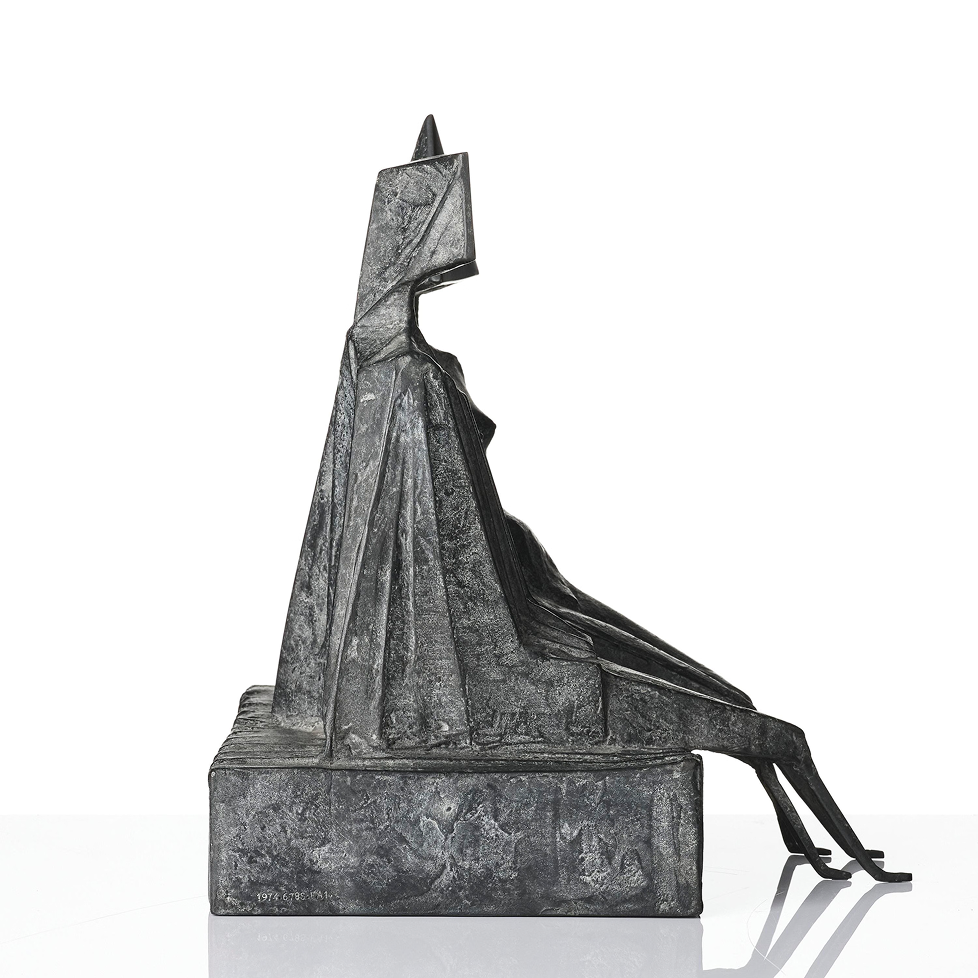
The character of Lynn Chadwick’s sculptures is inextricably linked to his working methods. Largely self-taught, he developed a technique of his own, described as a form of three-dimensional drawing with metal rods. He would first bend and shape the rods to achieve the desired form, then weld them together, filling in those sections intended to be solid. For certain sculptures, he employed sheet metal, creating the impression of a ‘metal skin’. It was not until the late 1950s that he also began working in cast bronze. Chadwick attached great importance to the patination of his sculptures, paying meticulous attention to the texture and subtle variations in colour across their surfaces.
The triangle, in its various configurations, is the fundamental geometric form in Chadwick’s work, sometimes combined to create rectangles. Positioned vertically or diagonally, and rarely horizontally, the triangle forms the structural framework of his sculptures and generates their formal tension. Chadwick himself regarded the triangle as the simplest outline of a human or animal figure, from which the body could be developed. He emphasised that the human figure was always his point of departure.
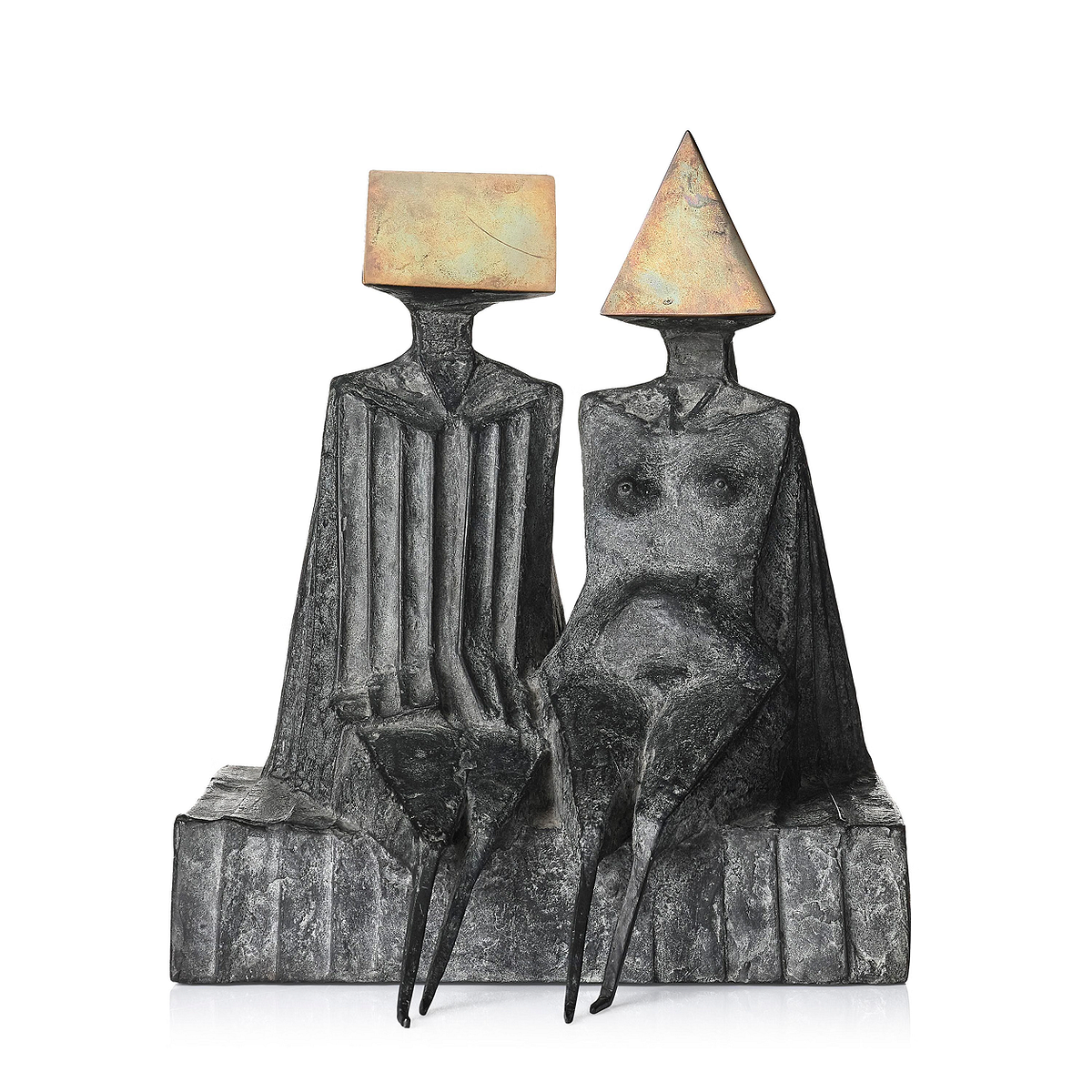
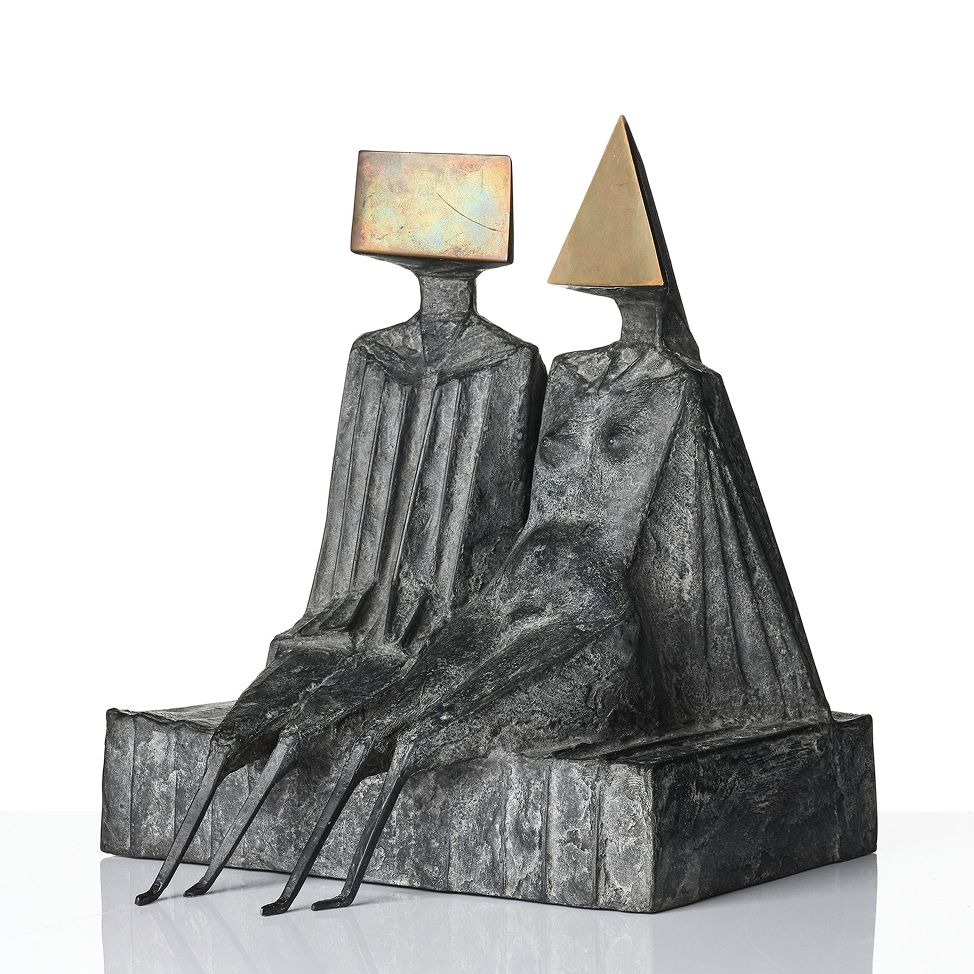
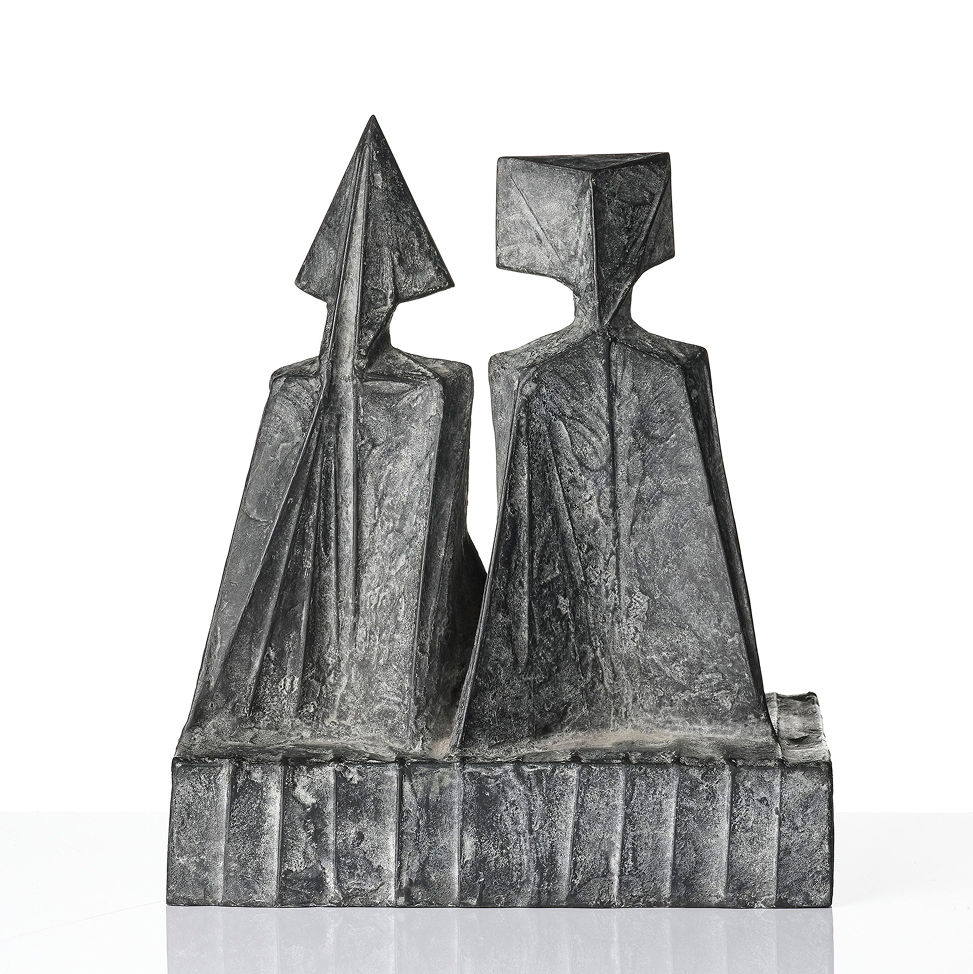
The sculpture "Sitting Couple on Base IV" belongs to Chadwick’s output of the 1970s, a period characterised by his iconic, mature style, in which forms became increasingly refined and pared back. As viewers, we encounter two archetypal, timeless forms. It is difficult to say whether Chadwick drew his inspiration from Neolithic civilisation or from Carl Jung’s theories of archetypes and the collective unconscious. The figures inhabiting the artist’s imaginative world are hybrid creatures, borrowing characteristics from humans, birds, reptiles and insects. We recognise something of ourselves in them, yet at the same time they inspire a sense of unease, even fear. Within this particular group, it is essentially the faces alone that offer clues to the figures’ identities: the square represents the male, while the triangle represents the female, a motif that recurs throughout Chadwick’s oeuvre.
Chadwick himself described art as a dark, inner force that revealed itself to the artist and was translated through the artist’s ability and skill. What the artist has thus translated for us, the viewers, remains open to our own interpretation.
Lynn Chadwick at Modern Art & Design
Enquiries and Condition Reports