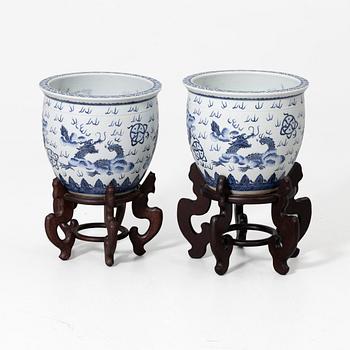
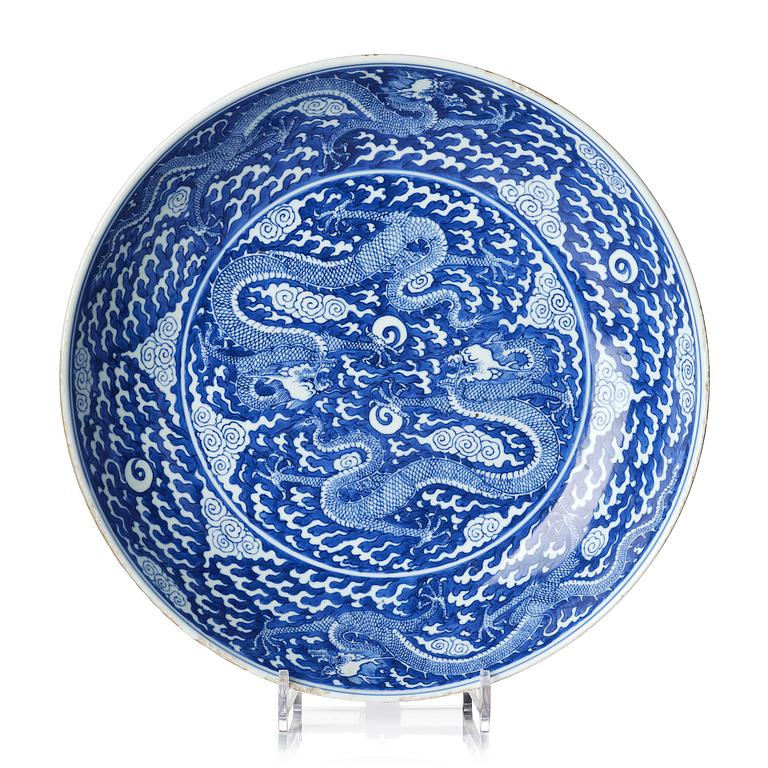
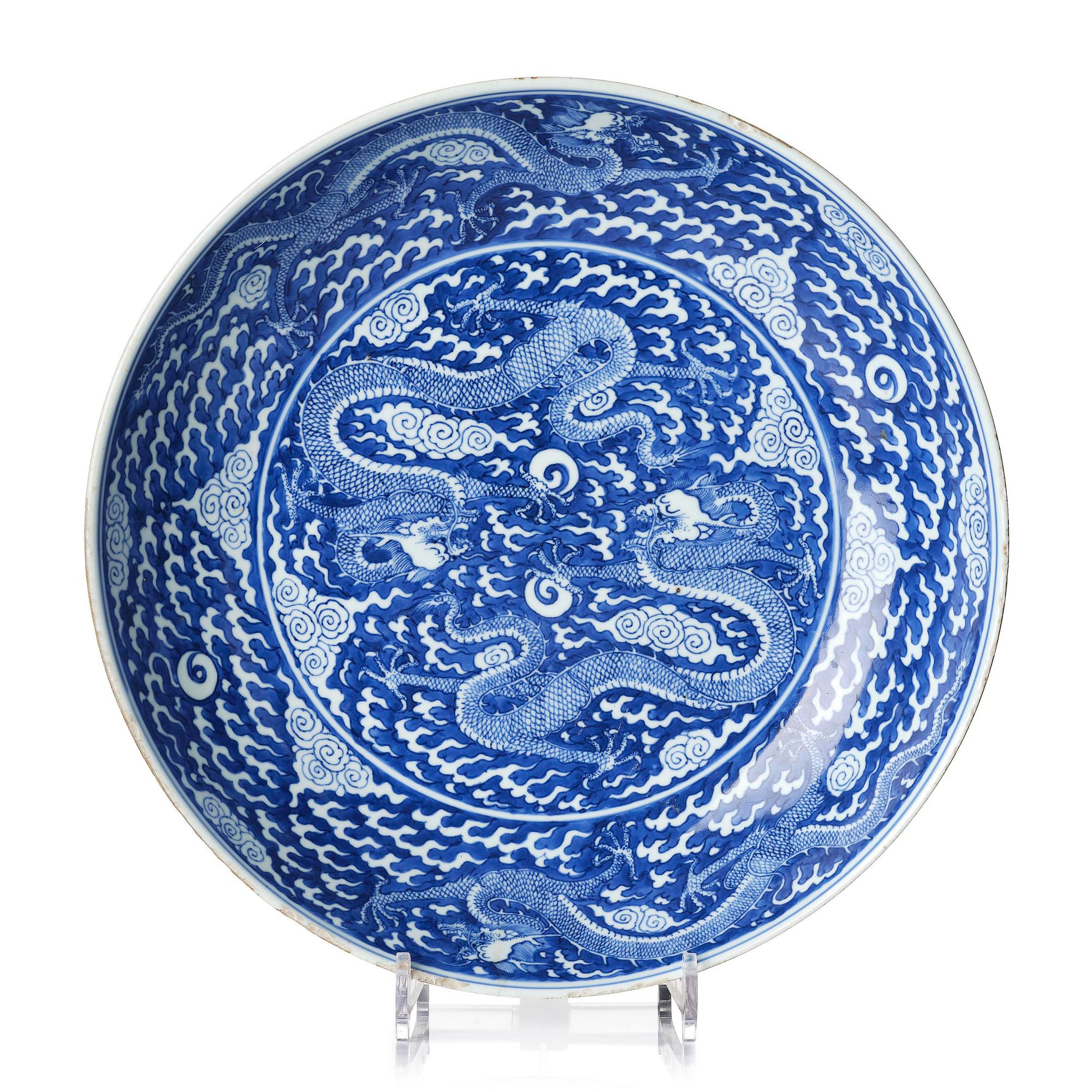
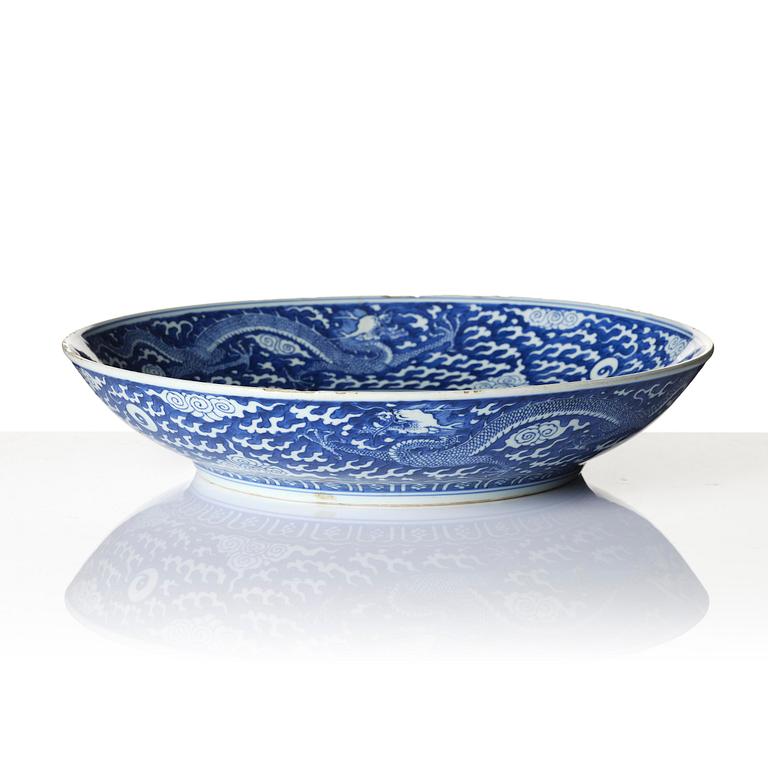
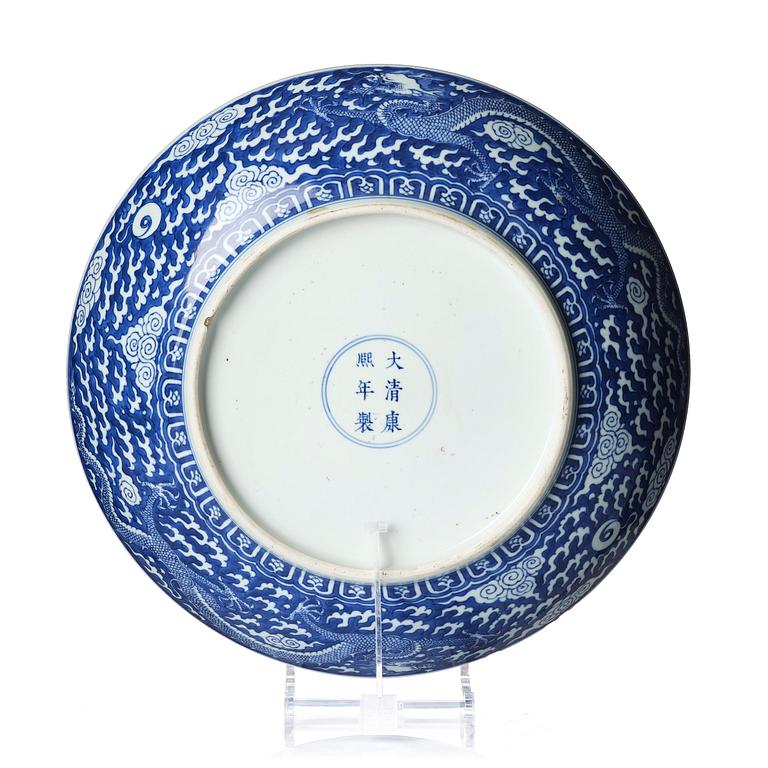
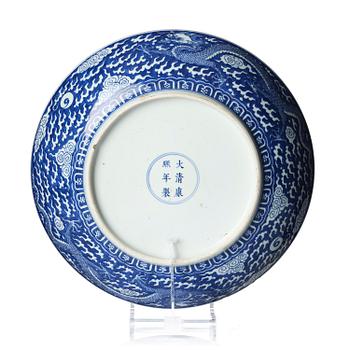
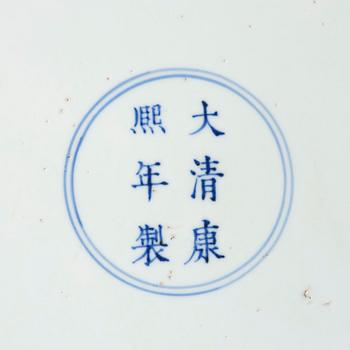
Rundade sidor på en svagt sluttande fot, insidan dekorerad i kraftfull underglasyrblå färg med två femkloade drakar som jagar den flammande pärlan bland molnformationer. Baksidan upprepar dekoren med ytterligare två drakar. Diameter 36 cm.
Nagg.
Proveniens
From the Collection of Ivan Traugott (1871-1952). Thence by descent within the family.
Ivan Traugott was a leading figure in the burgeoning Chinese Art circles of Stockholm in the early twentieth century. An early member of the famous Kinaklubben (‘China Club’) alongside the likes of the Crown Prince (later King Gustaf VI Adolf), Carl Kempe, Emil Hultmark and Gustaf Lindberg, Traugott played a key role in the history of Chinese Art collecting in the West. Traugott also invested in the famous Karlbeck Syndicate of the early 1930s, which forms the foundation of the Museum of Far Eastern Antiquities, Stockholm, and countless others around the world. He was also a good friend and sponsor of Johan Gunnar Andersson in the early 20th century. A large part of his collections can be seen today at Nationalmuseum and East Asian Museum in Stockholm.
Utställningar
Compare with a dish like this one sold at Bonhams, Fine Chinese Art, London, New Bond Street. 10 November 2011, lot 114.
Compare also, Christies, 13 MAY 2014 | Live auction 1523. Fine Chinese Ceramics and Works of Art. Lot 351.
Litteratur
Surviving examples of this design and large size are rare. Compare Kangxi dishes of this design with additional coloured enamels, including an example with added green enamel, preserved in the Hong Kong Museum of Art, included in The Wonders of the Potter’s Palette, Hong Kong Museum of Art, Hong Kong, 1984, cat. no. 25; and another, with yellow enamel on a green ground, in the Nanjing Museum, illustrated in Xu Huping, ed., The Official Kiln Porcelain of the Chinese Qing Dynasty, Shanghai, 2003, p. 75.
För konditionsrapport kontakta specialist





Andra har även tittat på