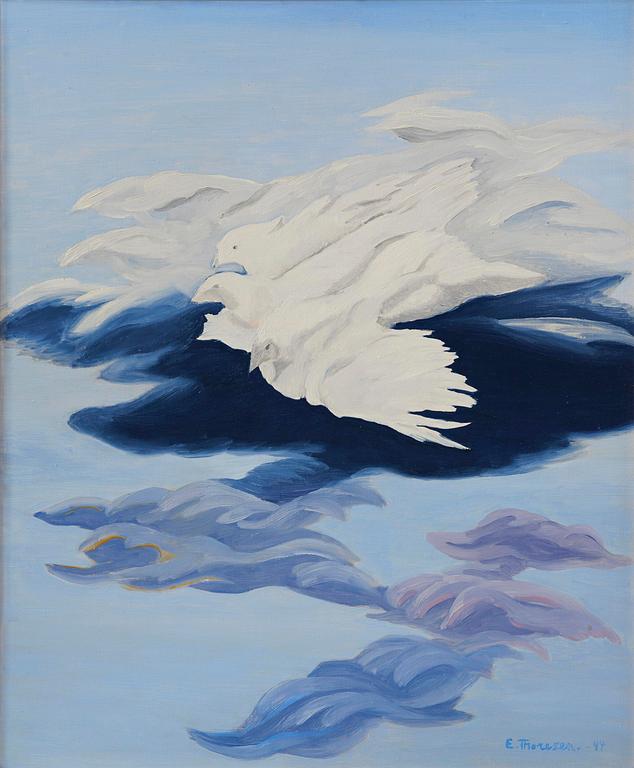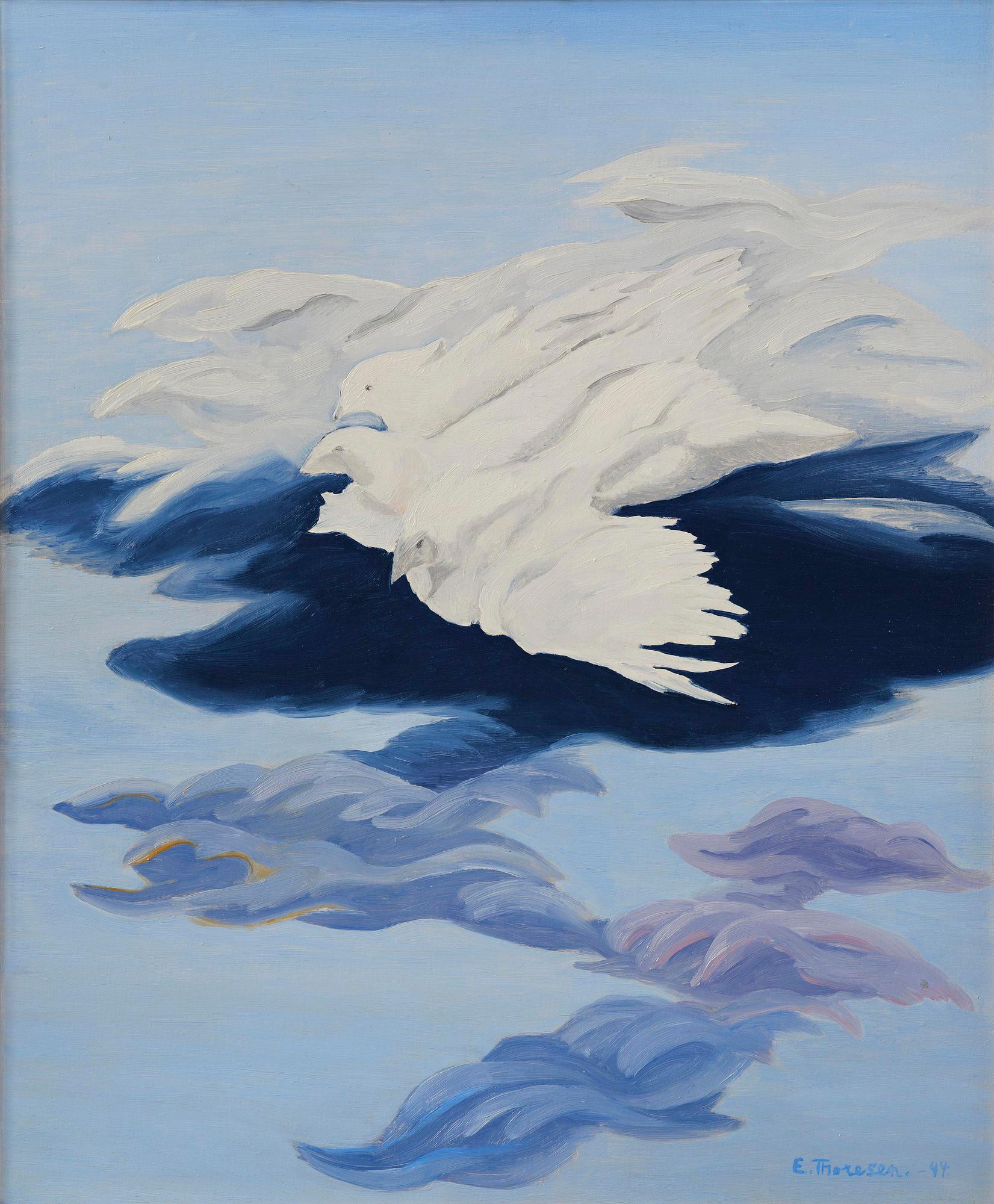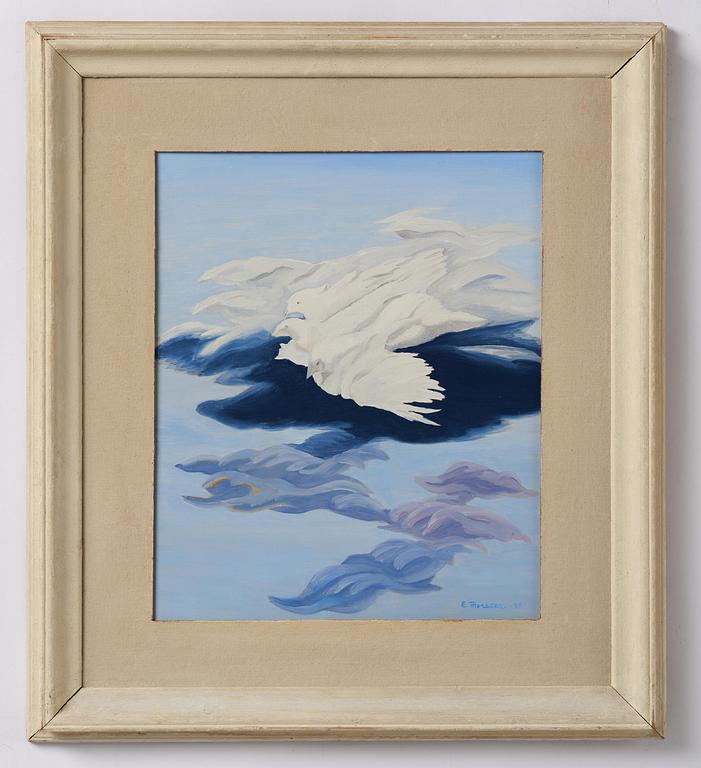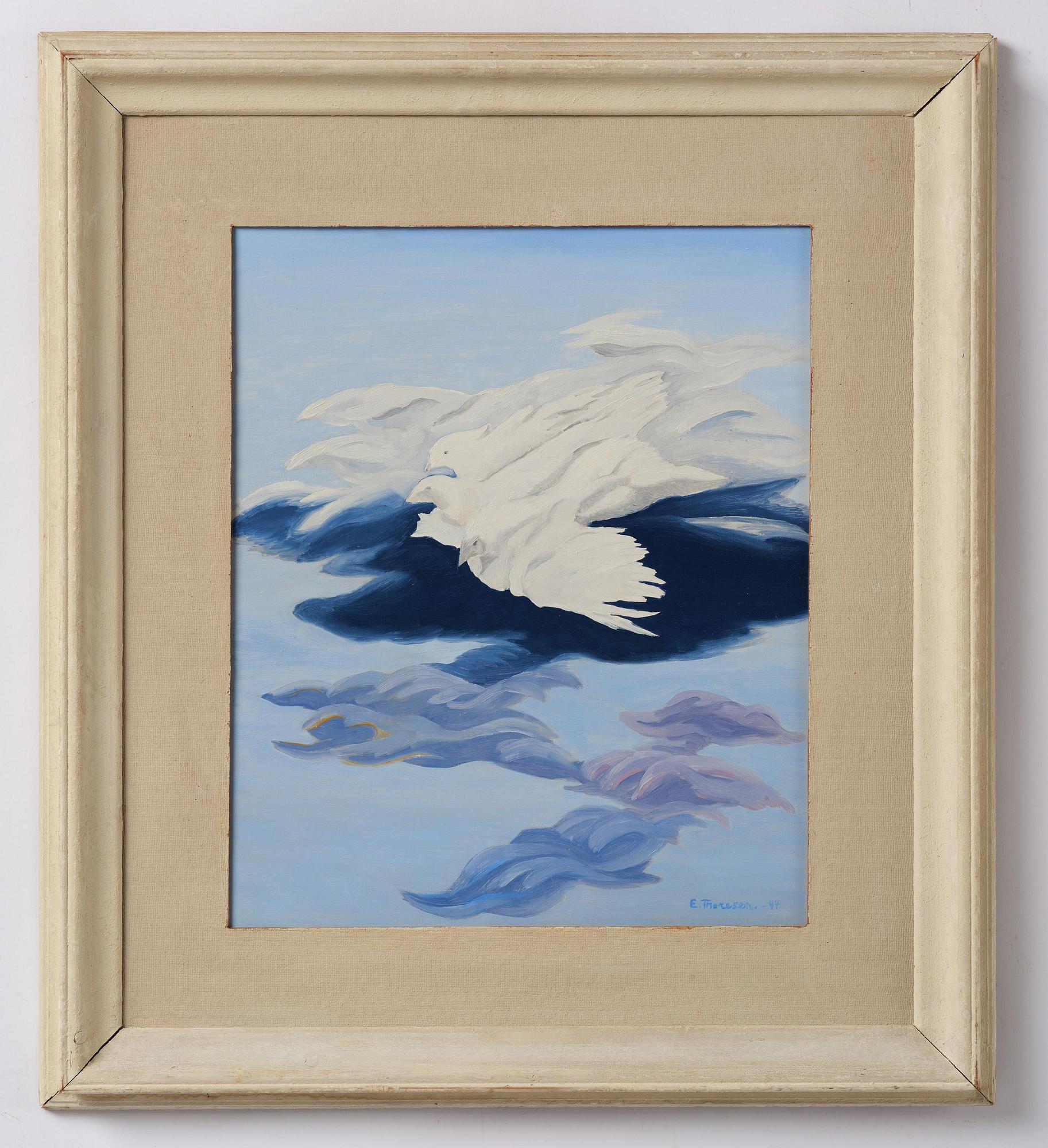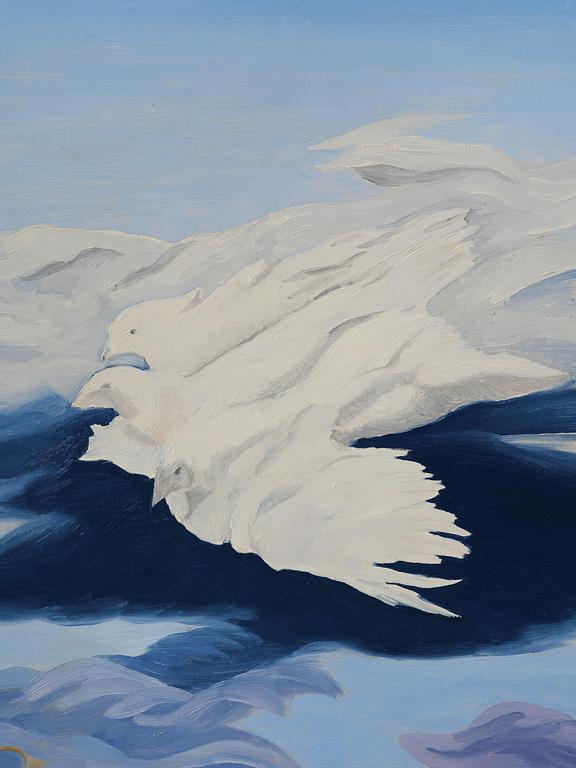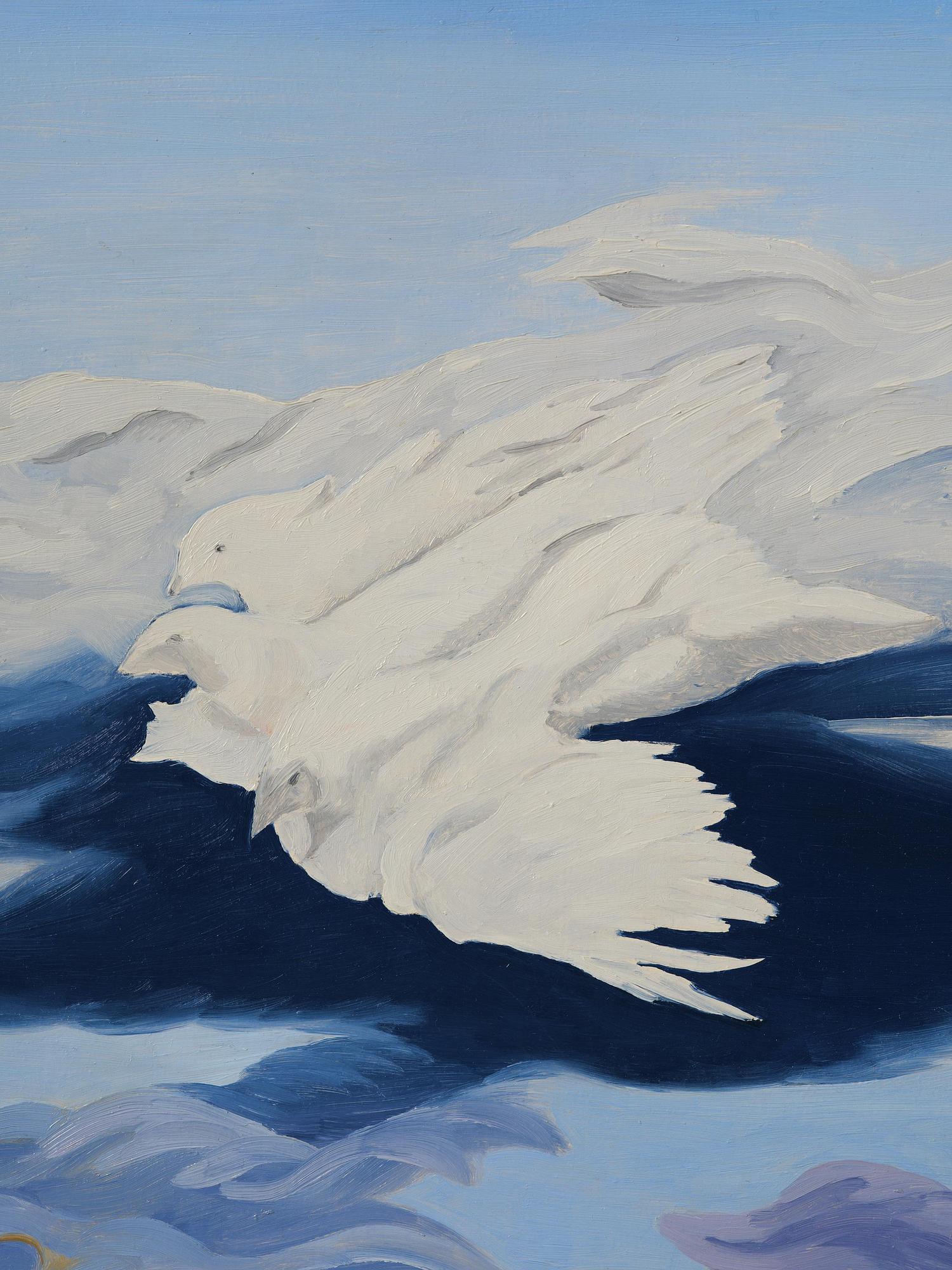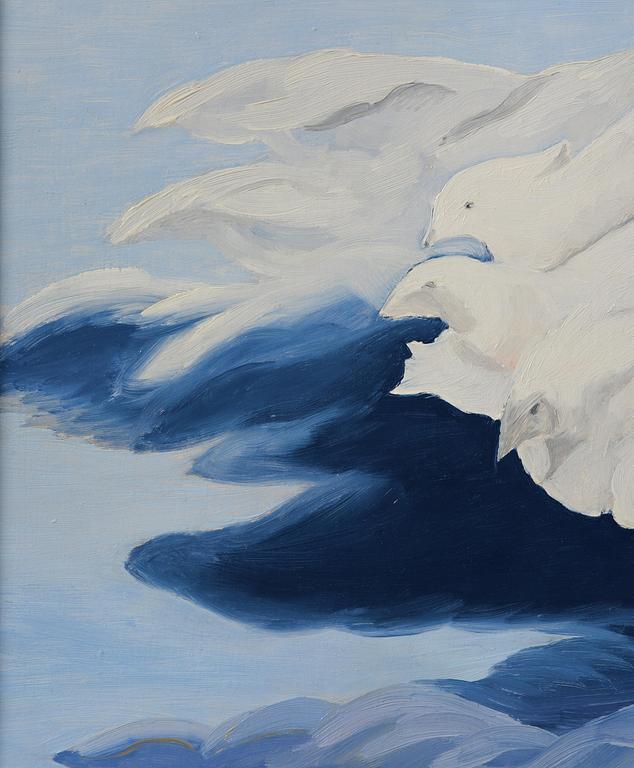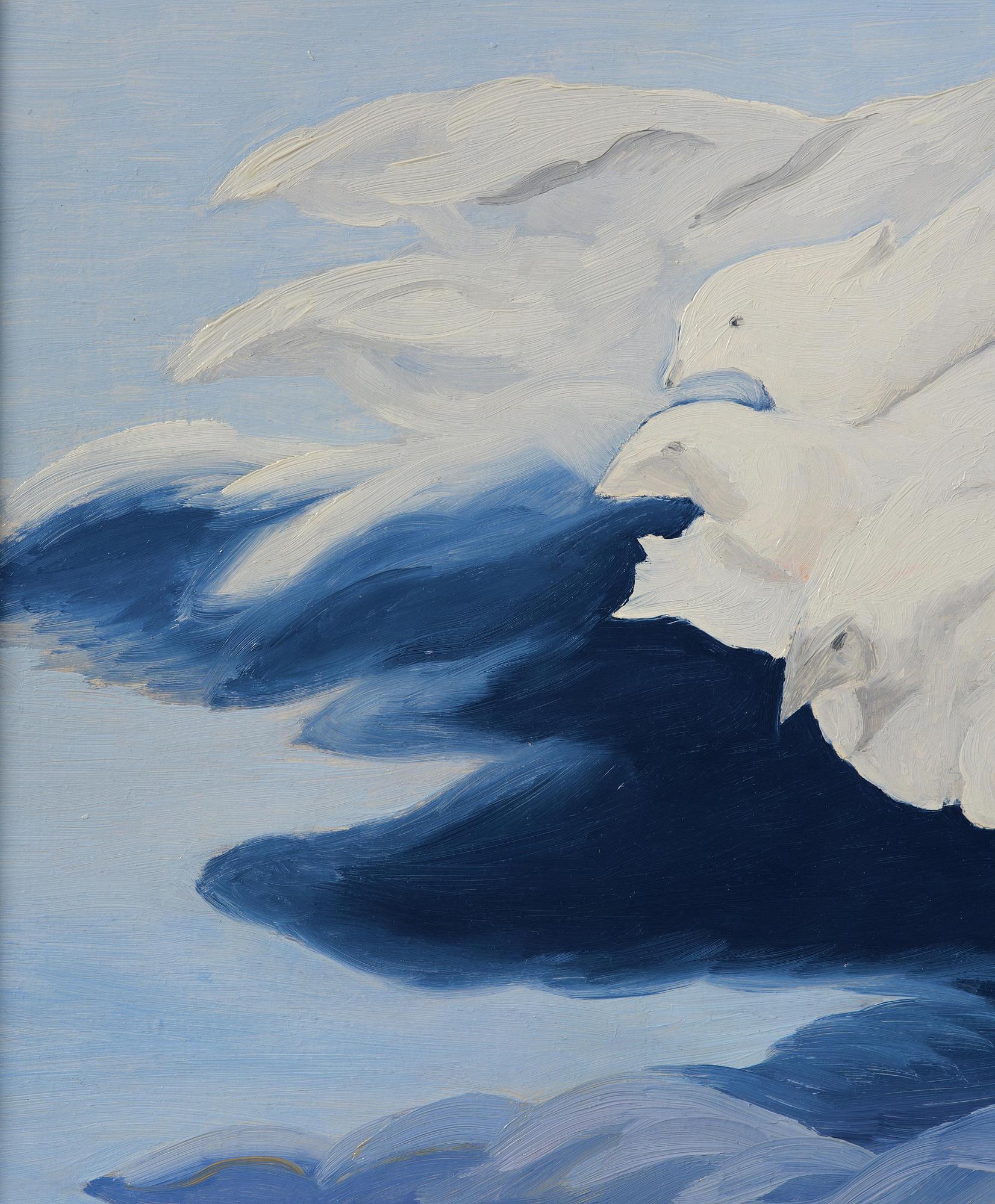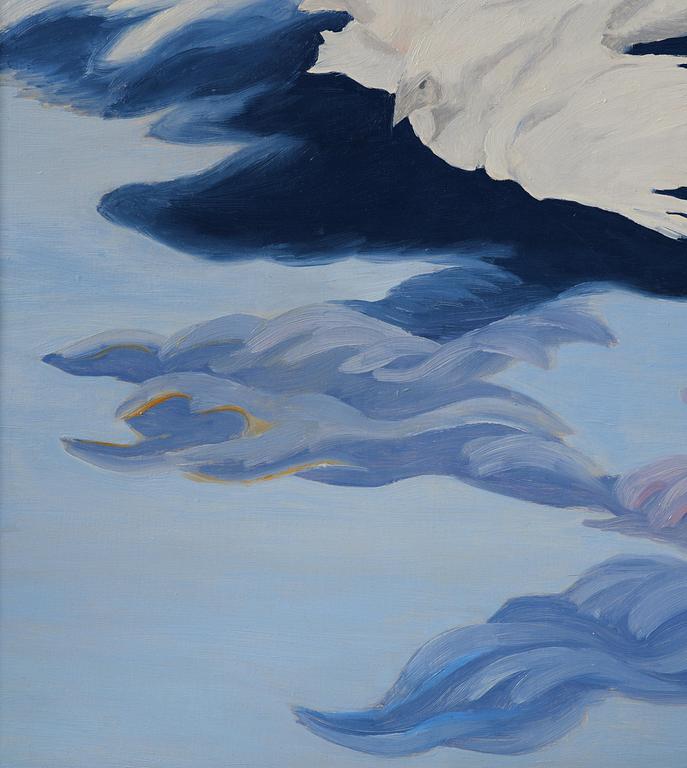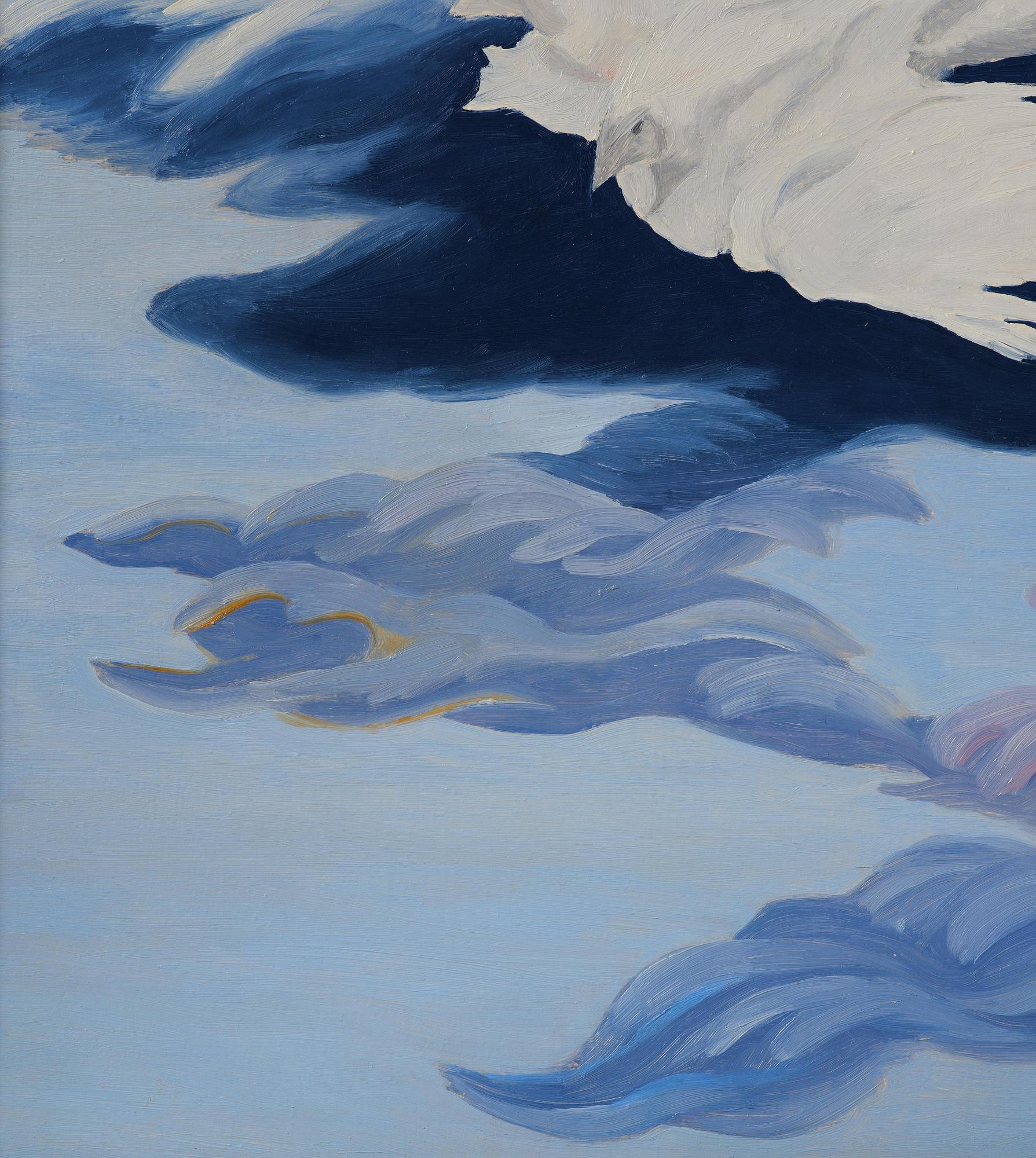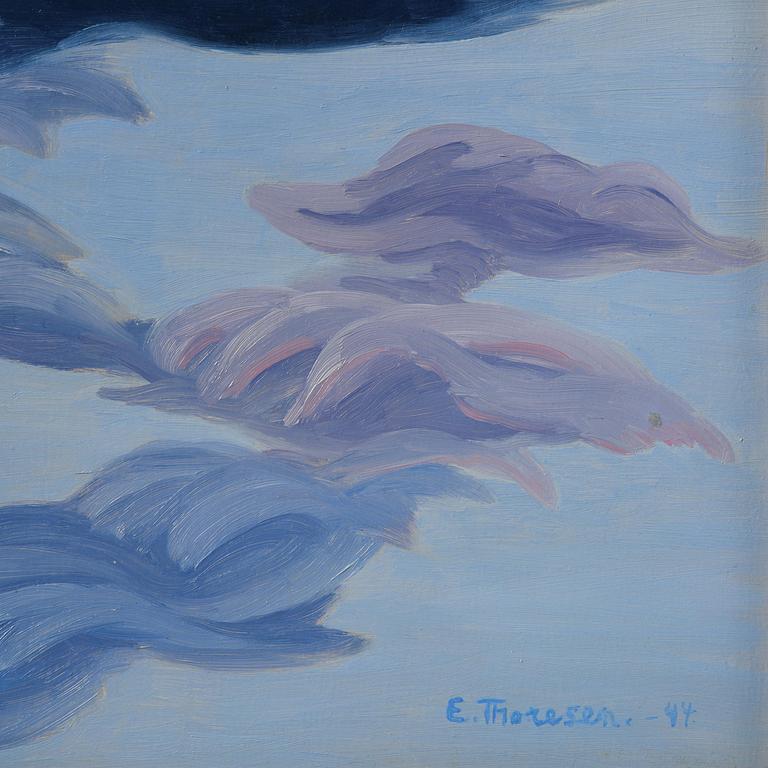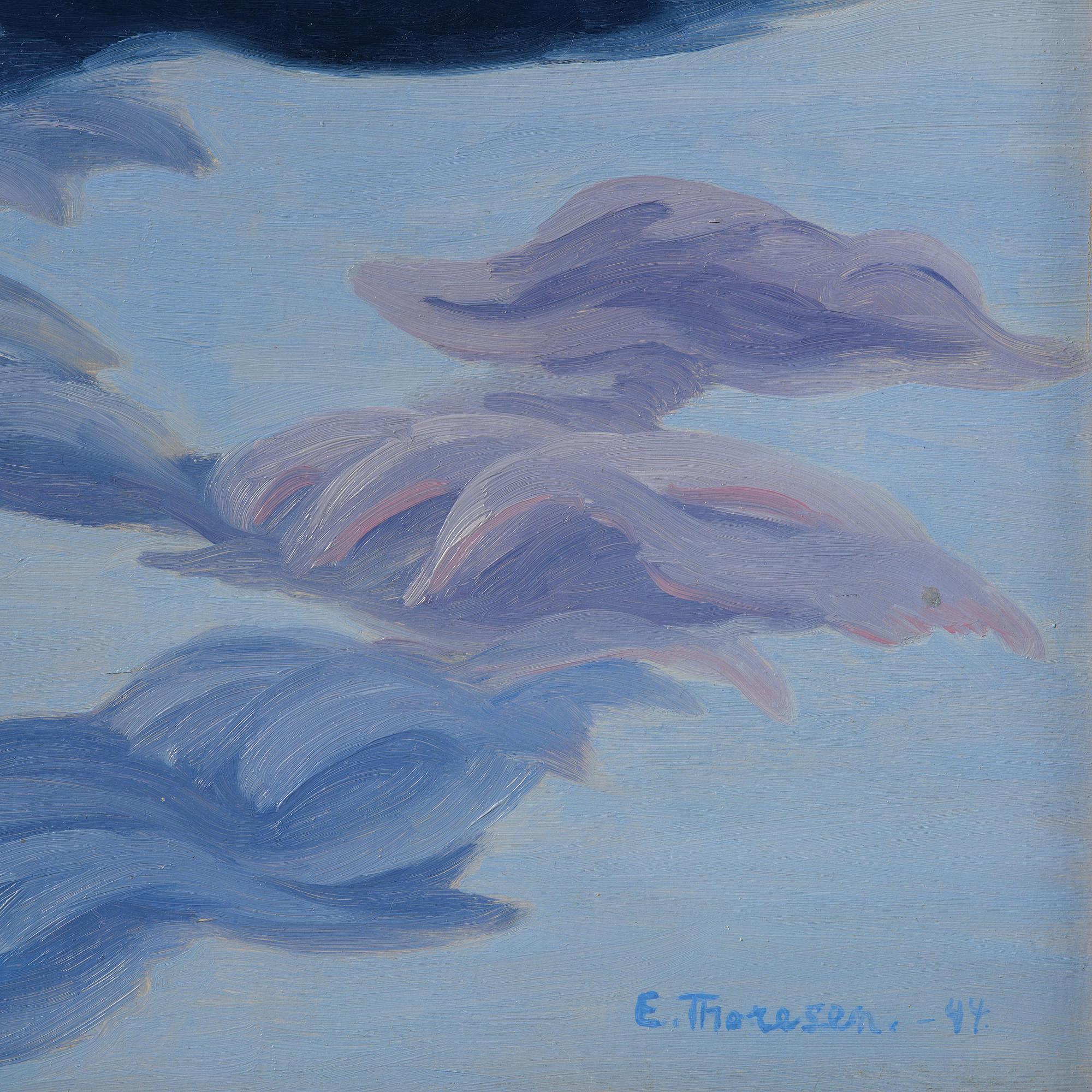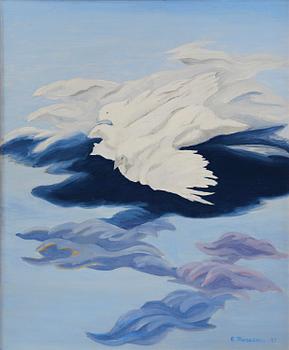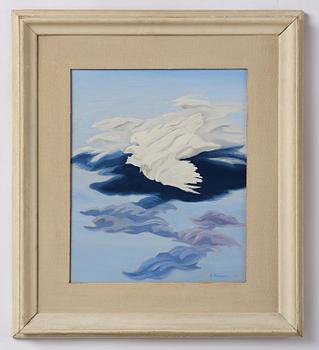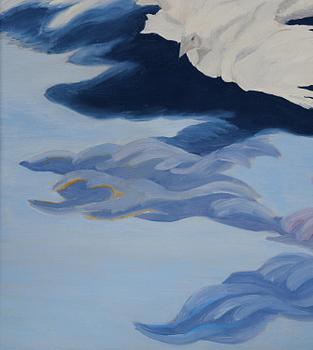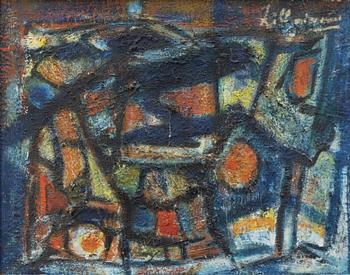
"Duvornas moln"
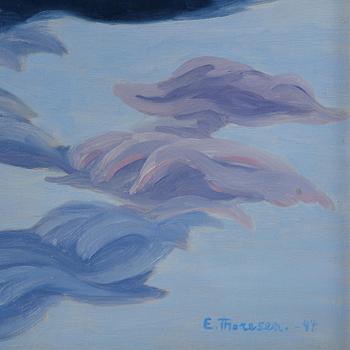
Signed E. Thoresen and dated -44. Oil on panel, 55.5 x 46 cm.
Alkuperä - Provenienssi
Acquired directly from the artist by Dr Oscar Hagen in Halmstad during the 1940s.
Subsequently inherited by the current owner.
Näyttelyt
Färg och Form, Stockholm, group exhibition with Elsa Thoresen, Alf-Jörgen Aas, Vilhelm Bjerke-Petersen, Henrik Inne and Egon Møller-Nielsen, 1944.
God Konst, Concert Hall, Gothenburg, “From Five Nations”, exhibition 36, 25 May–10 June 1945. Thoresen exhibited four paintings, one of which was entitled “The Cloud of Doves”, referring either to the painting in the present auction or to a painting with the same title sold at Bukowskis in 2019 and now in the collections of Halland Art Museum.
Kirjallisuus
Thomas Millroth, "Good luck, Elsa", 2024, cf. another variant of "Duvornas moln" in the collections of Halland Art Museum, illustrated p. 79.
Muut tiedot
Elsa Thoresen was born in the United States, but was of Norwegian descent. She lived in Oslo for several years, where she also received her education. For a period, she also studied at the Académie des Beaux-Arts in Brussels, Belgium. Thoresen subsequently moved to Denmark, where she married the artist Vilhelm Bjerke Petersen. They were both central figures in the radical Danish Surrealist movement, a group that turned its opposition against the Nazi German occupiers during the war. However, they managed to escape to Sweden, where they became closely associated with the artists of the Halmstad Group.
Thoresen was highly regarded by André Breton, the leading figure of international Surrealism. He selected works by her for the movement's major exhibitions in 1938 and 1947. After fleeing to Sweden, she worked both in Sweden and Denmark for several years, but returned to the United States in 1953. Over the years, Elsa Thoresen faded into obscurity, but in recent years her artistic output has been rediscovered. In 2018, audiences were able, for the first time in many years, to see a presentation of her work in the exhibition Kvindernes Surrealism at Kunstforeningen Gl. Strand and the Art Museum in Tønder in Denmark, as well as at Mjellby Art Museum in Sweden.
In the recently published book on Elsa Thoresen, Good Luck, Elsa (2024), Thomas Millroth writes the following about the motif Duvornas moln (Cloud of Doves):
“(…) As already mentioned, Elsa Thoresen participated in Färg och Form in Stockholm in September 1944, together with Vilhelm Bjerke-Petersen and Egon Möller-Nielsen. The latter was already known to Stockholm audiences, and his ‘refined linear drawings’ were singled out for particular praise by the critic Ulf Hård af Segerstad in Svenska Dagbladet. He assessed the artists who were new to the public with a discerning eye. He regarded Bjerke-Petersen as a doctrinaire artist, whereas Thoresen was praised for works that were much more independent than his and distinguished by a ‘peculiar and captivating beauty’, according to Svenska Dagbladet, 26 September 1944.
There was, however, one thing he regretted: the fact that the writer Artur Lundkvist, whom they had presumably come to know in Söndrum, had invented the titles, or ‘stuck on labels roughly as one does on jam jars’, as the reviewer mockingly put it. He considered them banal and felt that there was no need to constrain the viewers’ imagination. Her paintings in themselves ‘have the power to stimulate everyone’s imagination’.
(…) And if I then try to follow this gaze a few years forward and see what Thoresen was painting at that time, I stop at Duvornas moln, 1944, painted in Sweden shortly after the escape. In a decisive way, it recalls Strandens ansigt, namely through the clear division of the background into two fields of colour. The movements are the same, towards the left, away.
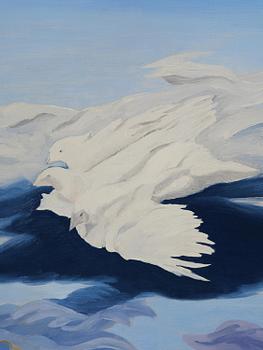
Here too there is a transformation, a metamorphosis. The first thought is, of course, where these three doves at the centre of the image have come from; who or what has been transformed into them. And, just as skilfully as in 1939, she uses colour as the vehicle of the imaginary. It is her sieve through which to sail.
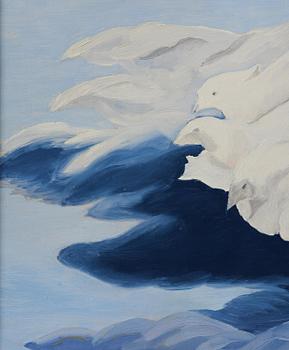
The clouds in the sky are painted in caput mortuum, which swallows up all light; that which seemed to emanate from the face in the shore in the earlier painting. The colour is the dark matter of the place of the skull; nothing returns from it. And yet Thoresen transforms the scene with light brushstrokes in caput, broken with a little white, so that the sky resembles plumage, an impossibility risen from the trampled earth of death.
And with a little more white in the dark red, she paints the three doves with their enigmatic form. Tightly closed together, are they about to plunge into, or make their way across, the restless green sea? Their shadow is already floating on the surface of the water. The breath is heavy. But they fly.” (Thomas Millroth, Good Luck, Elsa, pp. 180–182).
Bukowskis would like to thank Kent Belenius for the information regarding exhibitions.
Lisätietoja ja kuntoraportit

Mitä kuljetus maksaa?
Toimituksen voi tilata vain ottamalla yhteyttä osoitteeseen specialdelivery@bukowskis.com.
Tietoa ostamisesta
Kuvan käyttöoikeudet
Tämän tietokannan taideteokset ovat tekijänoikeudella suojattuja, eikä niitä saa kopioida ilman oikeudenhaltijoiden lupaa. Teokset kopioidaan tässä tietokannassa Bildupphovsrättin lisenssillä.