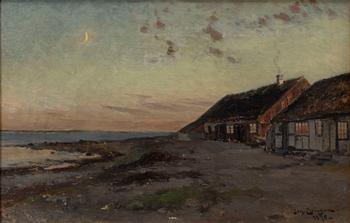
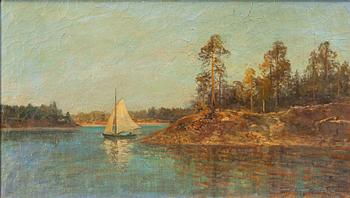
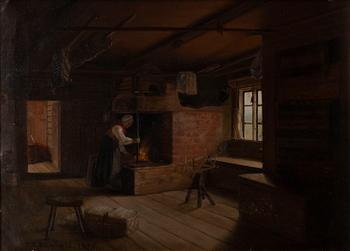
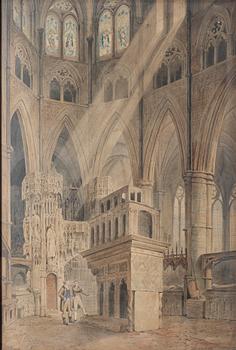
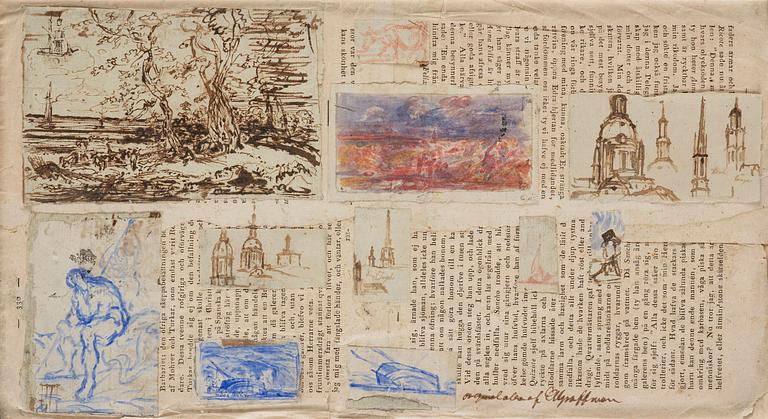
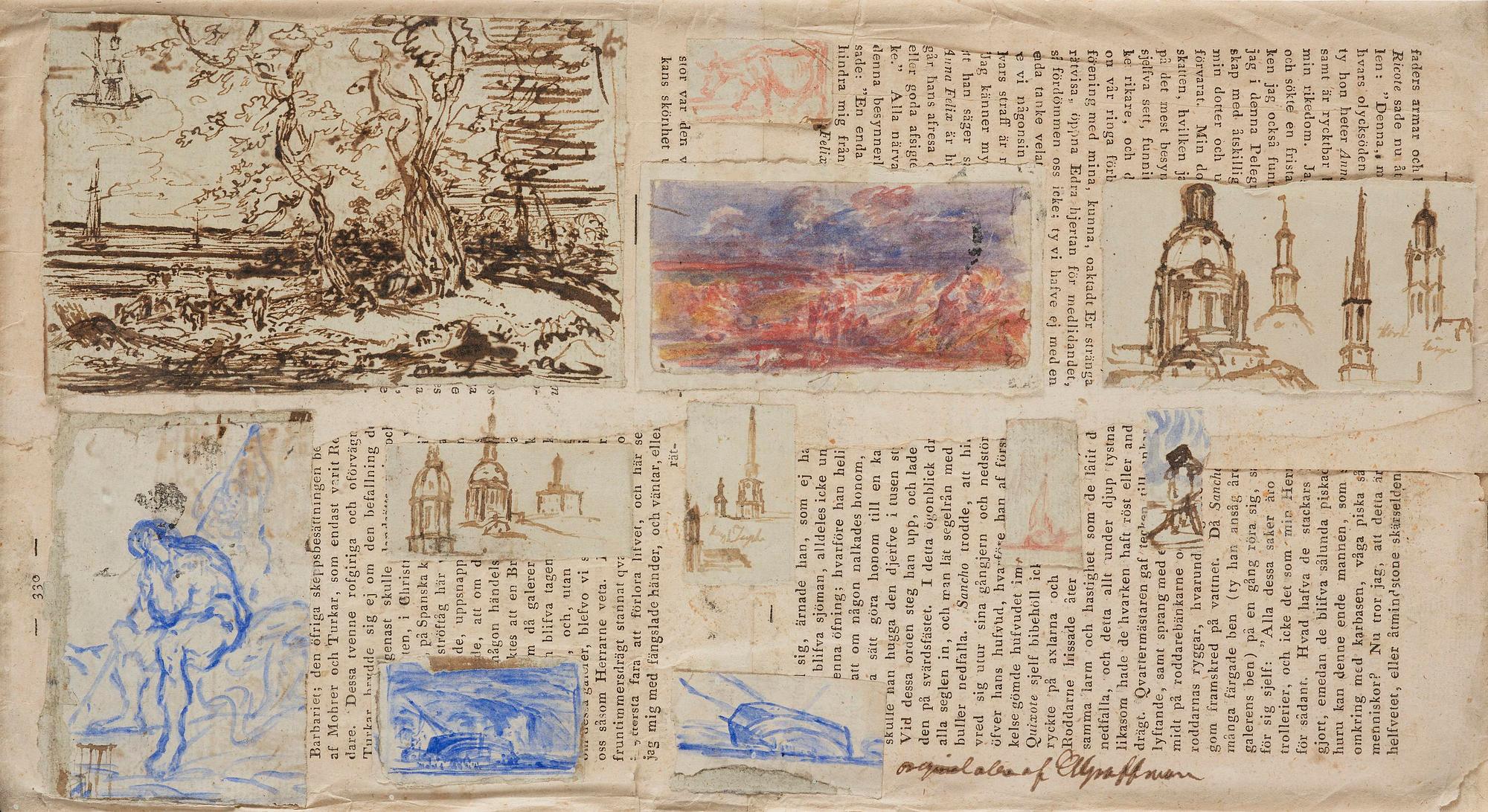
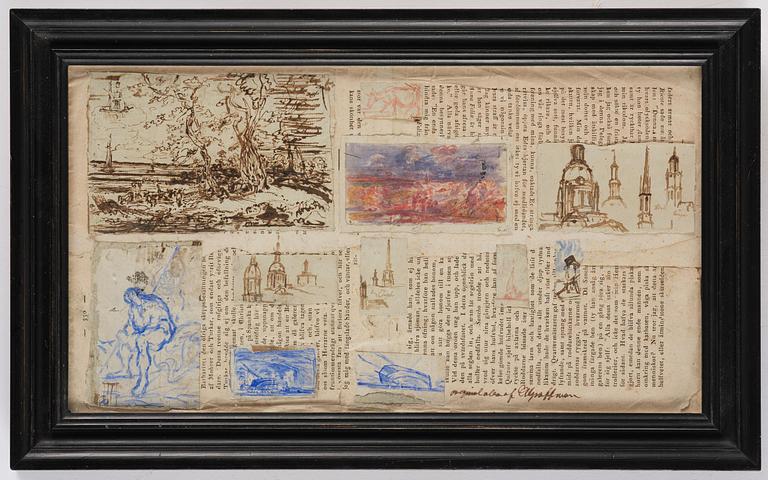
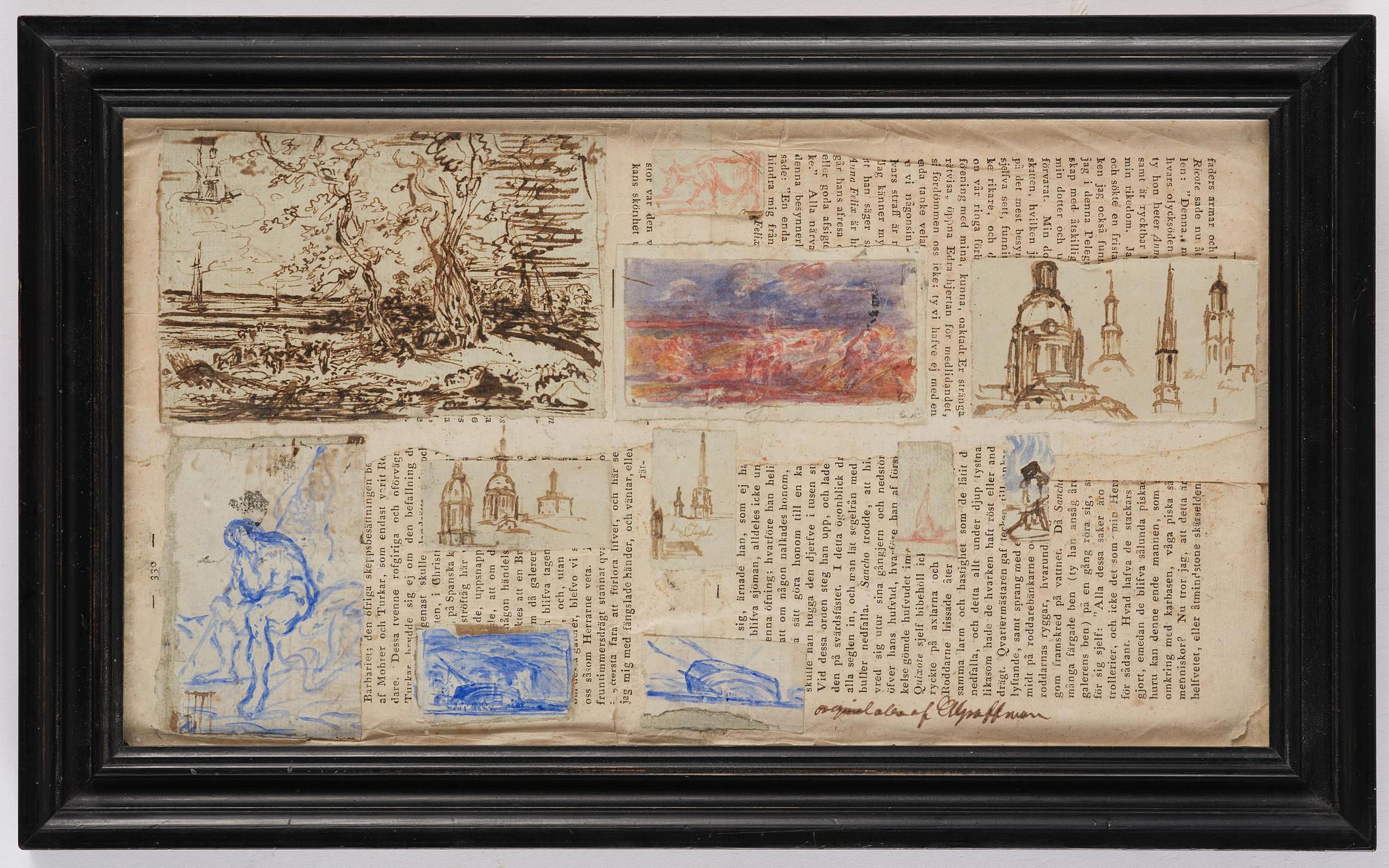
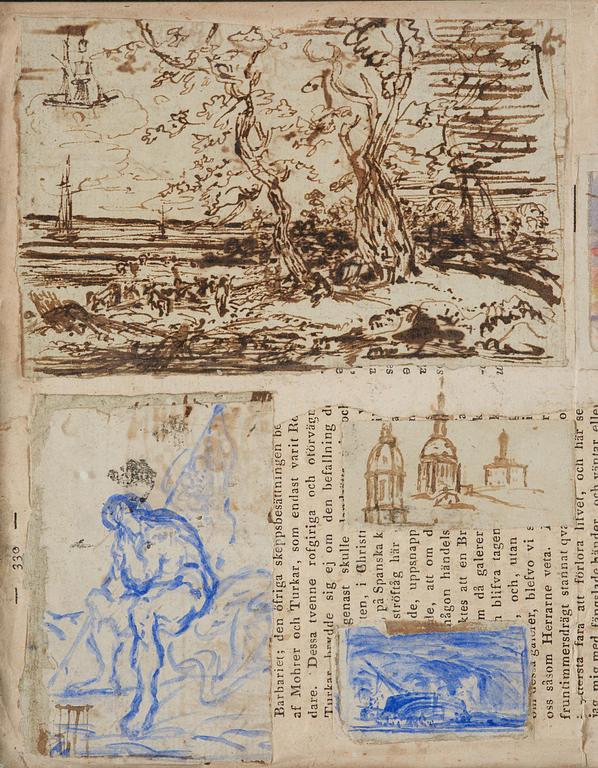
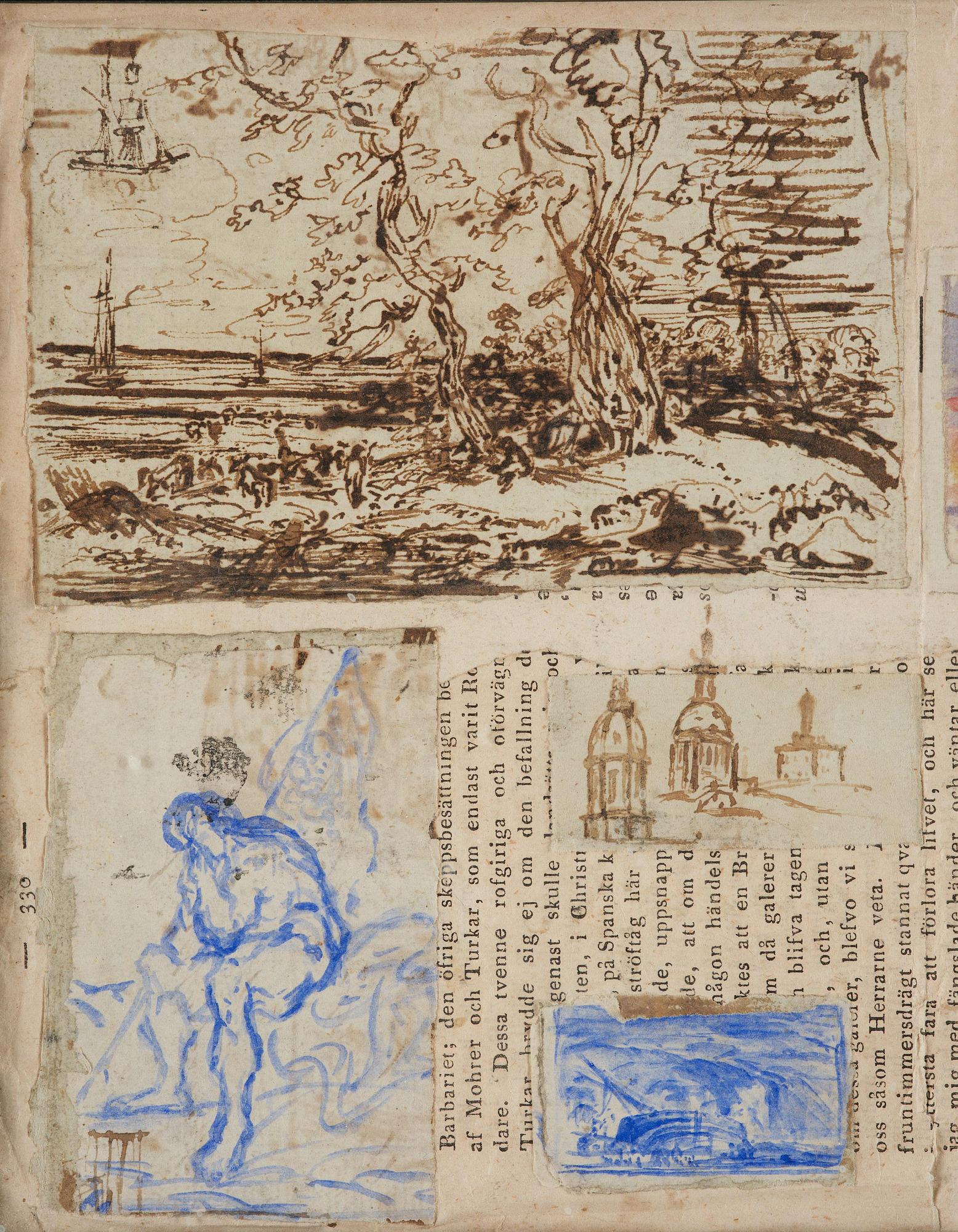
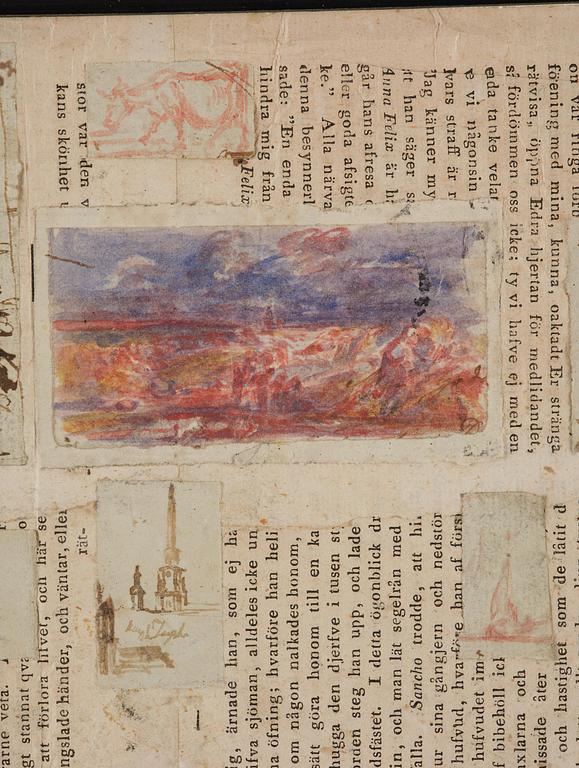
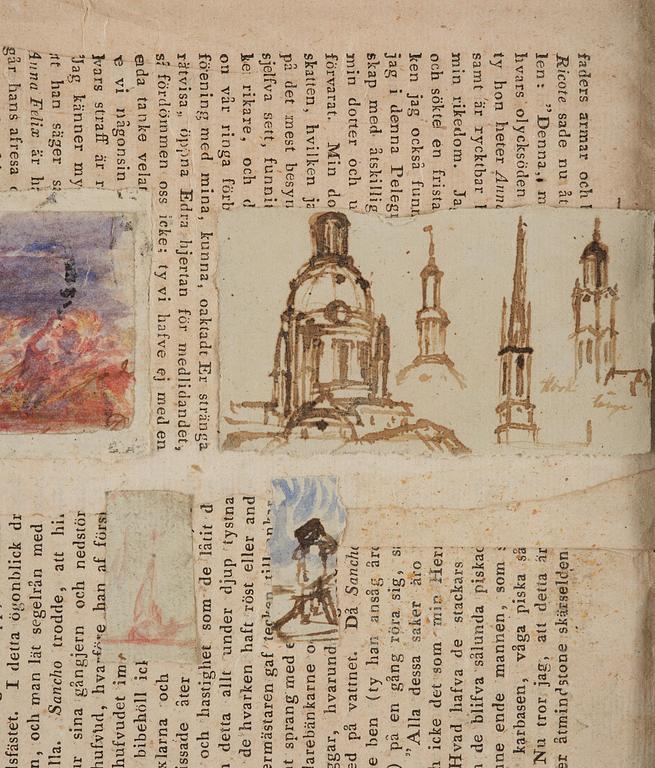
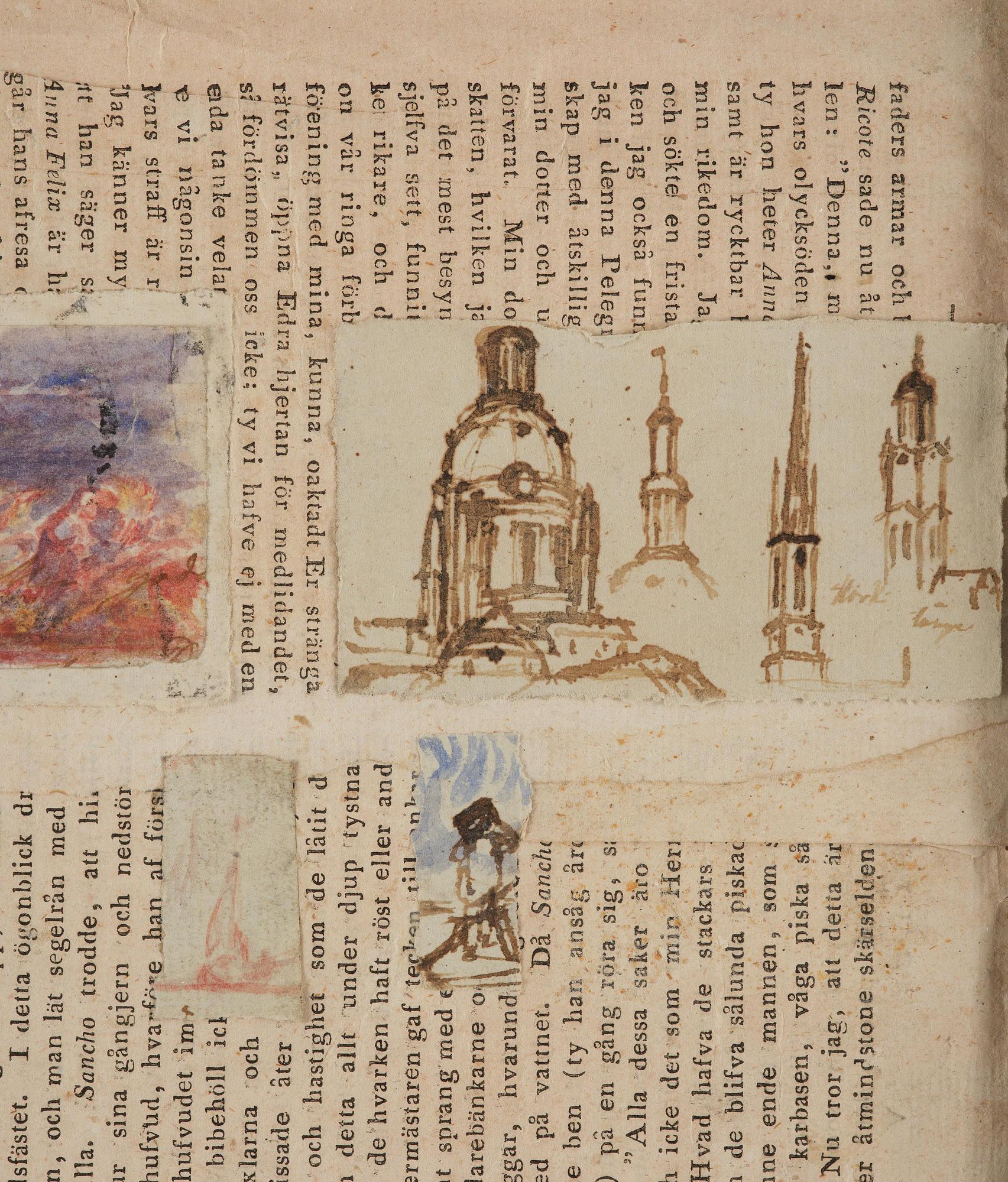
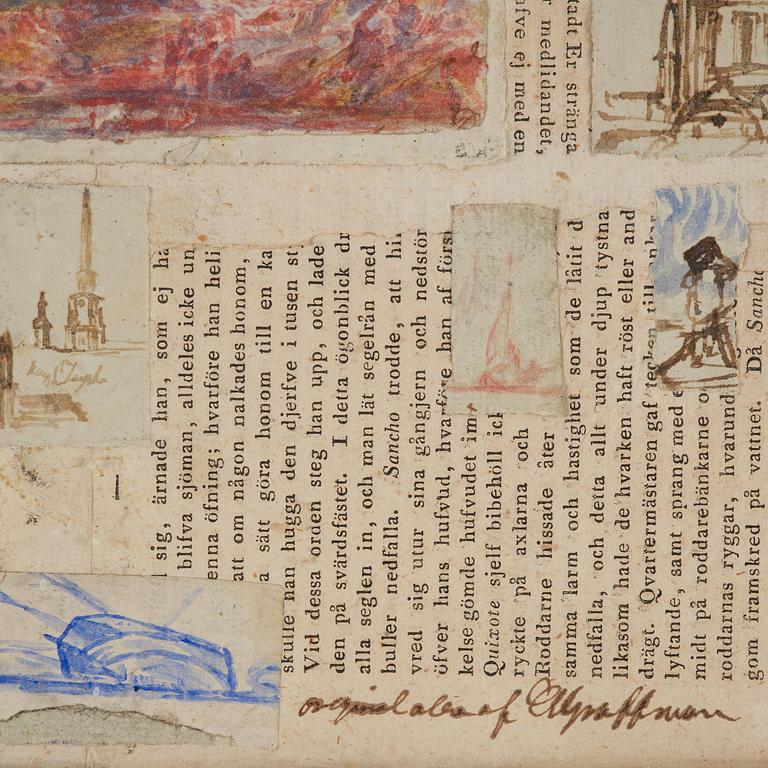
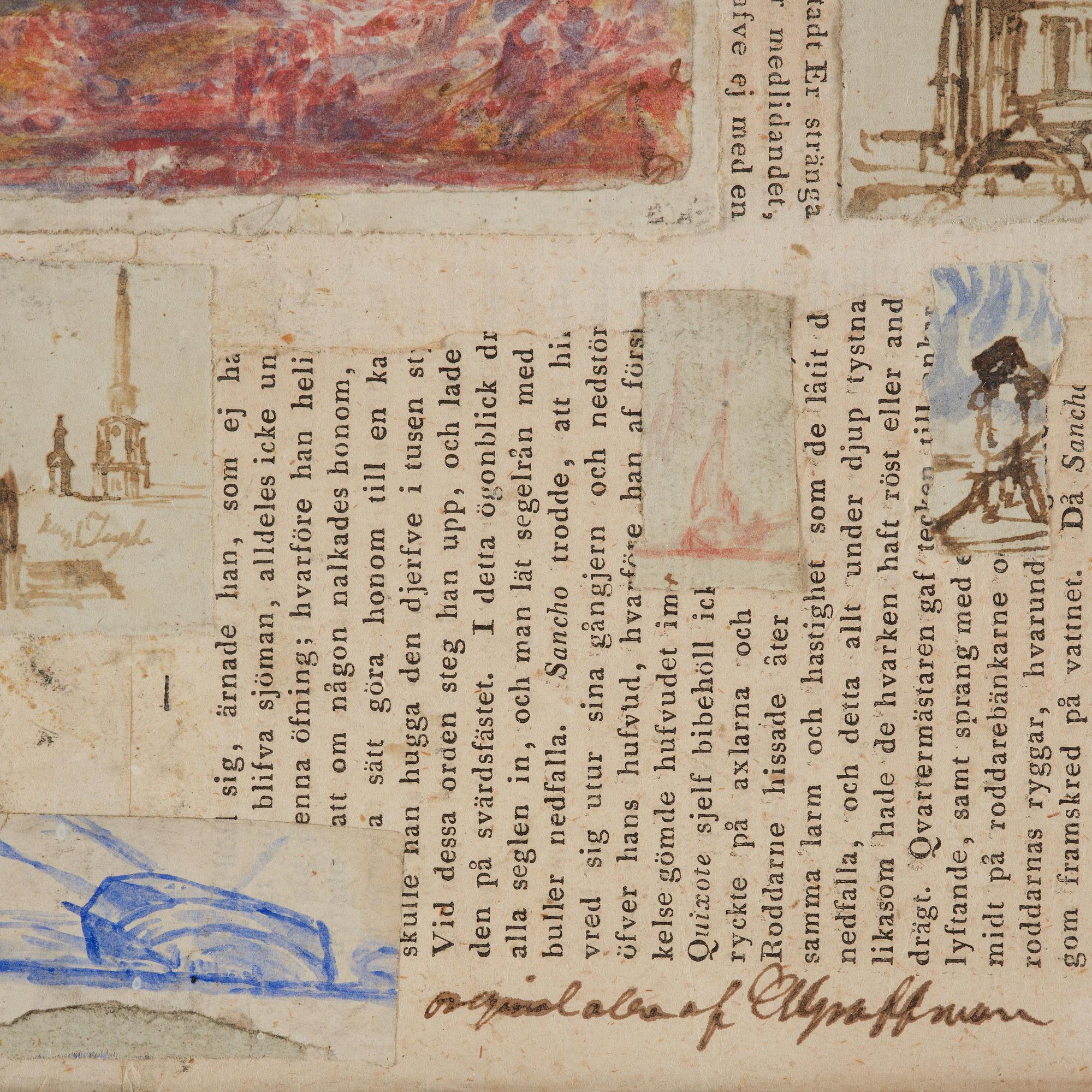
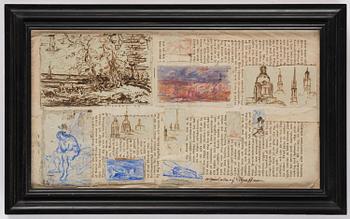
Carl Samuel Graffman (Ruotsi, 1801-1862) Eleven drawings of various subjects laid on a printed text sheet
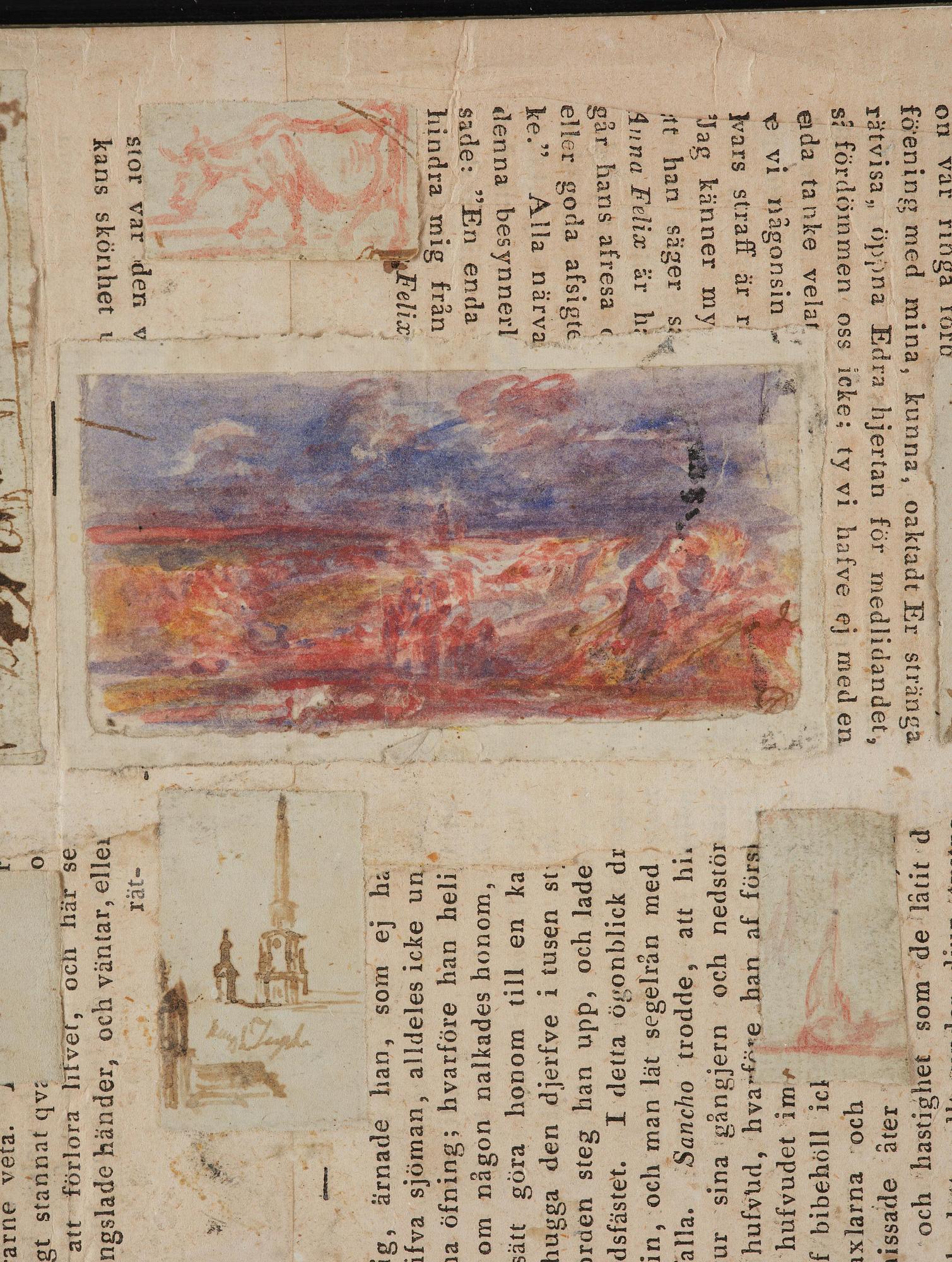
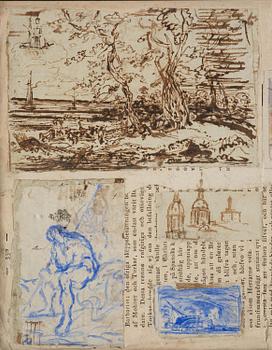
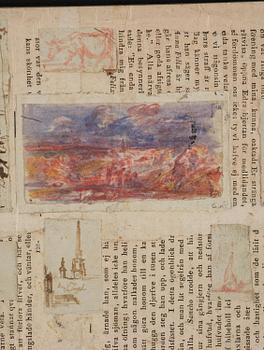
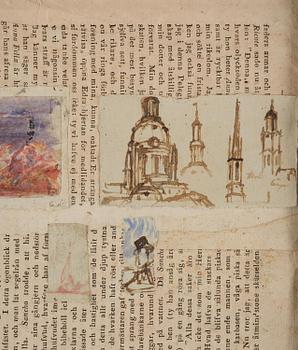
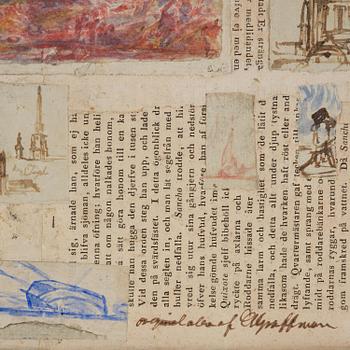
Eleven drawings of various subjects laid on a printed text sheet
Signed ”Orginalarbete af C Graffman” (original work by C Graffman). Various techniques and various sizes, sheet size 20 x 35.5 cm.
Näyttelyt
Prins Eugens Waldemarsudde, Stockholm, "Carl Samuel Graffman", 3 March - 28 May 2006.
Kirjallisuus
Sten-Åke Nilsson, Fragment av ett liv. En biografi över landskapsmålaren Carl Samuel Graffman, p. 101, illustrated in color full page.
Muut tiedot
Drawn at Danviken’s hospital in Stockholm between 1841-42.
Swedish art during the latter part of the 19th century and the beginning of the 20th century would appear considerably paler and poorer if works created by artists who suffered from mental illnesses were excluded. Without judging between "sick" and "healthy", it can be stated that painters such as Carl Fredrik Hill and Ernst Josephson during their repective mental illnesses gave us works that we count as inalienable. To these can be added two lesser known artists, Johan Fredrik Hörling (1718-1786) and Carl Samuel Graffman. Both suffered from mental illnesses early in their lives, which explains why relatively few works from their mentally healthy periods are known.
Groundbreaking for the knowledge of Graffman as an artist is Gunnar Jungmarker's article Carl Samuel Graffman and his disease drawings, in Nationalmusei yearbook, 1935. In 1966, Karin Melander wrote an unpublished three-grade essay about him, Carl Samuel Graffman: a forgotten 19th-century artist, and in 1995 Professor Sten-Åke Nilsson published an article about him in Artes, Drawn after nature: Carl Samuel Graffman. However, the public breakthrough for his art only came as late as in 2005 when Nilsson published the first monograph on him, Fragment of a Life. A biography of the landscape painter Carl Samuel Graffman. The book was followed up with an exhibition of Graffman's work at Prins Eugen's Waldemarsudde the same year. In 2008, finally, Nilsson published an article in Biblis about Graffman, The eagle in a cage, in which he gives an account of some newly discovered documents concerning Graffman’s life.
Graffman begun his career as a romantic landscape painter and graphic artist. During his study years at the Royal Academy he was a student of Professor Carl Johan Fahlcrantz, the leading landscape painter in Sweden at the time. Fahlcrantz considered Graffman his most talented student. In the summer and autumn of 1830 Graffman conducted a journey to Scotland, which at that time was enjoying great popularity—it was the romantic land of Ossian and Sir Walter Scott. Graffman visited Scott at his home in Abbotsford, probably through a recommendation by Fahlcrantz. Guided by Scott's instructions, Graffman criss-crossed Scotland in all directions visiting historic and scenic sites. It was the wild nature of the highlands' wilderness that attracted him. A product of this trip was the work Skottska Vuer, from 1833 with lithographs by Carl Johan Billmark after Graffman’s work and text by Thure Vensjoe. The work became hugely popular and helped make Graffman famous. Graffman’s oil paintings based on his sketches from Scotland were exhibited at the Royal Academy where several were bought by King Karl XIV Johan (Rosendal Castle, Stockholm).
In 1834, Graffman received a three-year travel scholarship to France for further studies. Towards the end of his stay, in 1836, mental illness broke out and he was interned in a mental hospital in Charendon outside Paris for a year. Recovered, he returned to Sweden in 1837. Graffman arrived in Stockholm during a politically turbulent time. The hostility towards the government's pro-Russian policy was widespread and was not lessened by the fact that the Russian Emperor Nikolai I unexpectedly visited Stockholm on 10 June 1838 to discuss trade on the Baltic Sea. The fierce political atmosphere reached its climax in 1838 with Magnus Jacob Crusenstolpe’s anti-monarchist series of writings. For several years he had fiercely opposed the government’s pro-Russian policy and had called for rejection of the declining defense budget. Crusenstolpe was convicted of lèse-majesté and sentenced to three years in prison. The harsh sentence led to riots breaking out and during the summer Stockholm was on the verge of a revolution. On June 22, 1838, the people and the military clashed, shooting broke out and two people were killed. Following his return to Sweden, Graffman had shown a penchant for political musings. In connection with the impending visit of the Russian Emperor, he committed an act which was to have fatal consequences ro his life. The Chief Medical Officer at Danviken Madhouse, Carl Ulrik Sondén, tells about this in a report concerning Graffman from 1856 (Nilsson, op. cit., p. 55):
"G. undertook the imprudence [in the summer of 1838] to reason widely about politics in Castehoff's cellar at the breakfast table, and having reached a certain ecstasy, he pulled out a couple of pistols and struck them on the table while exclaiming: "let the damned Russian come here, I'll be a man because he doesn't get out of here alive". This caused G. to be arrested, and, once in prison, he fell into complete madness with rage and was taken to Danvik's Madhouse, where he arrived in July 1838.”
On October 19, 1841, an allegory about Graffman's fate was published in the daily Aftonbladet with the title "The eagle in a cage". The anonymous author pleaded for Graffman’s release. Graffman himself made serious attempts to be released and pleaded for pardoning. In his report, Sondén writes (Nilsson, op. cit., 2008, p. 25):
”Since his entry into the asylum, he has not been able to bring himself to paint, only draw with pen and ink or charcoal, fragments of landscapes, animals and human figures and portraits.”
The article coincide with Graffman’s only known period of artistic activity during his lifelong internment. It thus appears that his artistic activity was a last attempt to show that he was still fully capable of functioning in society as a performing artist. Society's verdict against patients admitted to Danviken's hospital was harsh, however. Only ones during Danviken's more than 100-year history a patient was released. Eight years after his internment, Graffman wrote to J. G. Sandberg, professor of painting at the Academy of Fine Arts (op. cit., p. 27):
"I protest with all my understanding and concepts and with the letter of the law against my conviction"
After 23 years at Danviken, Graffman was transferred in 1861 to the newly established Konradsberg Hospital, where he died the following year.
Some 200 drawings by Graffman are known, the majority executed at Danviken between 1841-42, most of which are in museum collections. The majority comprise of imaginative landscapes and portraits of fellow patients and nursing staff. Many of the surviving drawings have been pasted onto cut-out book pages. They are often signed and in several cases also dated. The majority are executed in miniature format, but some evocative large studies of trees are also known. Some of the landscapes are based on views he had from the windows at Danviken's hospital, but in most cases they are products of Graffman's memoriy and imagination.
Graffman's drawings from his internment at Danviken Madhouse have few parallels in art history. In his isolation, he managed to break out of the conventional framework and achieve something highly original and deeply personal.
Lisätietoja ja kuntoraportit

Mitä kuljetus maksaa?
Tietoa ostamisesta

Muiden katsomia kohteita