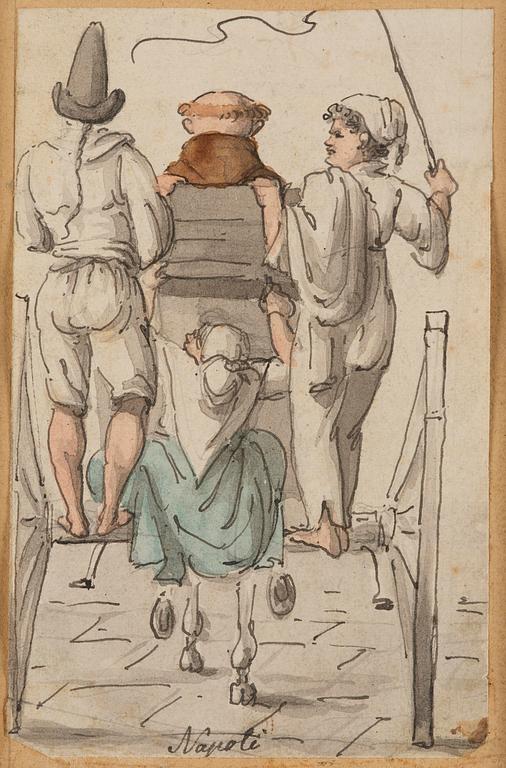
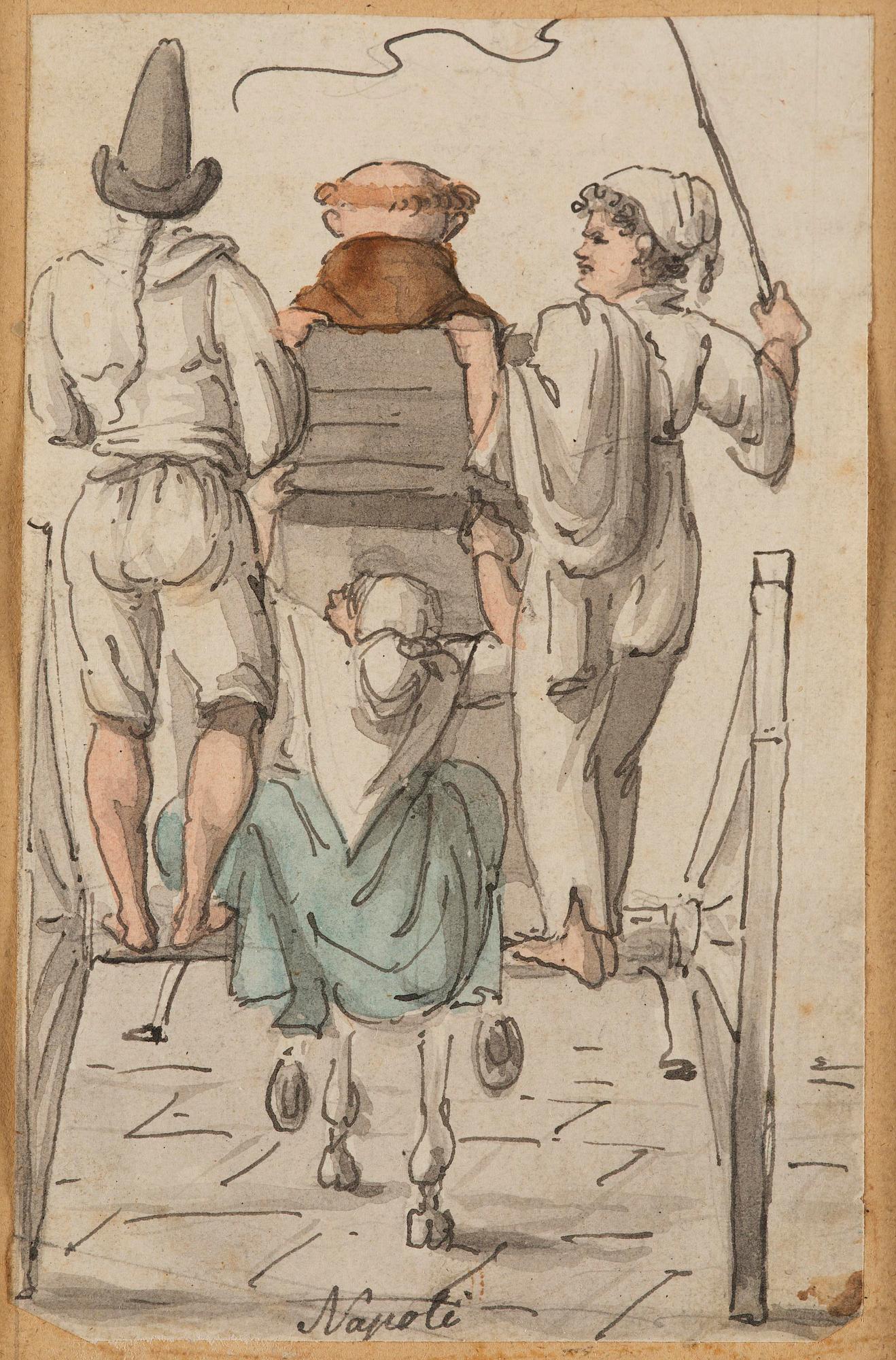
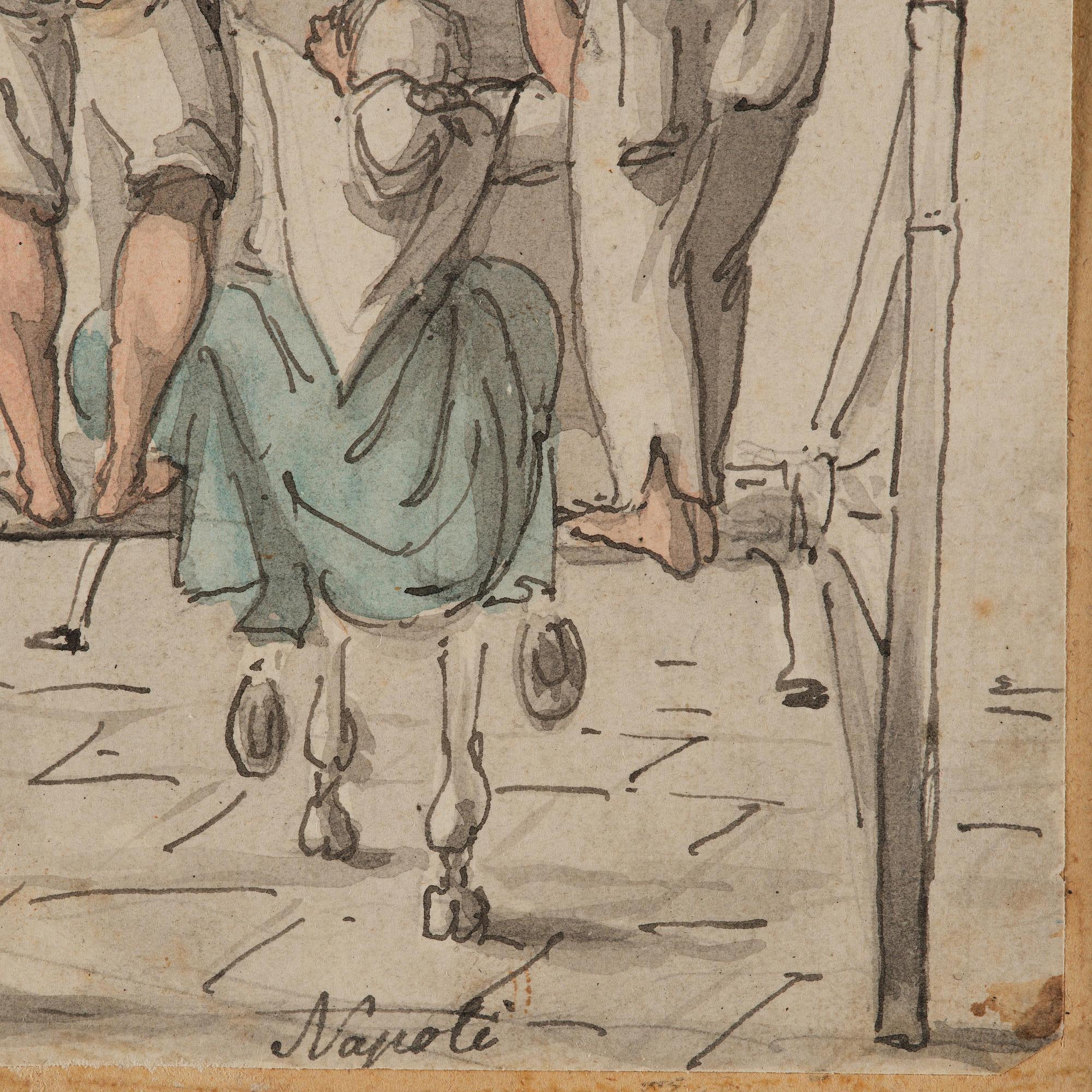
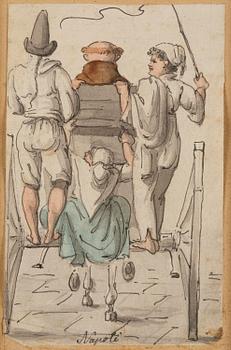
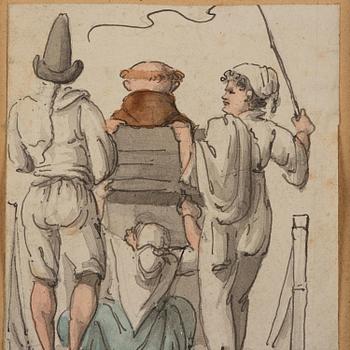
Carl August Ehrensvärd (Ruotsi, 1745-1800) A monk seen from behind being taken away in a cart by two guards standing on either side of a woman
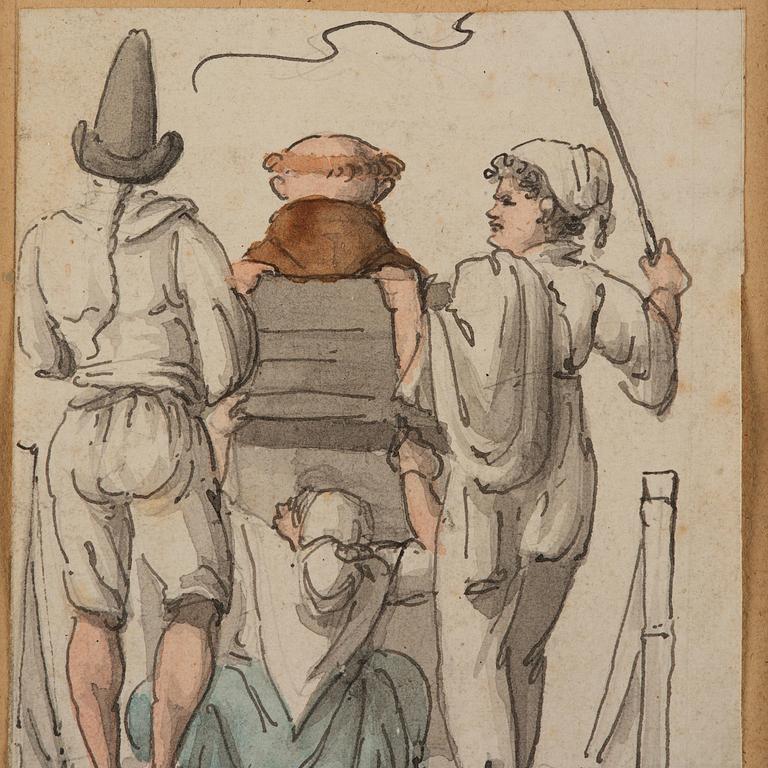
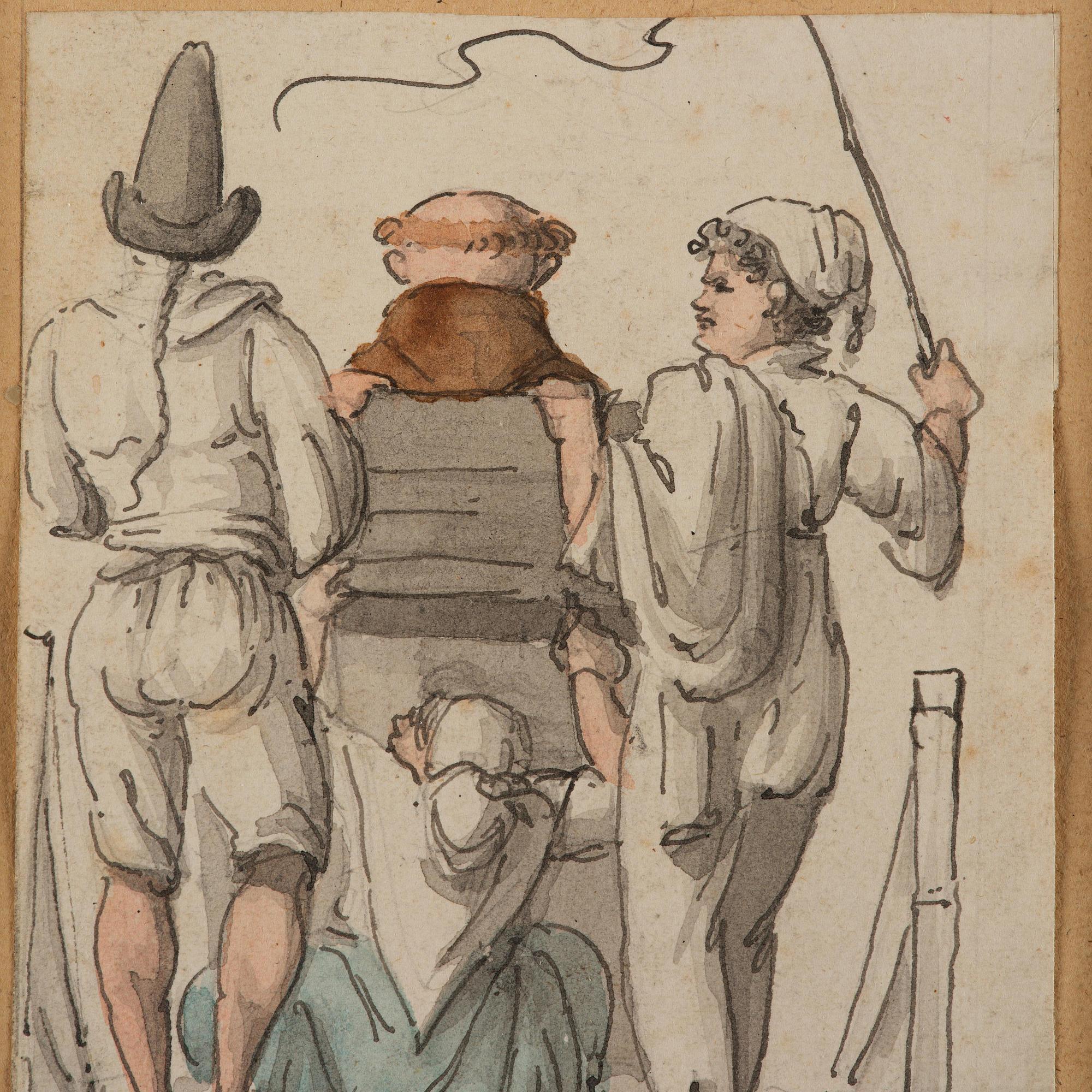
A monk seen from behind being taken away in a cart by two guards standing on either side of a woman
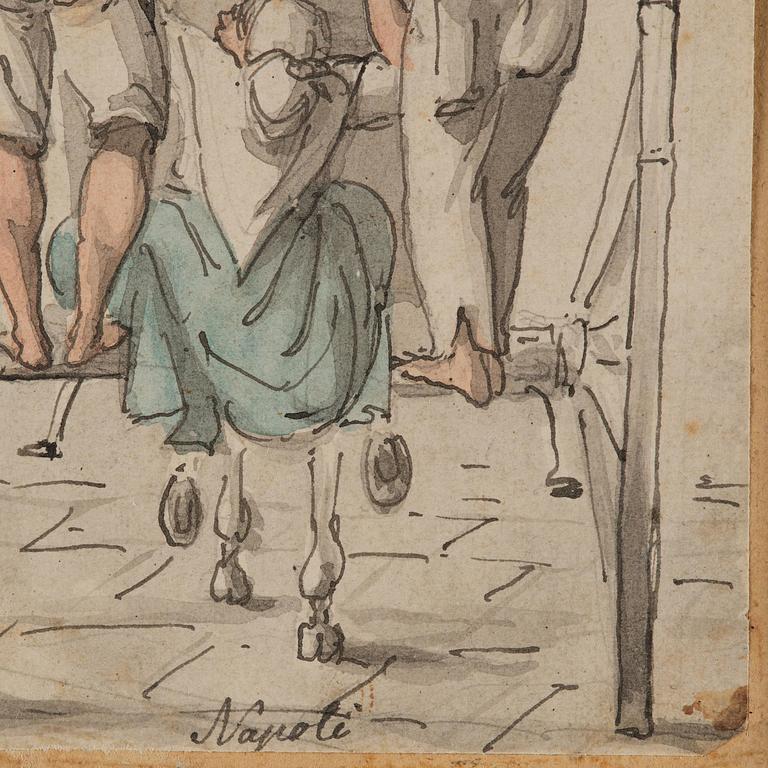
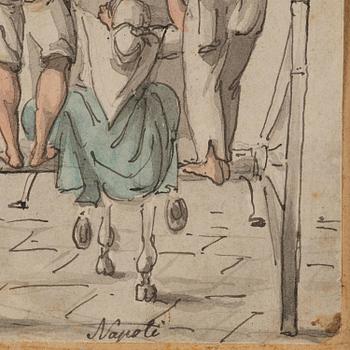
Ink and watercolour mounted on paper 12.7 x 8.1 cm. Inscribed “Napoli”.
Muut tiedot
Carl August Ehrensvärd stayed in Italy from September 1780 until the spring of 1782. He travelled together with his relative Lars Augustin Mannerheim. The journey resulted in the classic account “Resa til Italien, 1780, 1781, 1782”, with illustrations by Elias Martin based on Ehrensvärd’s sketches made in Italy. Ehrensvärd wrote the account in 1782 in Stralsund during their return journey. During their stay in Italy, they visited Naples three times: in March 1781, in May–June 1781 and in the winter of 1782. Ehrensvärd was fascinated and shocked by Naples’s intense, noisy and chaotic atmosphere. He felt that the city’s lively street life and population stood in stark contrast to the austere ideals of antiquity. He therefore mainly used the city as a base for travelling onwards to ancient temple sites in southern Italy, such as Paestum and Sicily. In his book, he devotes a separate chapter to what he calls the “Neapolitan School”. There, he analyses how the city’s climate, temperament and character are reflected in its artistic taste and aesthetics.
The subject of the present drawing most likely has its background in the persecution of monasteries and monks that took place in Naples on several occasions. In 1780, the Holy Roman Emperor Joseph II issued an edict prohibiting contemplative religious orders. This forced thousands of monks to leave their monasteries and led the state to confiscate extensive ecclesiastical property. In Naples, the official archives of the Inquisition tribunal were closed in 1780, and on the neighbouring island of Sicily the institution was formally abolished in 1782. Although this brought an end to tribunals often headed by monks, it was a legal closure of an institution rather than a campaign involving mass arrests of monks. Earlier, in 1767, the House of Bourbon had actively arrested members of a religious order and expelled them from Naples; King Ferdinand IV expelled the Jesuits from both Naples and Sicily and ordered the confiscation of their property. Following the French Revolution, the Neapolitan monarchy dealt harshly with suspected Jacobins. This led to a large number of citizens – including some politically radical monks and priests – being arrested, imprisoned and executed. These events culminated in the proclamation of the Parthenopaean Republic in 1799. The most notable campaign against a religious order took place under the Bourbon monarchy and its influential, reform-minded minister Bernardo Tanucci. Inspired by the ideas of the Enlightenment and seeking to centralise royal power, Tanucci forcefully curtailed the privileges of the Church by employing a legal framework known as "Polizia ecclesiastica" (ecclesiastical police). On 3 November 1767, the Bourbon government issued a surprise decree. Neapolitan soldiers confiscated the Jesuits’ property and rounded up members of the order. Without trial or formal charges, the Jesuits were escorted under armed guard to the border with the Papal States and expelled, with the death penalty as a threat should they attempt to return.
Lisätietoja ja kuntoraportit

Mitä kuljetus maksaa?
Tietoa ostamisesta
Muiden katsomia kohteita