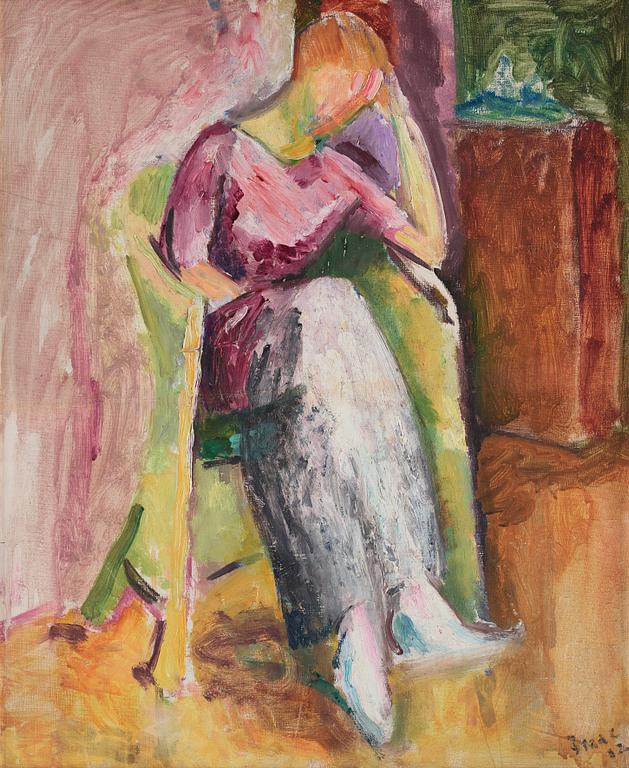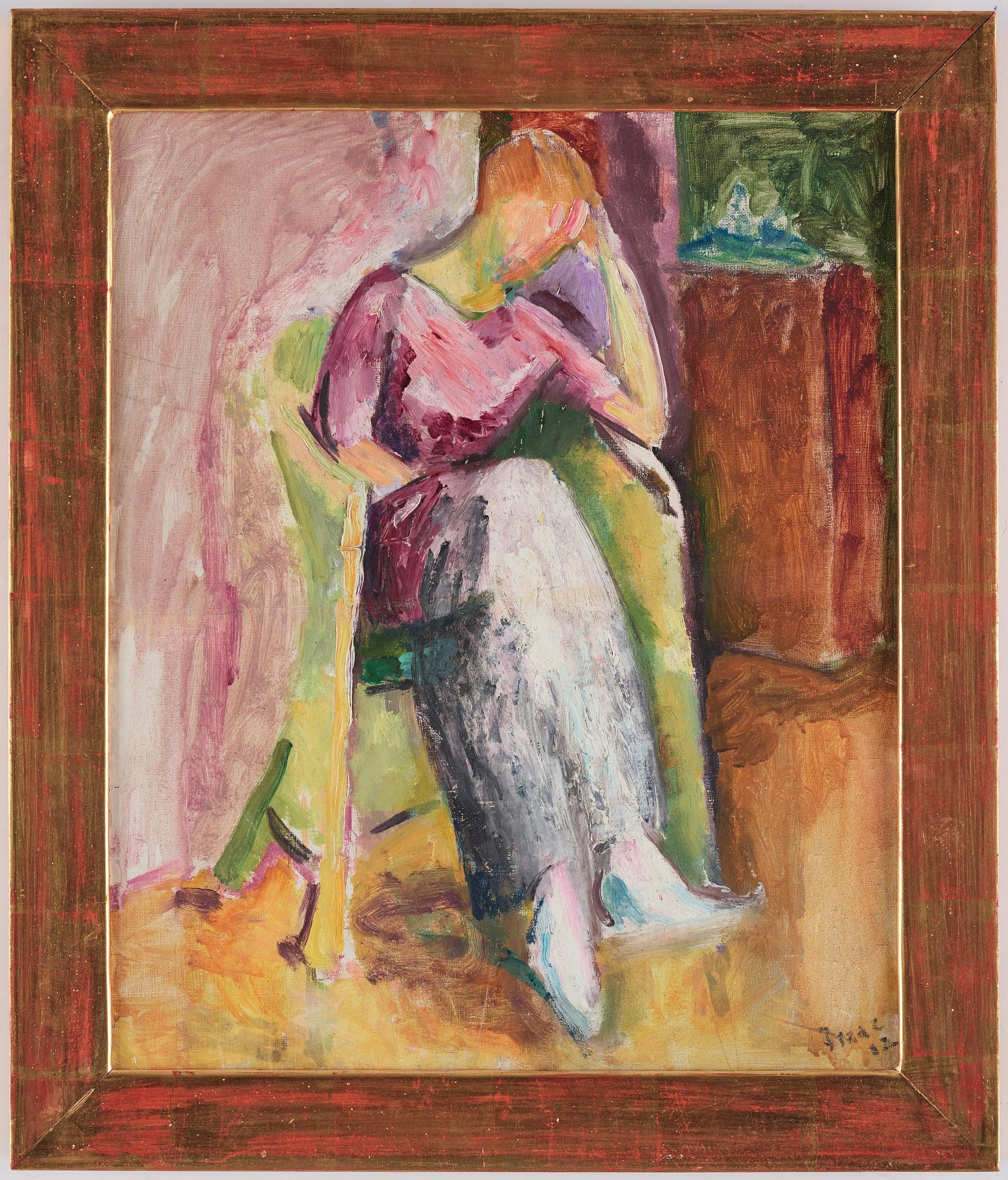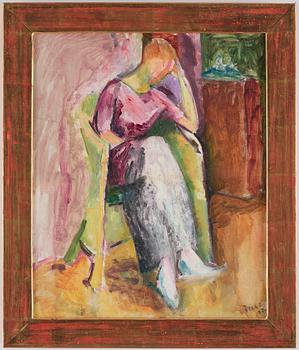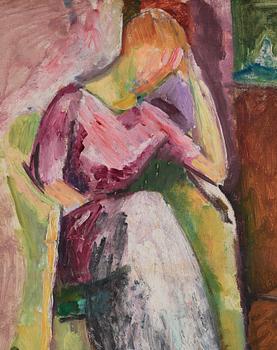
The green armchair.
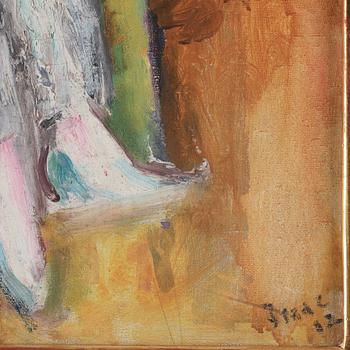
Canvas, signed and dated -12. 45 x 37 cm.
Muut tiedot
Isaac Grünewald is most often referred to as a student of Matisse, but one could also call him a pupil of Cézanne. Whilst studying with Matisse, Grünewald utilised Cézanne's principles to construct a painting, in conjunction with Matisse’s methods. "Just as Cézanne layered colour on top of colour, he (Grünewald) sought form with a richly-faceted viewpoint. With scale upon scale next to scale, he built up his forms and draped them in shimmering colour. He used colour and scale to create contrasts and harmonies and tried to fill every centimeter with light. (J P Hodin, "Isaac Grünewald”, Stockholm 1949, pages 45-46)
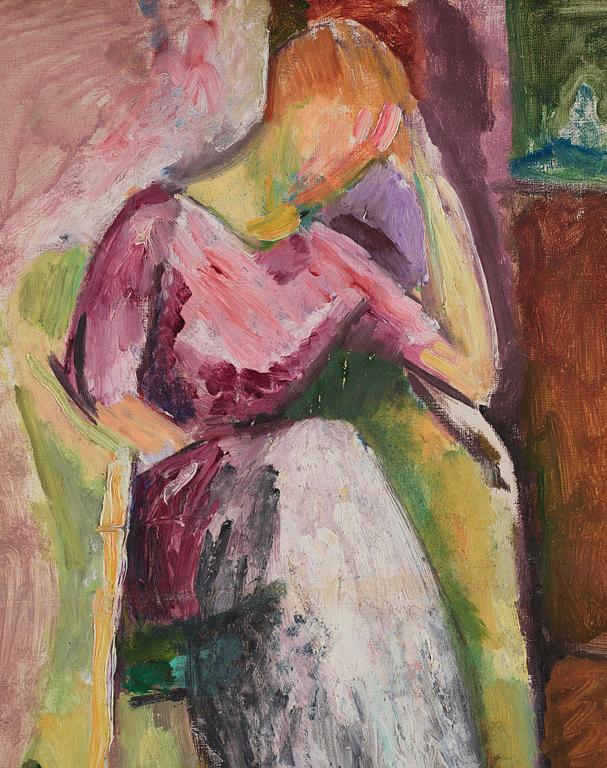
This painting, depicting a female figure in a green armchair, is a fine example of how carefully Isaac Grünewald adopted Cézanne's theories of form (particularly considering nature through the cylinder, sphere and cone), colour and light. The figure is constructed from sparingly depicted geometric shapes and Grünewald shows here how masterfully he manages to juxtapose warm and cold tones. The everyday scene is illuminated by a background light source that makes the woman assume an almost saint-like appearance.
Tietoa ostamisesta