Important Spring Sale presents Anders Zorn | June 10–12
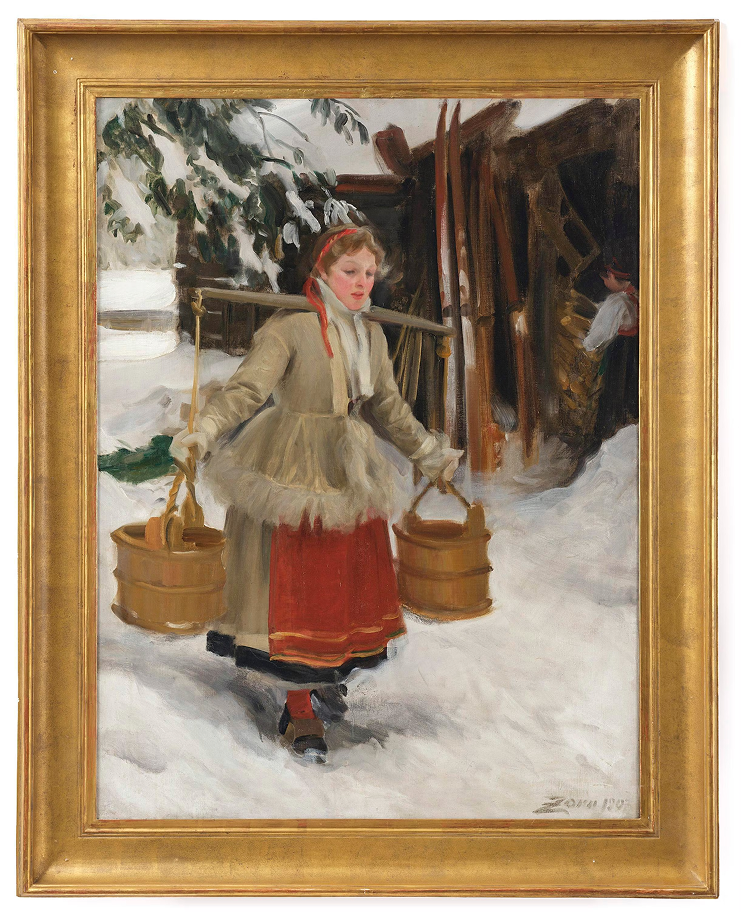
"Hämta vatten" ("The Water Pails")
When Anders Zorn passed away, he did so as one of Sweden’s greatest artists of all time. Whatever medium he turned his hand to, he mastered it with a rarely witnessed skill and elegance, appearing effortless and spontaneous, though often carefully studied and prepared. Likewise, he moved with ease between the aristocracy and the common folk, both formally dressed and buttoned-up, as well as naked and free.
From an early age, Zorn was drawn to the world beyond his native district and undertook many journeys to fascinating places. His remarkably accomplished technique as a watercolourist attracted international attention, not least through portraits and genre scenes exhibited across Europe. Zorn’s breakthrough came during his travels in London and Paris, where he adapted to an international audience and developed his distinctive style of painting. During this period, he increasingly turned to oils, which allowed him greater scope to explore light, skin tones, and reflections — particularly in his celebrated bathing scenes. His artistic talent was extraordinary, and regardless of medium — from early watercolours to meticulously crafted bronze sculptures and powerful oil paintings — his works are characterised by exceptional quality and technical brilliance.
Despite international influences and success, he always held his native Dalarna close to his heart. Mora remained the natural place for celebrations such as Christmas and Midsummer, and it was within the simplicity of everyday life that he felt most at home. After nearly ten years with Paris as his base, Anders and his wife Emma Zorn therefore chose, in the summer of 1896, to return to Sweden and settle in Mora, where the artist deepened his interest in the Swedish landscape and rural life. Here he developed a more nationally inspired imagery, depicting peasant life, traditions, and nature, often through naked or semi-naked figures in open-air settings.
Estimate: 6 000 000 - 8 000 000 SEK
Weekdays 11 AM – 6 PM
Weekends 11 AM – 4 PM
In 1904, Zorn purchased land by the Österdal River, a few miles outside Mora, with the ambition of living a life reminiscent of earlier generations — simple and close to nature. To the site, known as Gopsmor, he moved several buildings from the surrounding area and used it as a retreat, visiting a few times each year. There he was able to work undisturbed and immerse himself in his art without outside distractions. The secluded environment provided space for concentration and creative joy, and several of his most important works were produced there. This dual way of living was not unfamiliar to Zorn, who was already deeply acquainted with the traditional summer pasture culture of the Swedish peasantry. Life there was simpler, perhaps considered too primitive by some, as it is said that Erik Axel Karlfeldt, during a visit, felt embarrassed by the modest conditions.
Alongside his immense artistic achievements, Anders Zorn became one of Sweden’s foremost cultural benefactors. Above all, he sought to preserve historical traditions, including peasant culture. At Gopsmor, Zorn and the people of the household occupied themselves with traditional tasks and entertained themselves with indoor dancing games, while skiing enthusiastically during the winters. Several of Zorn’s most beloved motifs were created at Gopsmor, among them “I Eldhuset”, “Improviserat bad”, and “Dans i Gopsmorstuga”. The models who accompanied him to Gopsmor often took part in domestic work, and it is in his depictions of these everyday moments that his art achieves particular intensity and expressive power. Hans Henrik Brummer described Zorn’s images from Gopsmor as portraying “the sensualism of an unpretentious way of life. That he [Zorn] depicted an Arcadian paradise was entirely in keeping with his artistic programme.”
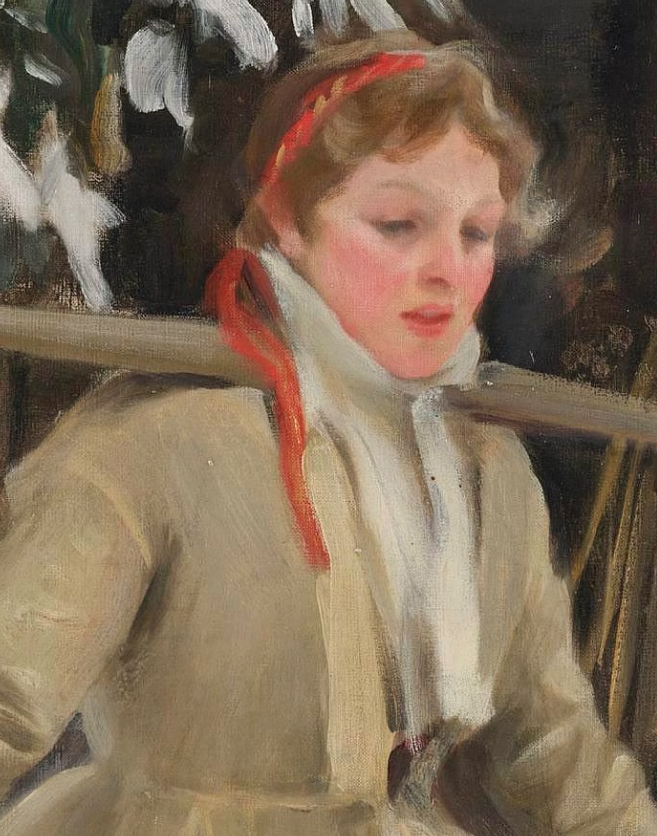
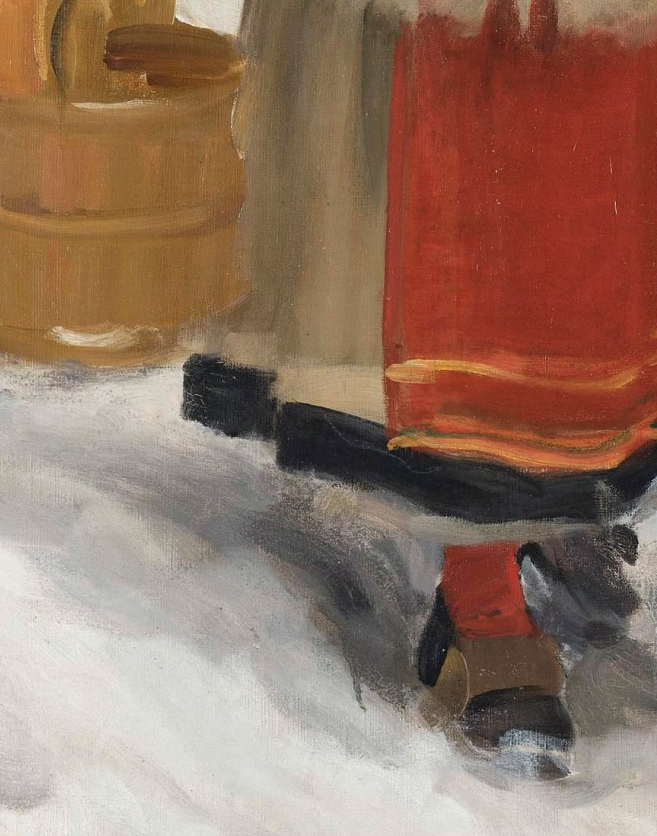
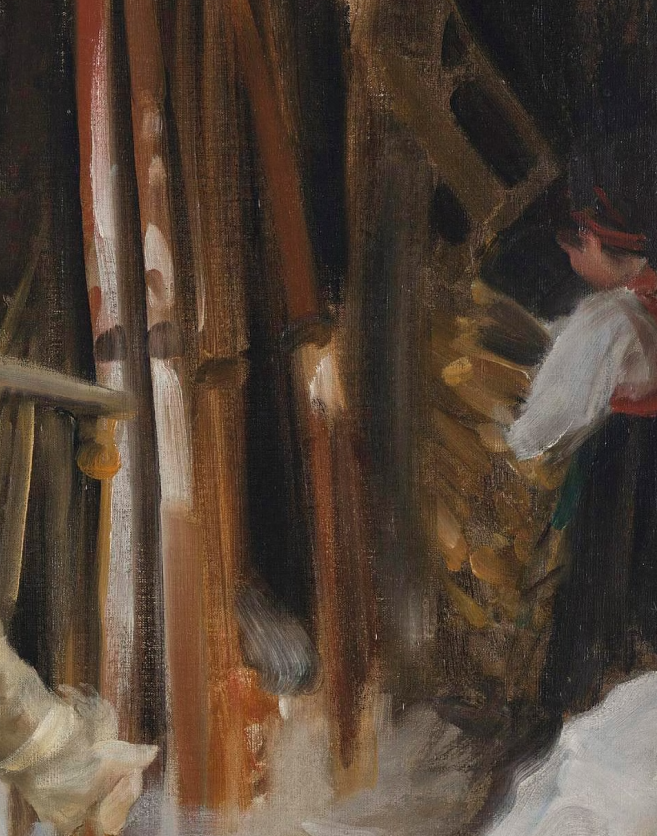
Frans Estenberg, who looked after the Gopsmor cottage for Zorn, wrote in his diary in January 1907 that “Zorn paints Kesti carrying water”, referring to the auction painting “Hämta vatten”. Kesti was none other than Hållams-Kesti, one of Zorn’s favourite models. The beautiful Mora girl Hållams-Kesti also posed for Zorn in “En flykting”, where he had originally intended to depict two girls skiing through a snowy landscape. However, he changed his mind, removed one of the girls, and transformed Hållams-Kesti into none other than Gustav Vasa himself, among other things by adding the monarch’s characteristic beard. Among the winter paintings from early 1907 — such as “Moraflicka på skidor”, “Rättvikskulla i snö”, and “En flykting” — “Hämta vatten” ranks among the very finest. Hållams-Kesti is portrayed wearing the beautiful winter costume of the women of Mora, where the red ribbon in her hair revealed to those in the know that she was still unmarried. In the background can be seen the long skis — a necessity for reaching Gopsmor during winter and also a popular leisure activity — together with another industrious Mora girl occupied with carrying firewood into the cottage. Of the painting “Hämta vatten”, Tor Hedberg wrote that “the colouring here is softer and more melting, with the ivory-yellow sheepskin coat exquisitely set against the white snow and the brown timber. Zorn’s lovingly painted furs could deserve a chapter of their own; one sees how greatly he delighted in their aged patina.”
With his characteristic virtuosity of brushwork and an extraordinary sensitivity to light and movement, Zorn transforms this simple action into a poetic moment, charged with presence and intimacy.
The painting’s first owner, Consul Erik Brodin, was a close friend of the artist, and his extensive art collection included some of Zorn’s greatest works in private ownership, such as “Kaikroddare”, “Väninnor”, “Reflexer”, and “Söndagsmorgon”, to mention but a few, alongside the auction’s exquisite “Hämta vatten”.
Anders Zorn at Important Spring Sale
Enquiries and Condition Reports