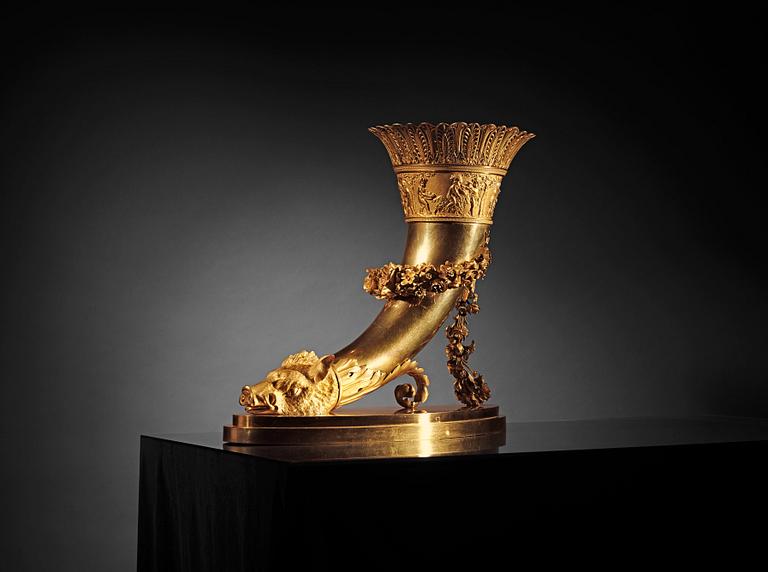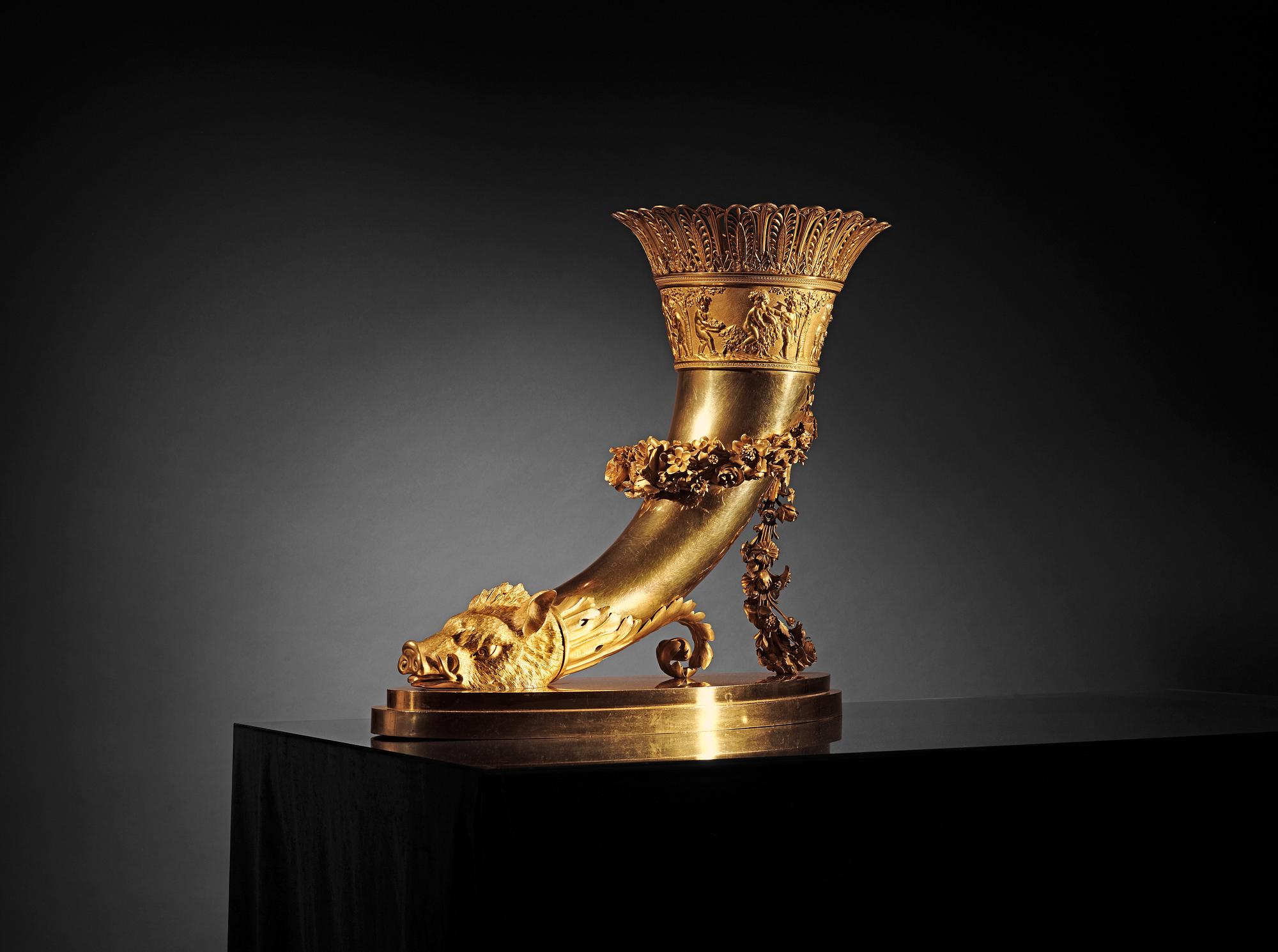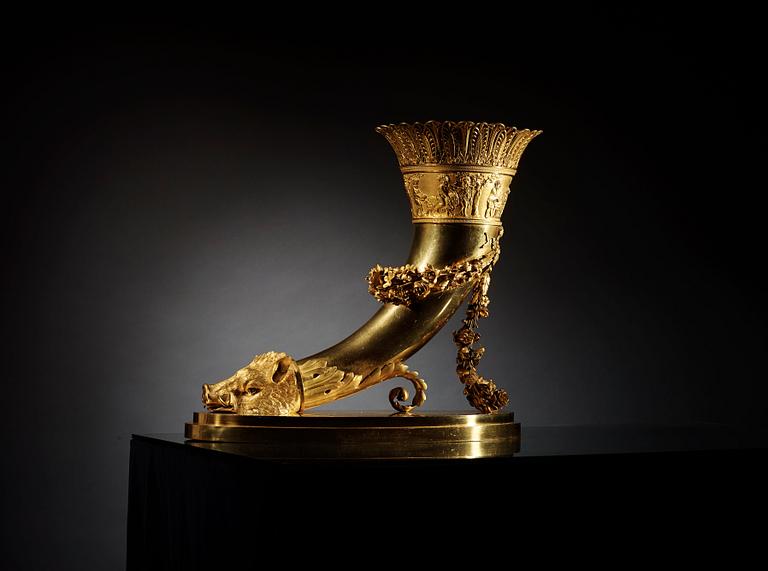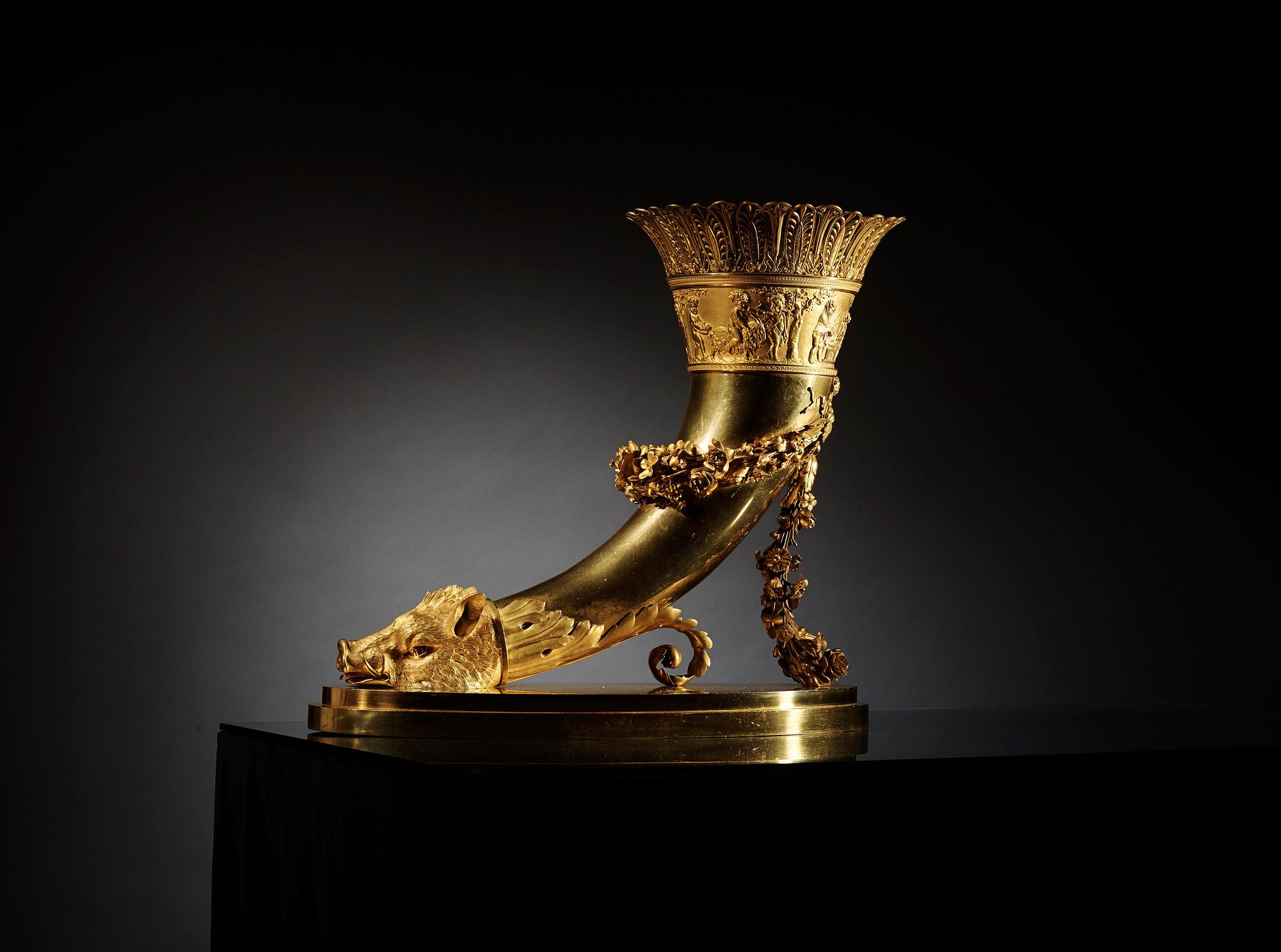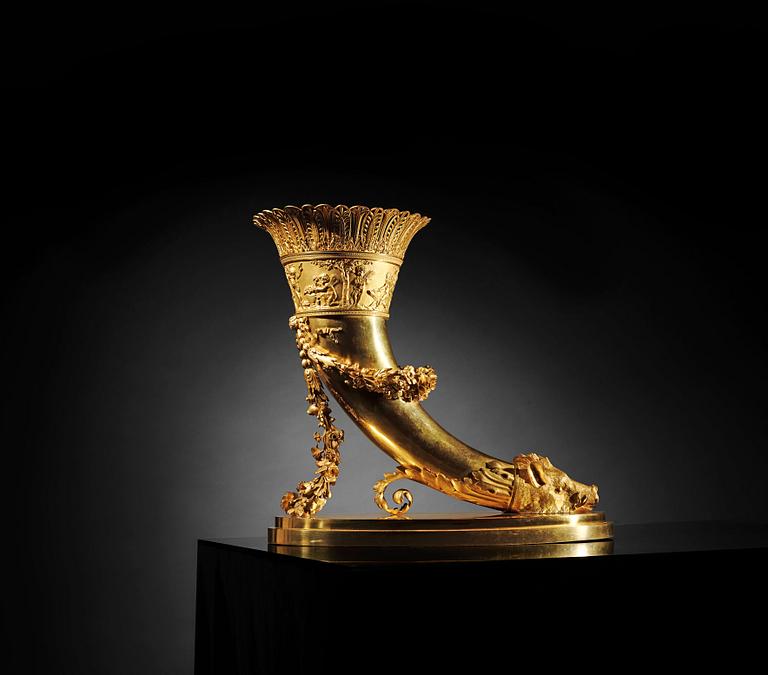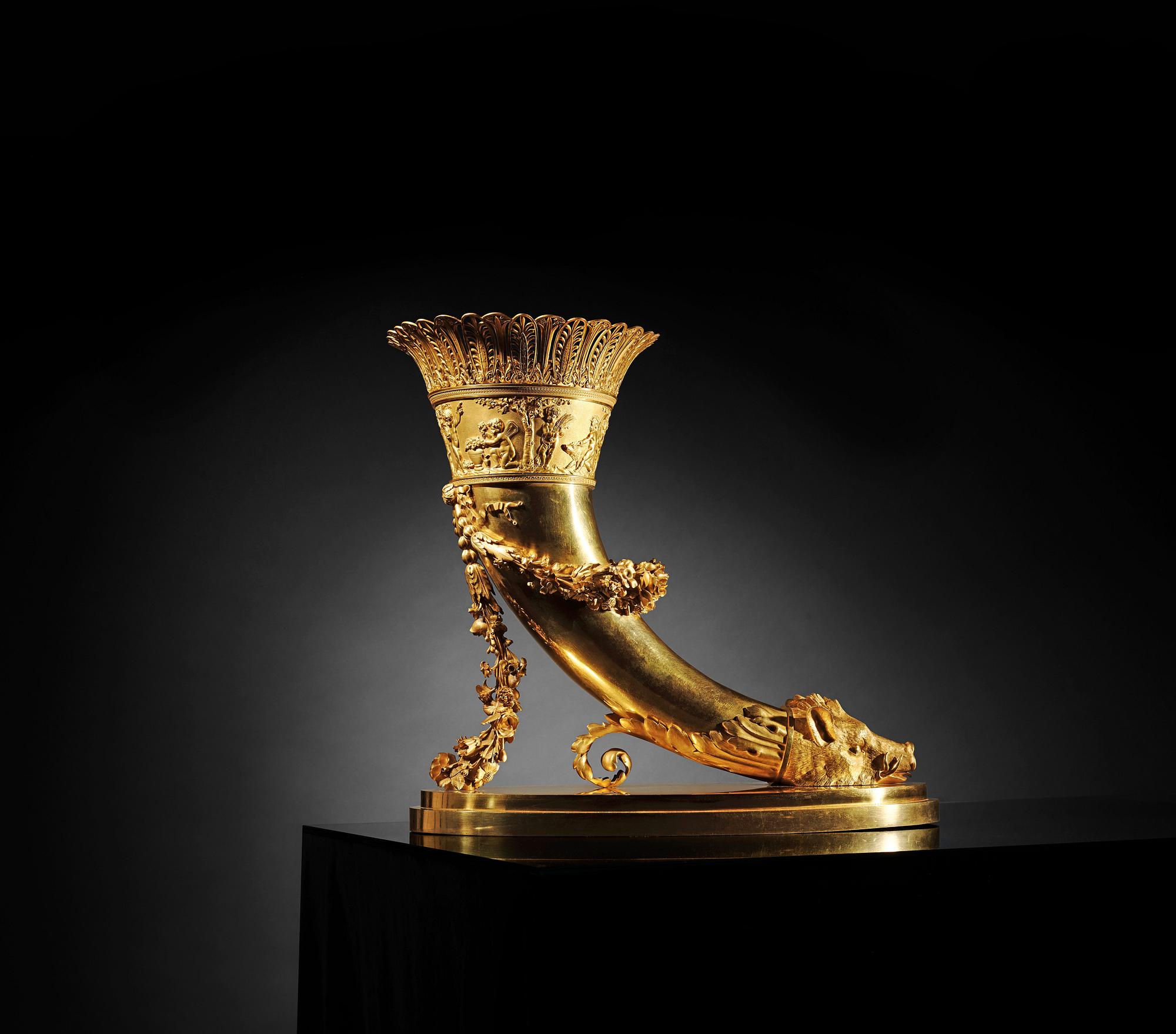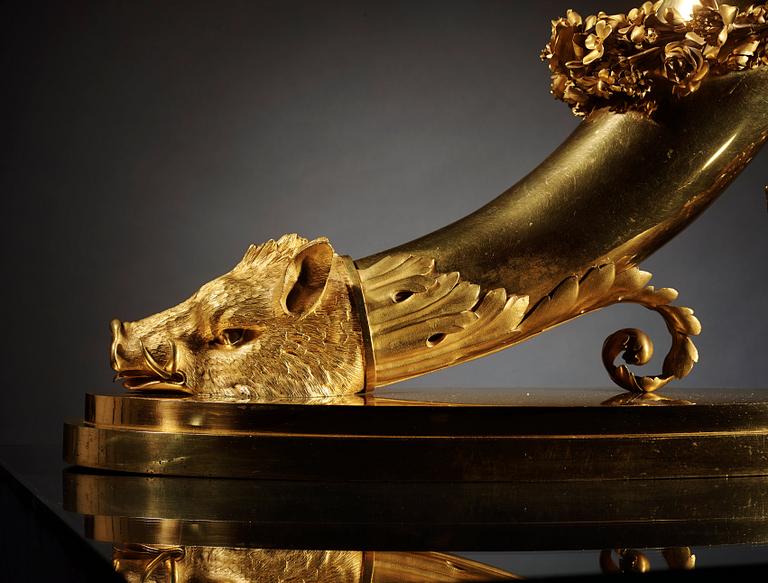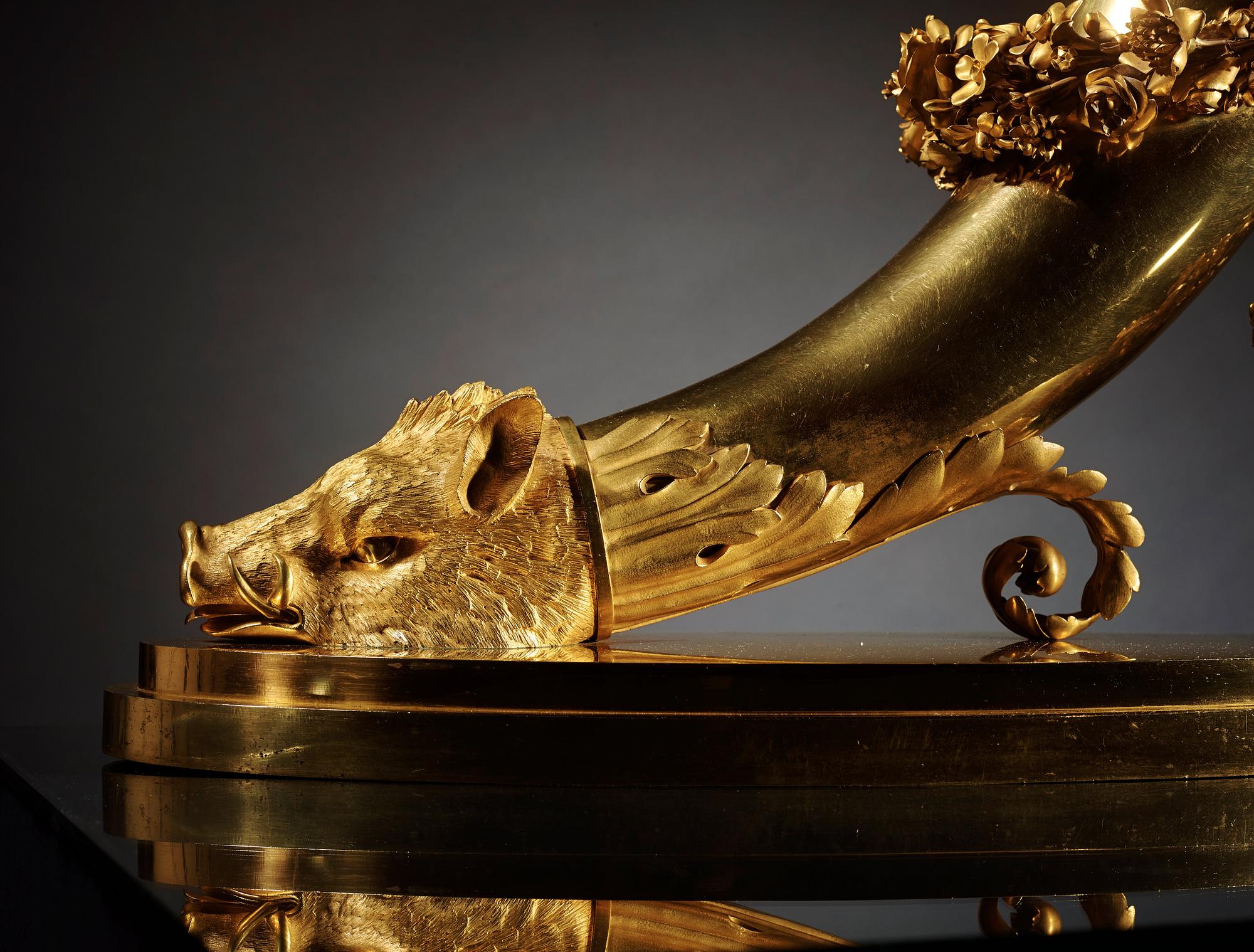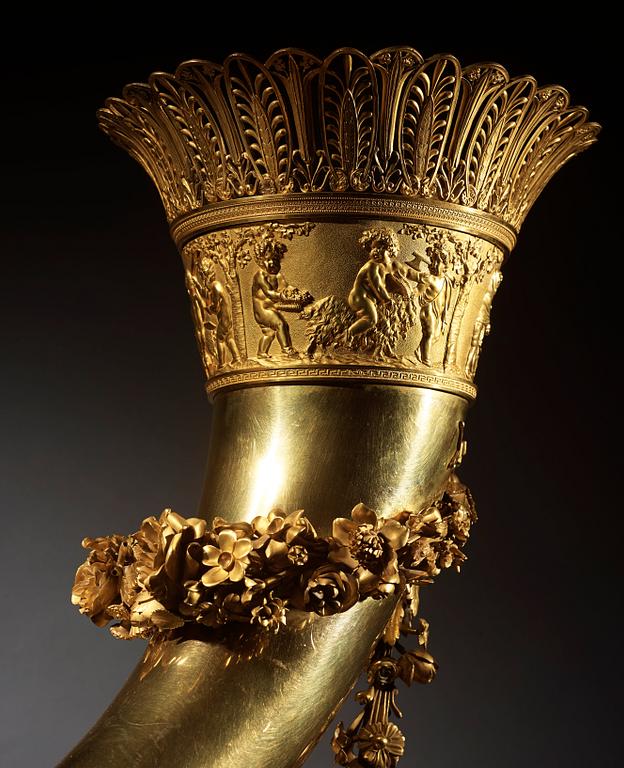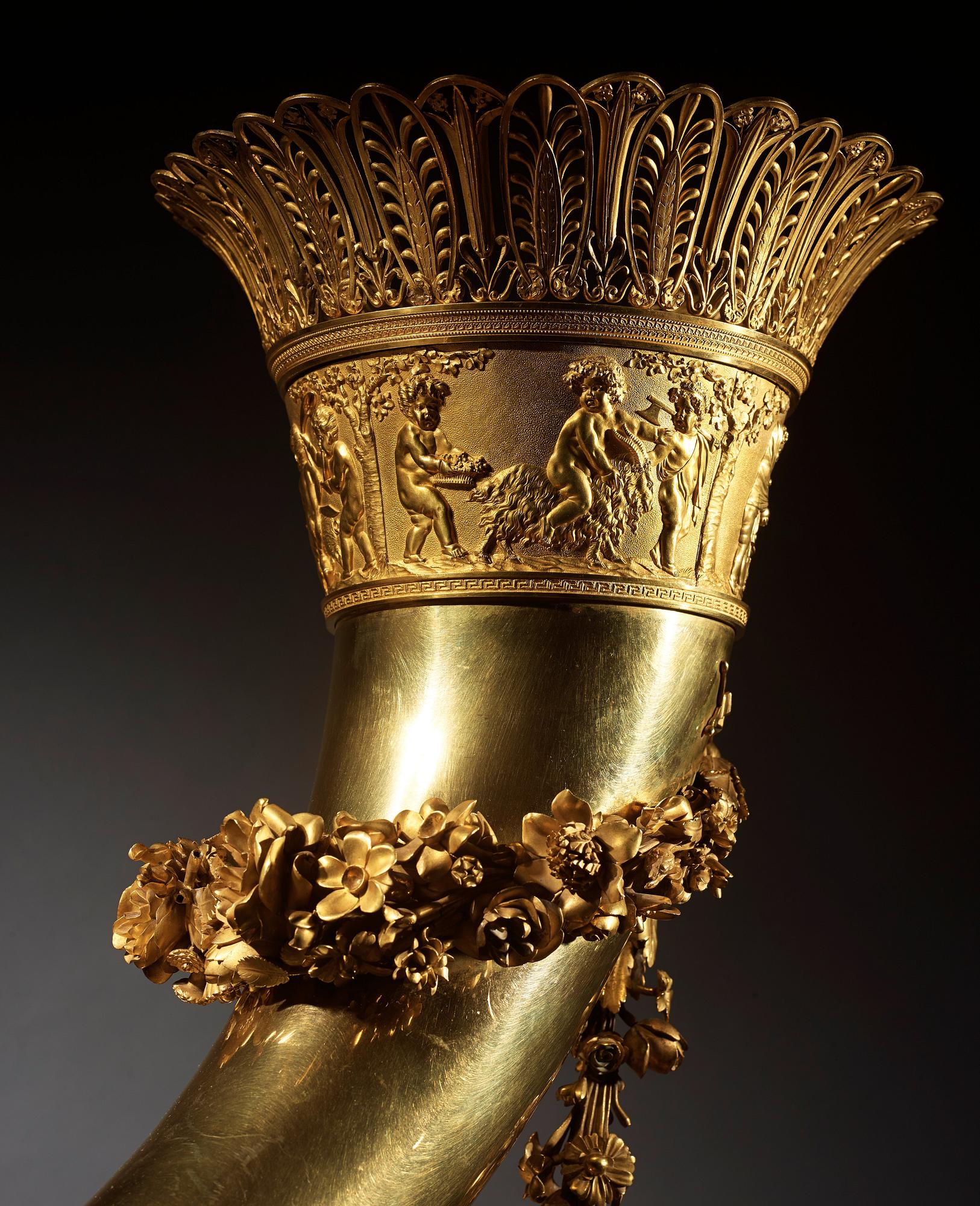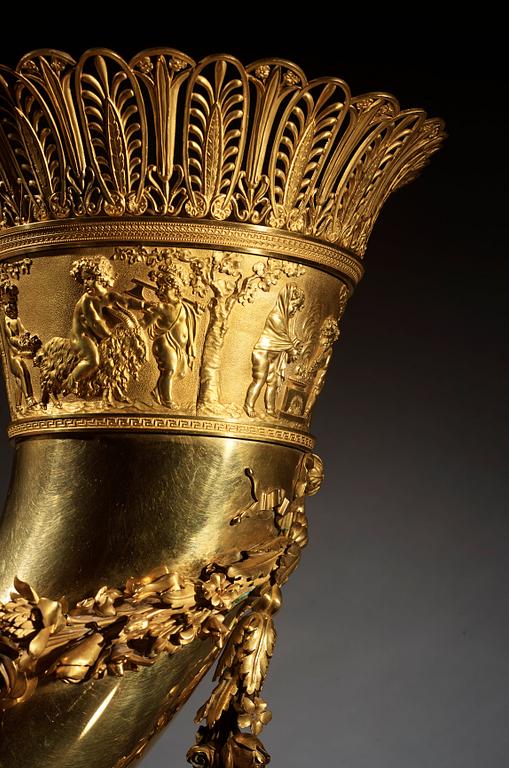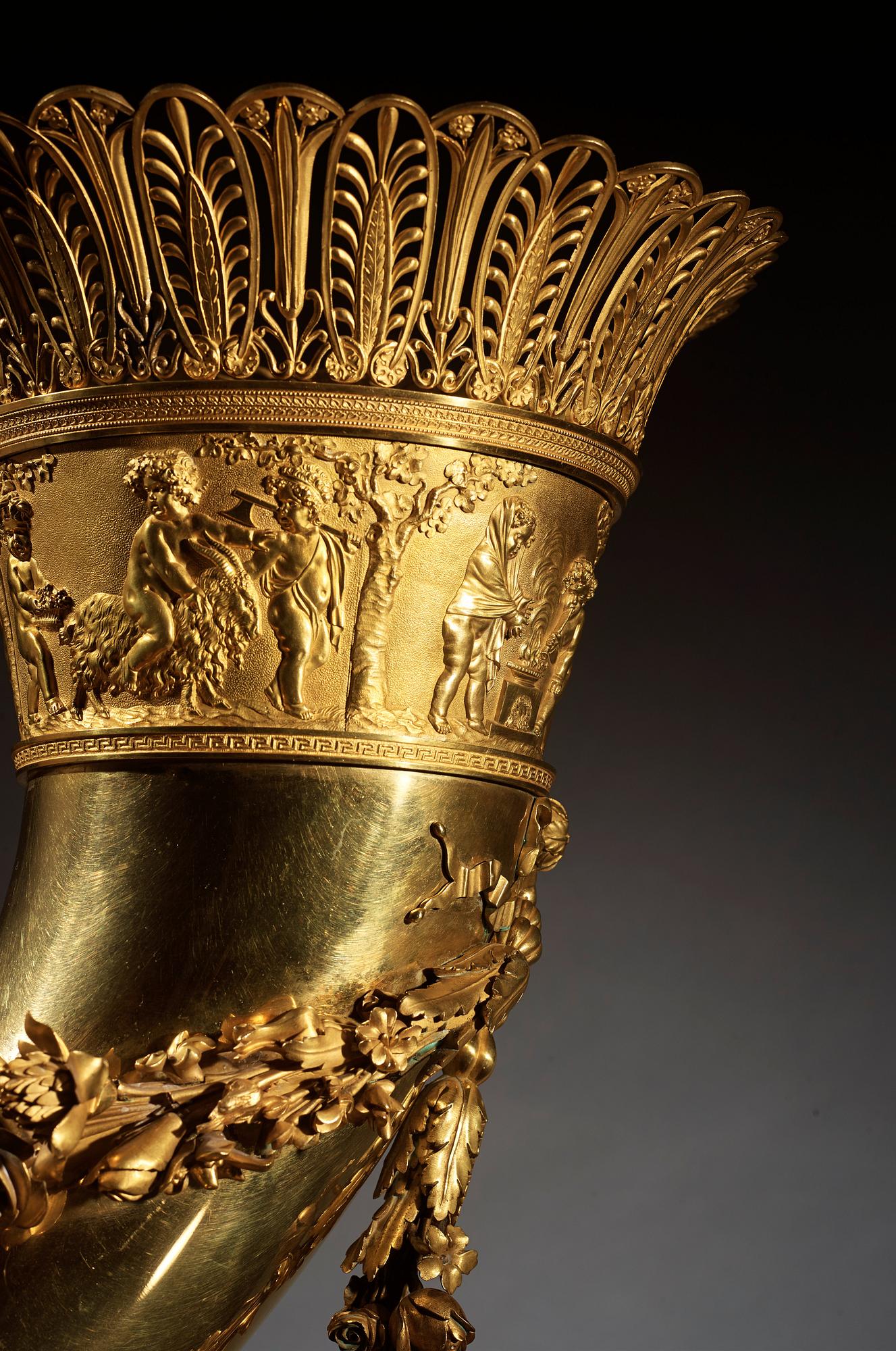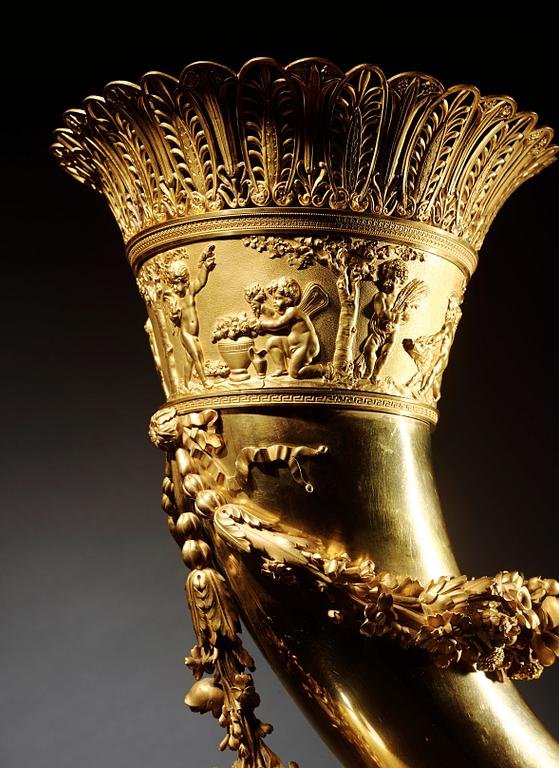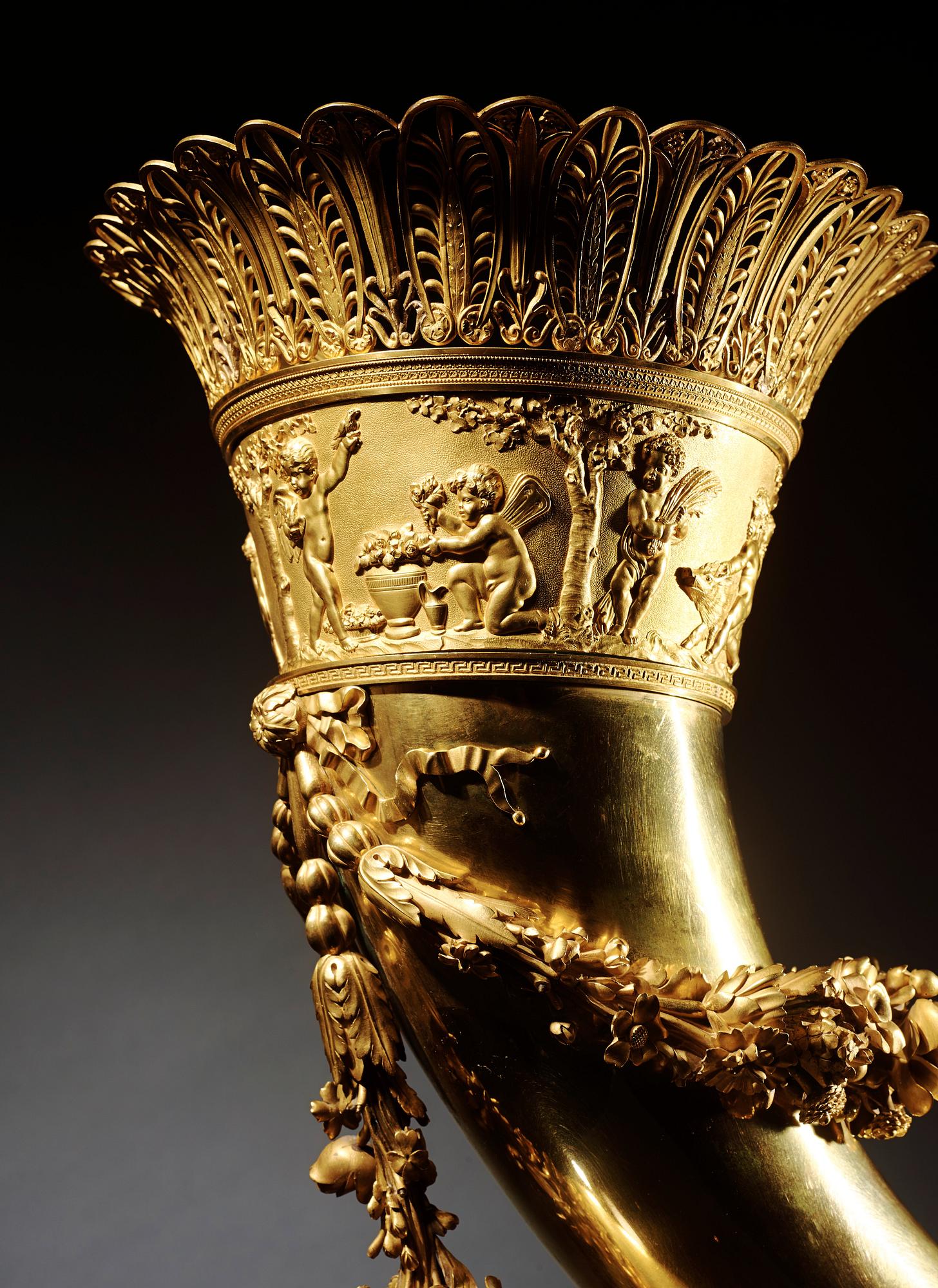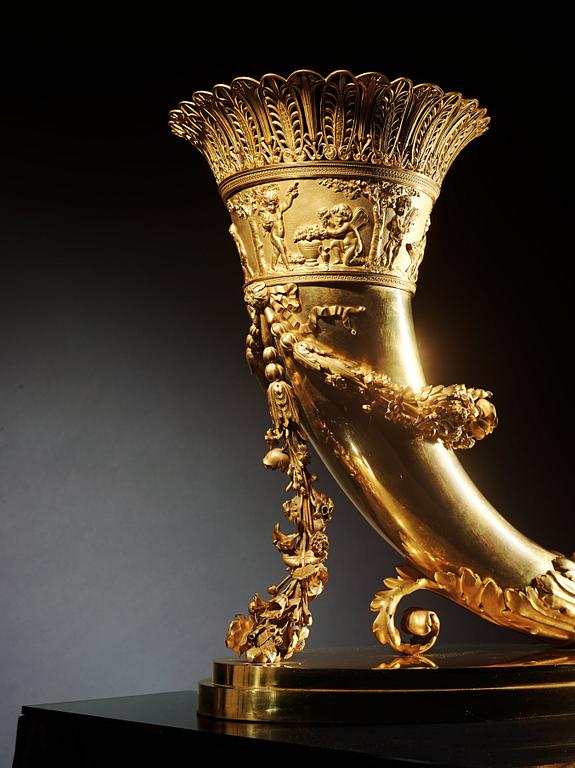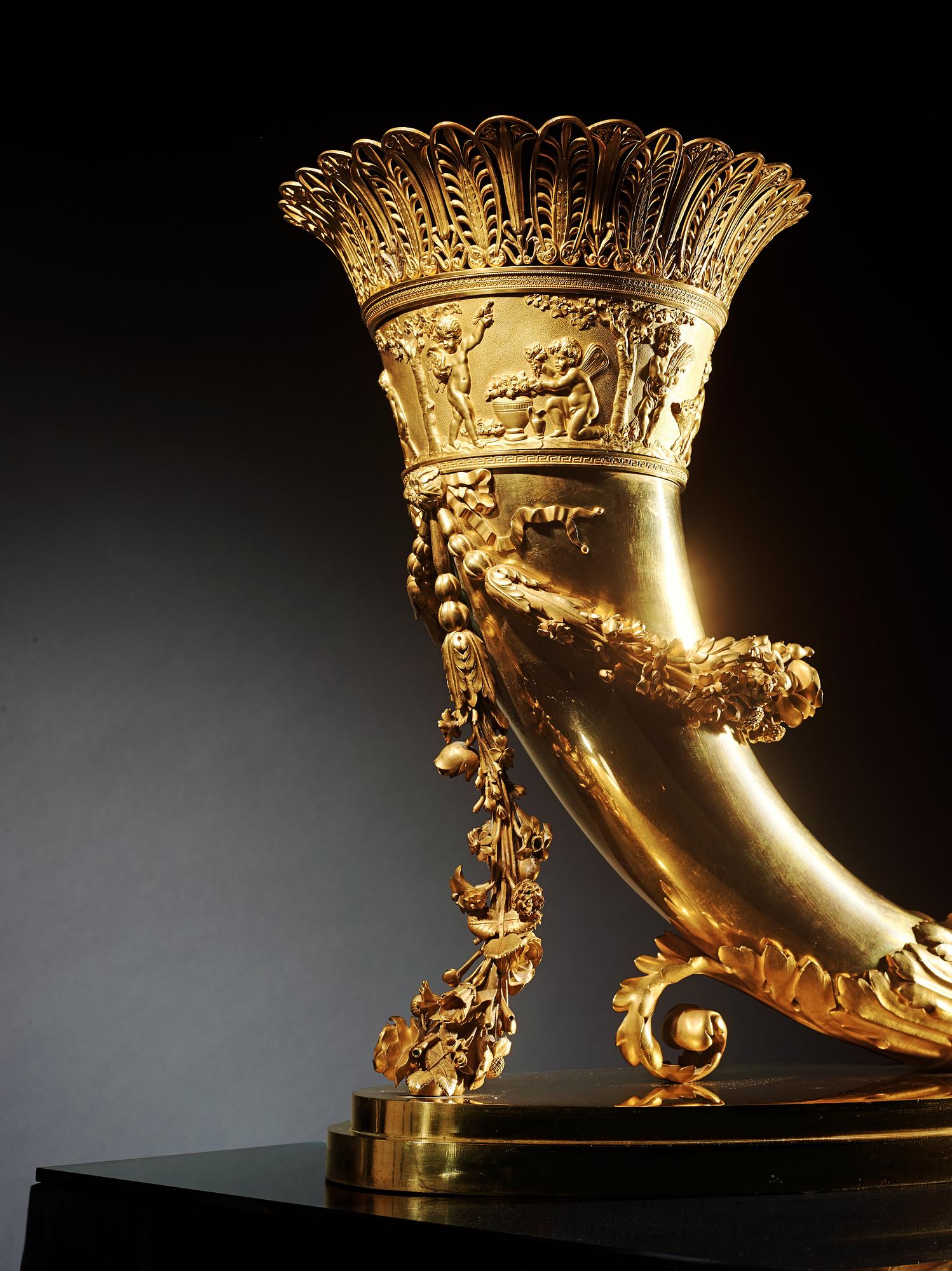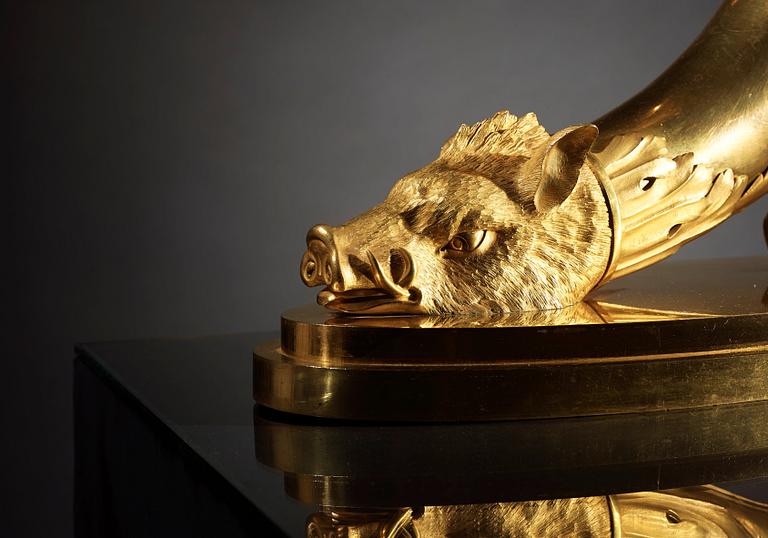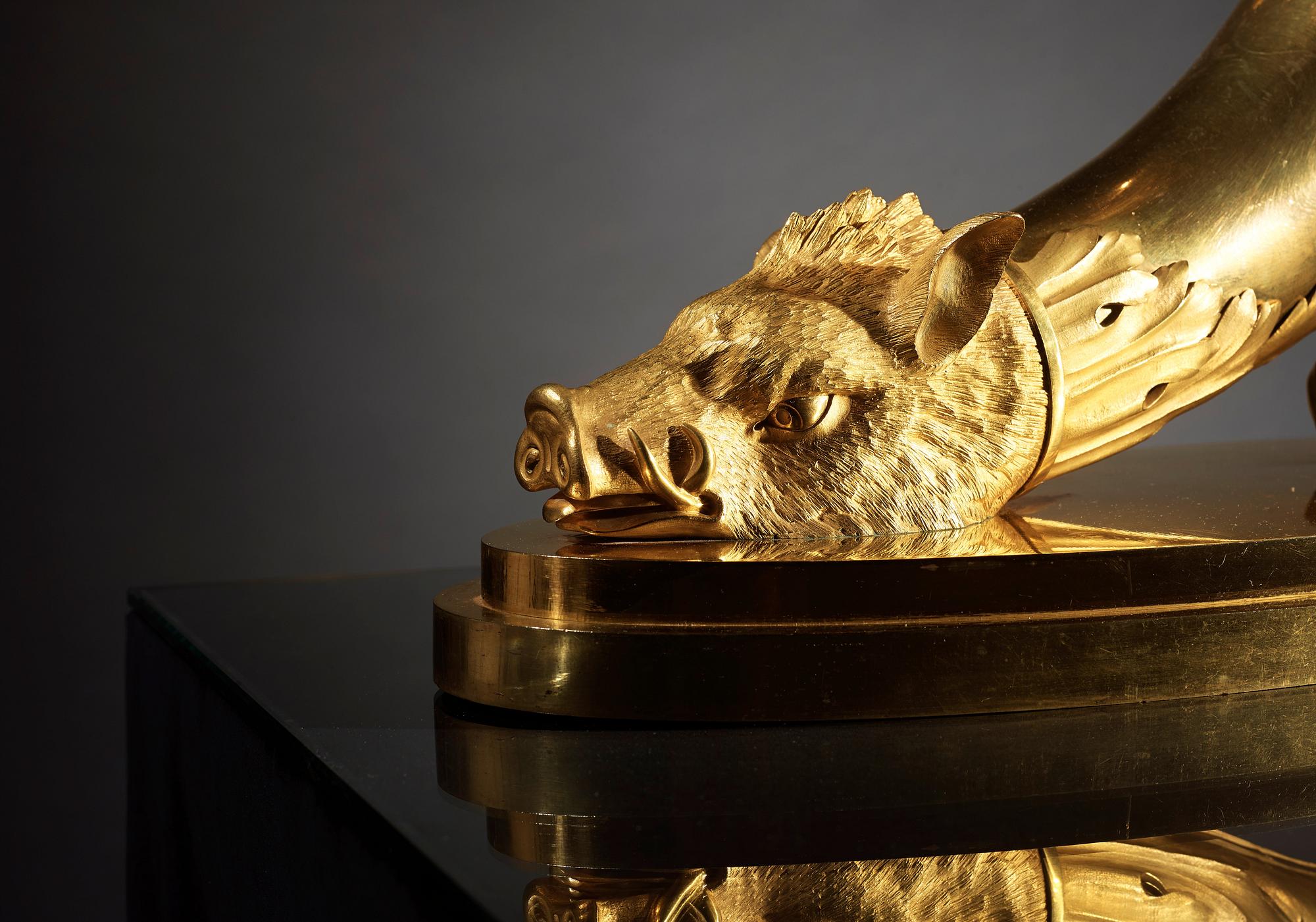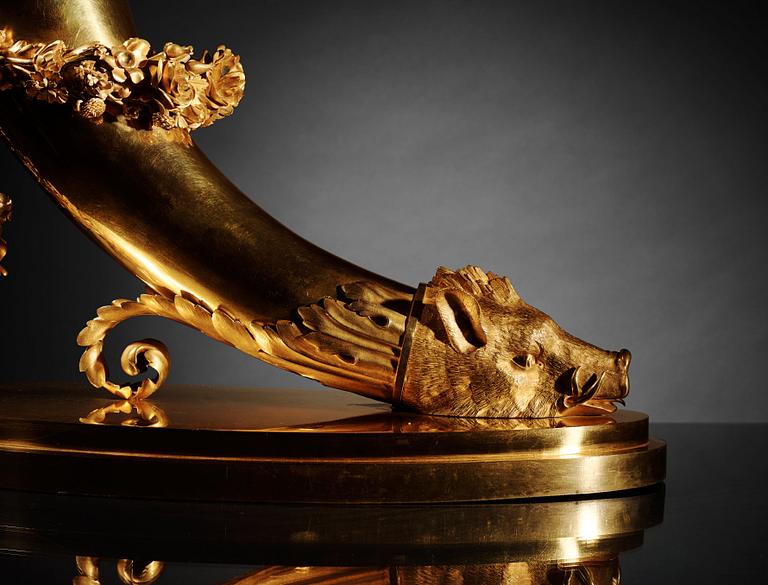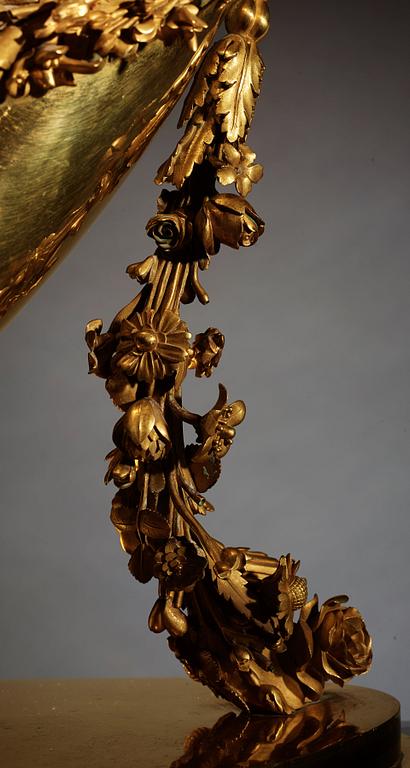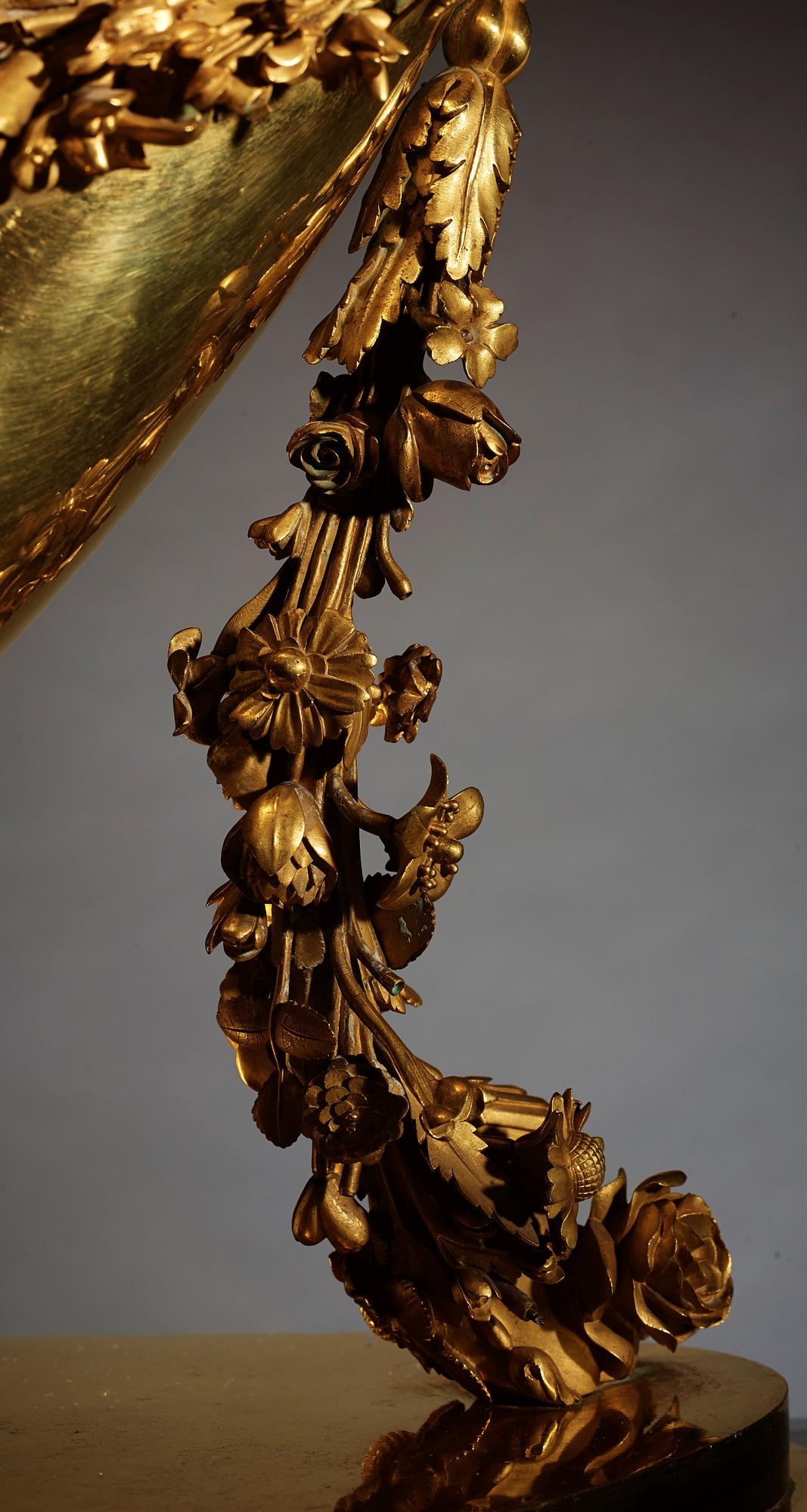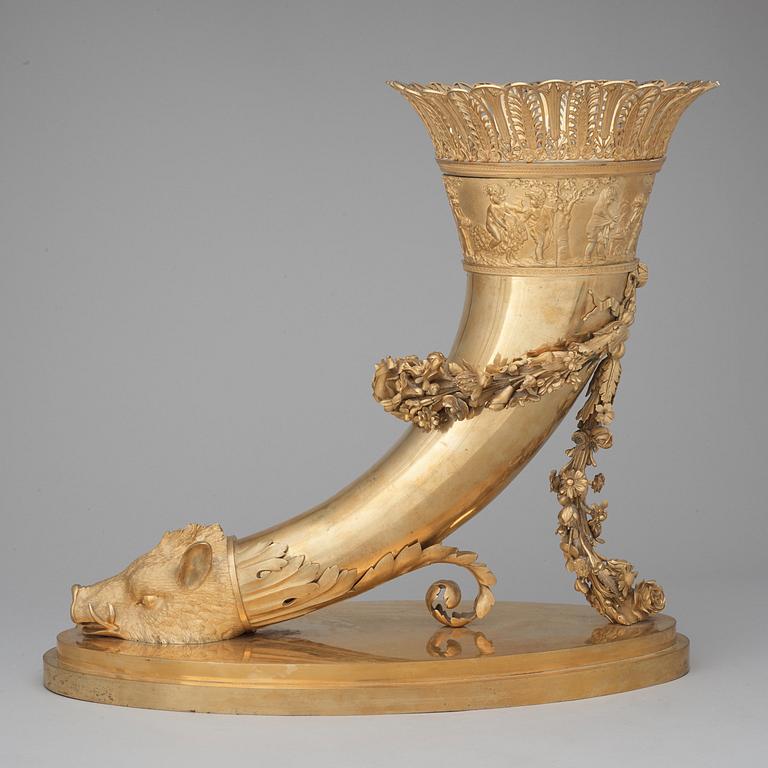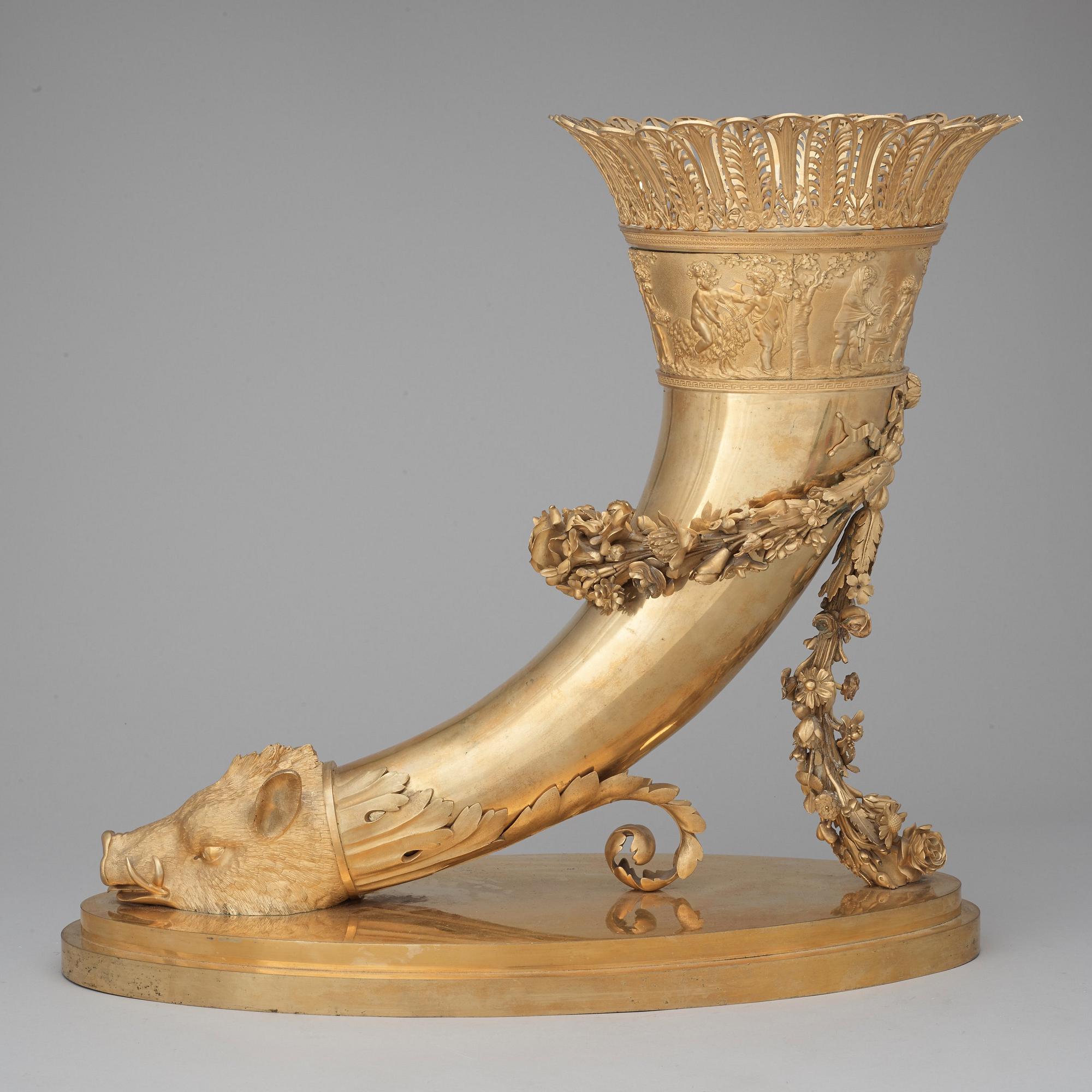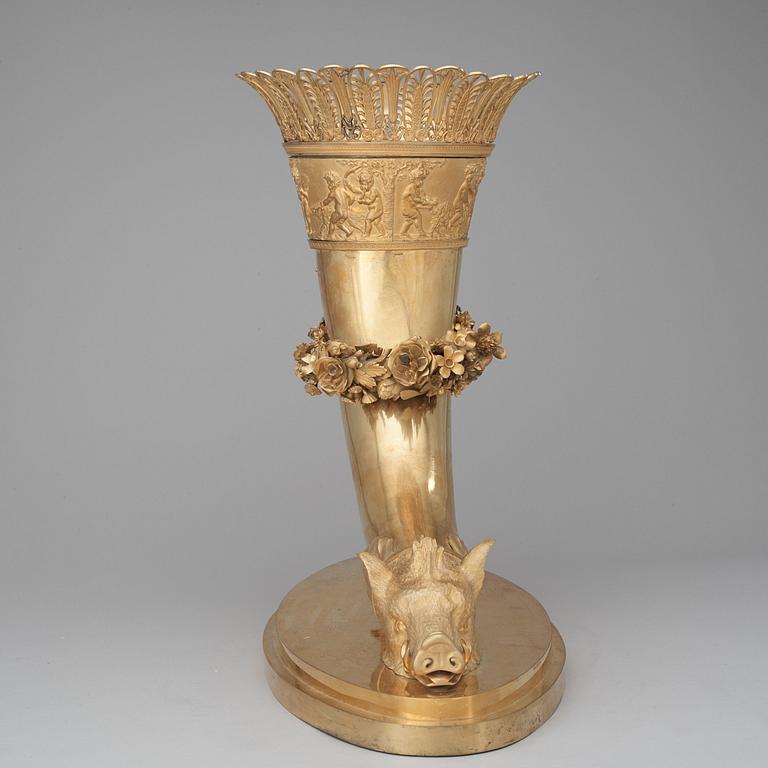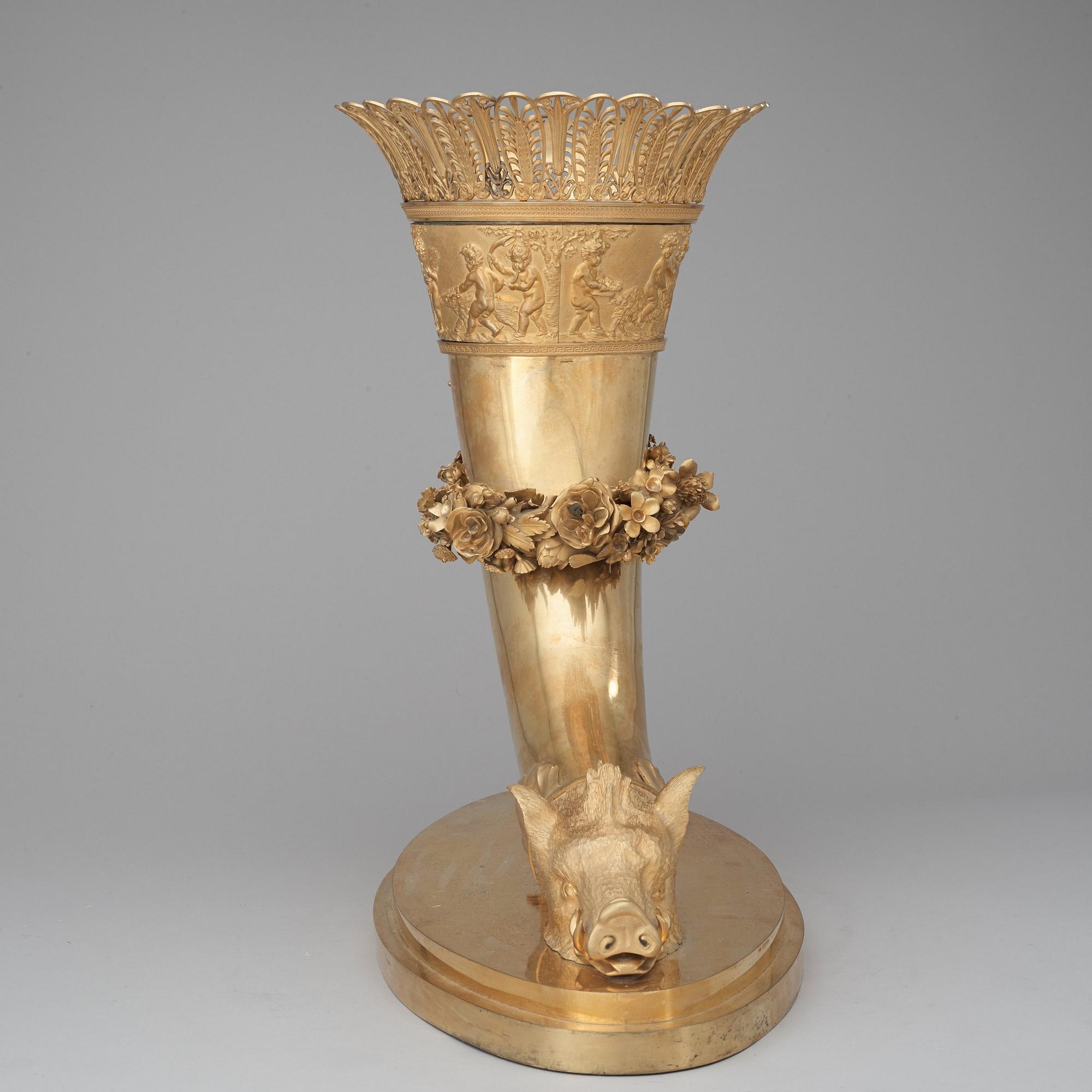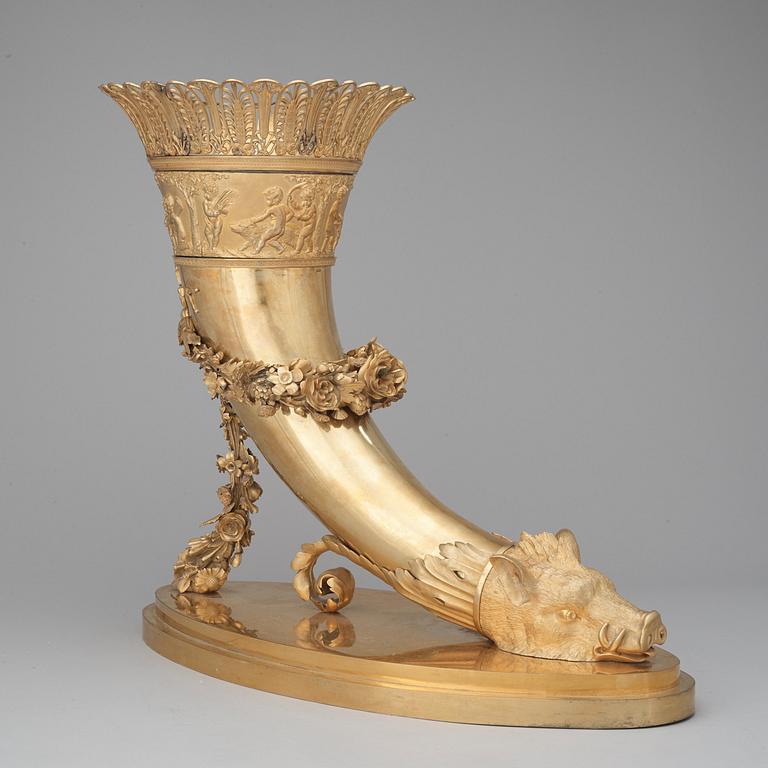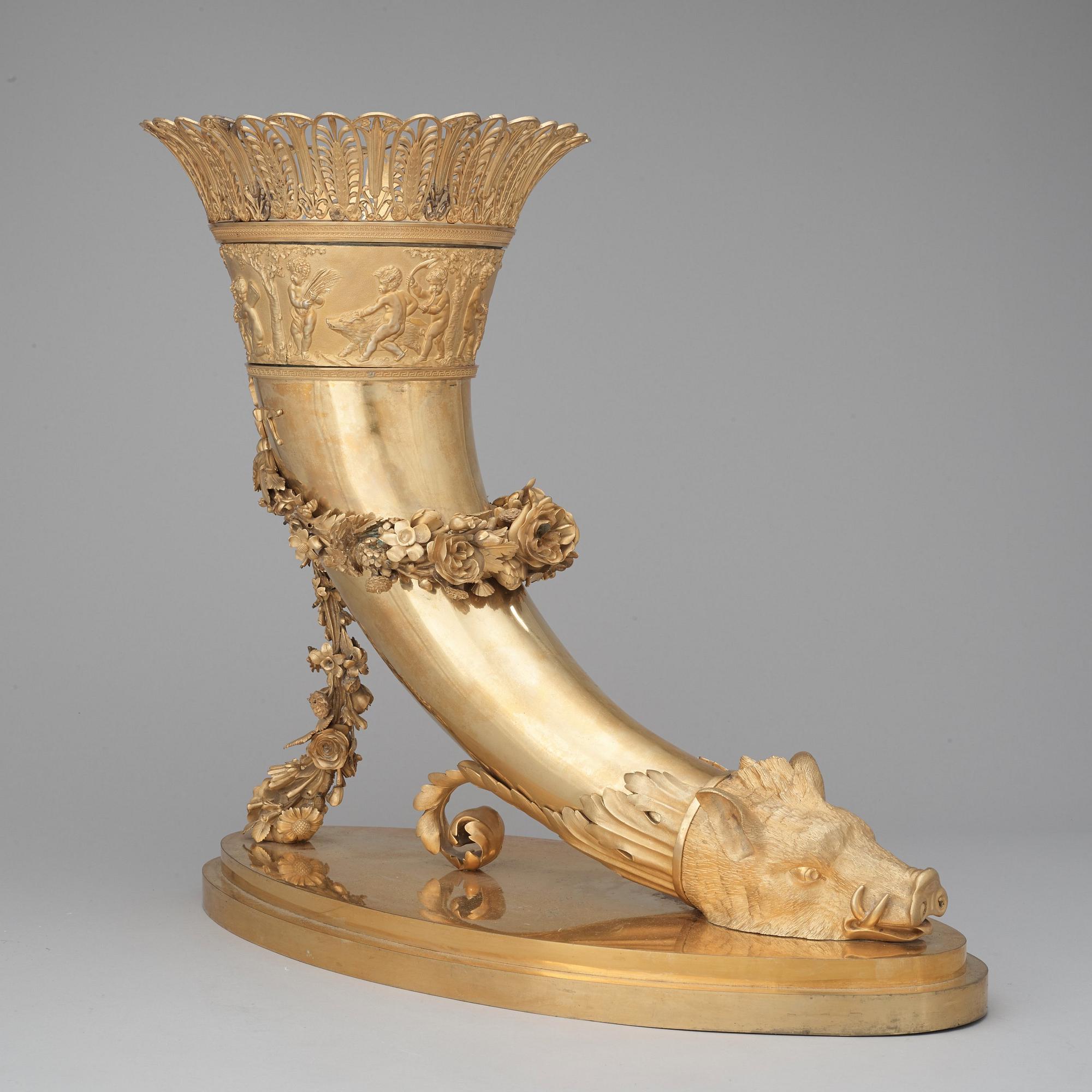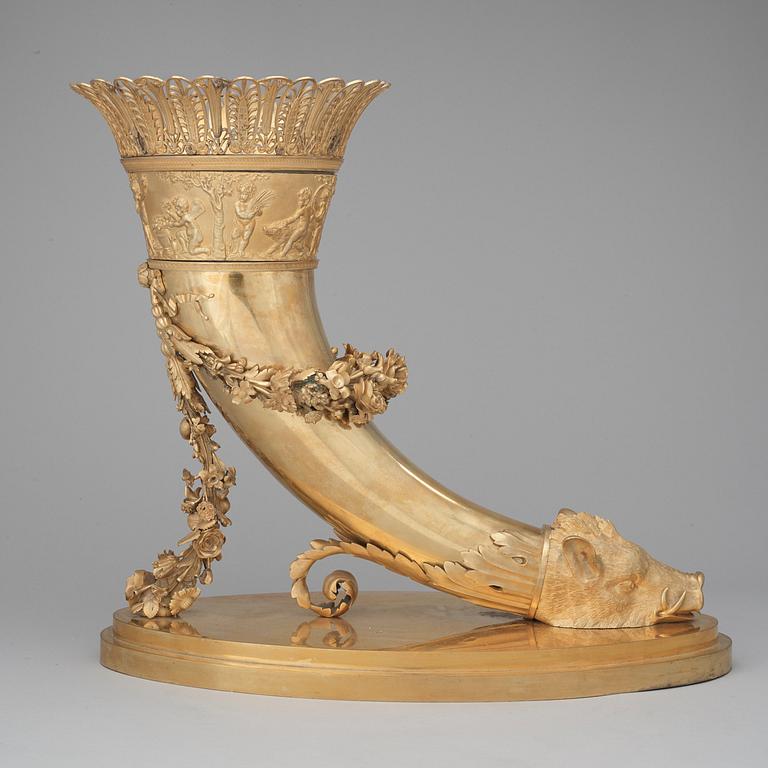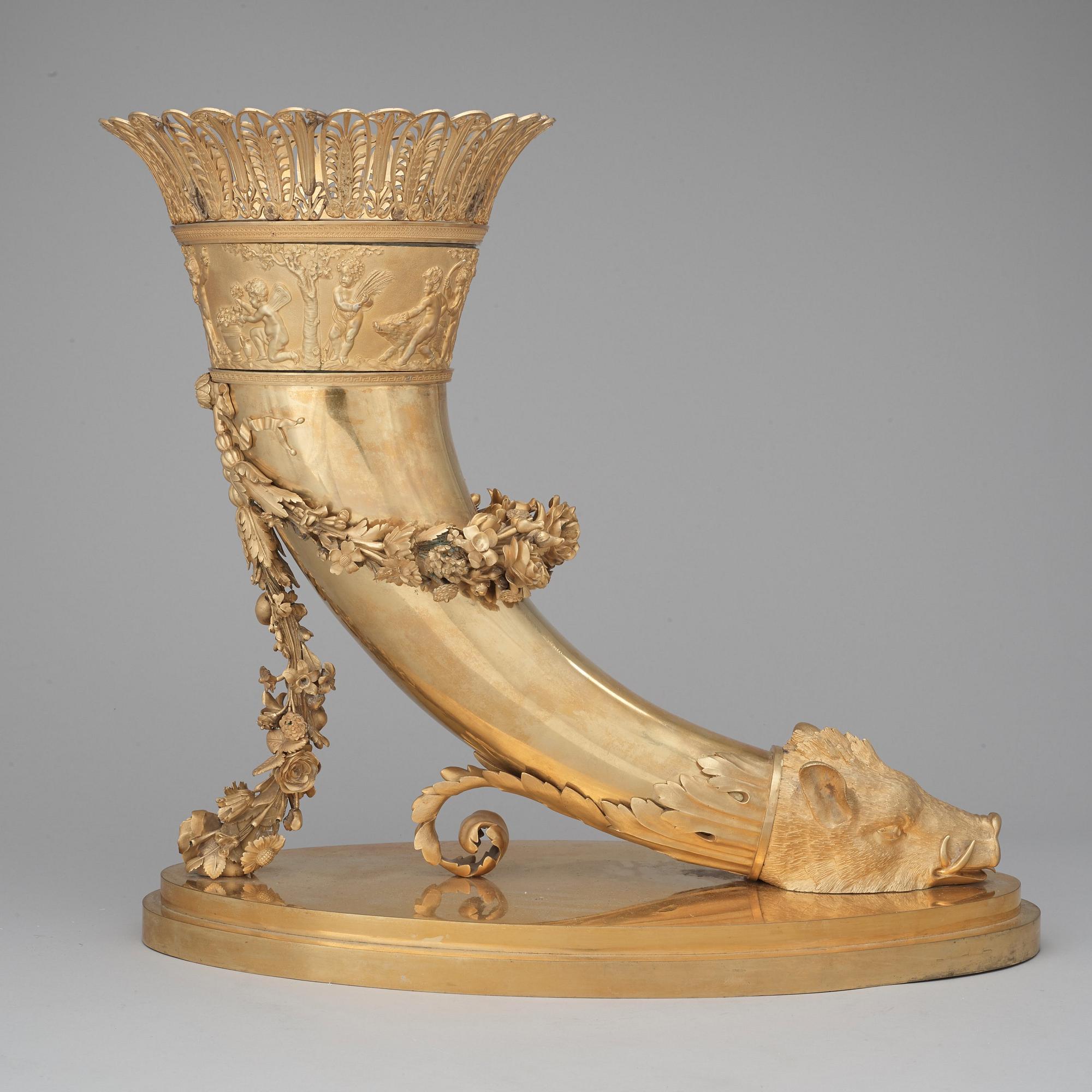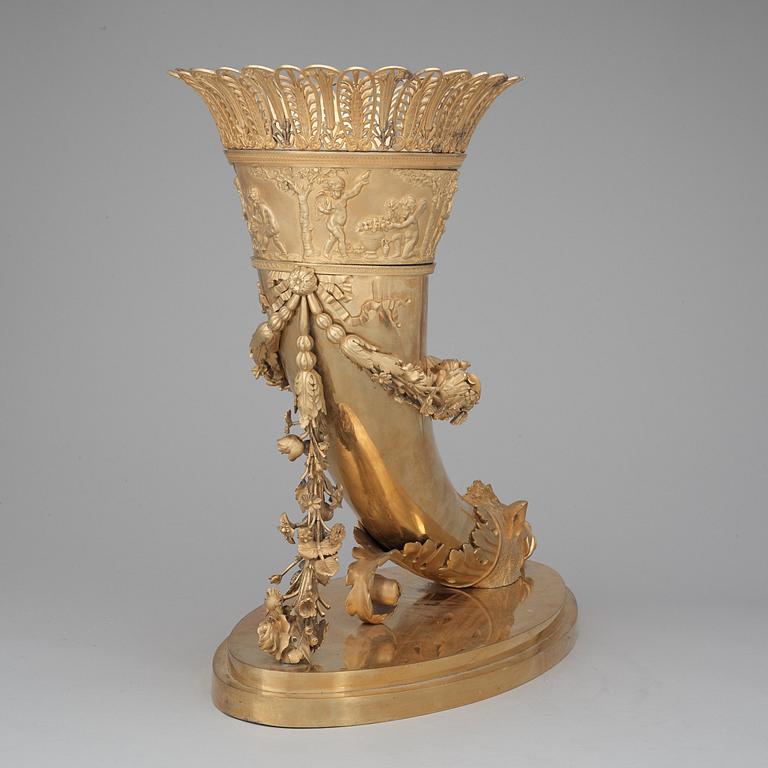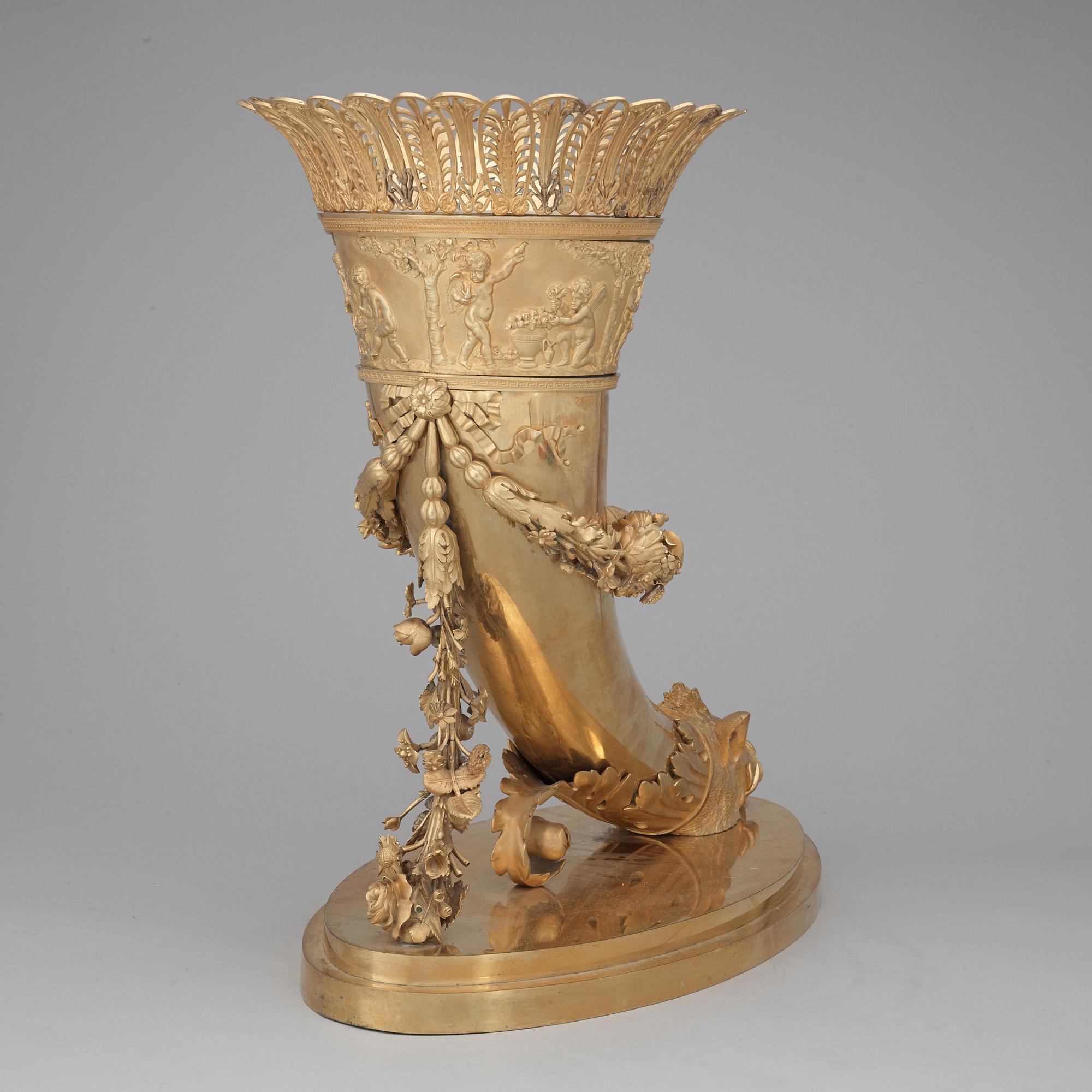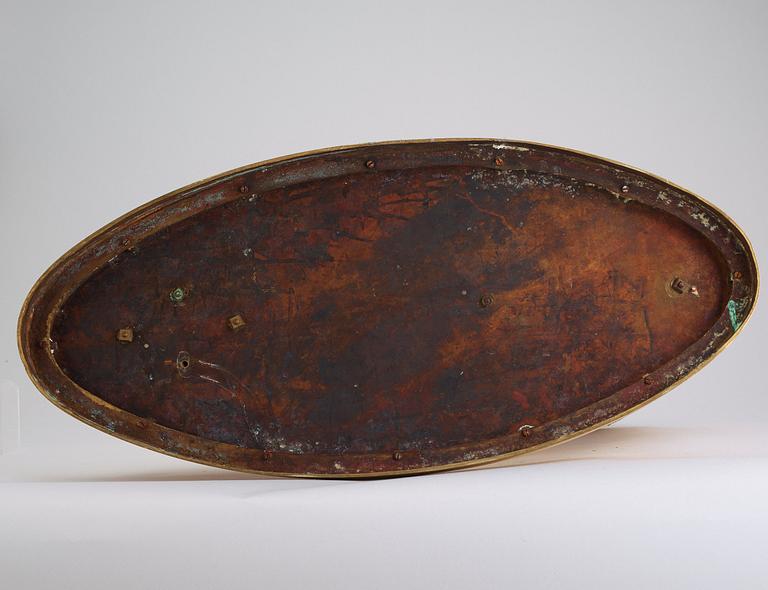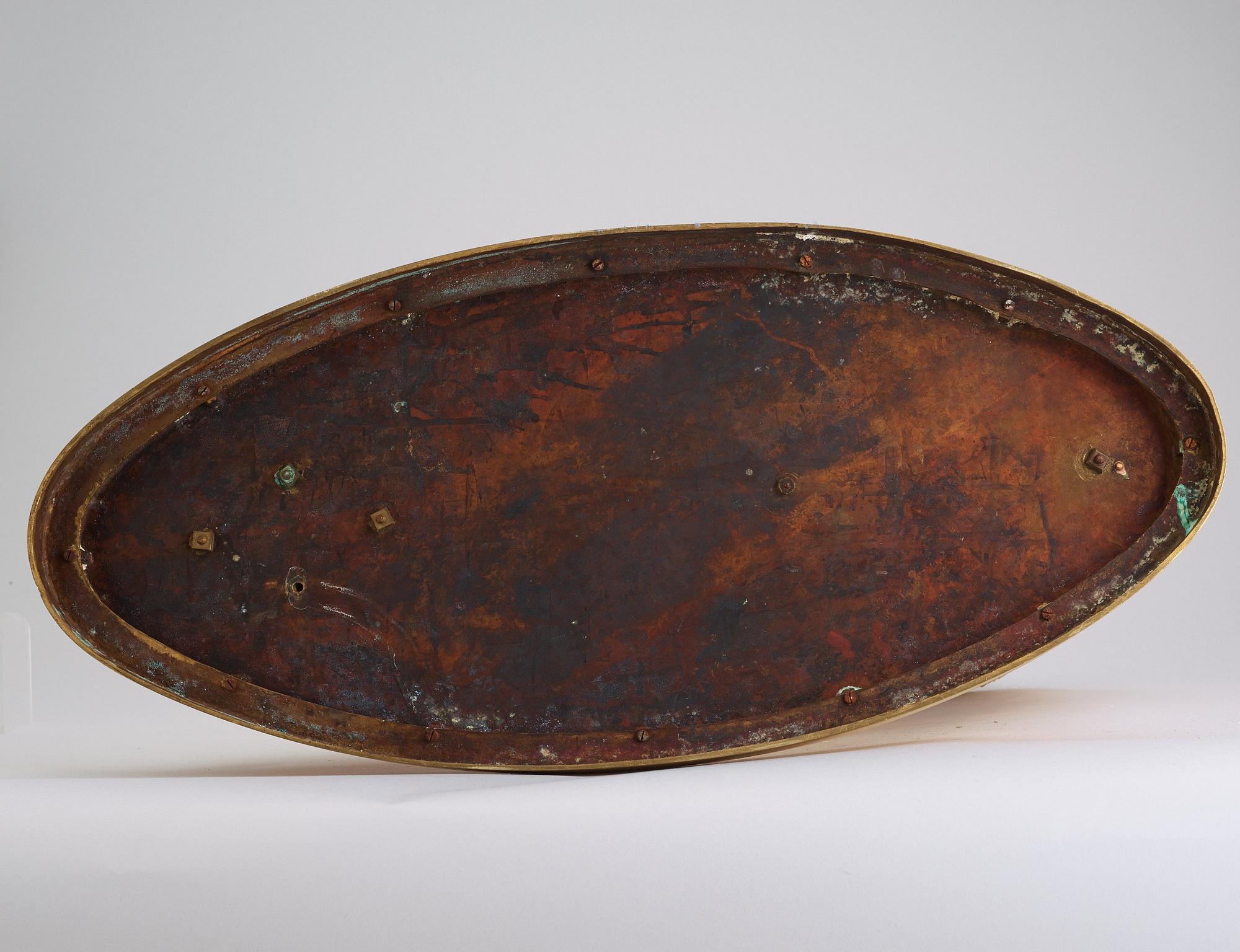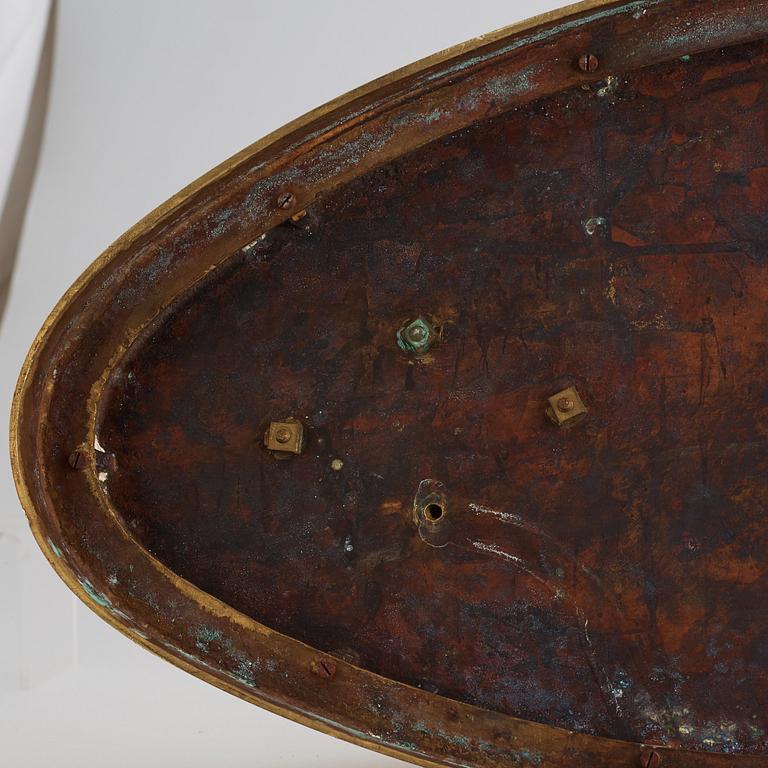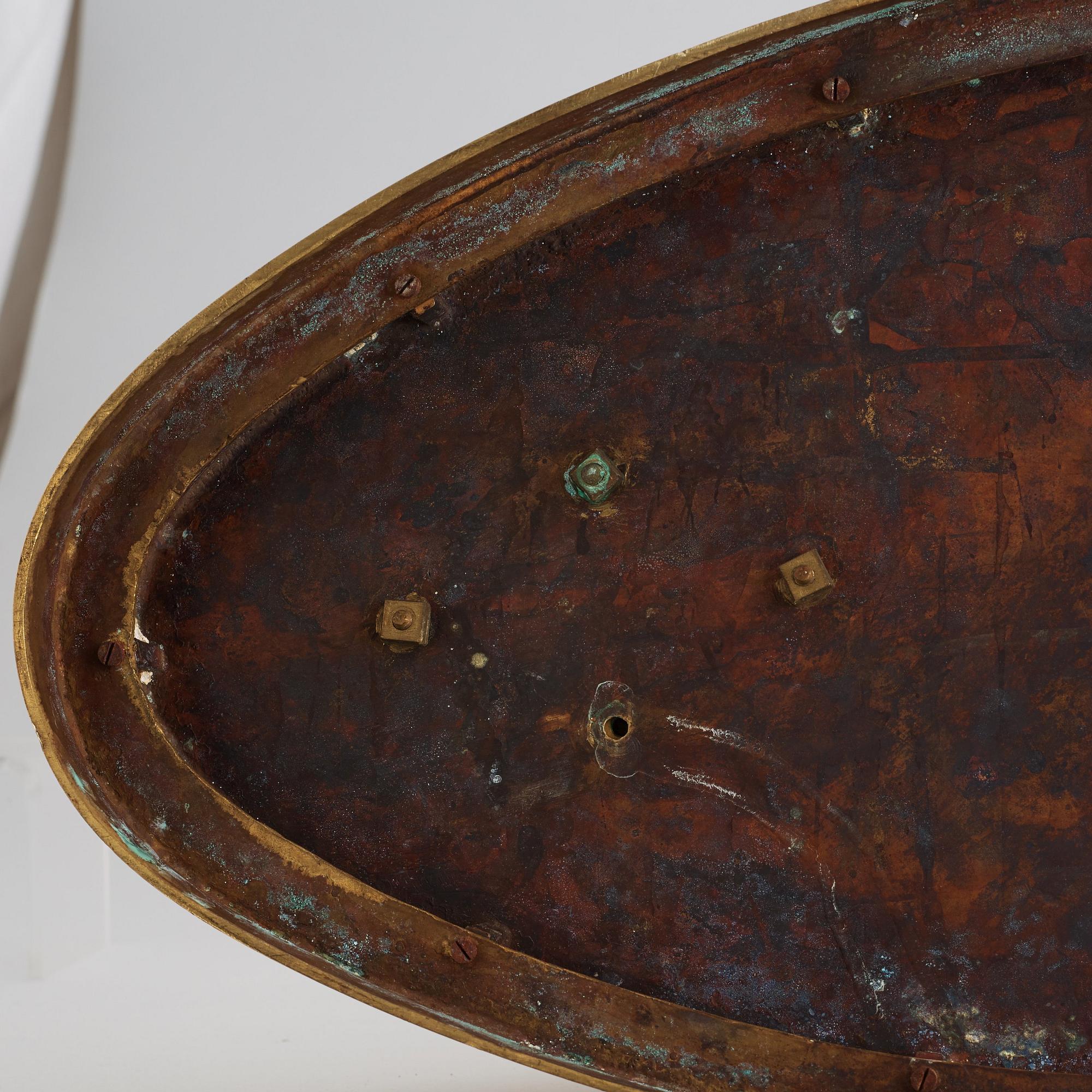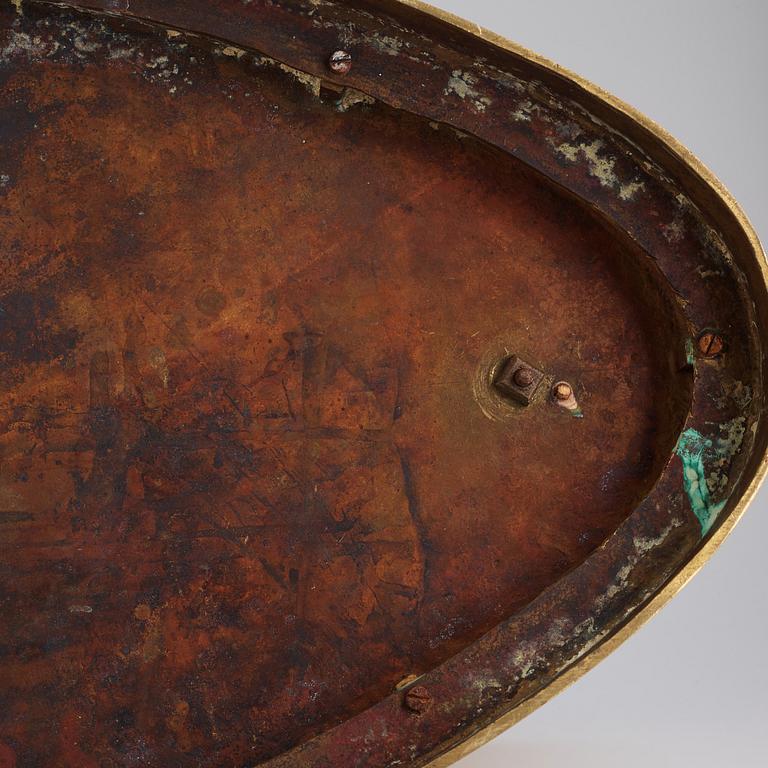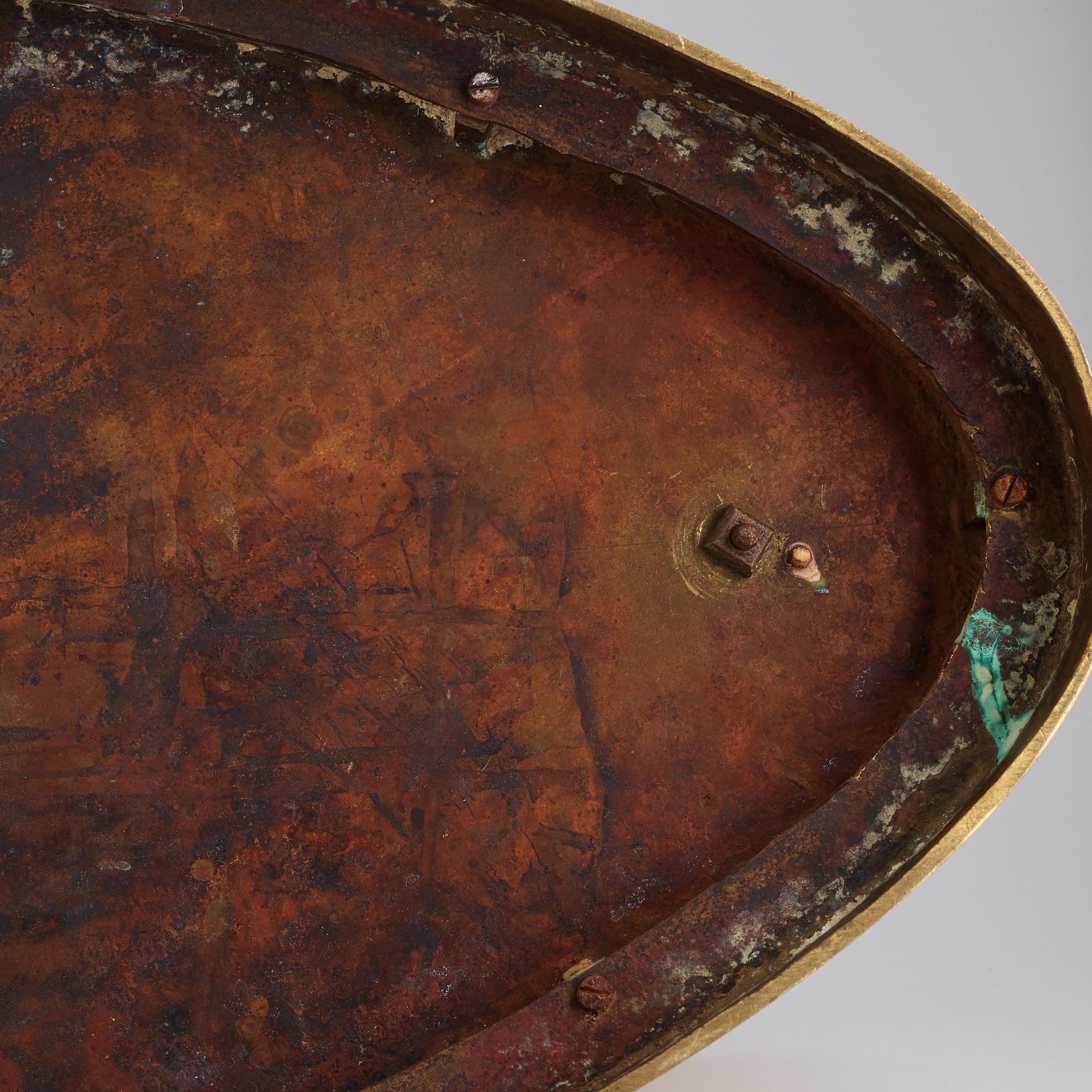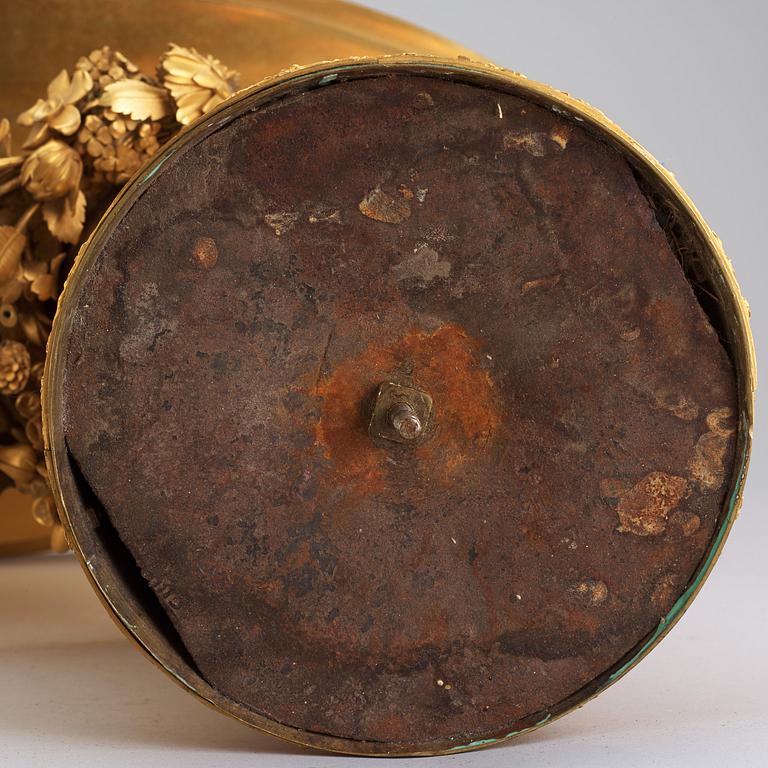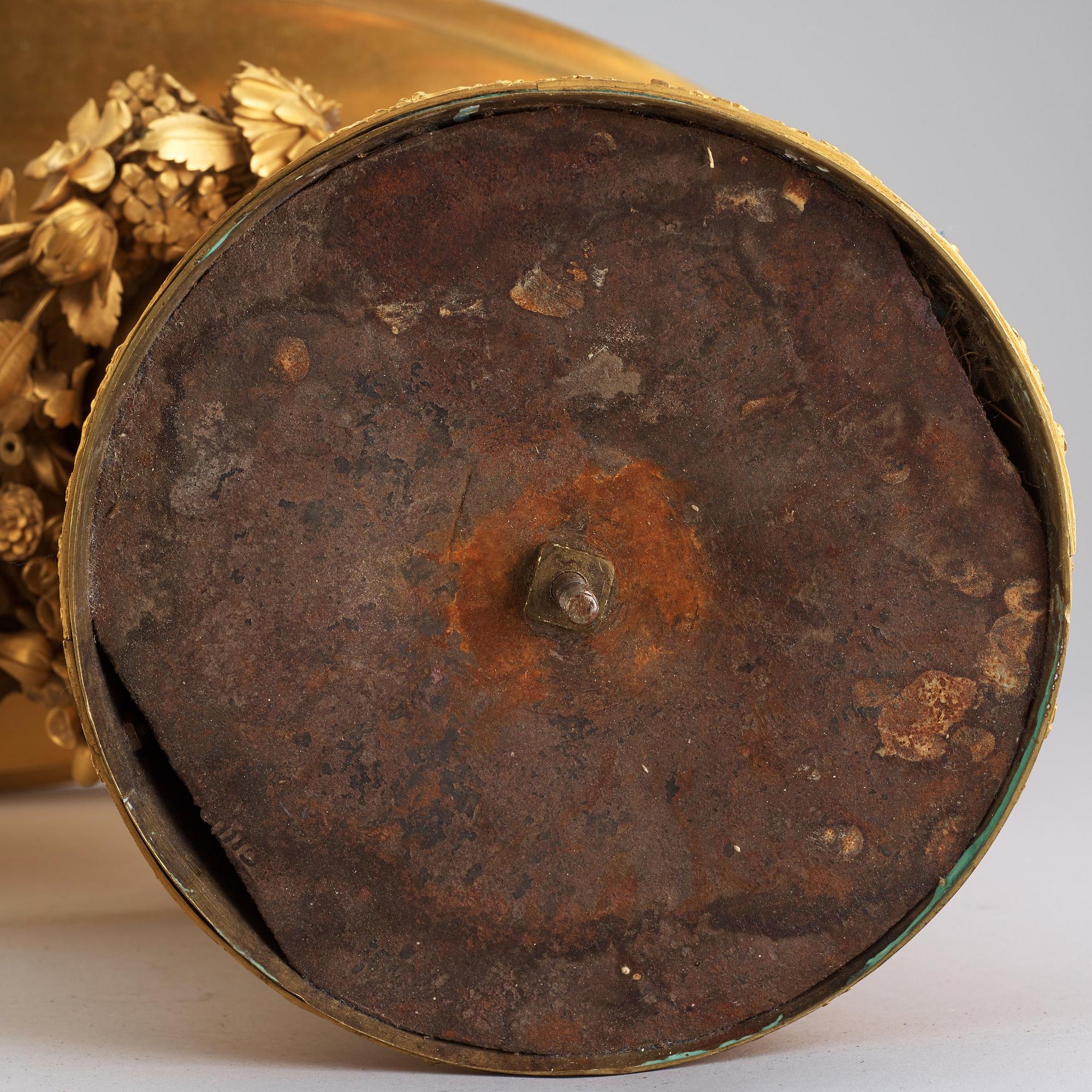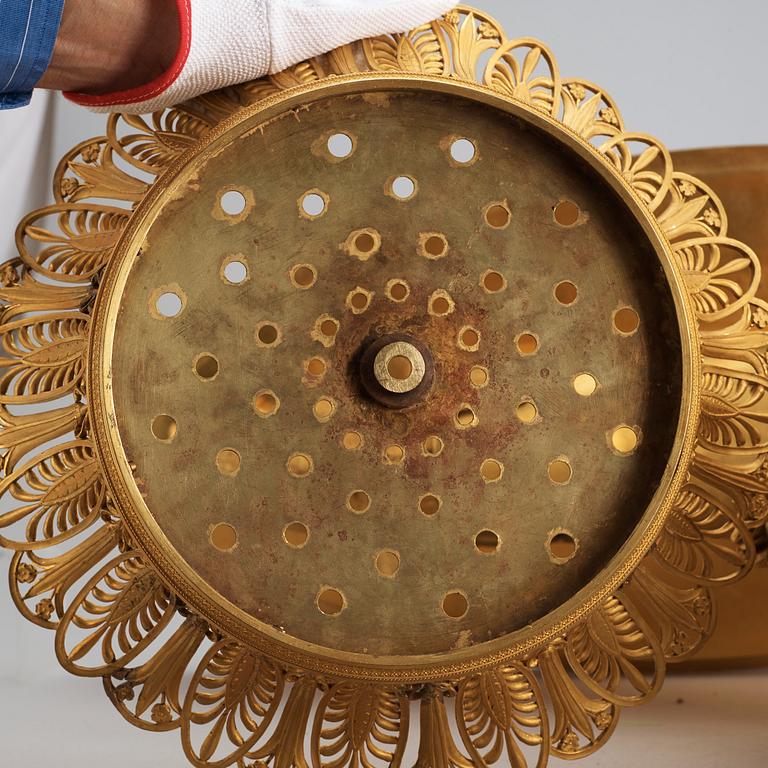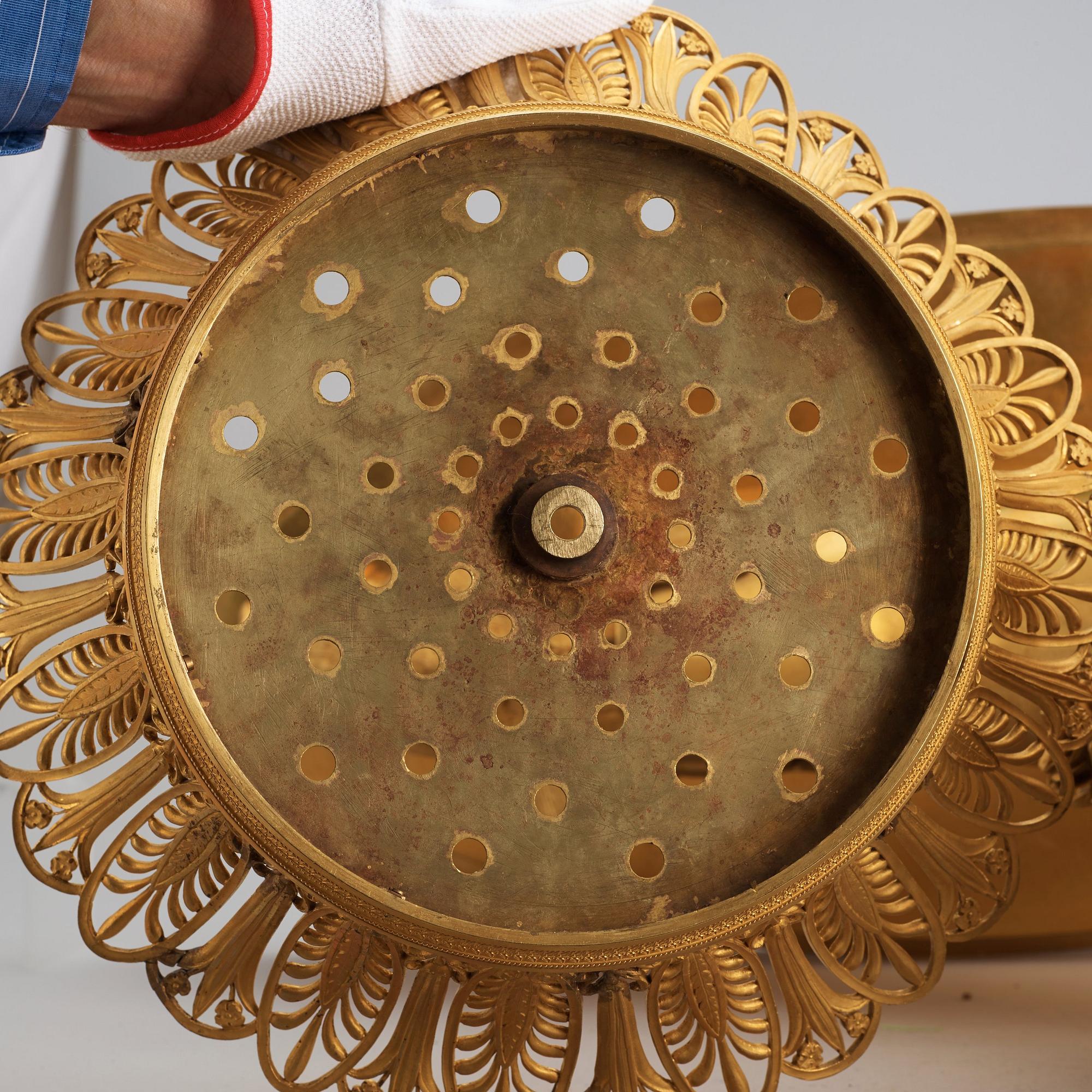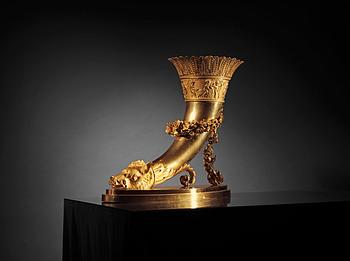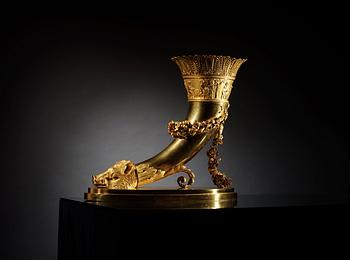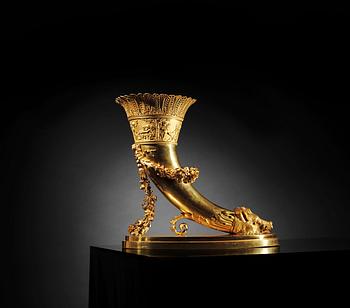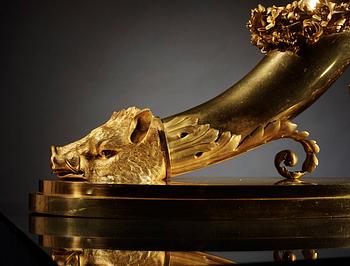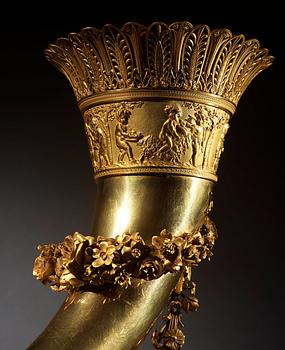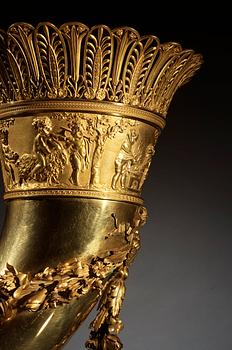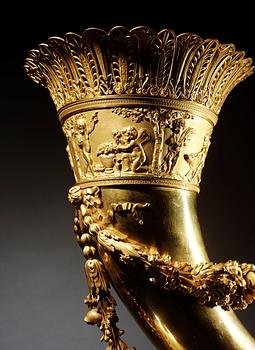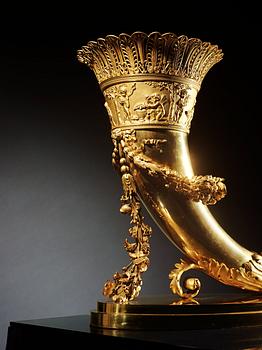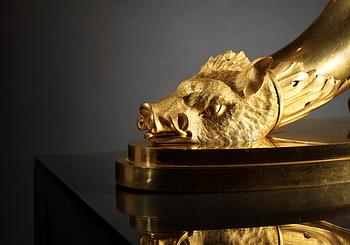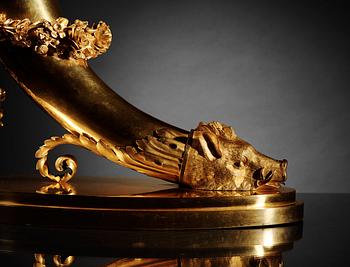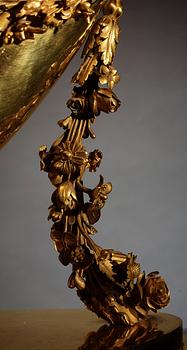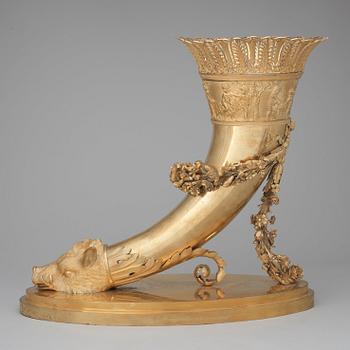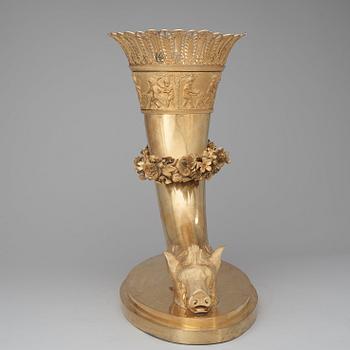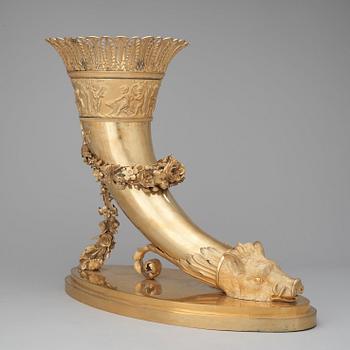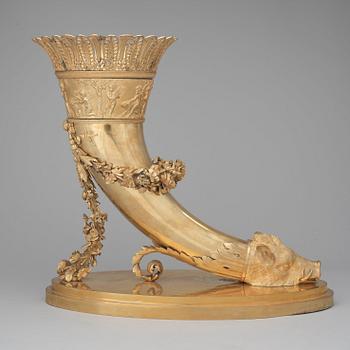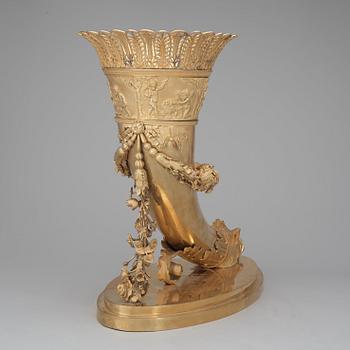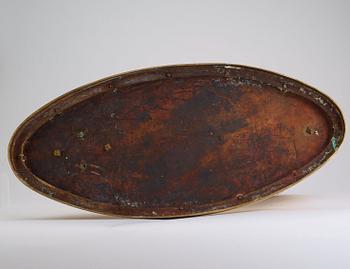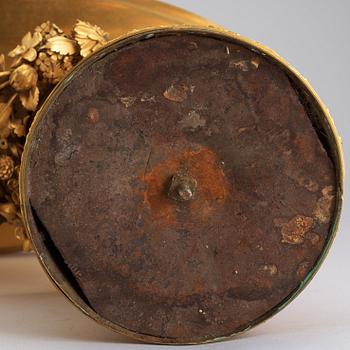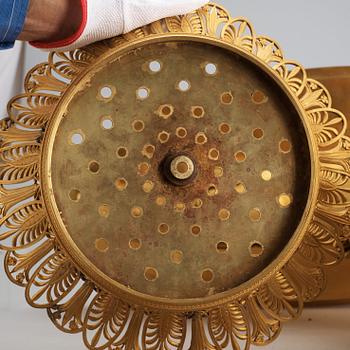
Gilt bronze. Horn/cornucopia shaped ending with a boar's head, decorated with garland that wraps around the belly and falls down at the back, the upper part frieze relief depicting putti and animals representing the four seasons: putti with doves and flowers (spring), boar hunting and grain harvest (summer), wine harvest and sacrificing a goat (autumn), putti by the fire (winter). On the top latticed rim around disc with holes for artificial flowers. Length 64, width 29, height 57,5 cm.
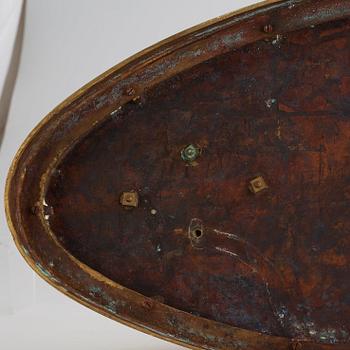
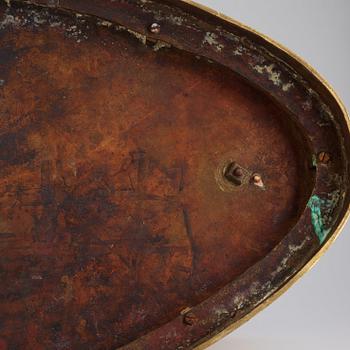
Bronze flowers missing partly, the latticed rim with repairs.
Provenance
Swedish engineer working in Russia in the early 1900s. Thence by inheritance to present owner.
More information
A MAGNIFICENT EMPIRE GILT BRONZE RHYTON VASE
The auction’s rare and large gilt bronze rhyton vase is of finest quality and is made by a skilled Parisian bronze manufacturer such as Pierre-Philippe Thomire (1751–1843) in the beginning of the 19th century. The rhyton vase has also several similarities with the porcelain rhytons in the Empire Olympic Service; ending with a boar's head; decorated with garland that wraps around the belly and falls down at the back; the upper part frieze relief of putti (for exampel sacrificing a goat). In the Louvre museum and in the Armory Museum in Moscow rhytons from the Olympic service can be found. The "antique" horn-shaped vases in the Olympic service were designed by Alexandre-Théodore Brongniart (1739–1813) after the form of ancient Roman rhytons. The painted and gilt porcelain imitated lapis lazuli and gilt bronze demonstrated that porcelain could be a match for precious stones and metals. Based on antique forms, he was most likely inspired by an engraving by Piranesi (1720–1778), but also perhaps from original pieces such as one of the two cornucopia of the Borghese Collection that entered the Louvre in 1808. There are several known pairs of 'antique' horn-shaped vases. The first, completed in 1806, was intended as a centerpiece for the Olympic Service, but presented by Napoleon I to Tsar Alexander I after the signing of the Tilsit Treaty 1807. It is now in the Armory Museum in Moscow. The second pair, finished in 1807 and shipped to Russia, is today part of France's National Furniture Repository. The Louvre porcelain vases are a third version of this model but conceived this time as a set of independent ornamental objects. The pieces were delivered to the Palais des Tuileries in 1813 to be presented as gifts to two of the Empress's dames du palais, the Duchess of Rovigo and the Countess of Montalivet.
The English word rhyton originates in the ancient Greek word ῥυτόν (rhŭtón). The conical drinking vessel was known in the Aegean region since the Bronze Age, perhaps originating from the drinking horn widespread over Persia and Eurasia since prehistoric times.