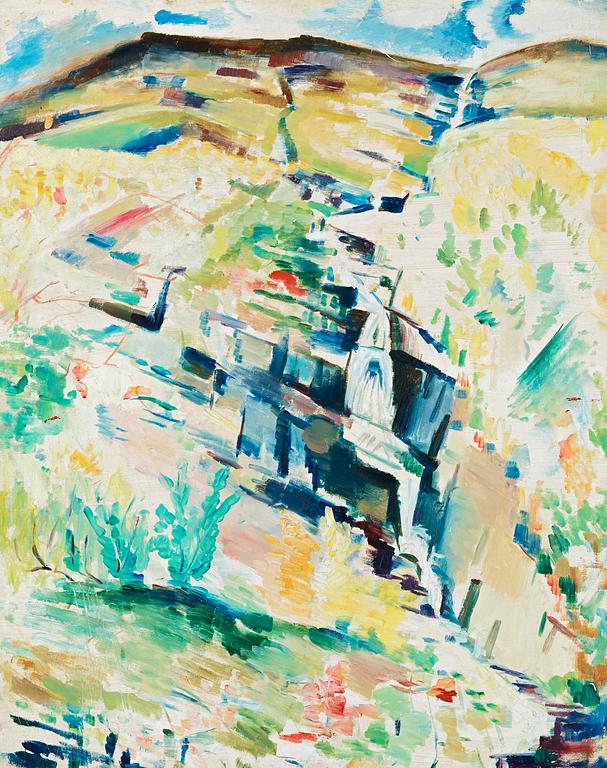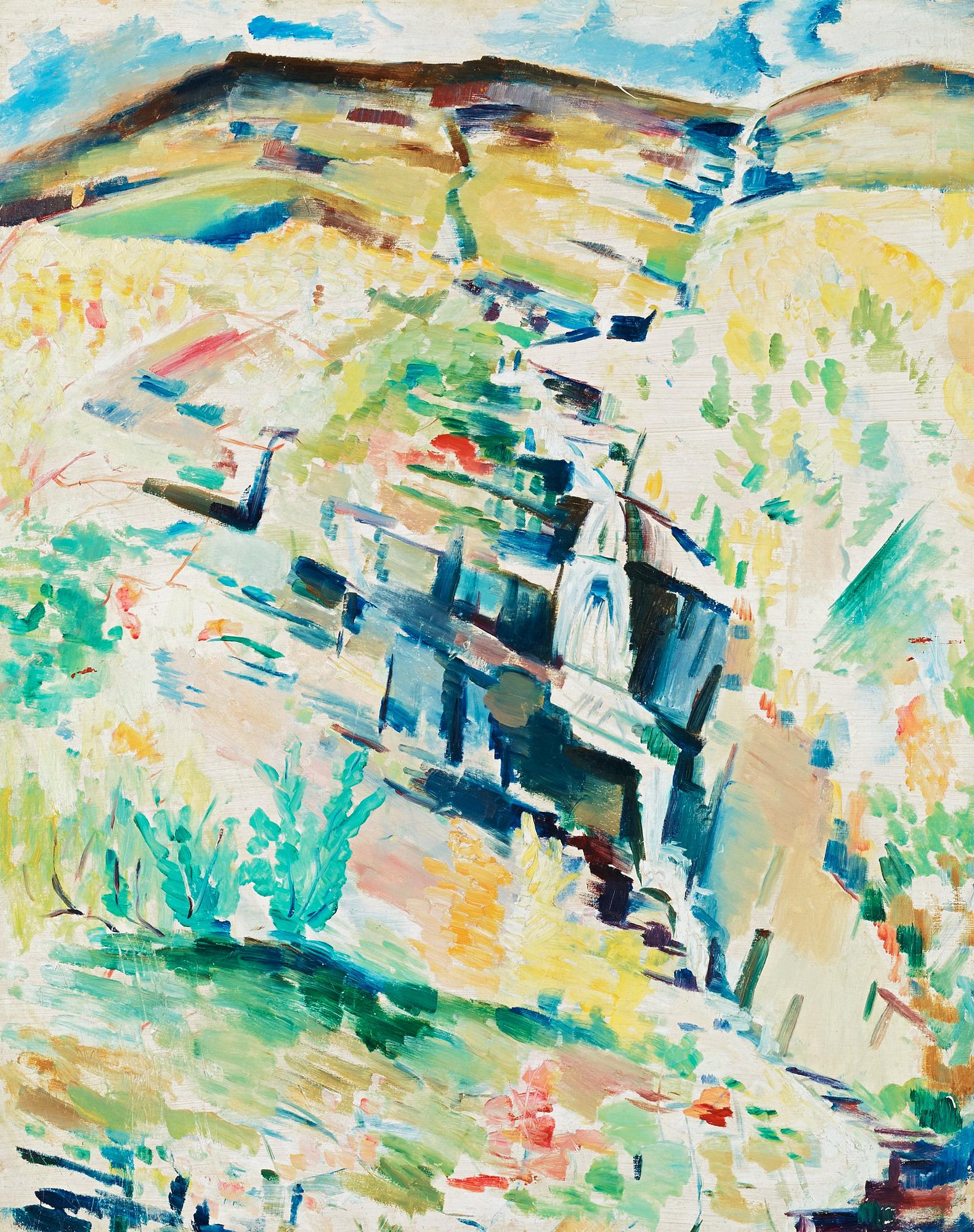
Nuoljabäcken - Abisko
Executed 1917. Panel 72 x 62 cm.
Provenance
Director Stellan Dahlstedt, Stockholm.
Stockholms Auktionsverk, "Moderna", October 28, 2010, cat no 1278.
Private collection, Stockholm.
Exhibitions
Gummesons Konstgalleri, Stockholm, 1917.
Prins Eugens Waldemarsudde, Stockholm, "Leander Engström", 1986, cat no 37, illustrated fullpage in colour in catalogue.
Museet Kulturhuset, Borås, "Leander Engström", 1986-87.
Literature
Hans-Olof Boström, "Leander Engström - Europé och provinsialist", 1986, p. 31, illustration in colour no 37.
More about Leander Engström
Per leander Engström was a Swedish visual artist born in Ytterhogdal. He studied under the tutorship of Henri Matisse in Paris and the artists association school in Stockholm. Engström was part of the artistic group De Unga together with none other than Isaac Grünewald and Tor Bjurström. Engström was greatly inspired by Paul Gauguin, Vincent van Gogh and Paul Cézanne. Leander Engström followed in Osslund's footsteps and was captivated by Lapland's overwhelming natural scenery, which he depicted using the forms and colors of Fauvism. His paintings from 1912-15 - landscapes, still lifes, nude scenes - are harmonious and emotional, built upon Cézannes principles of discrete, weak colours. The years between 1916 and 1919 kan be understood as his most expressionistic period. Sweeping lines, large stylised planes and bright strong colours dominated his characteristic style. Engström found himself in Italy between 1920 and 1922 where he studied the early Rennaissance; it was during this time that he neared new objectivity. Leander Engström was one of Matisse's most impressive pupils.
Read more