"Madonna"
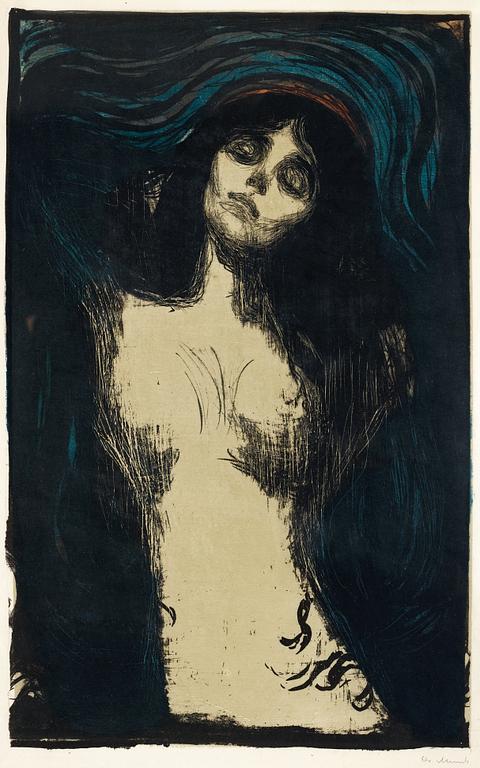
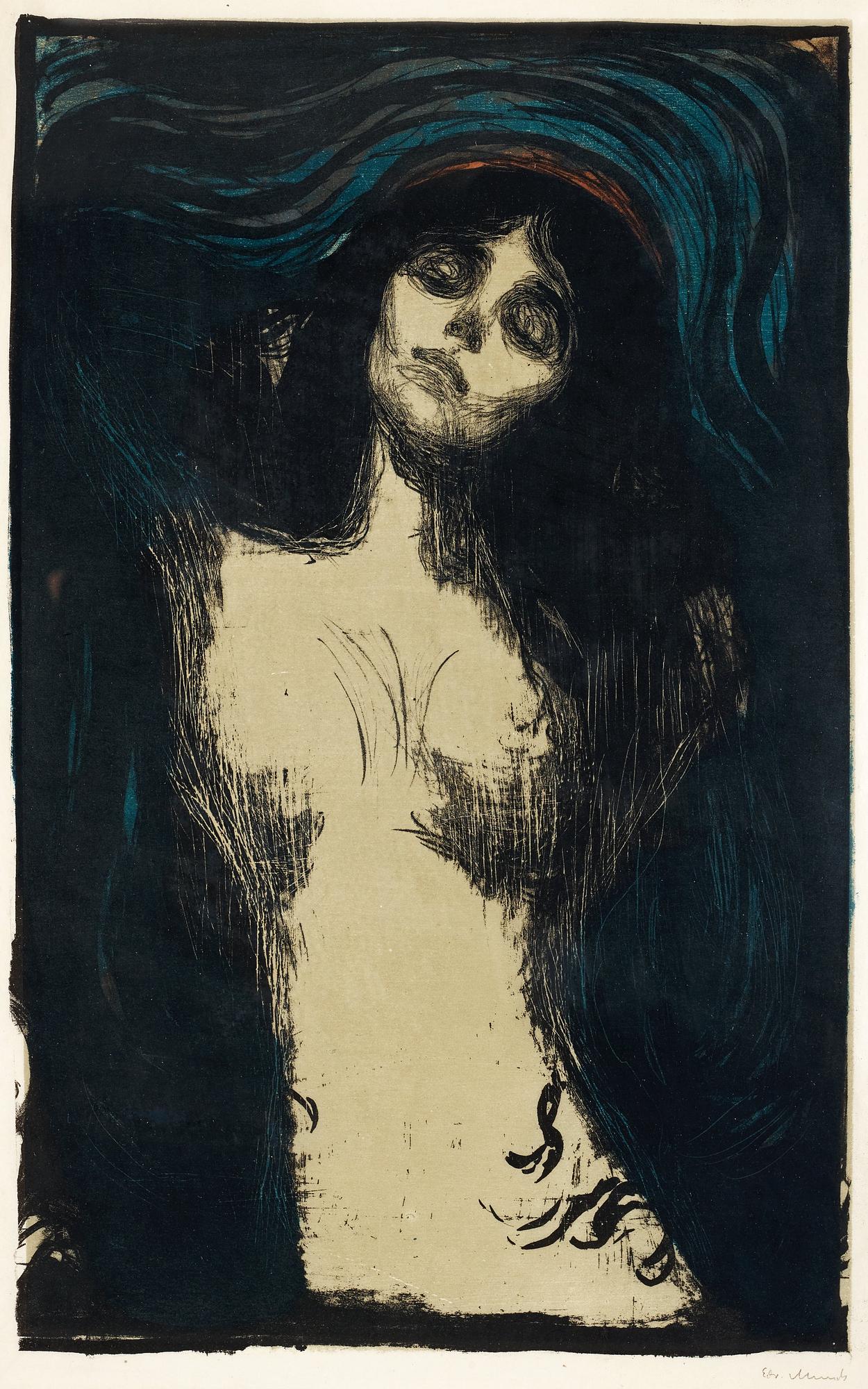
Lithograph printed in black, pale olive green, blue and rust red, 1895-1902, on tissue-thin paper, signed in pencil, Woll's final state of seven. I. 55,5 x 35,2 cm. S. 69 x 51 cm.
Pale time and mat staining, minor defects to edges of sheet and upper corners. Margins with a fine pattern of cockles. Few fine creases in image. A small skinned area to left margin, with a associated very small hole.
Saleroom notice
Lithograph
Provenance
Private Collection, Malmö, Sweden.
Literature
Woll 39. Schiefler 33.
More information
Today there exists five different pictures of "Madonna", the paintings being executed between 1894-97, all which presumably are a development of a now lost original, exhibited in Berlin in 1893, and titled "Madonna-Gesicht".
Edvard Munch started to work with the lithograph in 1895, and the intense portrait of the woman, both with an ecstatic and obsessive expression also shows a deep sense of vulnerability, and the woman self-abandoned, was to be called "Loving Woman", and a part of "The Love Series", which he later on developed into "The Frieze of Life".
There exist several different versions of "Madonna", where the earliest have a frame of swimming spermatozoa and a foetus, this being abandoned in the later and final version of this truly iconic work.
The naked woman is shown standing, half length, with her arms raised above her head, and the long dark hair cascading down in flowing lines, that we so often see in Edvard Munch's portraits of women, here being an important part of the composition, building up the ecstatic feeling of the woman, and continuing up in the halo-like arc round here head. All this giving us a strong feeling of motion, and also making us able to feel the ecstatic mood of the "Madonna". Edvard Munch's own words gives us perhaps the best key to the work - "The woman who abandons herself - and acquires the painful beauty of a Madonna".