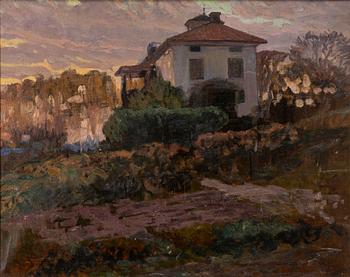
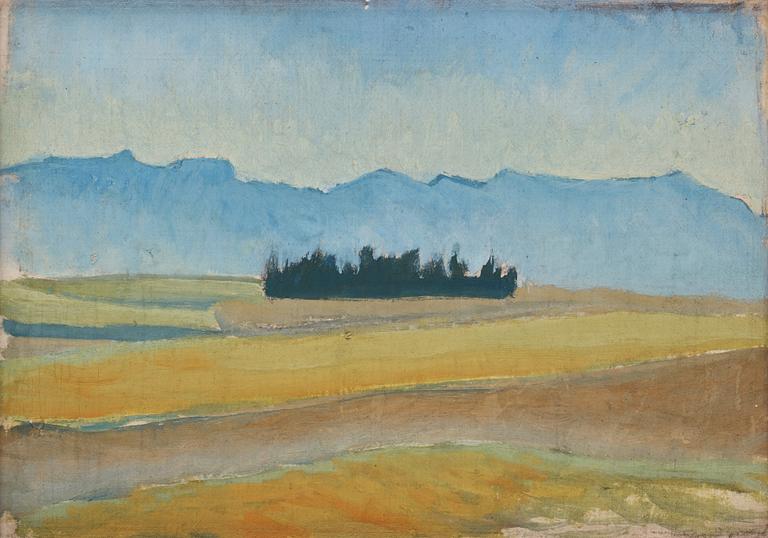
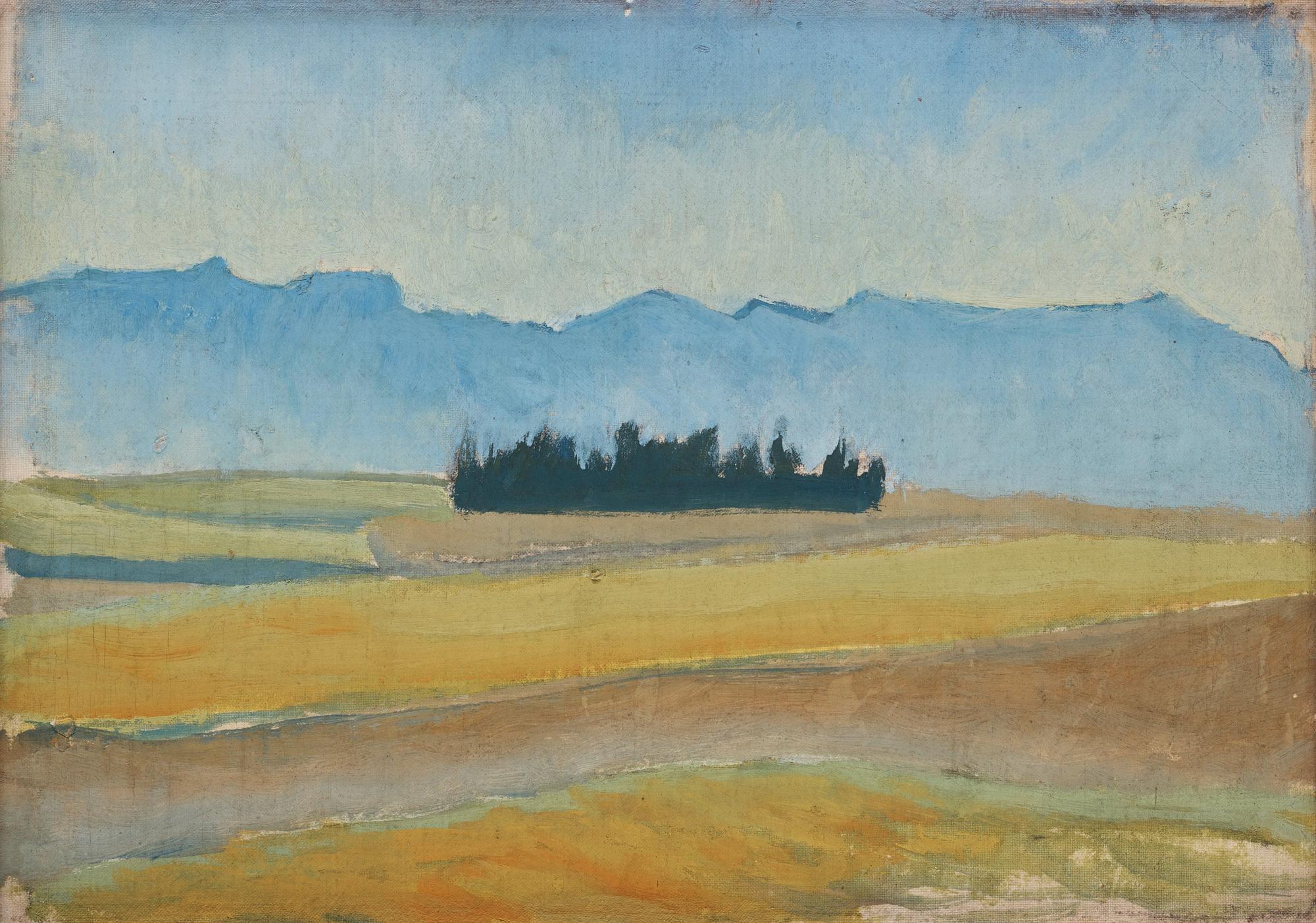
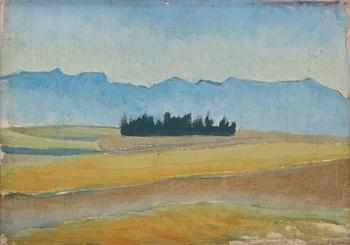
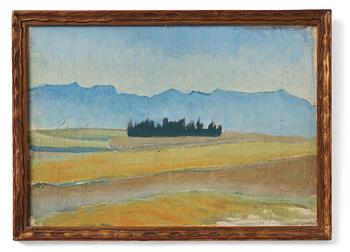
Autumn Plain
Canvas laid down on panel 22 x 32 cm
Saleroom notice
Canvas laid down on panel
Exhibitions
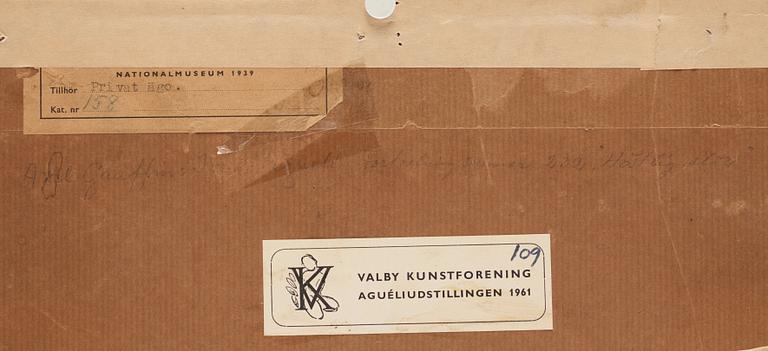
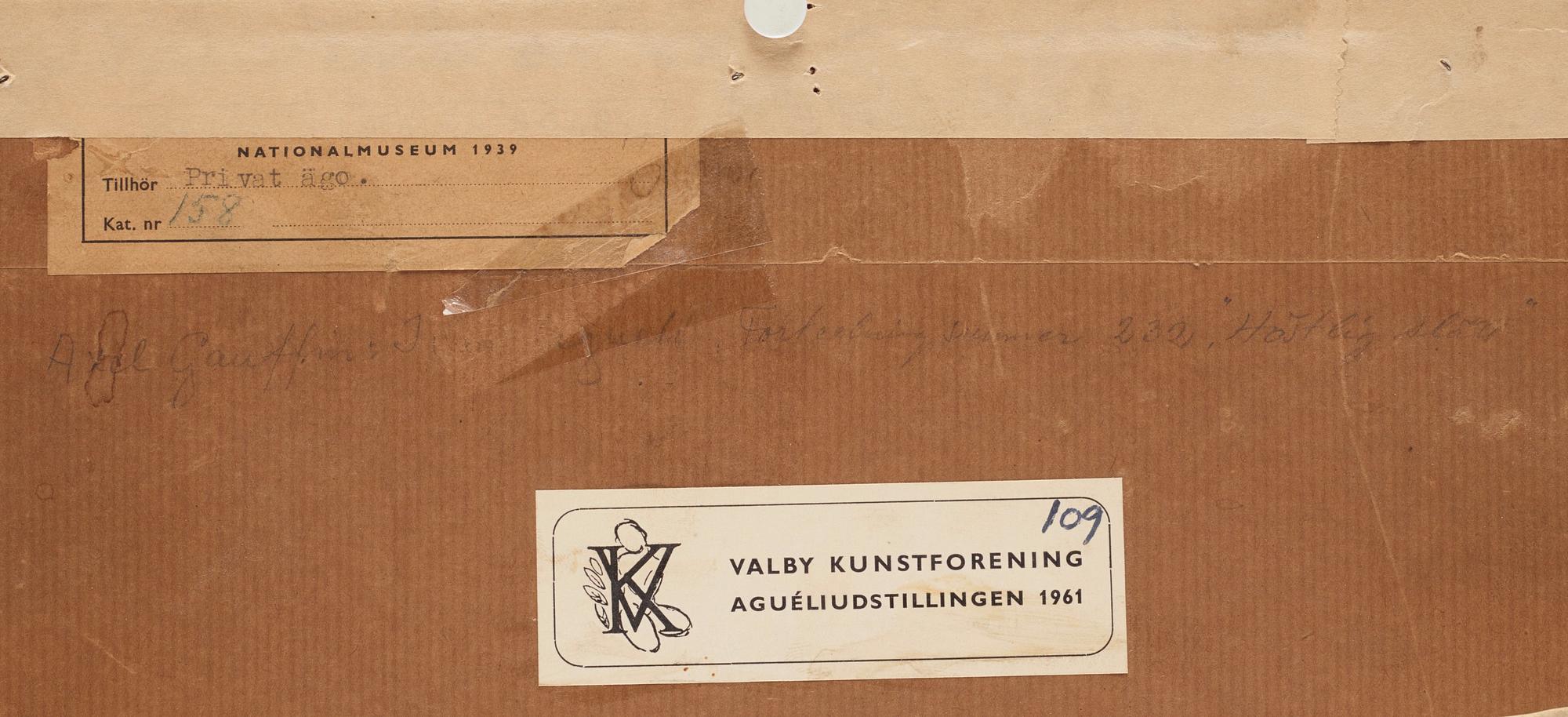
Nationalmuseum, Stockholm, "John Gustaf Agelii. Med konstnärsnamnet Ivan Aguéli", May-June 1939, cat. no. 158.
Valby Kunstforening, Frederiksbergs Town Hall, Denmark, "Aguéliudstillingen", 25 February-12 March 1961.
Literature
Axel Gauffin, "Ivan Aguéli. Människan - Mystikern - Målaren", part II, SAK, 1941, listed in catalogue p. 319 as no. 232, illustrated p. 285.
More information
After deciding to become an artist during a visit to Gotland in 1889, Ivan Aguéli traveled to Paris for the first time in the spring of 1890. The purpose of the trip was to study painting, and once there, Aguéli sought out Émile Bernard, who taught the theories behind the recently established style of Synthetism. This new school of art, developed by Bernard and other artists, including Paul Gauguin, in Pont-Aven, Brittany, during the last decade of the 19th century, advocated for artists to synthesize their visual impressions and paint from memory rather than making a direct representation of the subject. The results often consisted of paintings with large, clean colour areas surrounded by black outlines.
In 1890s Paris, Aguéli was also inspired by Symbolism, but his interest in Eastern philosophy and religion led to studies in Oriental languages and non-European art. In 1894, Aguéli traveled to Egypt, where Bernard had moved earlier. His fascination with North African culture and Eastern philosophy deepened. He first stayed outside Alexandria and later in Cairo. In 1898, he converted to Islam and adopted the name Abdalhadi, meaning servant of the guide. Over a ten-year period, he painted almost nothing, instead delving even further into religion and language.
Aguéli's paintings are characterized by intimacy and tranquility, with landscape painting dominating his artistic production. Gunnar Ekelöf suggested that it was in landscapes that the artist was most intimate: "In landscapes, he is perhaps the most intimate, no matter how monumental they may be. It seems to me that in them, he felt more free from the desire and the contemporary antipathy that people arouse in him."
For condition report contact specialist




Others have also viewed