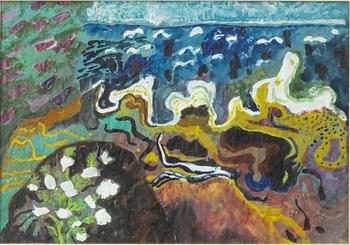
View from Gullholmen
Signed A. Cleve. Executed in 1913–15. Oil on canvas laid down on cardboard panel, 64 x 46 cm.
Provenance
Bukowski Auktioner, Stockholm, auction 515, 2 - 4 May 2000, lot 131.
Bukowski Auktioner, Stockholm, auction 572, 24 April 2013, lot 134.
Acquired at the above auction.
Exhibitions
Mjellby Konstmuseum, "Sommar på Skagen, Agnes Cleve - svensk modernist i världen", 10 May - 7 September 2014.
Stenungsunds konsthall, "Agnes Cleve", 6 June - 17 August 2019.
Literature
Exhibition catalogue, Stenungsund Art Hall, "Agnes Cleve", 2019, illustrated p. 8.
More information
Agnes Cleve grew up in an affluent bourgeois environment in Uppsala, where her father held a professorship in chemistry. After completing her studies at the Higher School of Industrial Art (now Konstfack) in Stockholm, Cleve worked as a designer, producing works characterised by the prevailing Art Nouveau style and its ornate, decorative expression.
At the turn of the twentieth century, however, Cleve abandoned the applied arts in favour of traditional painting. She began studying under Carl Wilhelmson at the Valand School of Art in Gothenburg. Her works from this period reveal clear traces of Wilhelmson’s influence, which is said to have extended far beyond purely artistic matters. According to surviving letters from the time, an intense love affair developed between teacher and pupil. Wilhelmson’s marriage came close to dissolution, and Cleve left her then husband.
It was, however, the artist John Jon-And, thirteen years her junior, whom Cleve would marry. They met in the early 1910s, travelled to Paris together and married in 1915. Her stay in Paris marked a radical new direction in Cleve’s artistic development. Cubism was in vogue, and Cleve and Jon-And were early to seek inspiration and instruction at the very centre of the art world: Paris. Their teachers at La Palette were Le Fauconnier and Dunoyer de Ségonzak.
Agnes Cleve was one of the few female artists to join the Swedish avant-garde in Paris. She was something of a solitary figure who worked independently and rarely exhibited on her own, but her talent and technical skill were unmistakable. When Cleve and Jon-And returned to Sweden in 1914, following the outbreak of the First World War, the foundations had been laid for these two remarkable artistic careers. Throughout the remainder of the 1910s, both Cleve and Jon-And adhered to a dynamic style of painting characterised by a fusion of Expressionism and Cubism, with cityscapes and landscapes alternating in Cleve’s production during these years.
More about Agnes Cleve
Agnes Cleve was born in Uppsala in 1876. After completing her secondary education, she studied art at the School of Arts and Crafts in Stockholm. When she started a family she moved to Gothenburg and studied art at Valand where Carl Wilhelmsson was her teacher. After a difficult divorce, Angnes moved to Paris in 1913, where she studied for Le Fauconnier together with John Jon-And. They eventually got married, and later moved to Stockholm and settling in Gothenburg. The couple often stayed at their summer cottage by the Gullmar Fjord, a place called Källviken, which became a gathering point for several artists, including the couple Gabriele Münter and Wassily Kandinsky. Kandinsky was, in his homecountry Germany, the leader of the group “Der Blaue Reiter”, a group which advocated for cubism and German modernism. It is without a doubt that they influences Agnes Cleve and Jon-And. Cleve has done several artists trips to paint Sandhamn, Skagen, London, Italy, Holland, Belgium, North Africa, Spain, Turkey, and the USA (where he even lived for a period). In Cleve’s collection, one can find figure paintings, window views, portraits, cityscapes, and west coast genres. Agnes Cleve's art was exhibited across Europe (Paris, Amsterdam, Copenhagen, among others). There was a lot of talk surrounding her exhibition together with none other than Sigrid Hjertén in Paris in 1937, and she was classified by a German critic as Sweden’s most influential artist during the first half of the 20th century. She is currently represented by the National Museum, Gothenburg’s Art Museum, Gävle Museum, Norrköping’s Museum to name a few.
Read moreFor condition report contact specialist

What will the transport cost?
Shipping can only be arranged by contacting specialdelivery@bukowskis.com.