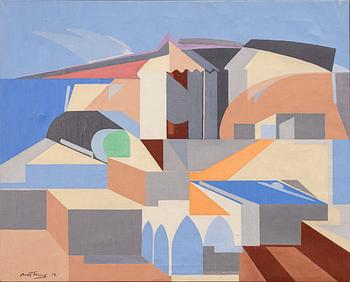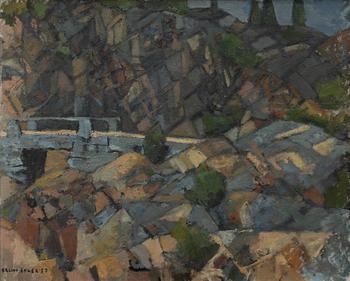
"Från trädgården/Från trädgården II".
Signed Evert Lundquist verso. Oil on canvas 58.5 x 65 cm.
Provenance
Beaux Arts Gallery, London.
Marlborough Fine Art Ltd., London.
Private Collection, Sweden.
Exhibitions
Gummeson’s Art Gallery, Stockholm, “Evert Lundquist”, March - April 1962, cat. no. 51.
Gallery of Art del Cavallino, Venice, 1962, cat. no. 21.
More information
Evert Lundquist’s impasto light painting reached its absolute peak during the 1960s, when he allowed his subjects to emerge from the light. His contemplative motifs take shape, almost crackling with life, from slabs of colour layered one on top of another. Stillness, warmth and a very particular light spread benevolently towards the viewer.
When Evert Lundquist was appointed professor and accepted as a teacher of painting at the Royal Institute of Art in 1960, he was 56 years old. The decade that lay ahead would prove to be of the greatest importance. At the beginning of the 1960s, his desire to work was at its height, while the cultural climate in Sweden was beginning to change. For a long time, the public and critics had focused on Constructivism, but now the expressive was being rediscovered.
Evert Lundquist’s forceful brushwork and heavily impastoed paint also presented him as an independent counterpart to artists such as de Kooning and Dubuffet, who were associated with “Abstract Expressionism”. The doors to an international breakthrough opened in 1959, when he exhibited in Paris, followed by exhibitions in London, Milan, Paris and New York. In 1960, he participated in an exhibition at Beaux-Arts Gallery in London, and in 1964 he was invited to take part in the exhibition “54-64, Paintings & Sculpture of a Decade”, organised by Tate Gallery. He achieved considerable success and was frequently praised by critics, but Lundquist soon realised that international recognition was not worth the price and decided that Sweden, and his studio in Kanton in Drottningholm, was his place on earth.
In connection with a major exhibition at the Royal Swedish Academy of Fine Arts in 1970, the year Evert Lundquist retired from teaching, he described the preceding decade in his artistic career: “It represented a consolidation of my own artistic vision, and perhaps testified to an increased interest in light and, possibly, also an ability to say things more simply than before.”
For condition report contact specialist

What will the transport cost?
Covered by droit de suite
Image rights
The artworks in this database are protected by copyright and may not be reproduced without the permission of the rights holders. The artworks are reproduced in this database with a license from Bildupphovsrätt.