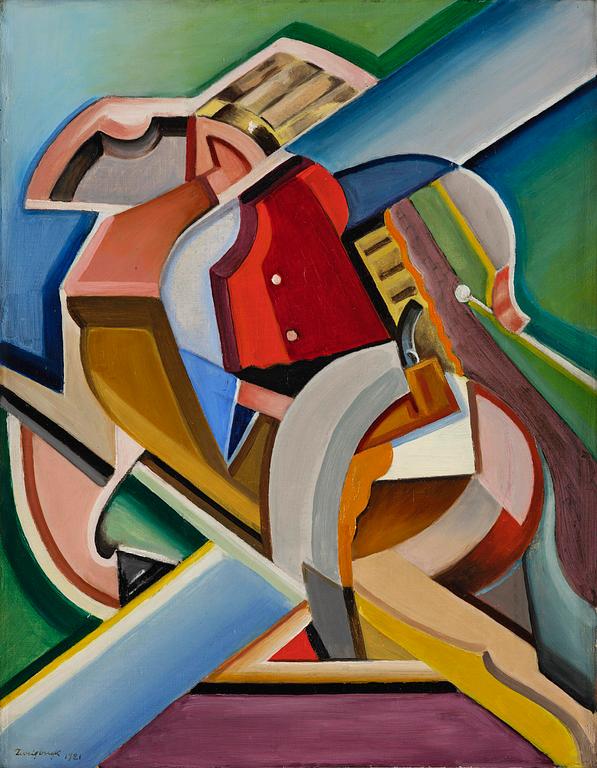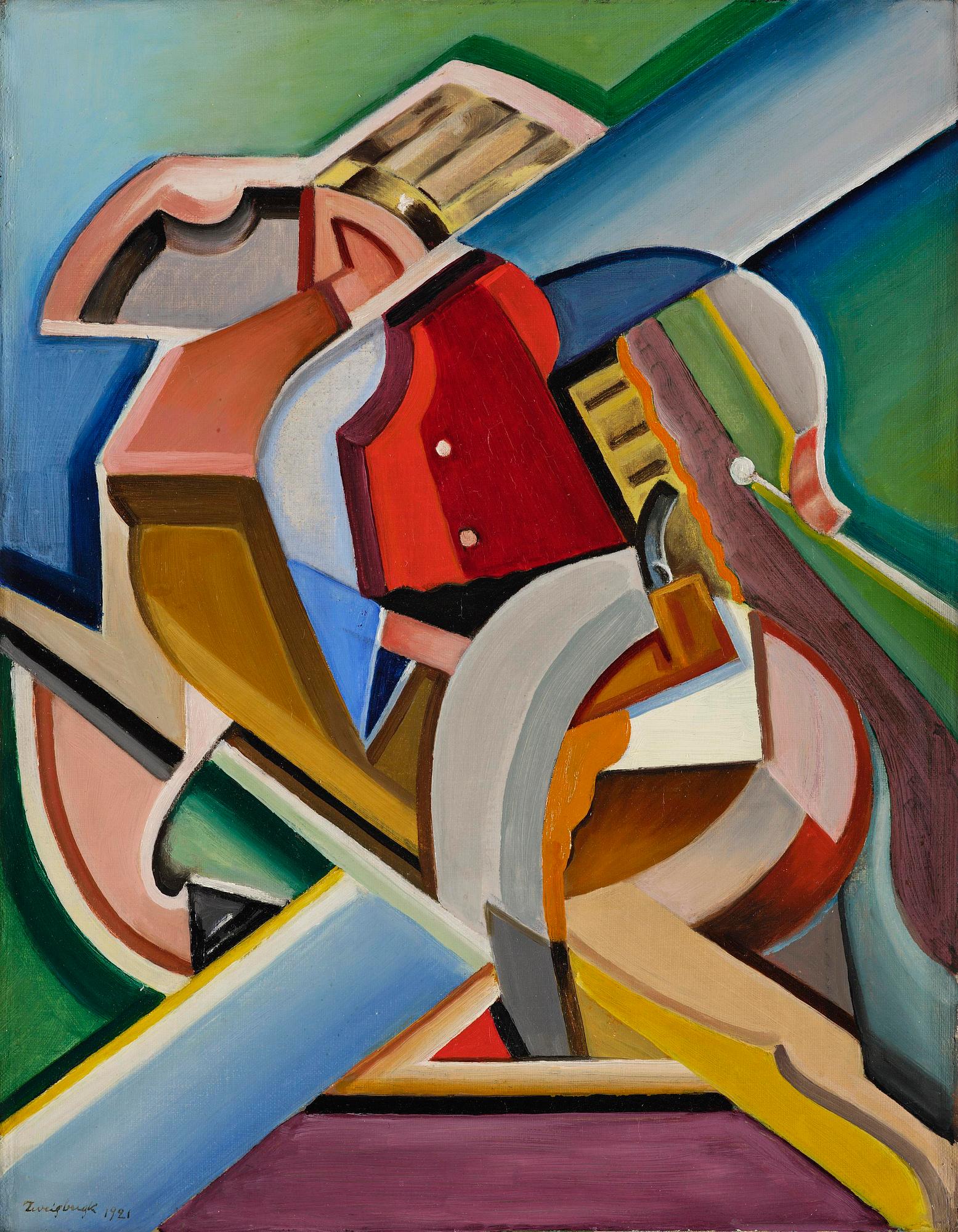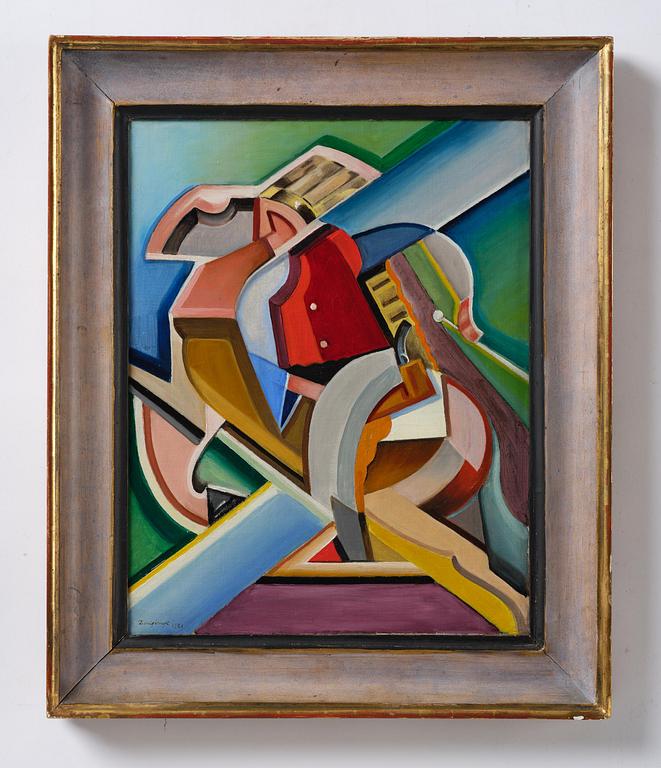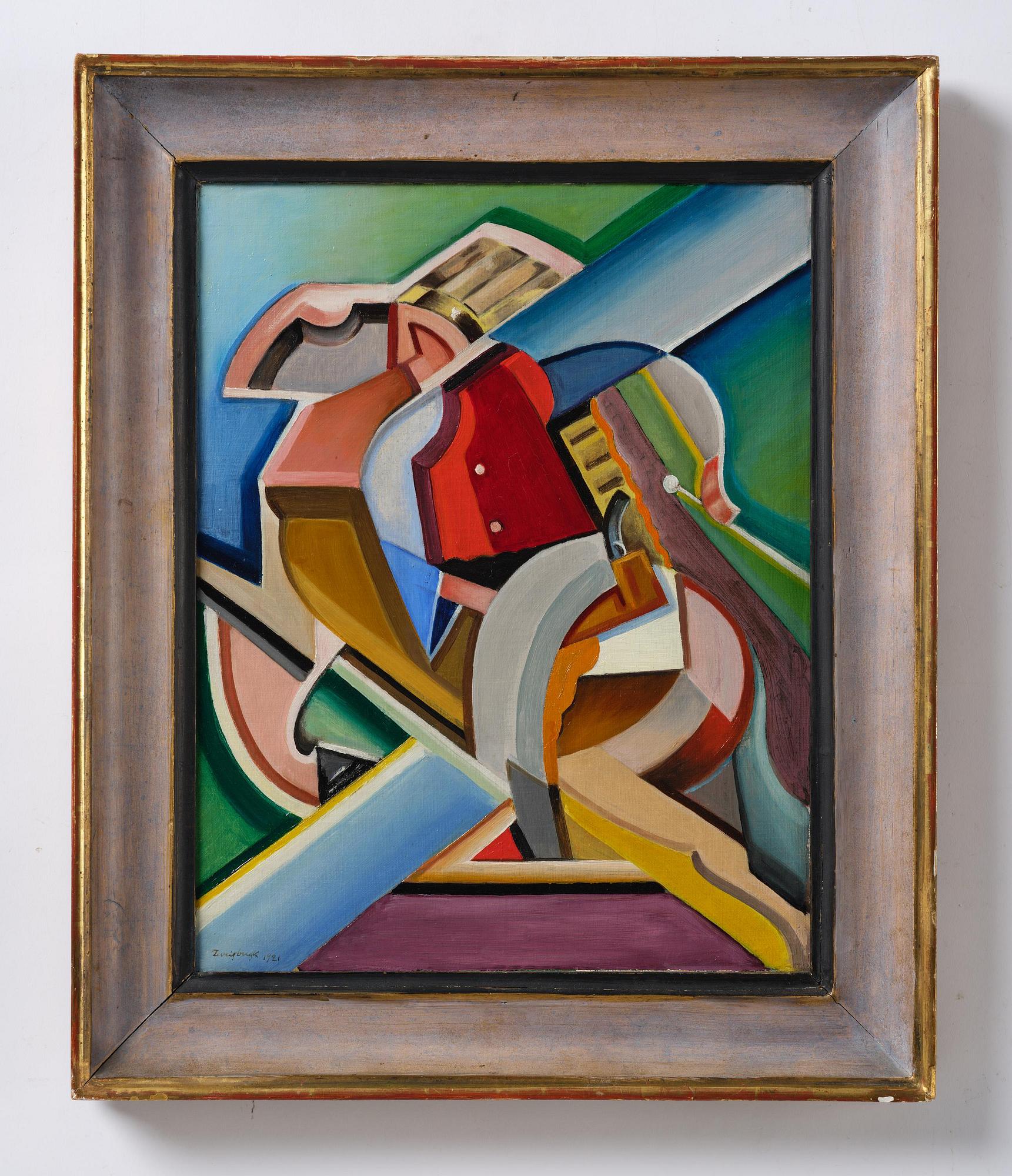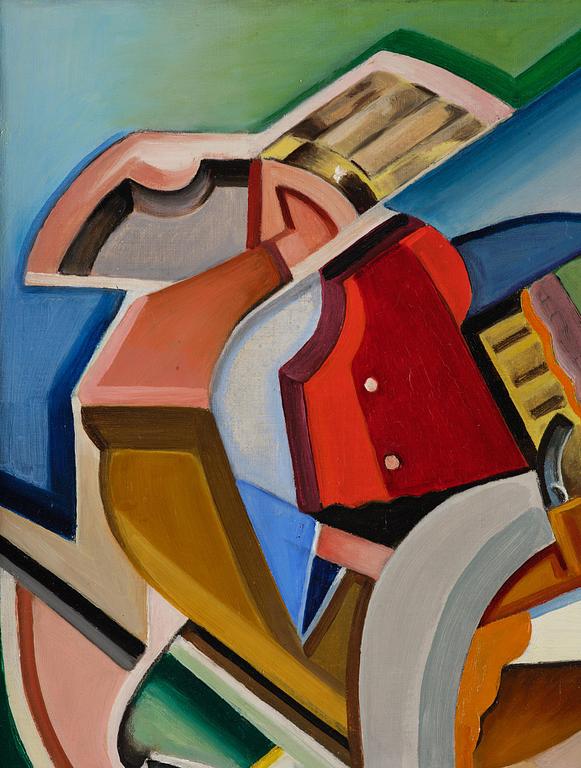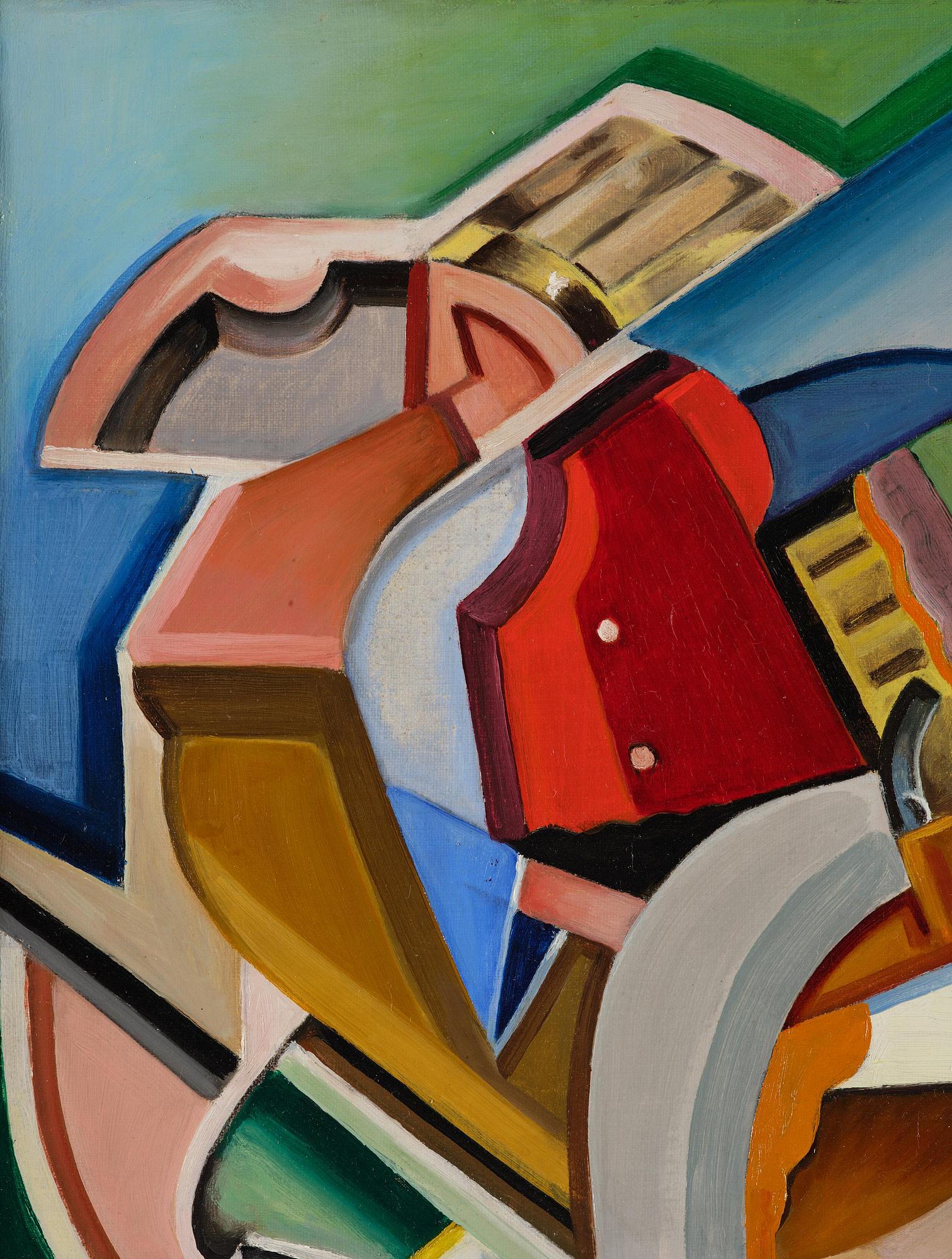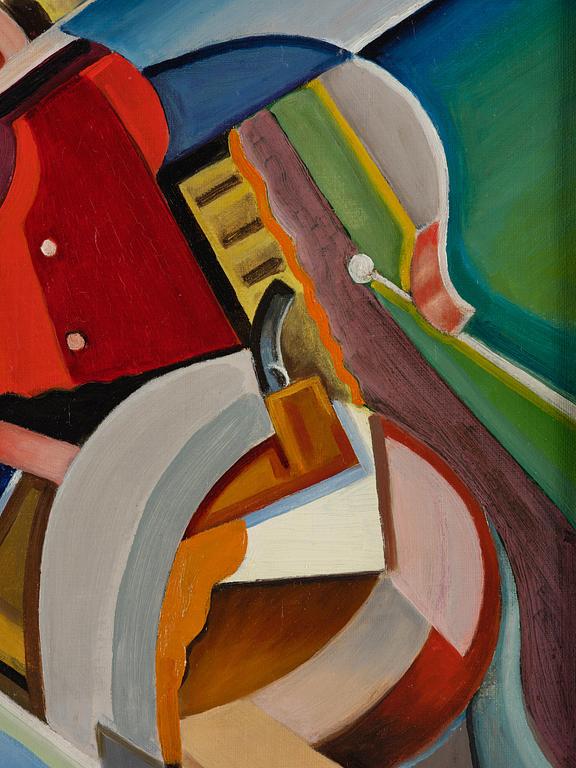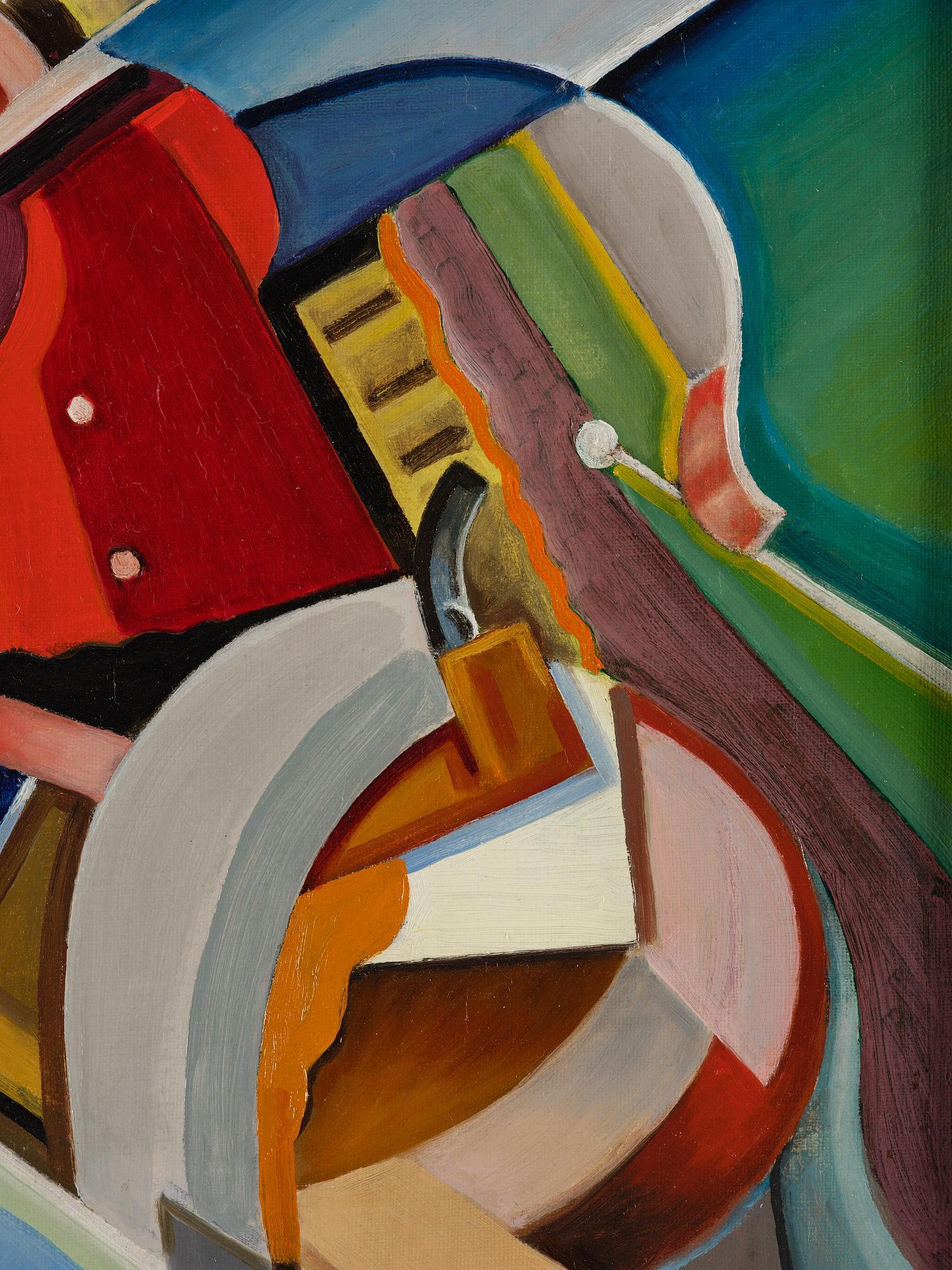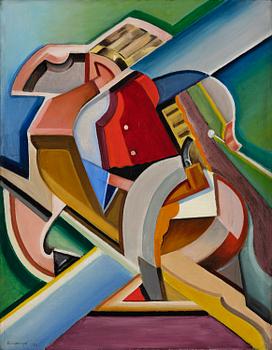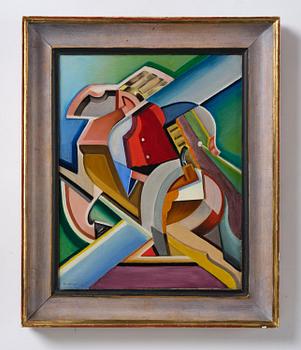
"Indian till häst"
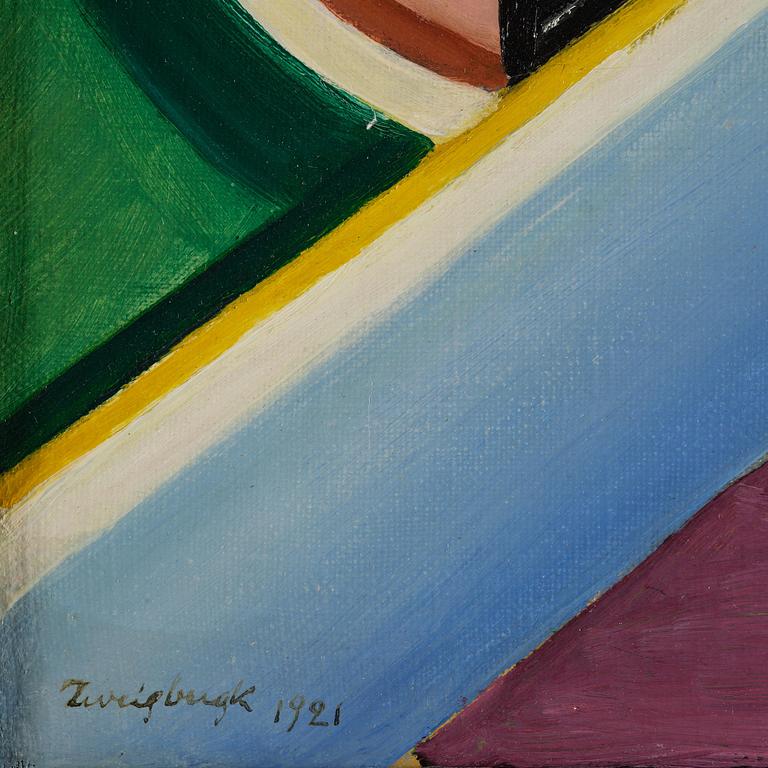
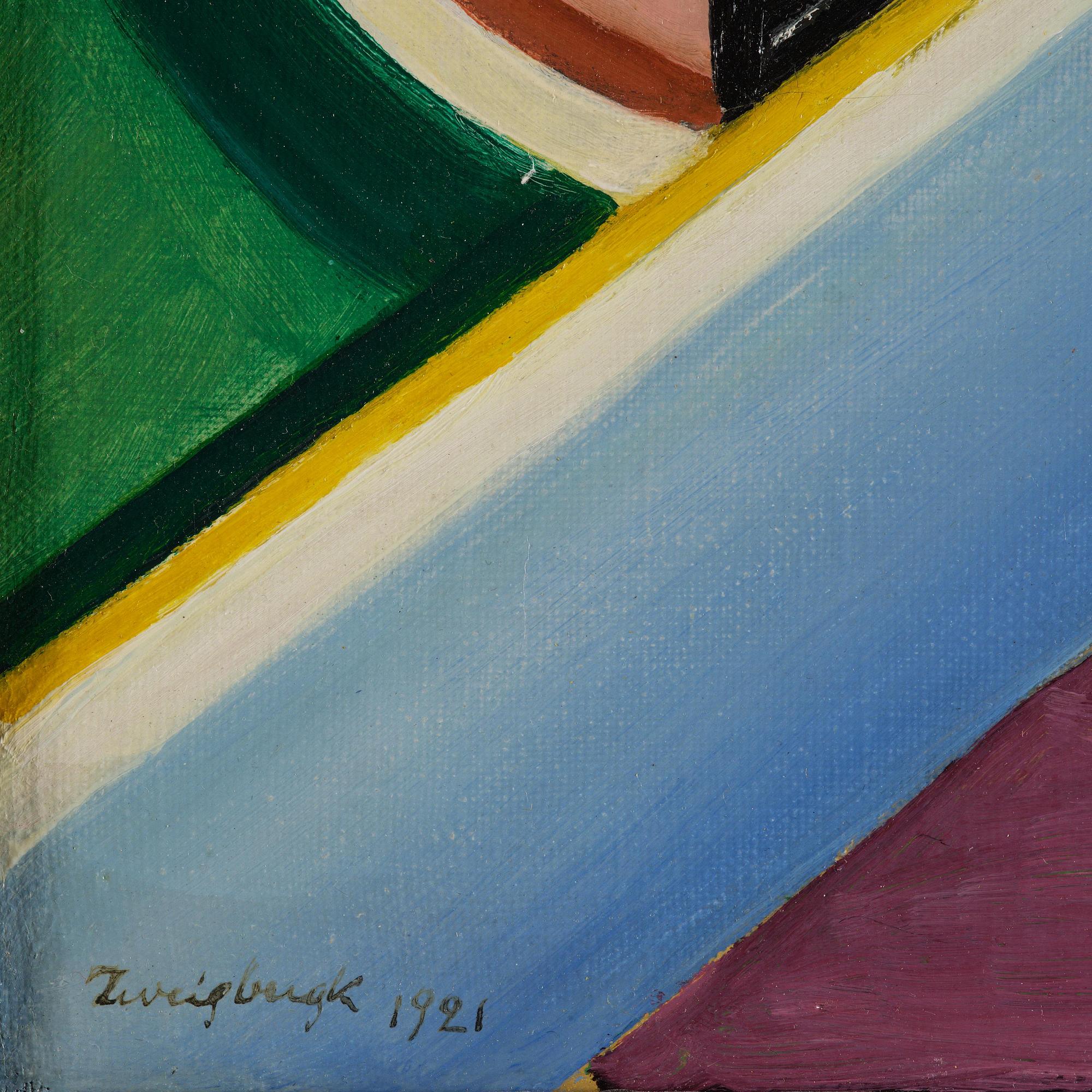
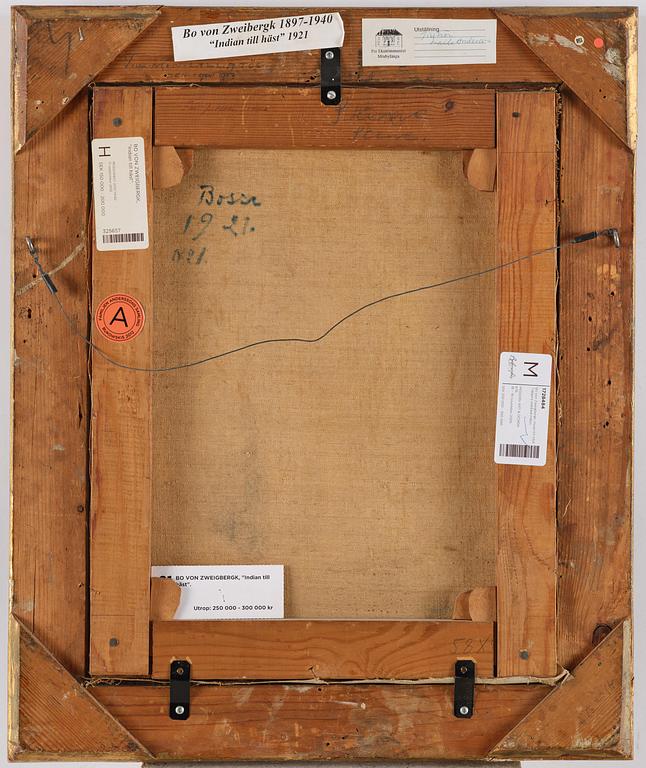
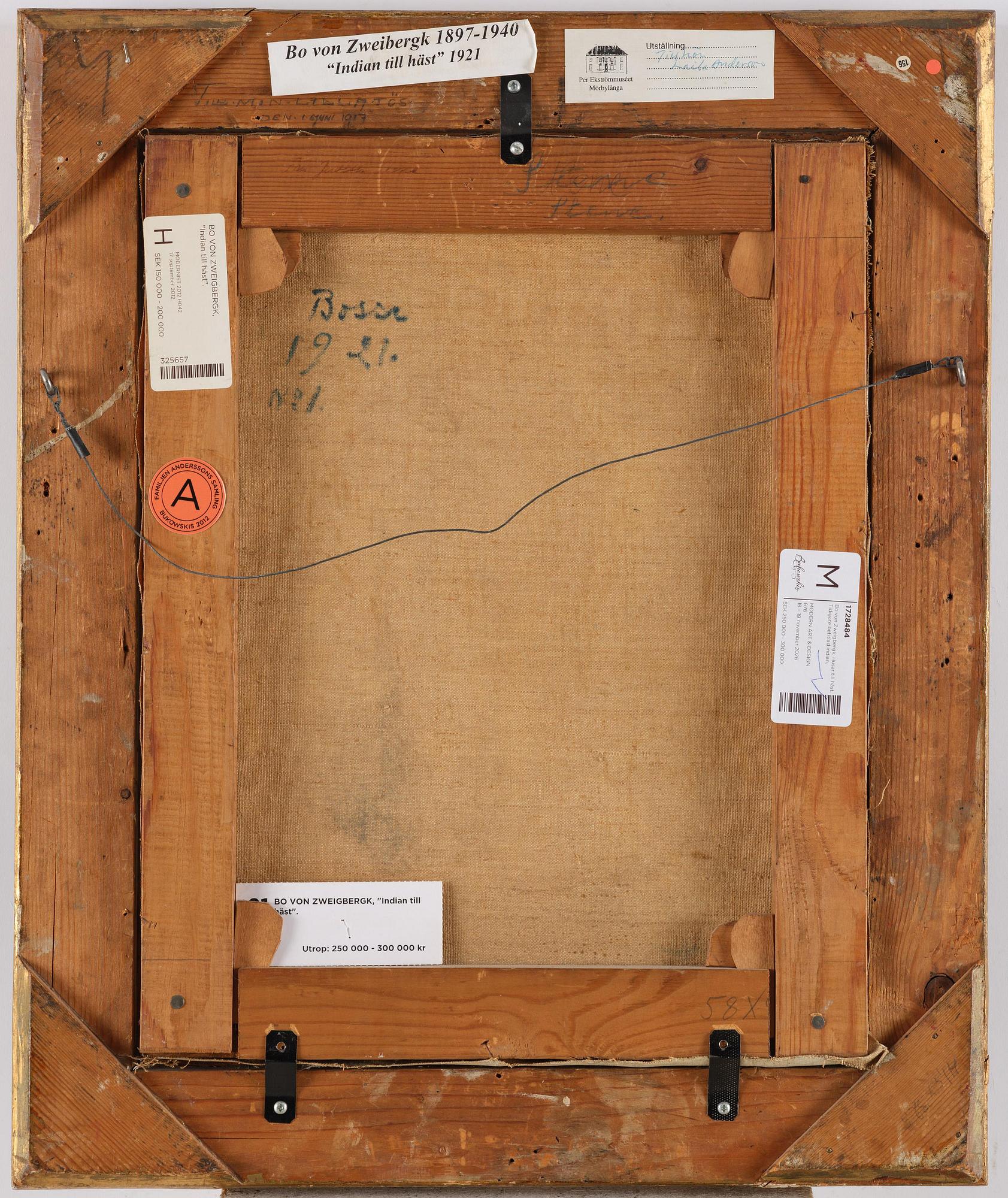
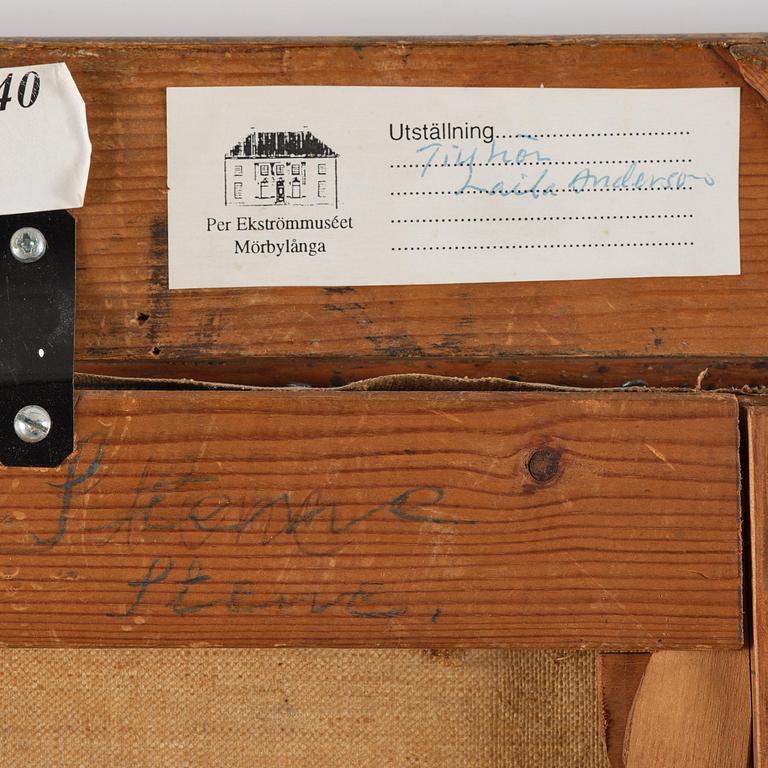
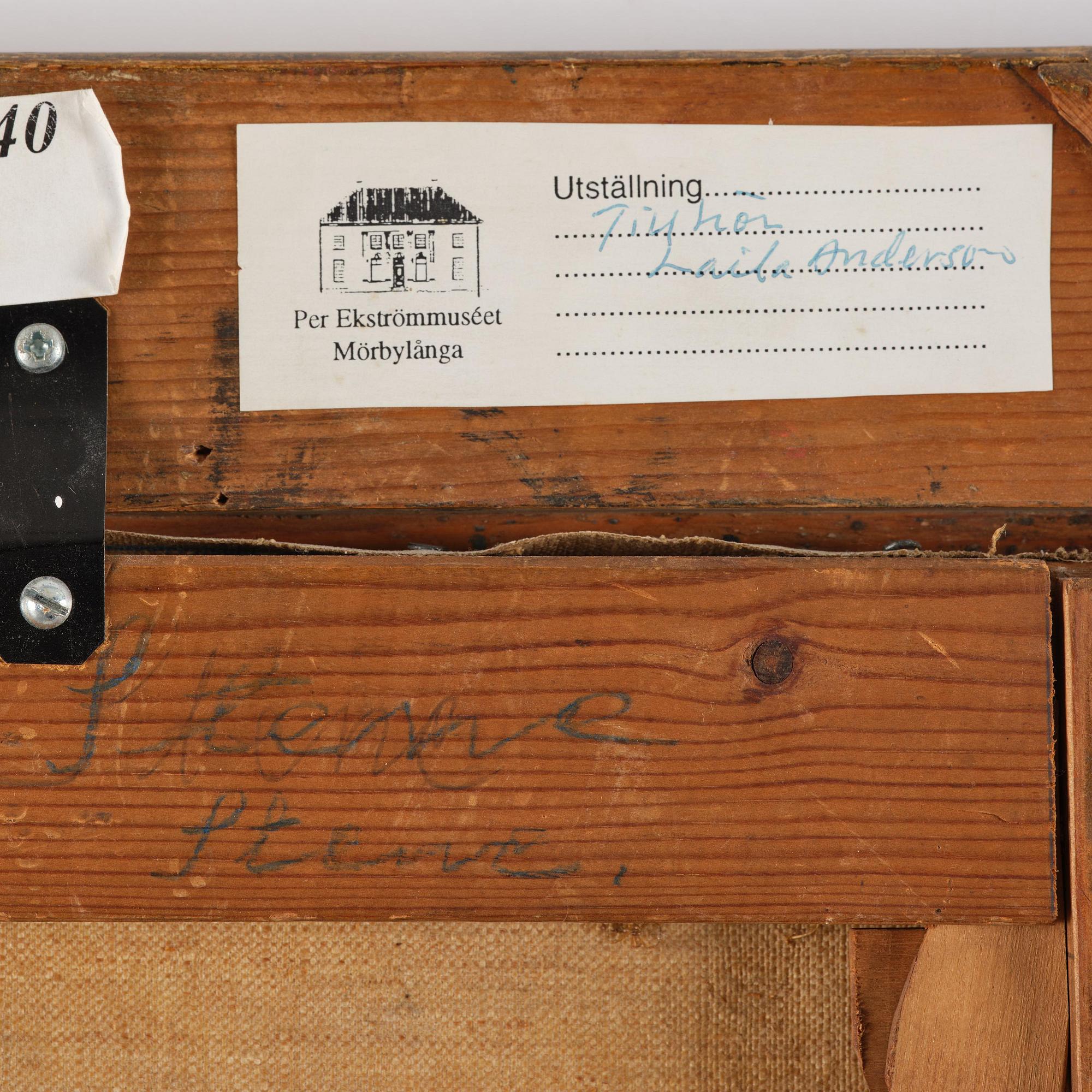
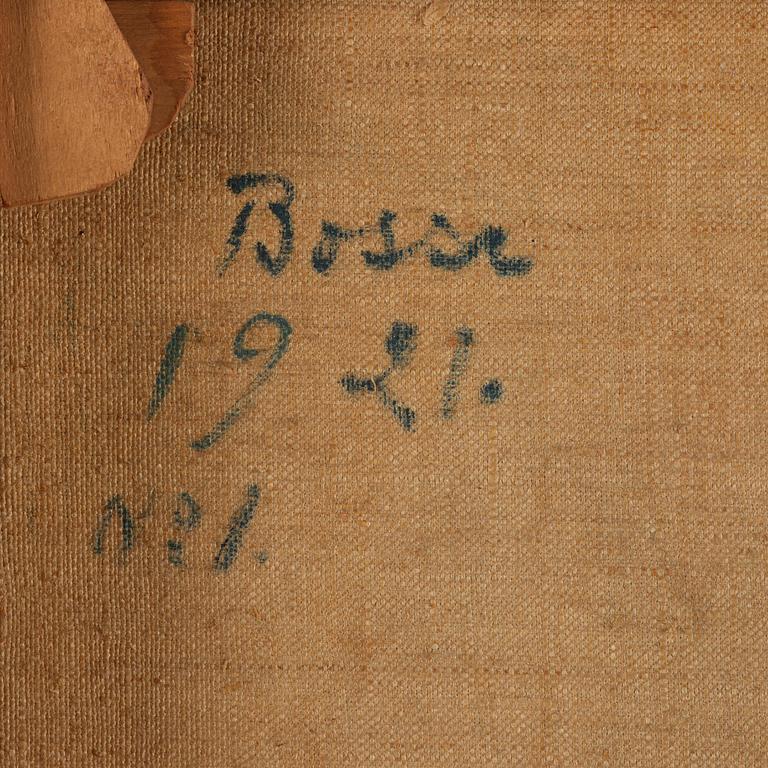
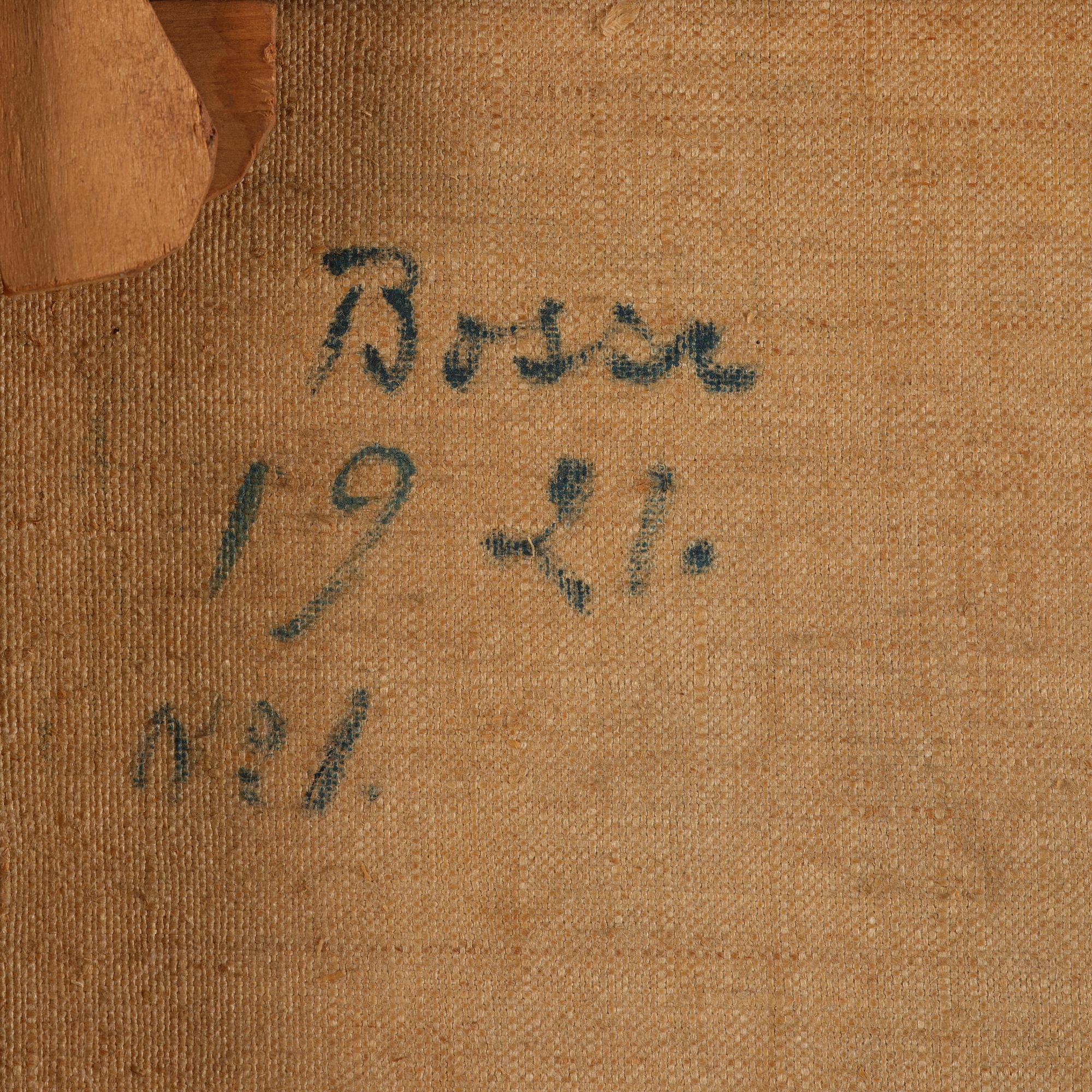
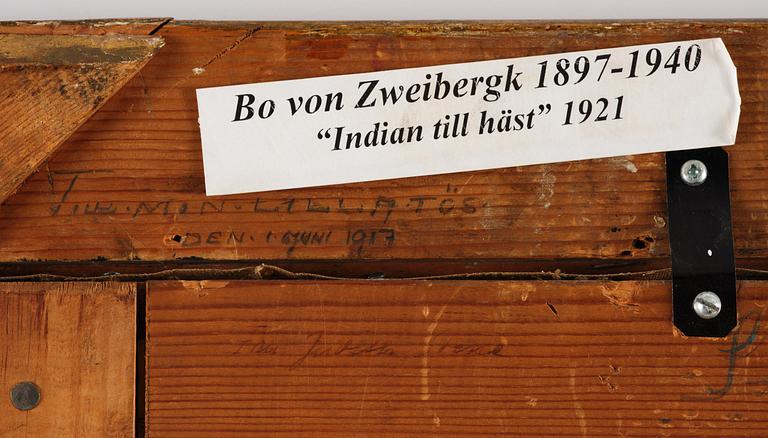
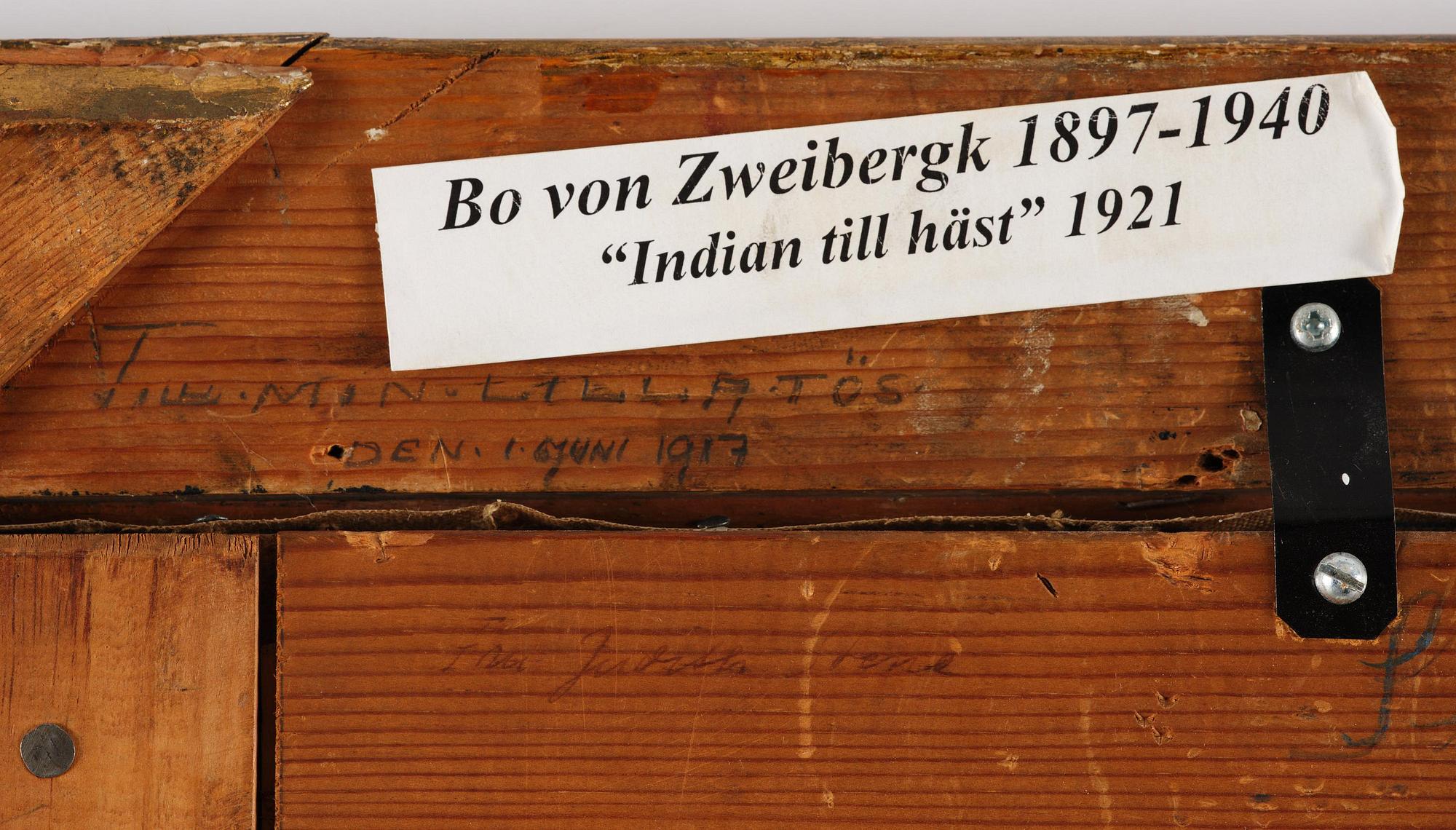
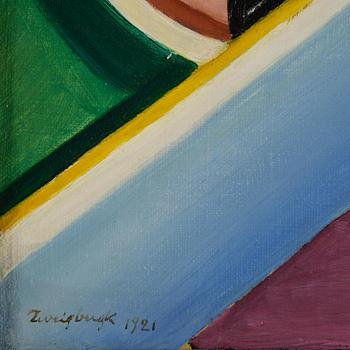
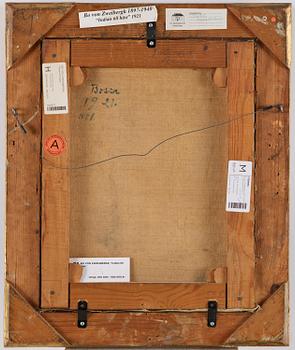
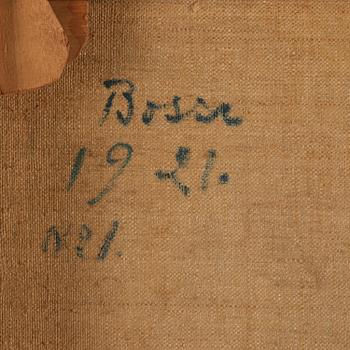
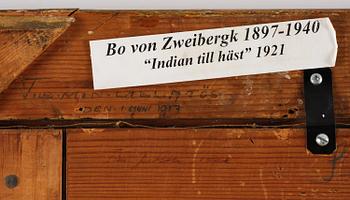
Signed Zweigbergk and dated 1921. Marked on the reverse Bosse N.1. Oil on canvas 47.5 x 37.5 cm.
Provenance
Previously in the collection of Judith Stene.
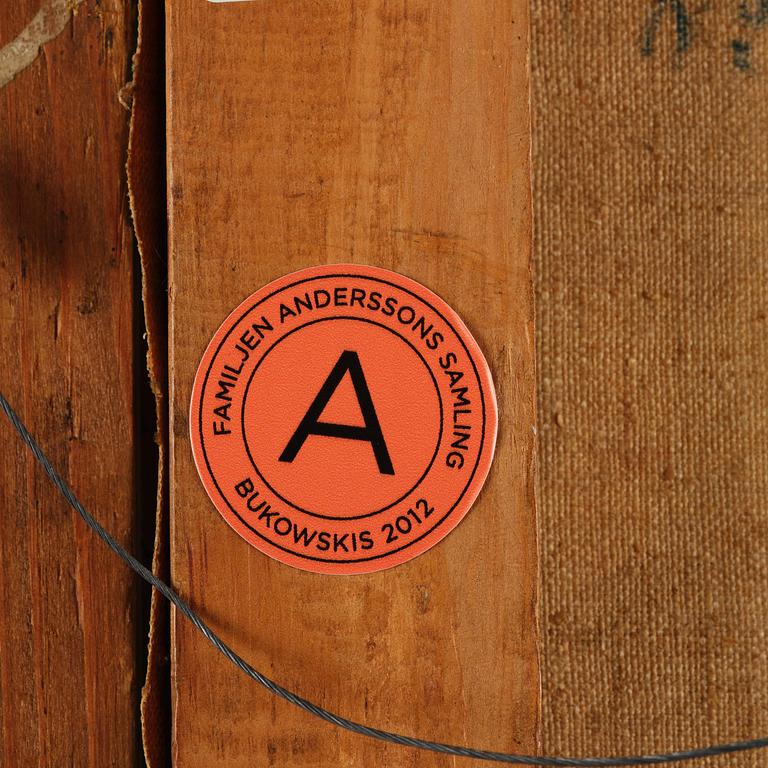
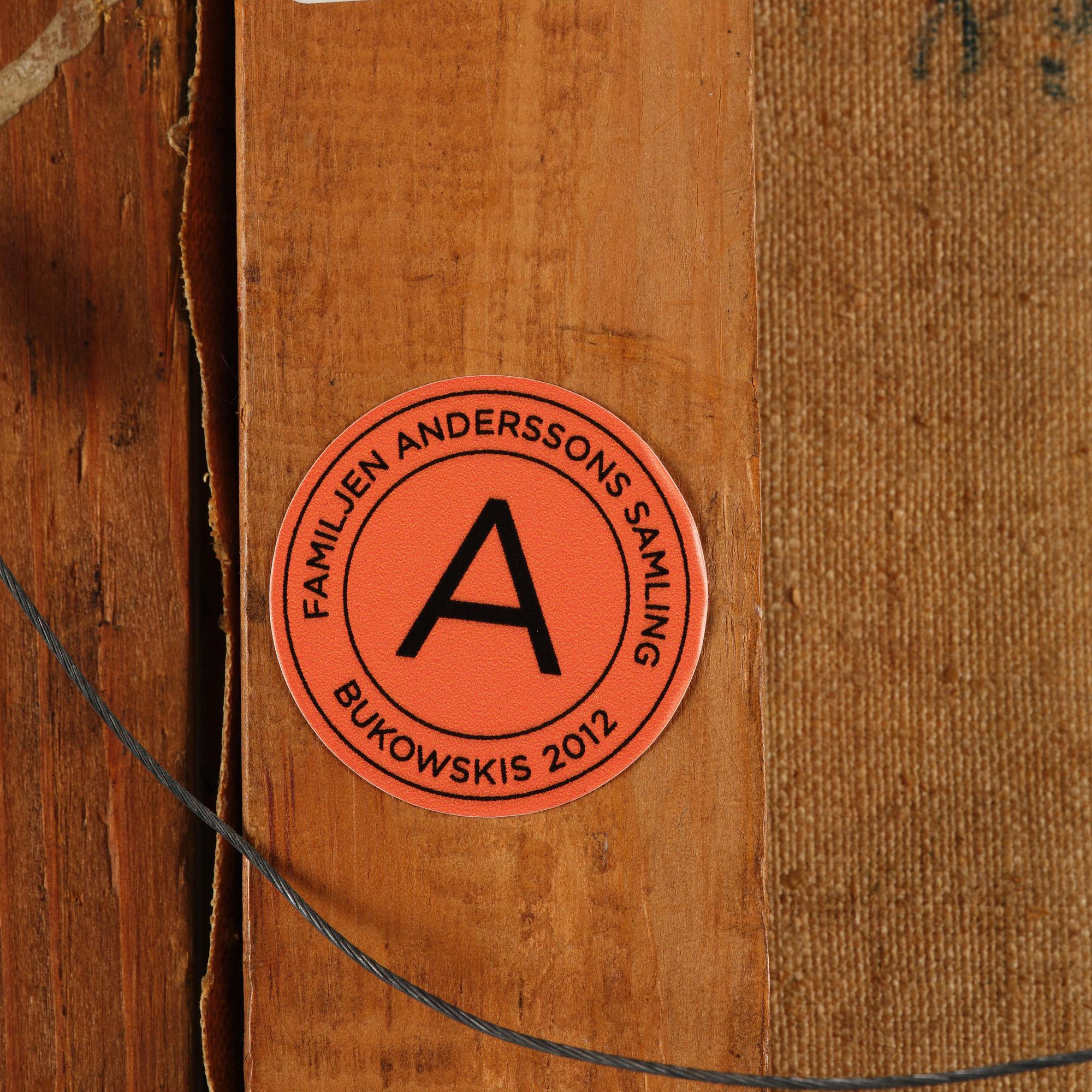
Bukowski Auktioner, Stockholm, "Familjen Anderssons Samling H042", 23 October, 2012, lot 21.
Exhibitions
Nya Konstgalleriet, managed by Arturo Ciacelli, Stockholm, 1921, (according to information given).
Konstnärshuset, Stockholm, "Minnesutställning", 6 - 25 September, 1941, cat. no 5.
Gävle Konstsalong, "Minnesutställning", 3 - 17 December 1941, cat. no 1.
Olséns Konstsalong, Göteborg, "Minnesutställning", 24 September - 13 October 1943, cat. no 1.
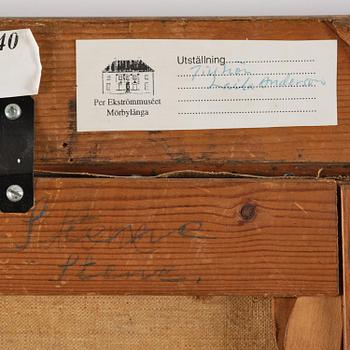
Per Ekström Museet, Mörbylånga, "Nordiskt Avantgarde", 4 August - 1 September 1996.
Literature
Svenska Dagbladet, Sweden, 10 September 1941, mentioned in review by Gotthard Johansson.
Barometern, Sweden, 30 August 1991, reproduced page 1,
More information
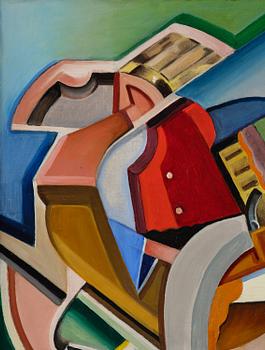
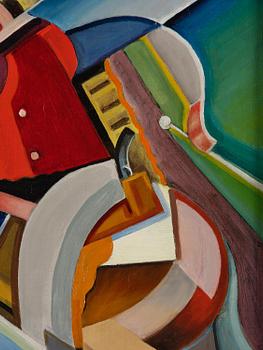
The years 1921–23 marked a high point in Bo von Zweigbergk’s artistic production, and it was during this period that he created some of the foremost works of early Swedish modernism. This auction presents 'Indian till häst' (Indian on horseback) from the important year 1921, when von Zweigbergk made his debut in a rhythmic and Cubist style, strongly influenced by Gösta Adrian-Nilsson. Von Zweigbergk’s Cubism was abstract and figurative at one and the same time, with a palette of clear, strong colours—flaming orange, rosehip red, verdant green and glowing yellow. During a short but intense period, he created some of the finest Swedish paintings of the 1920s, characterised by a purity and aesthetic quality with few parallels.
Together with Agnes Cleve, John Jon-And and Torsten Jovinge, von Zweigbergk spent a brief period in southern France, where they formed a small Scandinavian colony at Pension Bellevue in Cagnes-Sur-Mer. There, the group developed a Scandinavian Purism of which they were the sole representatives; in von Zweigbergk’s case, it was a dynamic, Futurist Purism with an intense palette. The art historian B.O. Österblom described his Cubism as “a kind of Futurism built on rhythmic contrasts”.
The art historian Oscar Reutersvärd considered the painting 'Indian till häst' one of the most interesting Futurist works of Swedish modernism. The painting was exhibited at Arturo Ciacelli’s Ny Konst gallery in Stockholm in 1921, where, according to the press, it attracted considerable attention. Stockholmers were said to have flocked to the gallery to see the Futurist work. Throughout the 20th century, the painting was in demand in connection with exhibitions of Swedish modernism and, whenever shown, repeatedly proved a major public attraction.
The Italian painter and printmaker Arturo Ciacelli joined the Futurist movement at an early stage. In 1910, he signed the Futurist Manifesto of Painting. Following his marriage to the Swedish artist Elsa Ström, he moved to Sweden, where he ran the Nya Konstgalleriet in Stockholm between 1915 and 1921. Ciacelli played an important role in the Swedish avant-garde scene during the 1910s and acted as a significant intermediary for international modernist currents. He also contributed to the art journals Flamman and L'époque Nouvelle, which exerted considerable influence on Swedish artistic life.
During his short life, Bo von Zweigbergk held solo exhibitions in Stockholm at Gummesons konsthall in 1928, 1931, 1935 and 1939, at Galerie Moderne in 1933 and at Konstnärshuset in 1937. He participated in exhibitions organised by Sveriges Allmänna Konstförening in Stockholm in 1925, 1934 and 1936.
Following von Zweigbergk’s tragic death in the major railway accident at Gårda outside Gothenburg in 1940, several memorial exhibitions were held: at Konstnärshuset in Stockholm and Gävle Konstsalong in 1941, at Olsens konstsalong in Gothenburg in 1943, and once again at Konstnärshuset in 1948.
For condition report contact specialist

What will the transport cost?
Shipping can only be arranged by contacting specialdelivery@bukowskis.com.