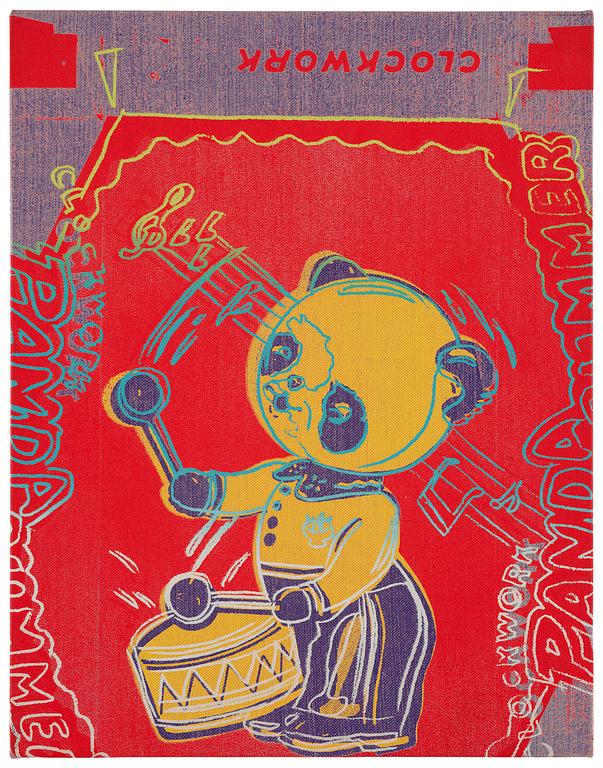
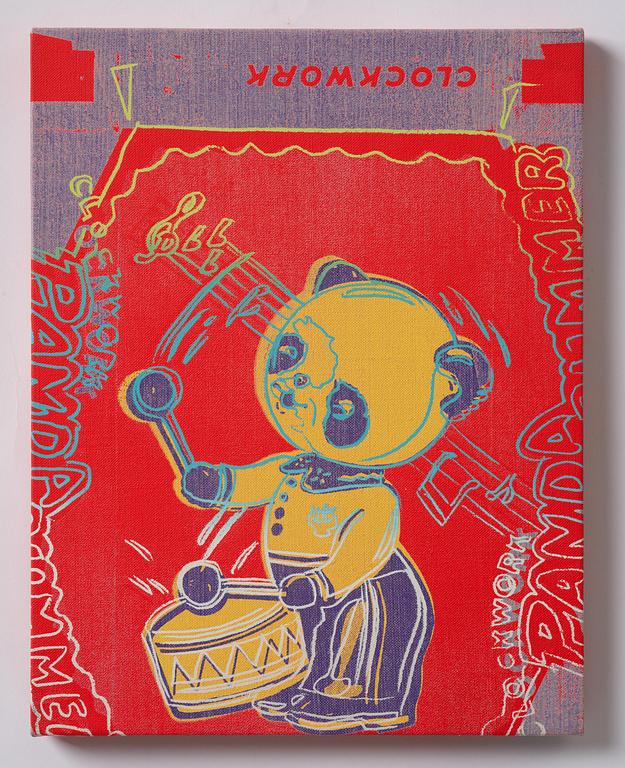
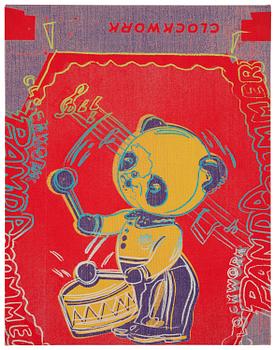
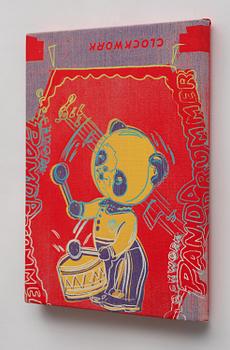
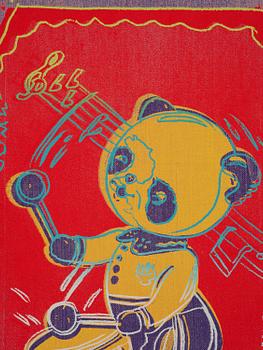
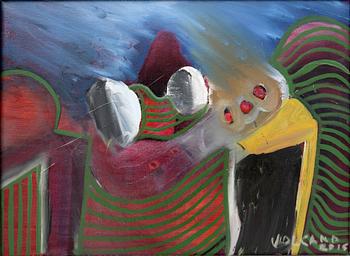
Andy Warhol (United States, 1928-1987) "Clockwork Panda Drummer"
"Clockwork Panda Drummer"
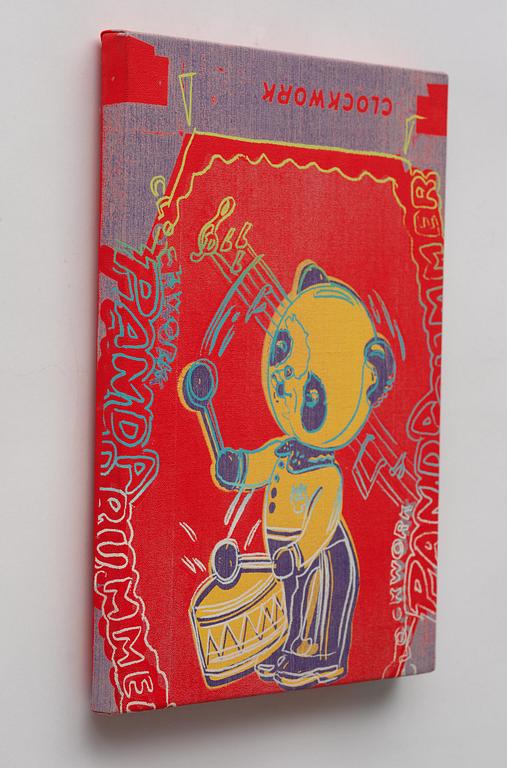
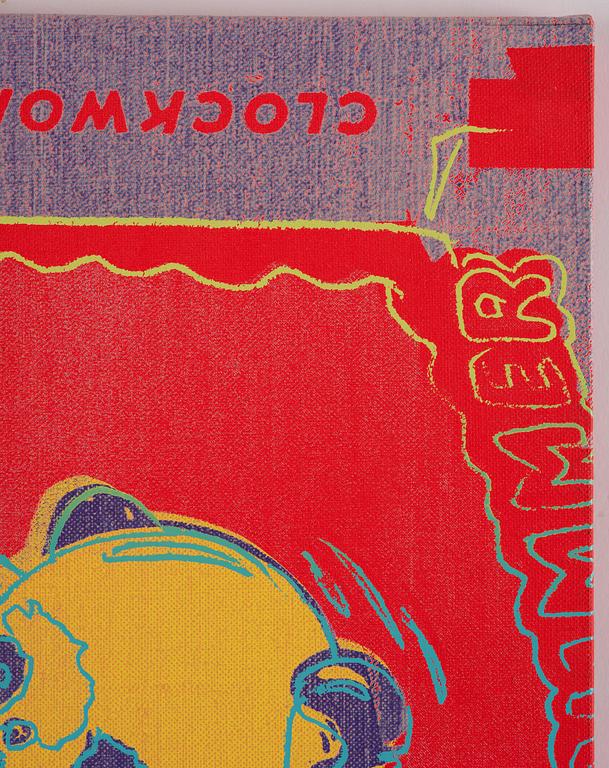
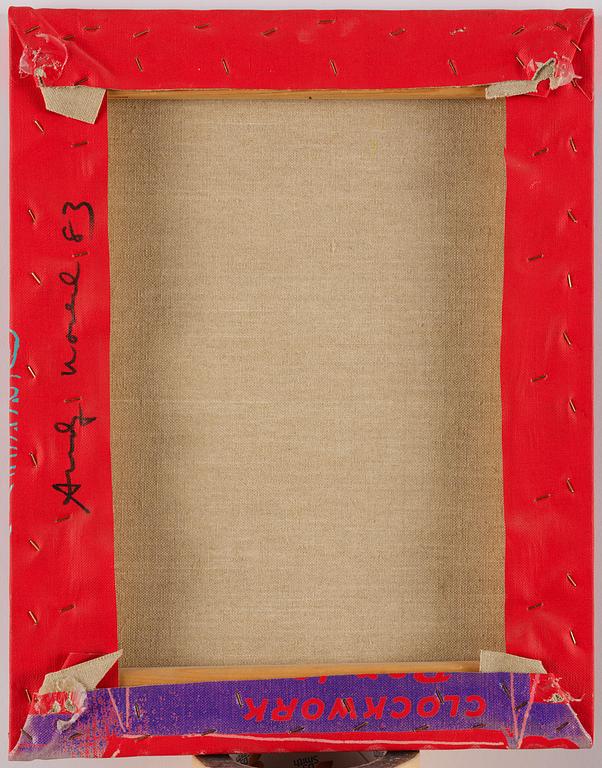
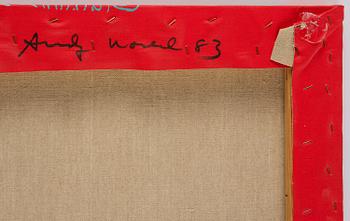
Signed Andy Warhol and dated -83 on the overlap. Acrylic and silkscreen on canvas, 35.5 x 28 cm.
Provenance
Galleri Bruno Bischofberger, Zürich.
Art Now Gallery, Gothenburg, acquired in 1984.
Private Collection, Gothenburg.
Exhibitions
Galleri Bruno Bischofberger, Zürich, ”Children Paintings and Installation”, 3 December 1983 - 10 March 1984.
Art Now Gallery, Gothenburg, "Children's Paintings", 1984.
More information
Clockwork Panda Drummer is part of a series of paintings known as the “Toy Paintings” or “The Toy Series”, which were executed in 1983 on commission from the legendary art dealer and collector Bruno Bischofberger in Zurich. He simply asked Andy Warhol to create an exhibition for children. Warhol was quick to respond; he liked the idea and created an extensive suite consisting of 128 paintings depicting monkeys, parrots, dogs, boats, cars, clowns, robots, etc., in unique colour combinations. The artist drew inspiration for the paintings from his own collection of wind-up mechanical toys. As Warhol said in an interview with The New York Times a few years later, when around one hundred paintings were shown at the Newport Art Museum: “Lots of international toys are included, [...] because a lot of them are the cutest of any I've seen.”
When the suite was originally shown at Galerie Bruno Bischofberger, under the exhibition title “Children Paintings and Installation”, from 3 December 1983 to 10 March 1984, the exhibition was conceived as an installation. The walls were covered with wallpaper specially produced for the exhibition and designed by Warhol. The wallpaper decoration consisted of screen-printed fish, identical but produced in multiples. This device is familiar and recurring in Warhol’s artistic practice. As early as Warhol’s extensive retrospective exhibition at Moderna Museet in Stockholm in 1968, which was also Warhol’s first major museum exhibition outside the United States, the façade of the museum was covered with wallpaper designed by Warhol himself, depicting cows in vivid colours. Warhol reused the same stylistic device when he exhibited at the Whitney Museum of American Art in New York in 1971, although on this occasion he confined the wallpaper to the interior of the exhibition space. On later occasions as well, Warhol returned to designing his own wallpaper to cover exhibition walls in museums and galleries. The final wallpaper design was in fact created for the very exhibition of toy paintings in question, “Children Paintings and Installation” in 1983.
Bischofberger decided together with Warhol that the paintings, which were intended for children and were small in format, should be hung at eye level corresponding to that of children between three and five years old. Adult visitors had to crouch as they moved around the gallery in order to properly view the works. Bischofberger also decided that adult visitors who arrived without a child under the age of six would have to pay an entrance fee. The money was then donated to a charitable project for disadvantaged children.
Bruno Bischofberger had worked with Andy Warhol since the 1960s. As early as 1965, he included works by Warhol in an exhibition on Pop Art at his gallery in Zurich. The following year, they met in person for the first time at The Factory, marking the beginning of a lifelong friendship. Bischofberger was also a co-founder and financier of Interview Magazine, which Warhol founded and first published in 1969. Their creative and energetic collaboration resulted in a series of now legendary exhibitions.
The auction painting has the provenance of Bruno Bischofberger and was purchased at the exhibition at Art Now Gallery in Gothenburg. Thirty-eight of the original paintings had been selected for the exhibition, and Warhol personally attended the opening, where he is said to have encouraged visitors to buy a painting for their children. The buyers were then to hang the works low in the nursery, and when the time came for higher education, the painting could easily be sold to help finance it.
More about Andy Warhol
American artist, printmaker, and filmmaker. He studied at the Carnegie Institute of Technology from 1945 to 1949 and began his career as an art director for the magazines Vogue and Harper’s Bazaar. His success in the advertising industry led to the Art Directors Club Medal in 1957.
Warhol is considered one of the leading figures of Pop Art. His artistic practice consists largely of portraits, often of well-known individuals, executed in silkscreen technique. He also worked with reproduced documentary images as well as installations in which everyday consumer objects, such as packaging, were given a central role. The underlying idea was that beauty and energy can be found everywhere in modern society, even in things often regarded as banal. As a result, detergent boxes and soup cans became artistic motifs. Campbell’s soup cans and Brillo boxes were transformed through his work into some of the most iconic artworks of the 20th century.
From 1963 onward, he produced and participated in a large number of films in his own studio, The Factory, which simultaneously developed into an important meeting place for New York’s artistic and bohemian scene. Warhol continuously documented his surroundings with a film camera and later also a Polaroid camera. In his so-called Screen Tests, he filmed a number of internationally known figures, including Mick Jagger, Bob Dylan, Marcel Duchamp, and Salvador Dalí. According to his will, The Andy Warhol Foundation for the Visual Arts was established in New York in 1987, and in 1994 The Andy Warhol Museum opened in Pittsburgh.
Read moreFor condition report contact specialist

What will the transport cost?
Shipping can only be arranged by contacting specialdelivery@bukowskis.com.
Image rights
The artworks in this database are protected by copyright and may not be reproduced without the permission of the rights holders. The artworks are reproduced in this database with a license from Bildupphovsrätt.