Andy Warhol (United States, 1928-1987) "Goethe"
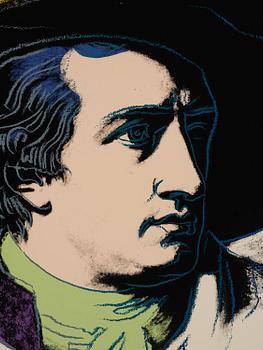
"Goethe"
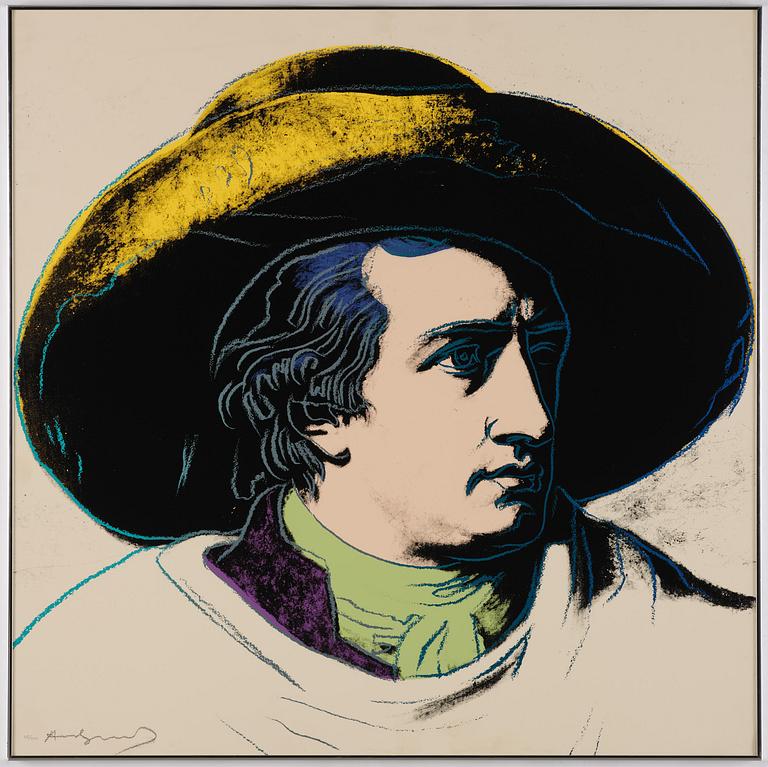
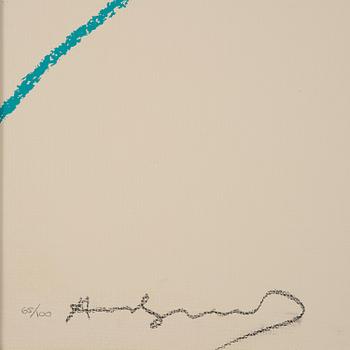
Signed in pencil and numbered 65/100. Colour screenprint, 1982. Printed by Rupert Jasen Smith, New York, with their watermark. Published by Editions Schellmann & Klüser, Munich, New York, and Denise René/Hans Mayer, Düsseldorf, with their stamp verso. S. 96.5 x 96.5 cm.
Literature
Feldman & Schellmann II. 272.
More information
Andy Warhol began creating portraits of well-known figures as early as 1962, and this fascination with celebrity culture would come to define much of his artistic practice. Through depictions of Elvis, Marilyn Monroe, Mick Jagger and Mao, among others, he produced works that combined familiar faces with a distinctly stylised visual language.
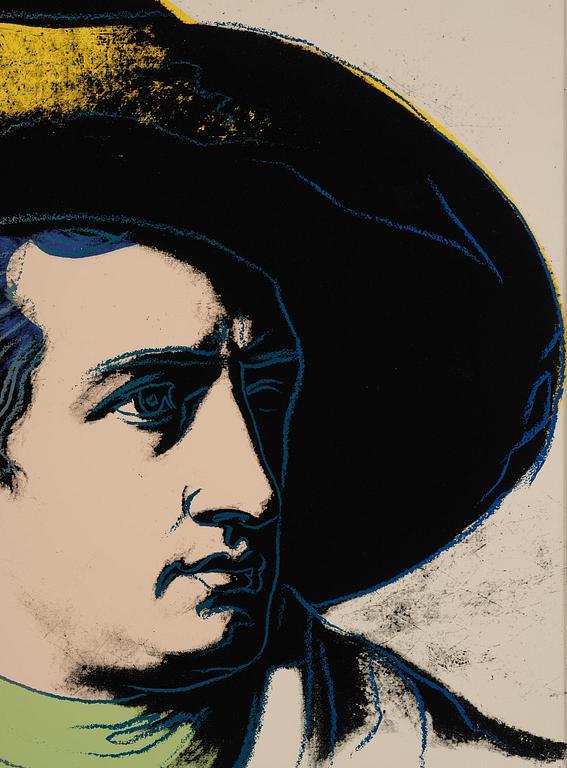
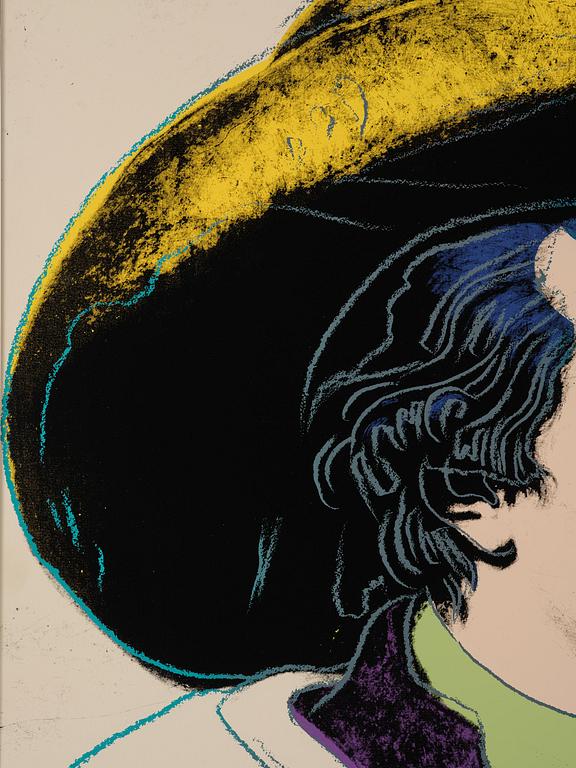
In "Goethe" from 1982, Warhol turned his attention to one of the most significant figures in Western cultural history, the German writer Johann Wolfgang von Goethe. The source image is Johann Tischbein's celebrated portrait "Goethe in der Campagna" from 1786/87. Whereas the original painting shows Goethe seated in a mountainous landscape with his legs outstretched, Warhol chooses to focus on the poet's face, his contemplative gaze and his characteristic hat. The original landscape gives way to Warhol's expressive, vividly coloured composition. The result is an encounter between the classical portrait tradition and the playful visual idiom of Pop Art.
Warhol found the inspiration for the motif during a visit to the Städel Museum in Frankfurt, where he viewed Tischbein's painting together with Siegfried Unseld. Unseld, who had invited the artist to the city, encouraged him to develop the portrait of Goethe further. Alongside the large-format paintings, Warhol used the motif to create a series of four screenprints. The work offered at auction is one of these four prints.
The "Goethe" series came about through close collaboration between Warhol and the publishers Jörg Schellmann and Bernd Klüser. Schellmann had been a leading publisher of contemporary prints since the early 1970s and had worked with several well-known artists, including Keith Haring and Joseph Beuys. During the 1980s he and Warhol produced more than 20 print editions, which are highly sought after by collectors today. "Goethe" is one of the finest examples of their collaboration, and the work shows how strongly both Goethe and Warhol still shape culture today.
More about Andy Warhol
American artist, printmaker, and filmmaker. He studied at the Carnegie Institute of Technology from 1945 to 1949 and began his career as an art director for the magazines Vogue and Harper’s Bazaar. His success in the advertising industry led to the Art Directors Club Medal in 1957.
Warhol is considered one of the leading figures of Pop Art. His artistic practice consists largely of portraits, often of well-known individuals, executed in silkscreen technique. He also worked with reproduced documentary images as well as installations in which everyday consumer objects, such as packaging, were given a central role. The underlying idea was that beauty and energy can be found everywhere in modern society, even in things often regarded as banal. As a result, detergent boxes and soup cans became artistic motifs. Campbell’s soup cans and Brillo boxes were transformed through his work into some of the most iconic artworks of the 20th century.
From 1963 onward, he produced and participated in a large number of films in his own studio, The Factory, which simultaneously developed into an important meeting place for New York’s artistic and bohemian scene. Warhol continuously documented his surroundings with a film camera and later also a Polaroid camera. In his so-called Screen Tests, he filmed a number of internationally known figures, including Mick Jagger, Bob Dylan, Marcel Duchamp, and Salvador Dalí. According to his will, The Andy Warhol Foundation for the Visual Arts was established in New York in 1987, and in 1994 The Andy Warhol Museum opened in Pittsburgh.
Read moreFor condition report contact specialist

What will the transport cost?
Shipping can only be arranged by contacting specialdelivery@bukowskis.com.
Image rights
The artworks in this database are protected by copyright and may not be reproduced without the permission of the rights holders. The artworks are reproduced in this database with a license from Bildupphovsrätt.










Others have also viewed