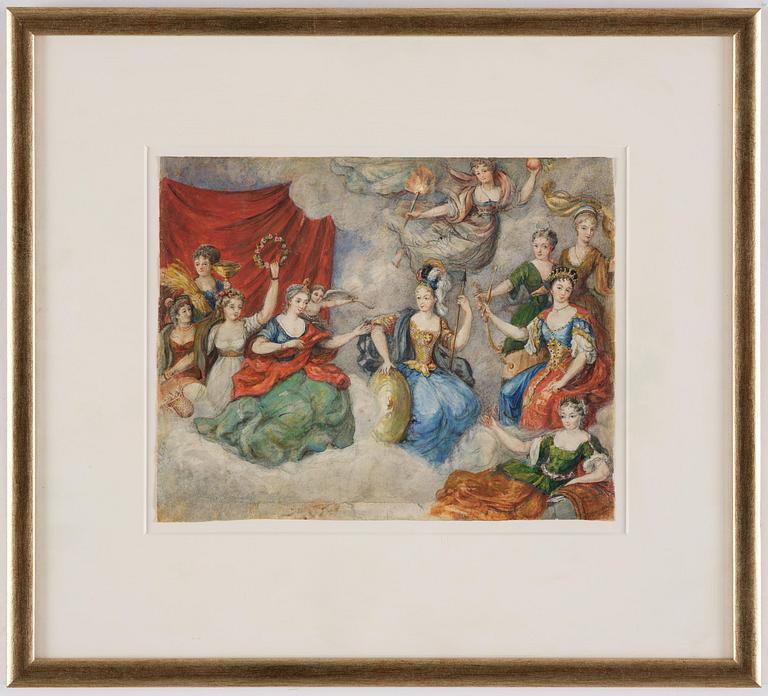
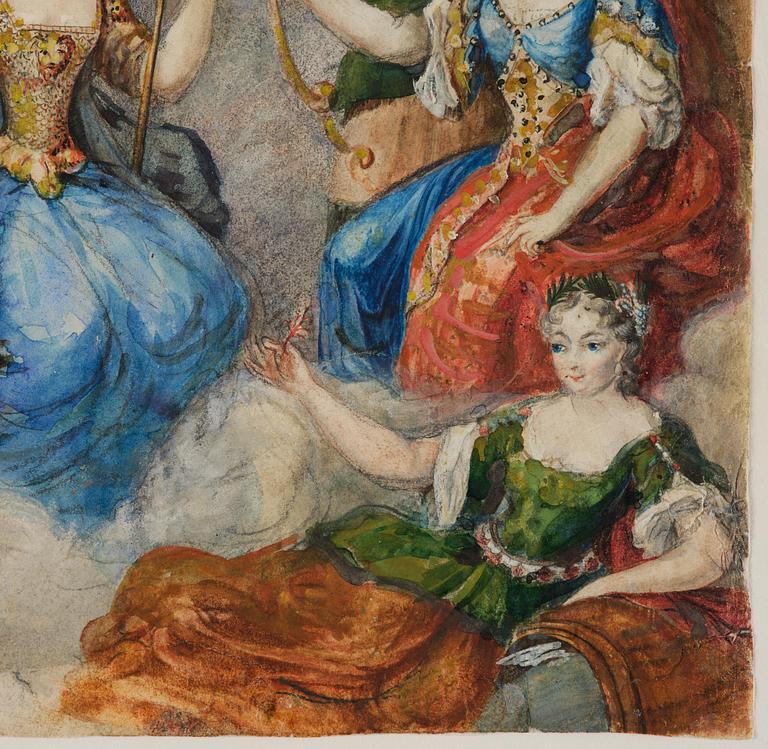
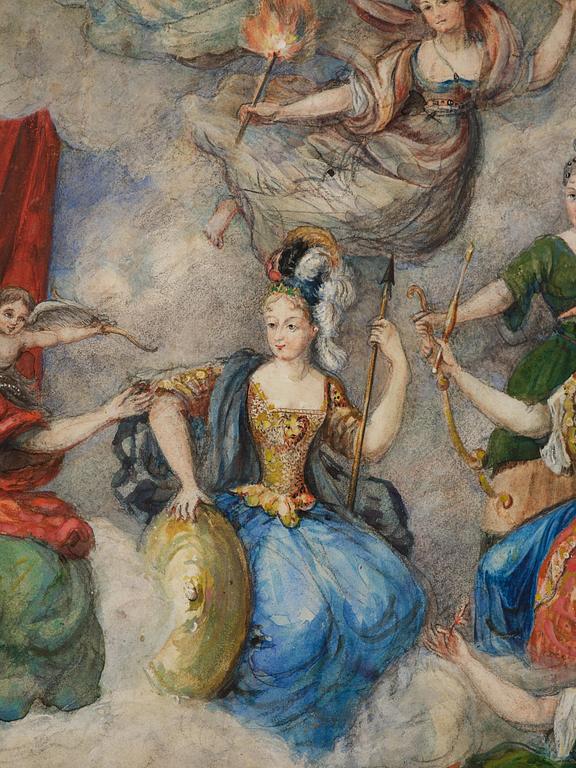
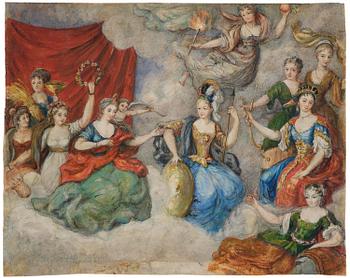
Amalia Wilhelmina von Königsmarck (Tyskland/Sverige, 1663-1740) Allegory
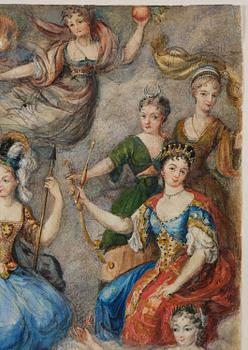
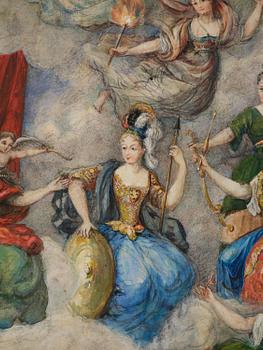
Allegory
Gouache and watercolour on paper, sheet size 19 x 24 cm.
Provenance
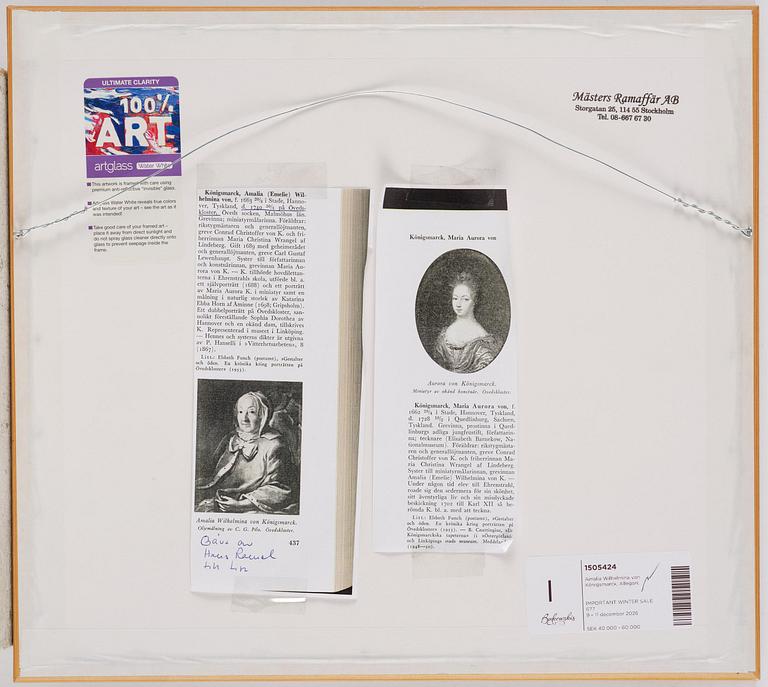
Probably formerly part of the de Ramel collections at Övedskloster, Skåne, thence by descent.
More information
Amalia (Emelie) Wilhelmina von Königsmarck was born in Germany in 1663, the daughter of the Master-General of Ordnance and Lieutenant General, Count Conrad Christoffer von Königsmarck, and Baroness Maria Christina Wrangel af Lindeberg. In 1689, she married the Privy Councillor and Lieutenant General, Count Carl Gustaf Lewenhaupt.
The very brief entry in Allhems also provides the following information:
“K. belonged to the court amateurs in Ehrenstrahl’s school and produced, among other works, a self-portrait (1688), a miniature portrait of Maria Aurora K., and a life-size painting of Katarina Ebba Horn af Åminne (1698; Gripsholm). A double portrait at Övedskloster, probably depicting Sophia Dorothea of Hanover and an unknown lady, is attributed to K. Represented in the museum in Linköping.”
Information about the artist is thus scant. However, further information about both Königsmarck’s family life and her artistic output can be found in the collections of Östergötlands länsmuseum in Linköping. The museum holds the so-called “Königsmarck tapestries” in its collections and provides the following account:
“The embroidered so-called Königsmarck tapestries at Östergötlands länsmuseum number six in total. According to family tradition, they are believed to have been made between 1689 and 1694. According to the same tradition, the tapestries were originally embroidered to hang in the dining room of the Lewenhaupt family estate of Vinäs in Norra Tjust. The sisters Amalia and Aurora von Königsmarck embroidered the tapestries with the assistance of friends and servants. The tapestries were made primarily using petit-point and cross-stitch embroidery. They are embroidered on loosely woven plain-weave linen. The total surface area of the six tapestries is 34 m². Calculating ten hours per dm², it would have taken 34,000 working hours to embroider all six tapestries. In terms of their subject matter, they follow the tradition popular at the time within tapestry weaving of depicting antique, historical, religious or allegorical motifs in complete series. All the tapestries have titles and, according to family tradition, deal with events within the Königsmarck and Lewenhaupt families, into which Amalia married. The titles of the tapestries are: The Masquerade, Triumph, Allegory, Childhood, The Hall of State and Old Age.”
The museum’s research into the tapestries is highly interesting in this context, as it opens the door to various theories and interpretations concerning the present catalogue number. The tapestries themselves provide evidence both of the artistic talent of the von Königsmarck sisters and of their familiarity with the pictorial concepts and artistic themes of the seventeenth century. In the case of these painstakingly produced, high-quality tapestries, made over an extended period of time, the inspiration appears to have stemmed from a desire to present the history of the family—or families—in a grandiose context linked to mythological and historical, as well as contemporary realpolitik, myths, narratives and events.
With this knowledge as a starting point, it is easier to approach the painting offered at auction. As always when information is scarce, there is room for speculation and theories. The following, however, is clear: Amalia von Königsmarck was taught by Ehrenstrahl himself and was thoroughly familiar with the art-historical genres of her time and the pictorial concepts of the Caroline era. Moreover, if we accept the interpretation of the tapestries, she was no stranger to using art to present herself and her family in grandiose contexts, where mythology and metaphor were employed to the full.
For condition report contact specialist

What will the transport cost?












Others have also viewed