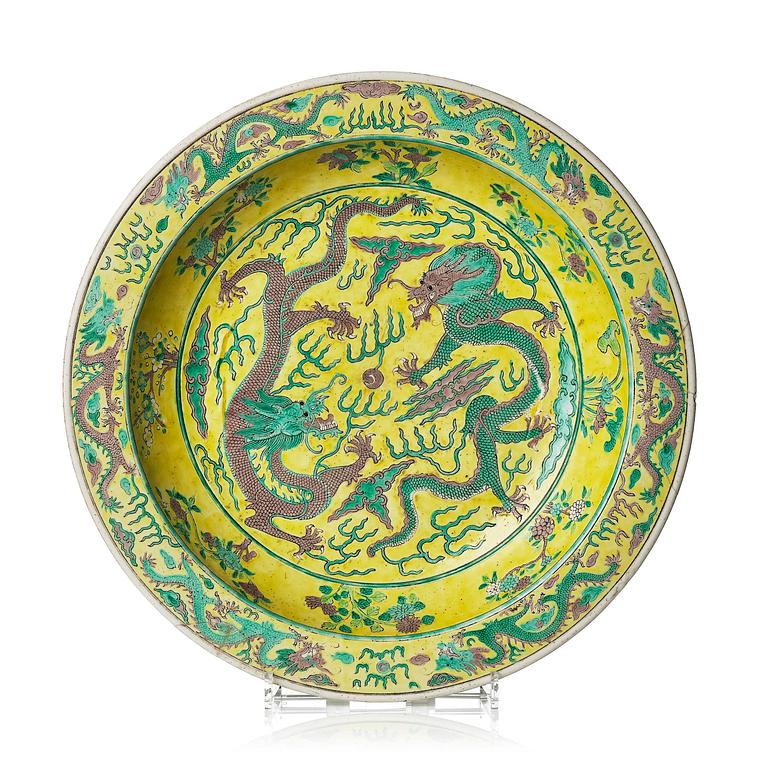
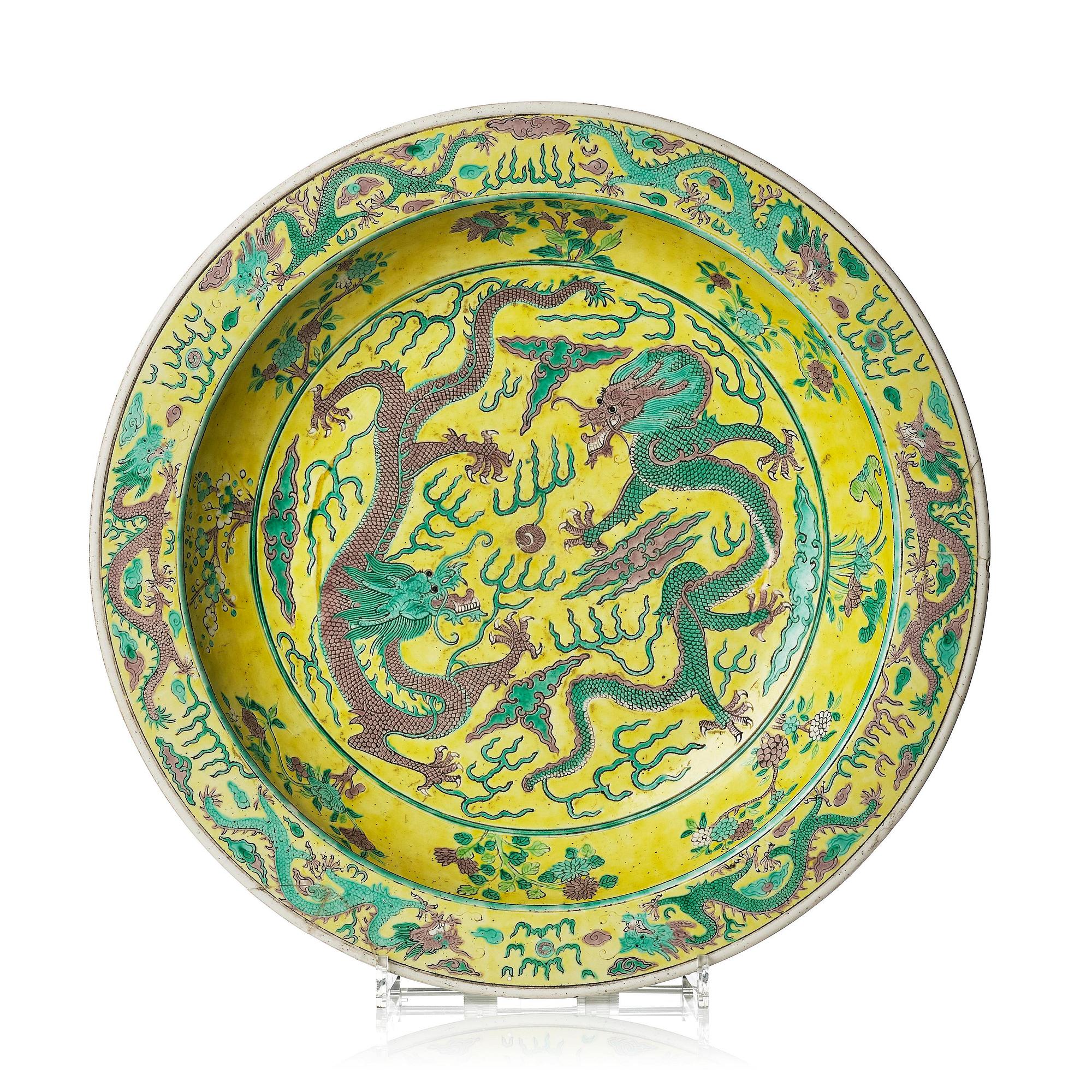
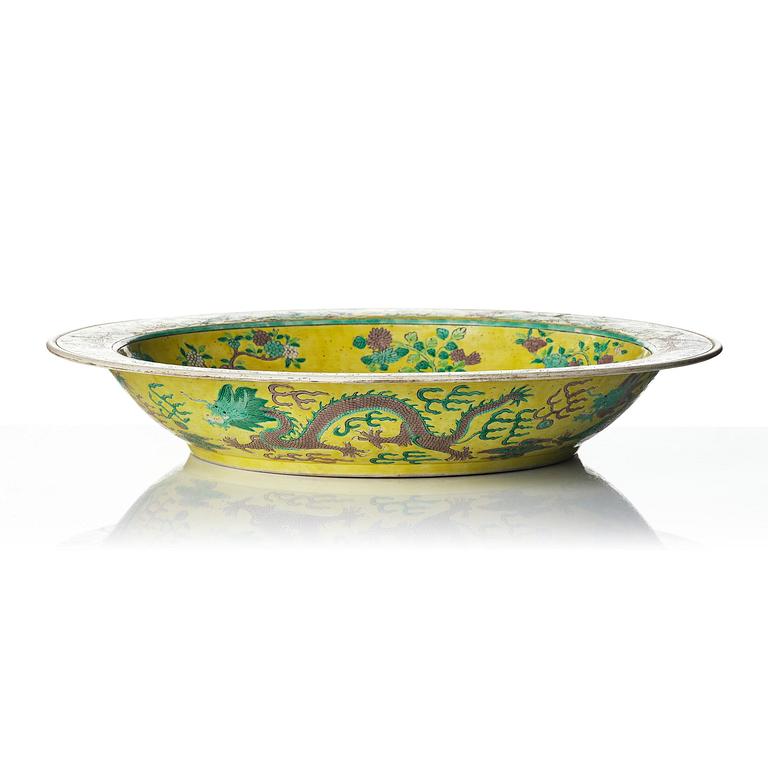
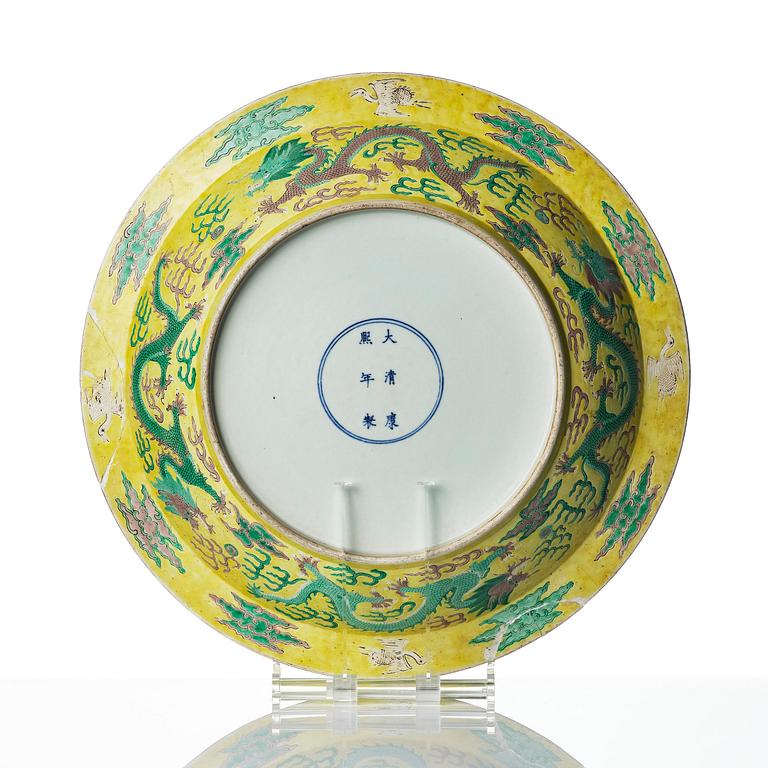
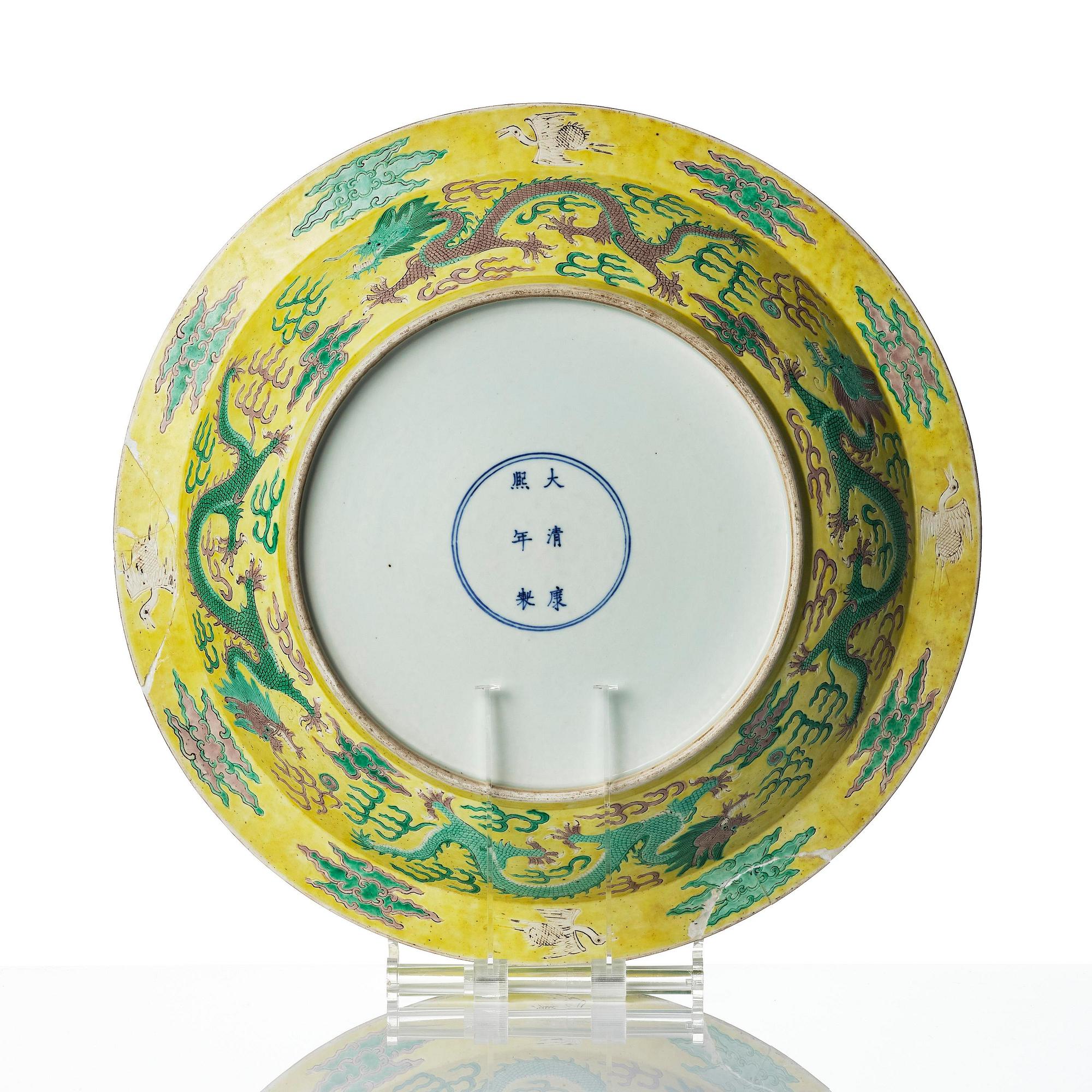
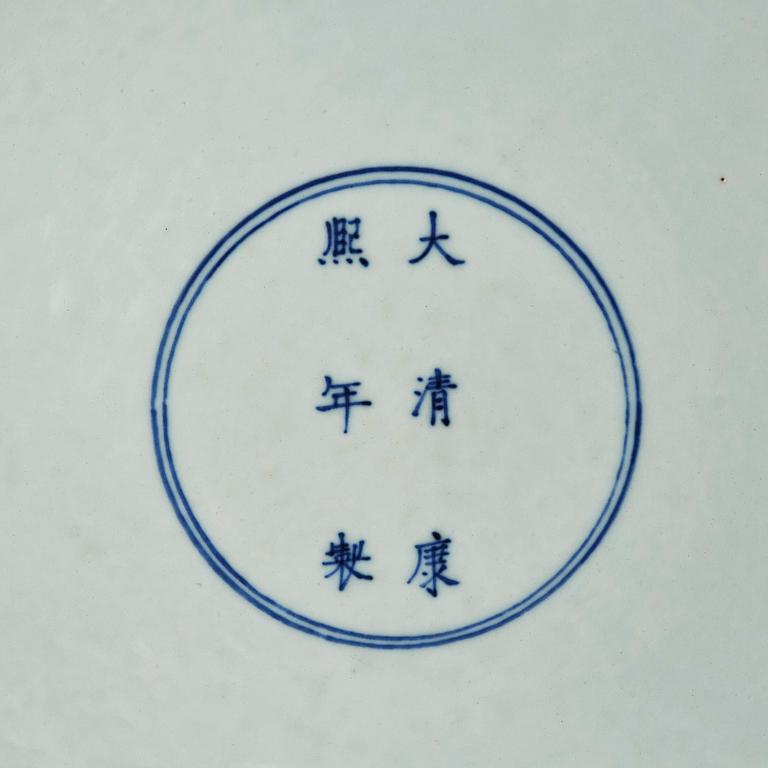
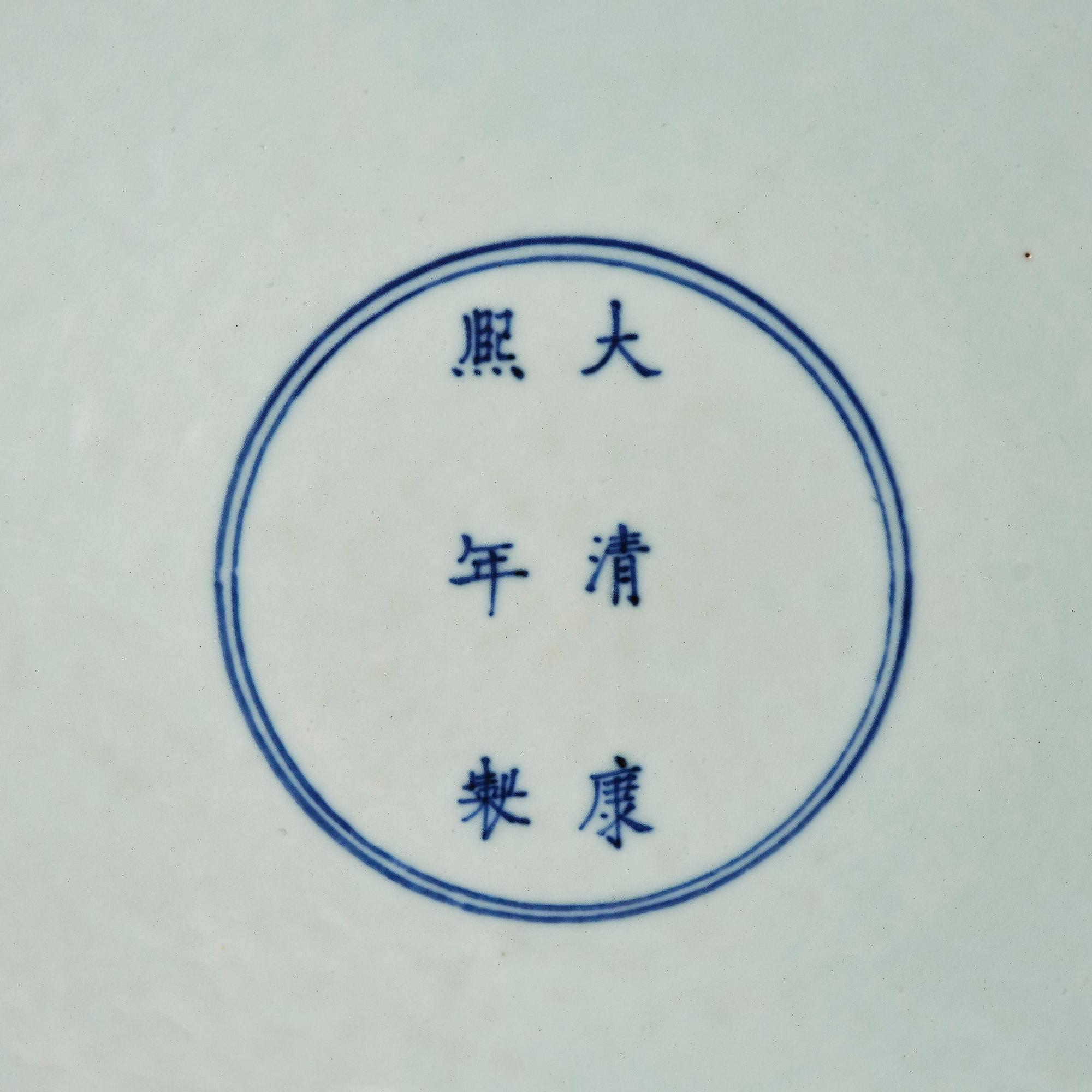
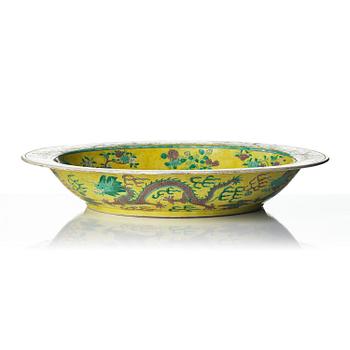
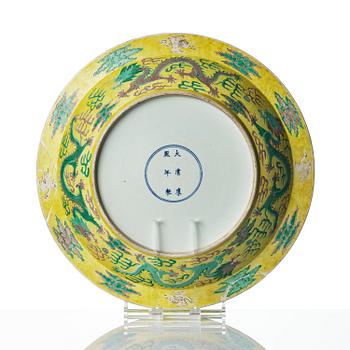
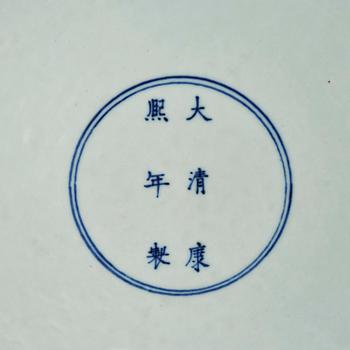
A massive yellow ground 'dragon' charger, late Qing dynasty, with a Kangxi six character mark.
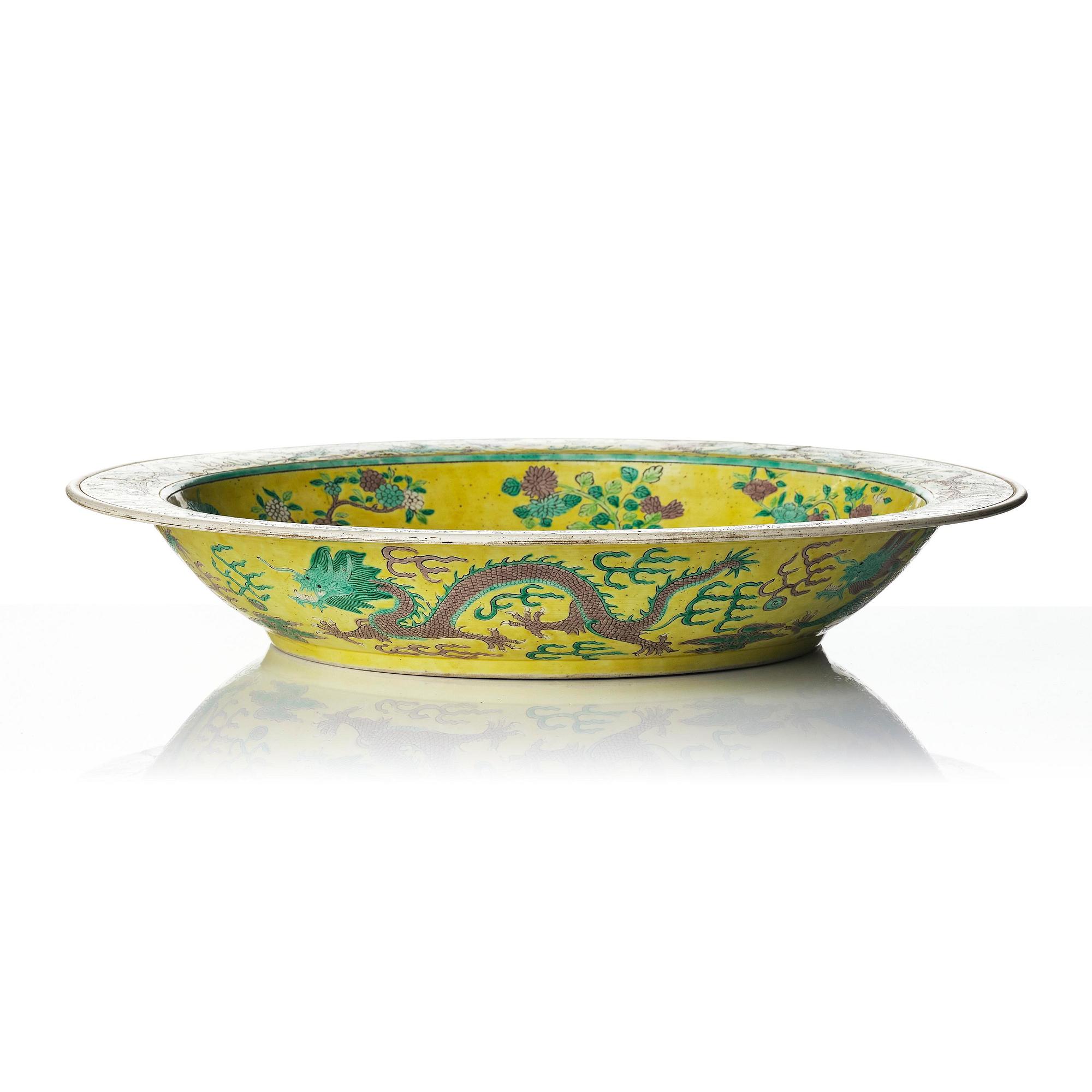
Incised with two confronting dragons centred on a 'flaming pearl', bordered with various flowering plants in the cavetto including lotus, prunus, chrysanthemum and peony, the rim with a band of dragons striding through the flames, the underside with four further striding dragons below cranes and trailing clouds, all picked out in tones of green, aubergine and white outlined in black on a bright yellow ground. An apocryphal underglaze blue six character mark within double circle. Diameter 51 cm.
Repair to rim.
Provenance
Purchased by the current owner’s father, who was chief engineer with Broströms shipping company in Gothenburg between 1940 and 1950. According to his family this dish was acquired by him sometime between 1948 and 1950, when he sailed with the vessel Antartic Ocean.
Exhibitions
Compare with a yellow ground 19th century dish at the Rijksmuseum, NL, Object number AK-RBK-15858.
Compare with dishes of this type marked with the ChuxiuGong Zhi mark. The Chinese University of Hong Kong Exhibition of Imperial Porcelain of Late Qing, Hong Kong, 1983, included a large biscuit dish, no. 96, with the Chuxiu Gong zhi mark, which is illustrated, p. 154. A discussion of this dish by Simon Kwan, ibid., pp. 30 - 31, states that these wares consist mainly of large objects for display, believed to have been ordered by the Empress Dowager Cixi for her own special use when she was residing at the Chuxiu Gong, the Palace of Gathering Elegance, in the Imperial Palace. The Empress Dowager was believed to have used the Chuxiu Gong for several years around 1856 and again around 1885.
Compare with a dish sold at Wolley and Wallace, lot no 199, Fine Asian Art - 10 Nov 2026.
Literature
The design of this dish originates from a earlier Kangxi prototype; for a Kangxi example, see John Ayers, Far Eastern Ceramics in the Victoria and Albert Museum, no. 197.
More information
Compare also with dishes of this type from the period, National Palace Museum, Object Number中瓷001888N000000000.
For condition report contact specialist

What will the transport cost?
Others have also viewed