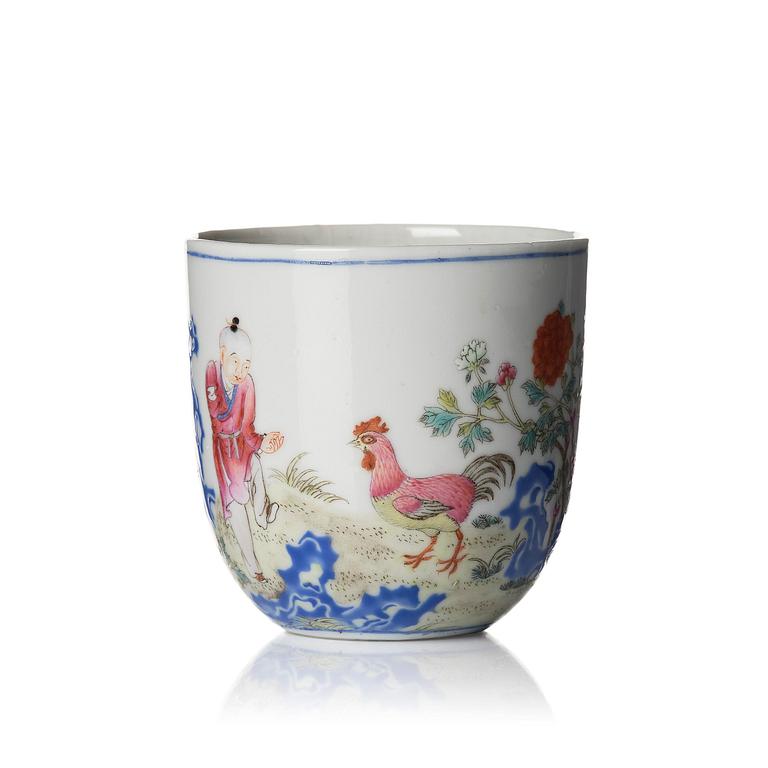
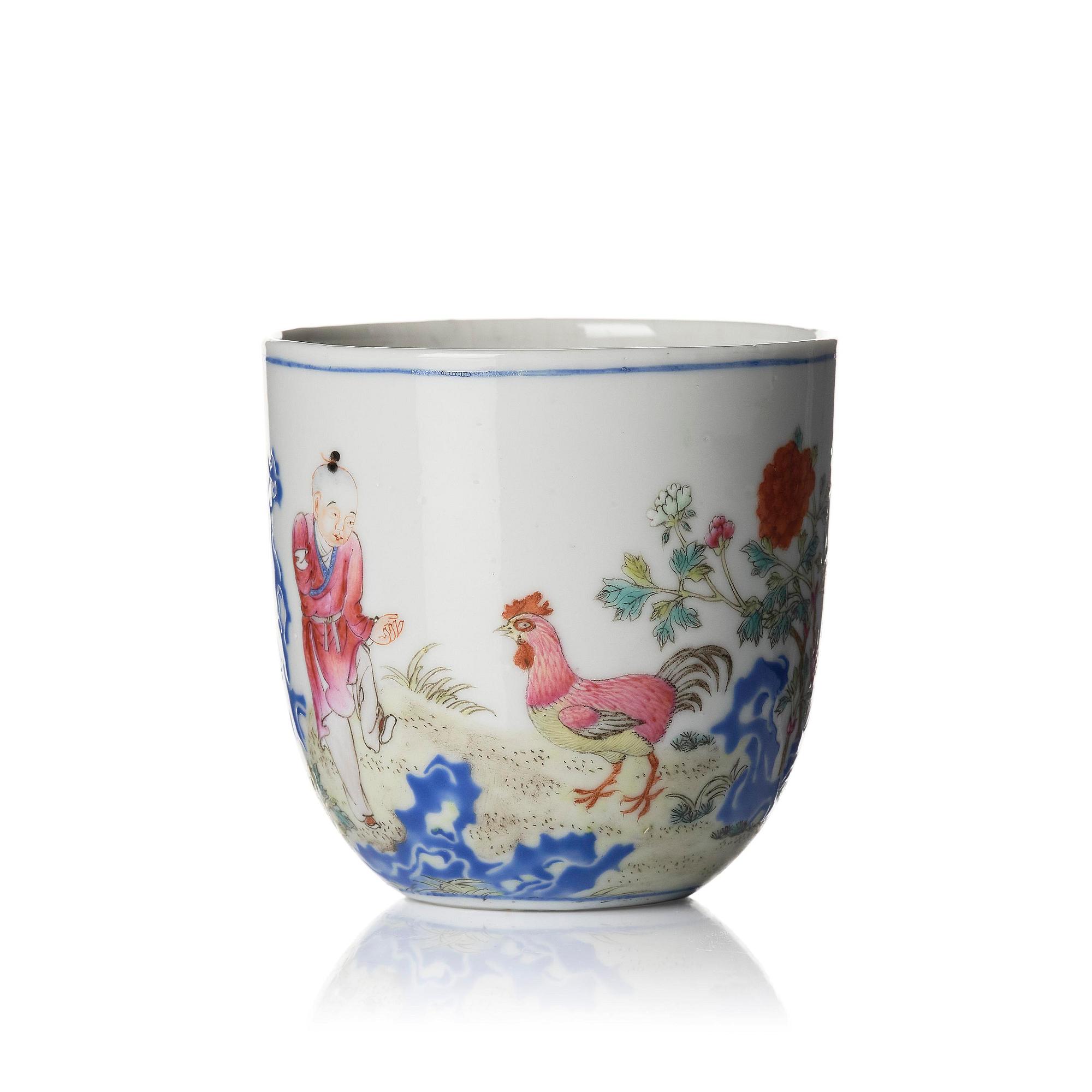
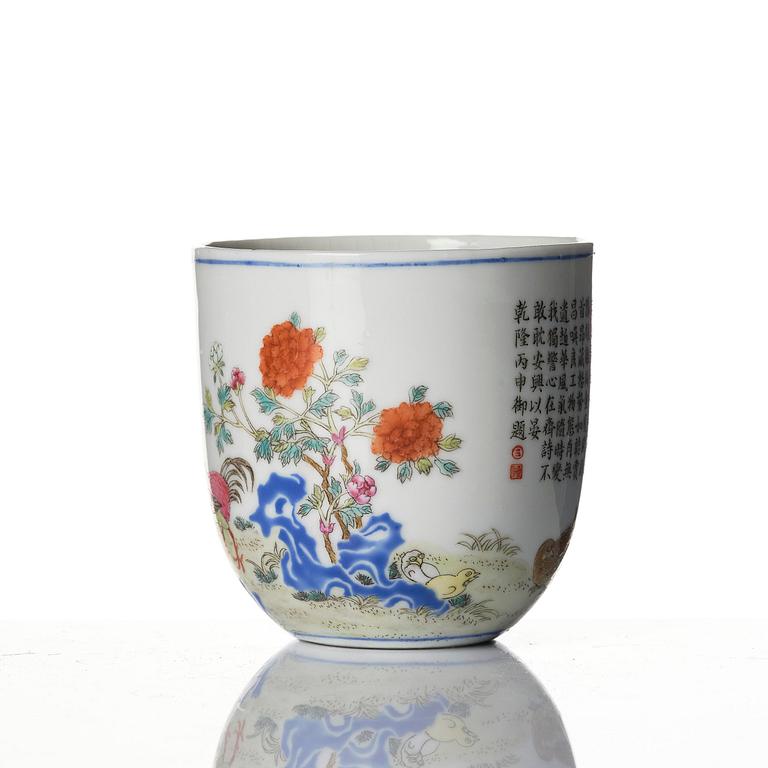
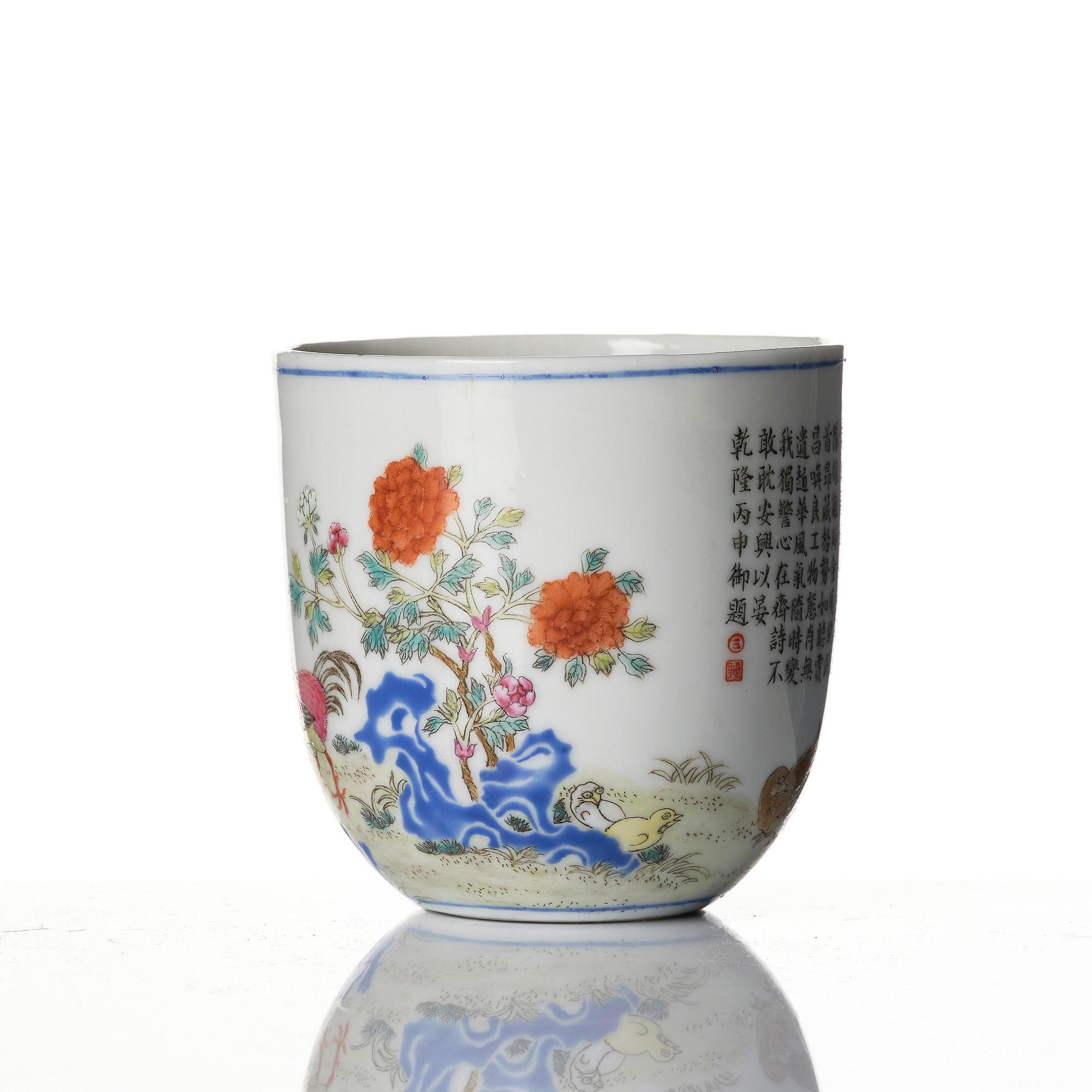
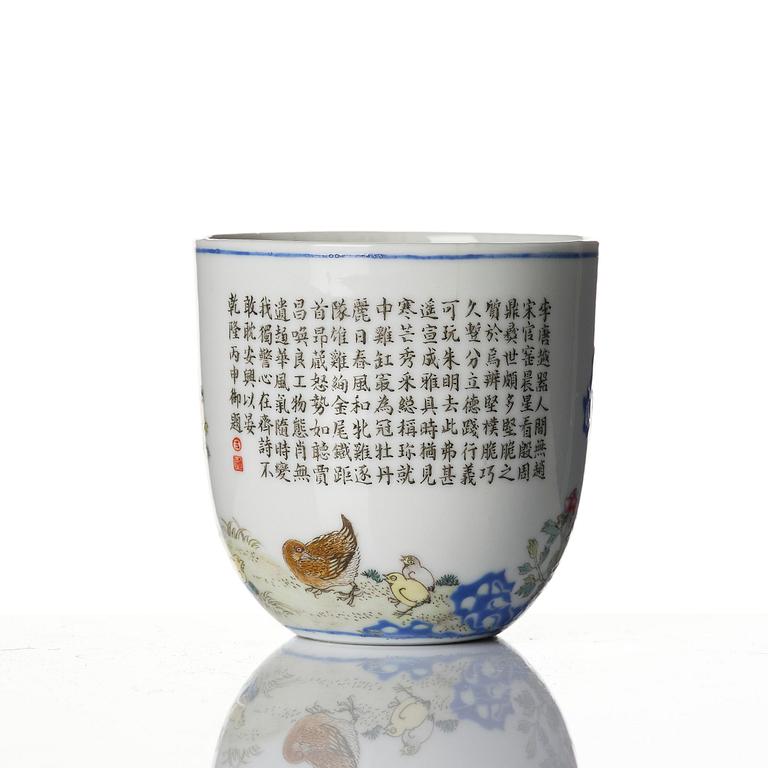
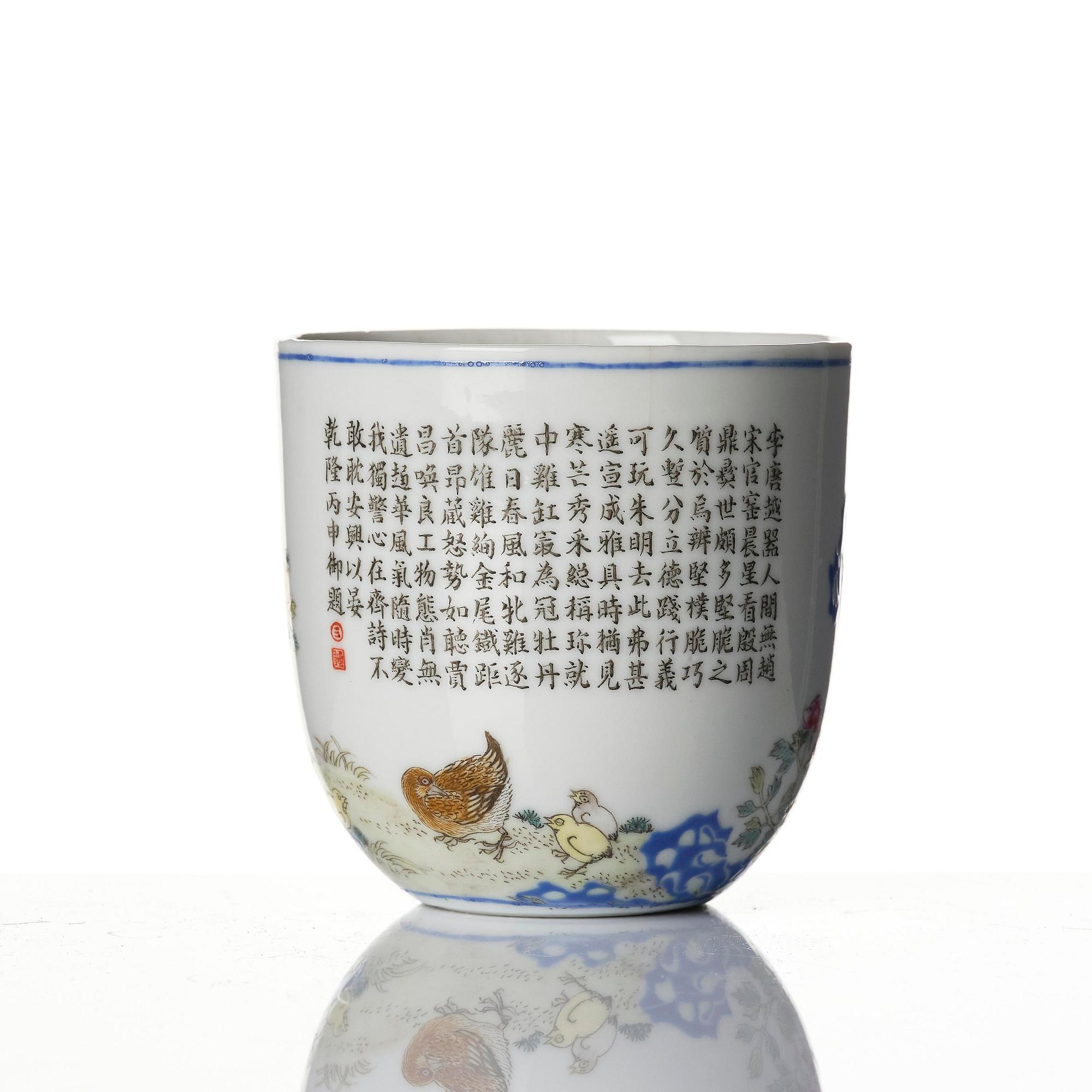
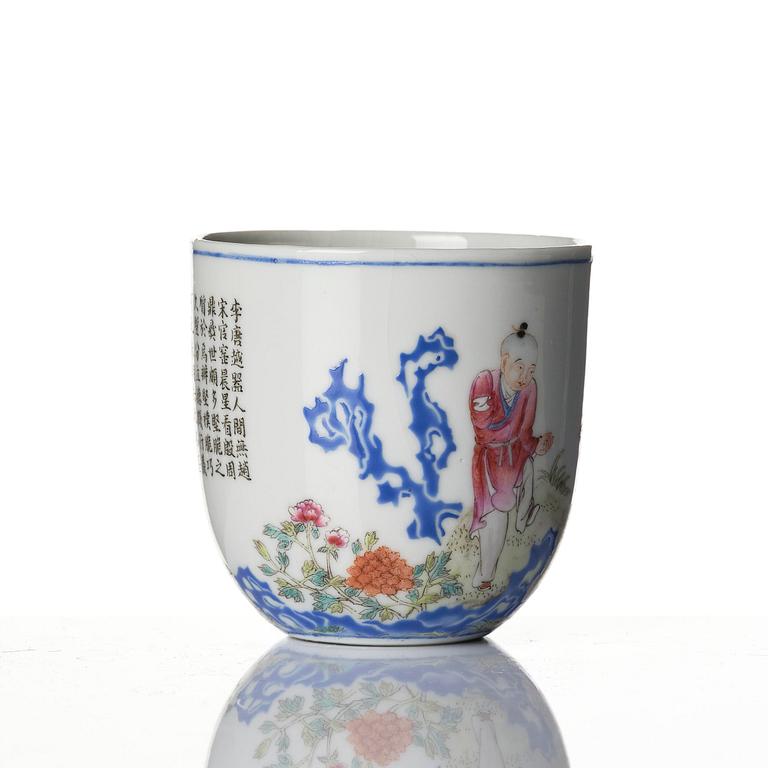
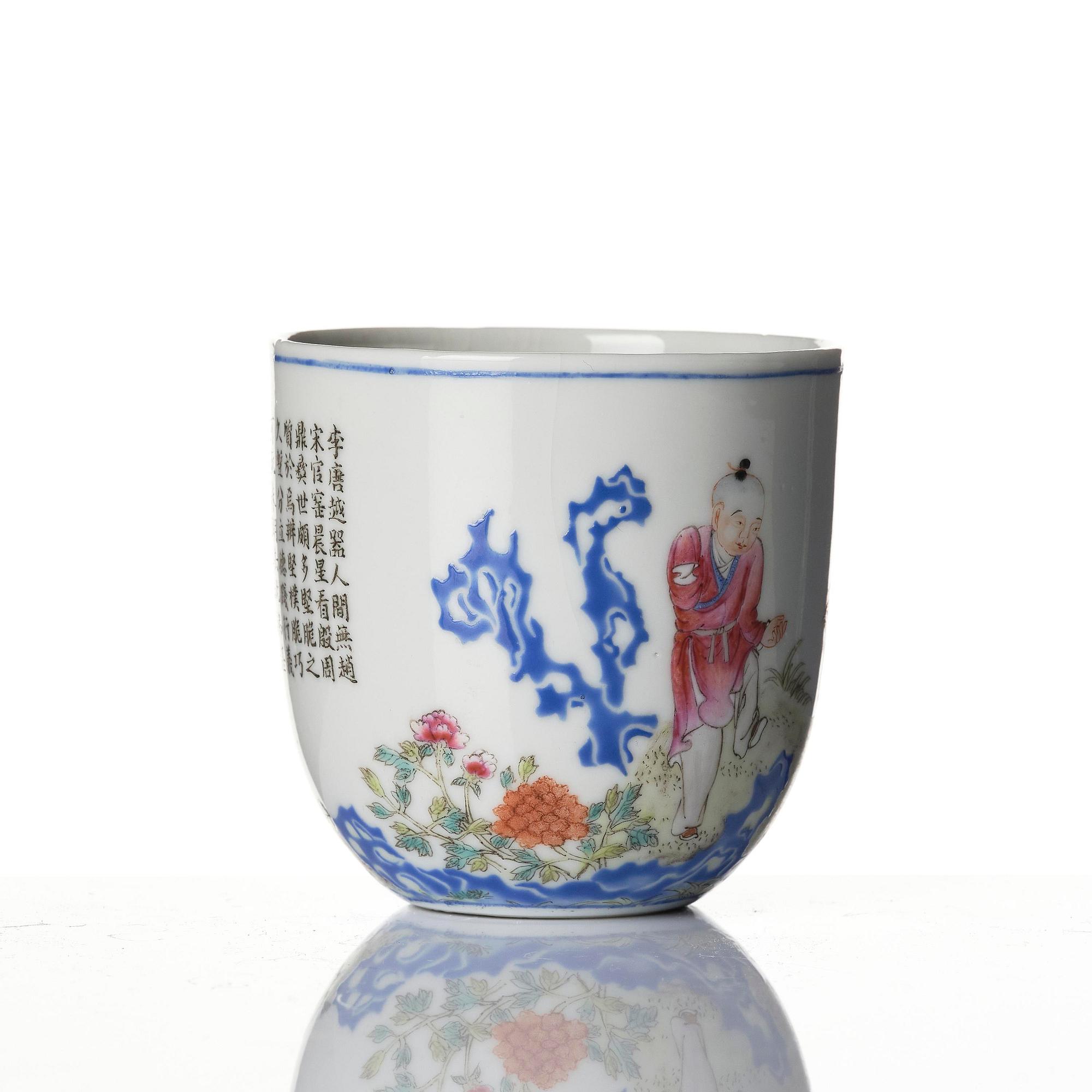
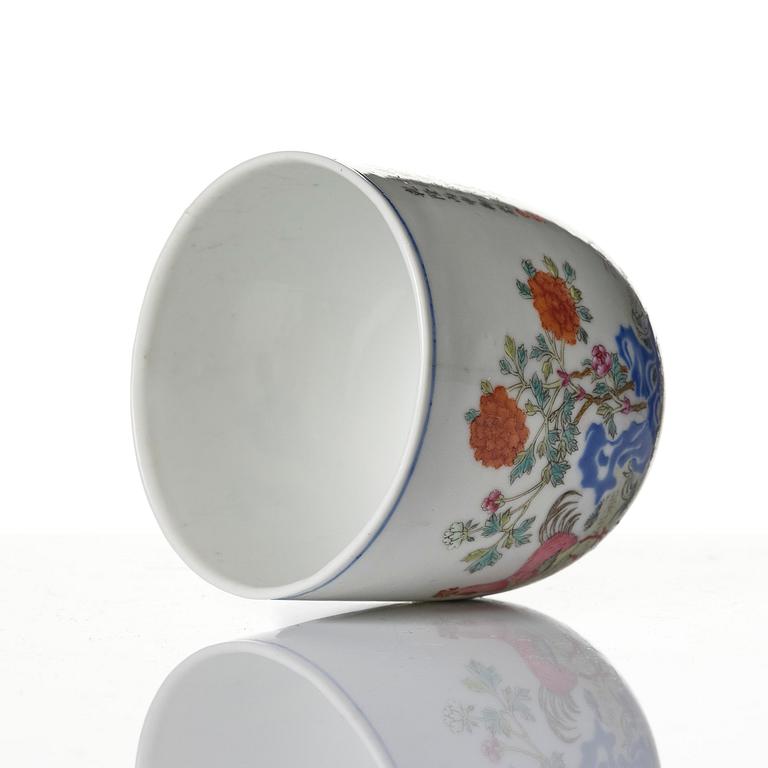
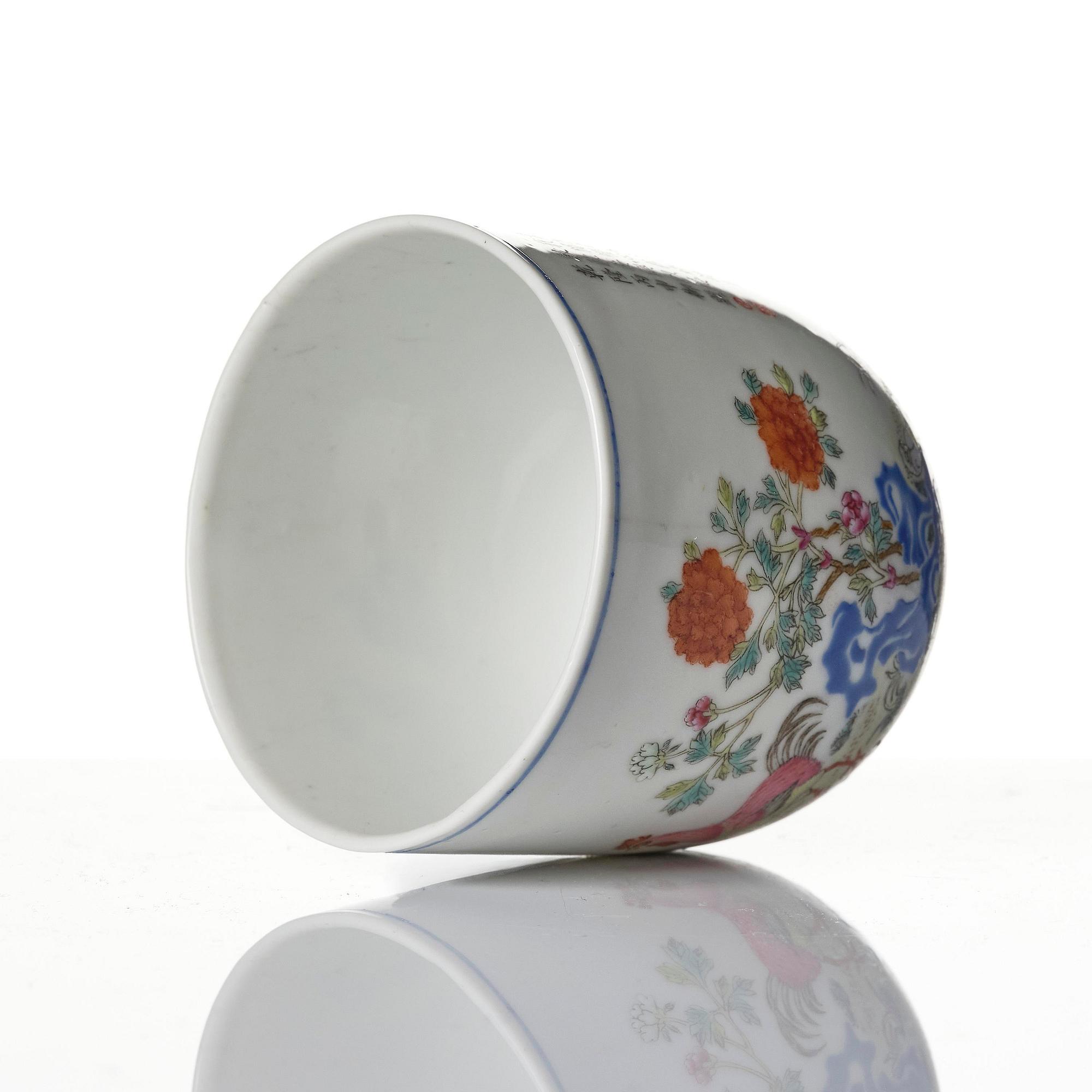
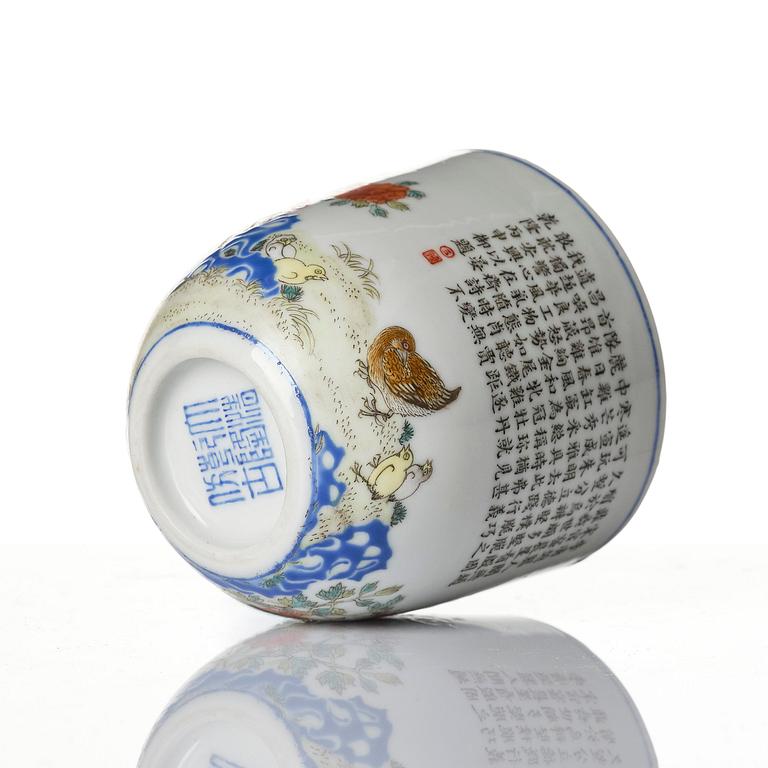
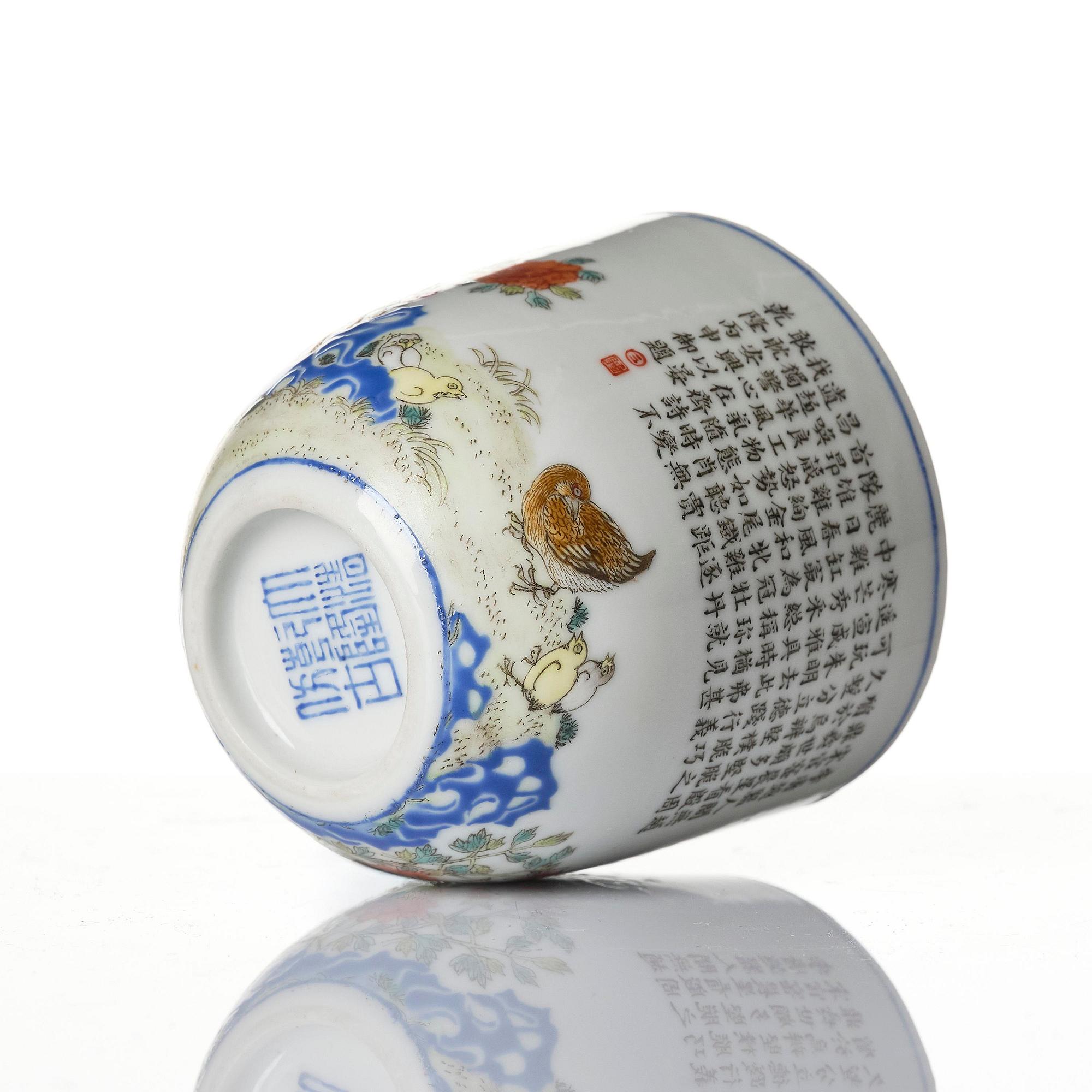
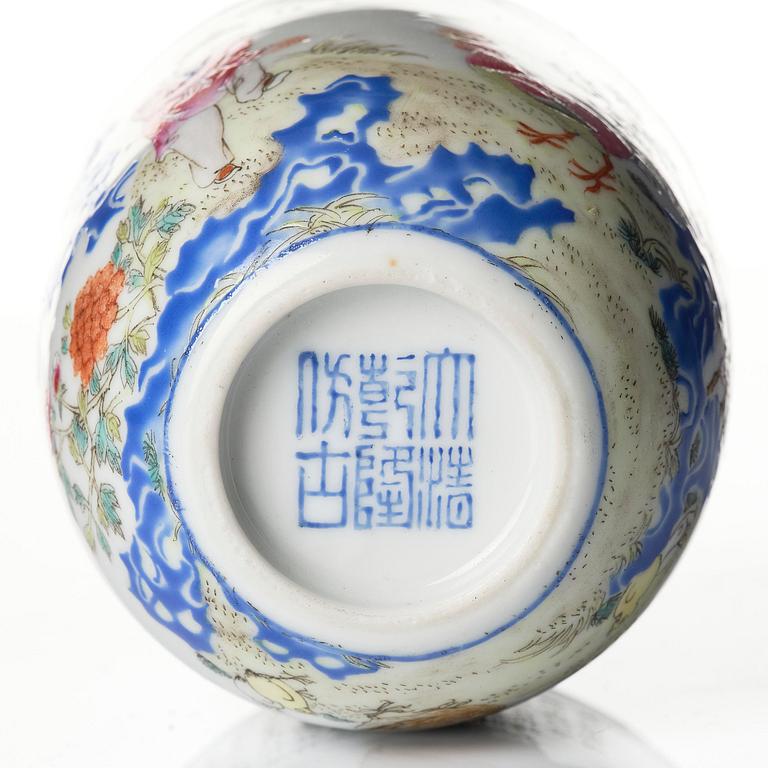
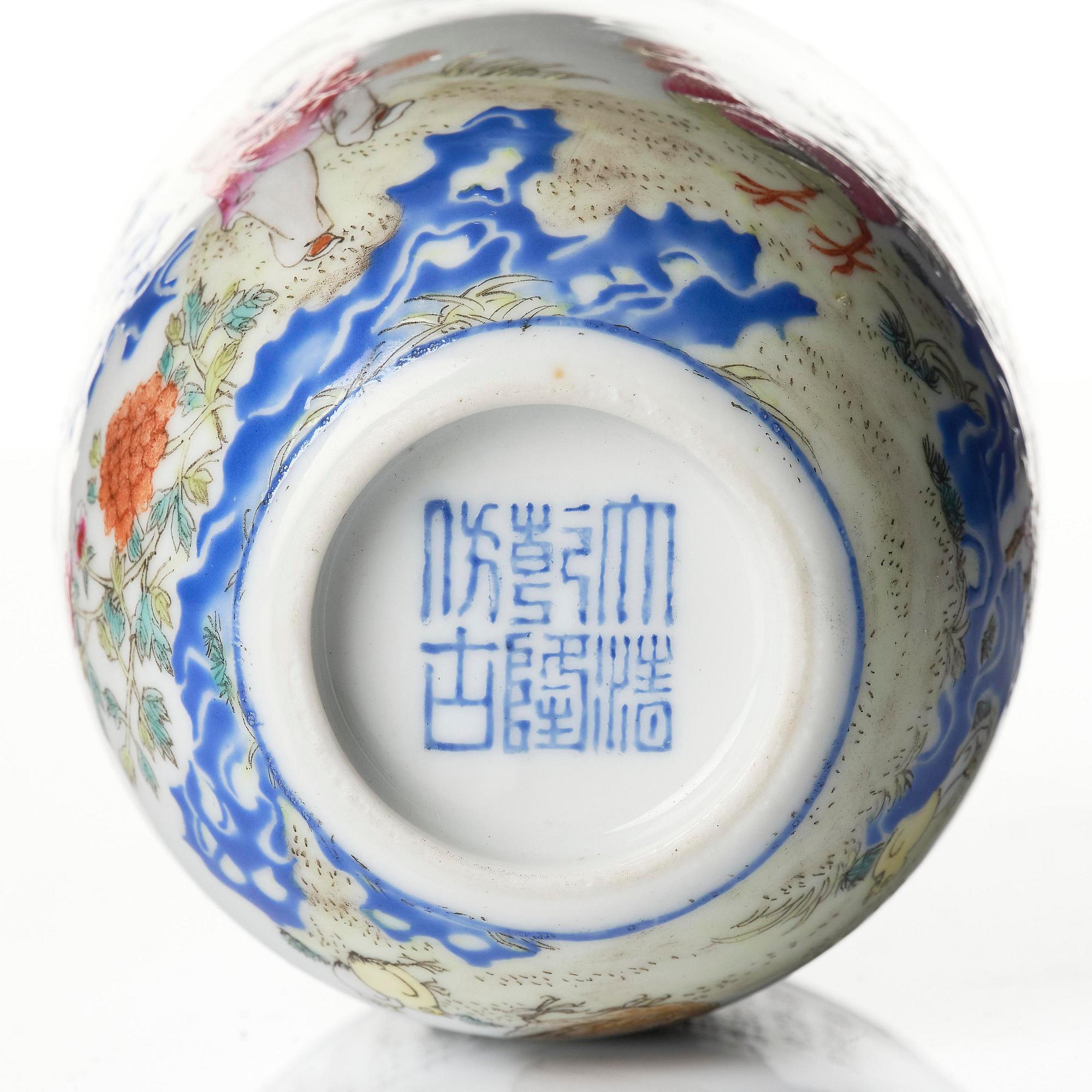
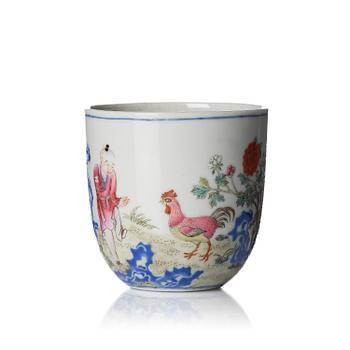
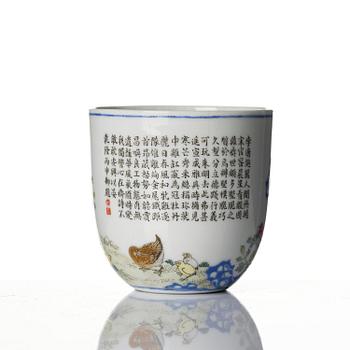
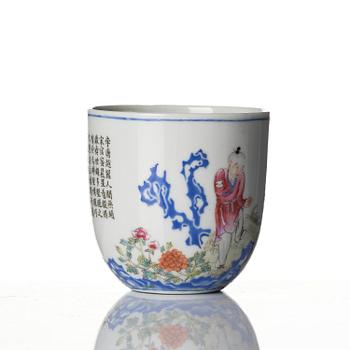
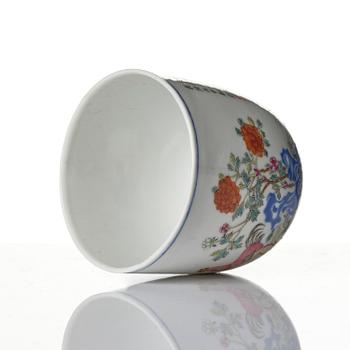
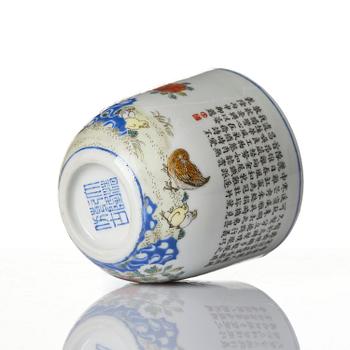
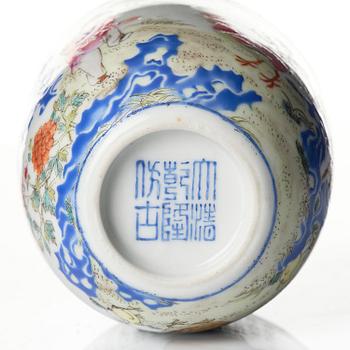
A famille rose 'Boy and Chicken cup', Republic period, with Qianlong seal mark.
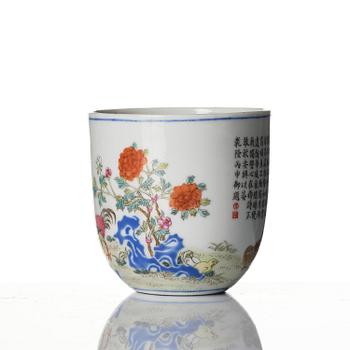
The deep U-shaped body finely painted with the scene of Jia Chang stamping his left foot to call the chickens in a setting of blue rocks and peonies, the boy depicted facing the rooster while the hen and four chicks are shown to the reverse beneath a poetic inscription. Höjd 6.5 cm.
Cracks.
Provenance
Property of a private Swedish collector.
Exhibitions
Compare Bonhams, lot 127. Fine Chinese Ceramics and Works of Art featuring Private Collections of Snuff Bottles
18 September 2023 | Live Auction, New York.
Literature
The mark on the base of all of these cups reads Da Qing Qianlong fanggu, which translates as 'made in imitation of antiquity in the Qianlong reign of the Great Qing dynasty'. The imitation of antiquity, or archaism, was a theme close to the Qianlong emperor's heart and a considerable number of imperial art objects in a range of different media bear this mark. The correct rendering of the mark was given by D. Howard and J. Ayers when they included a similar cup in their catalogue of the Mottahedeh collection, Chinese for the West, London/New York, 1978, vol. 1, pp. 171-2, no. 165.
A cup of this type was also loaned by the Chinese government to the International Exhibition of Chinese Art, Royal Academy, London, 1935, cat. no. 2155.
More information
Cups of this type are based on earlier Chenghua doucai prototypes such as the pair of cups of similar shape, but decorated with chickens only, included in the Illustrated Catalogue of Chinese Government Exhibits for International Exhibition of Chinese Art in London, vol. II, Porcelain, 1948, p. 130, no. 171.
The poem is in praise of well-known works of art from earlier periods and in particular to Ming dynasty chicken cups. As with most of Qianlong's poems, there are many archaic references. In this instance, the Emperor mentioned the child prodigy, Jia Chang (b. 713 AD), as depicted by the image of the boy on the present cup. At the age of thirteen, Jia Chang was such a talented trainer of fighting cocks that the Tang dynasty emperor Xuanzong (r. 713-56 AD) employed him to train the imperial fighting cocks. The design on these cups is therefore often known as 'the precocious boy'.
For condition report contact specialist

What will the transport cost?
Others have also viewed