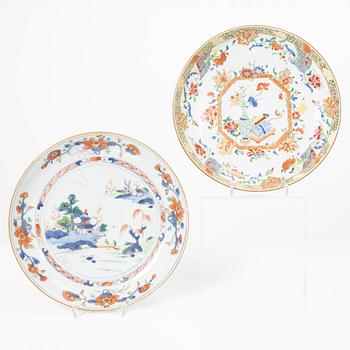
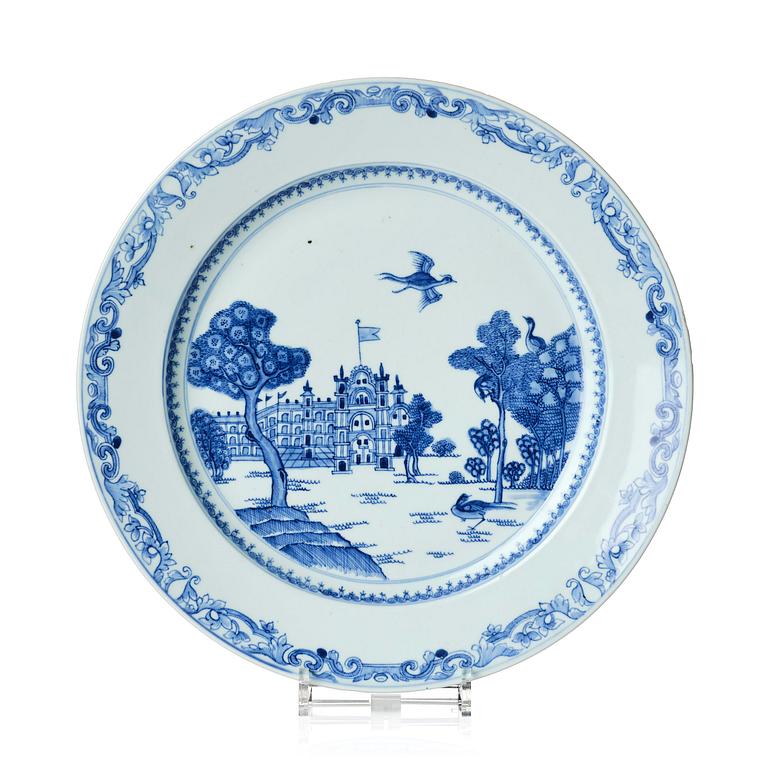
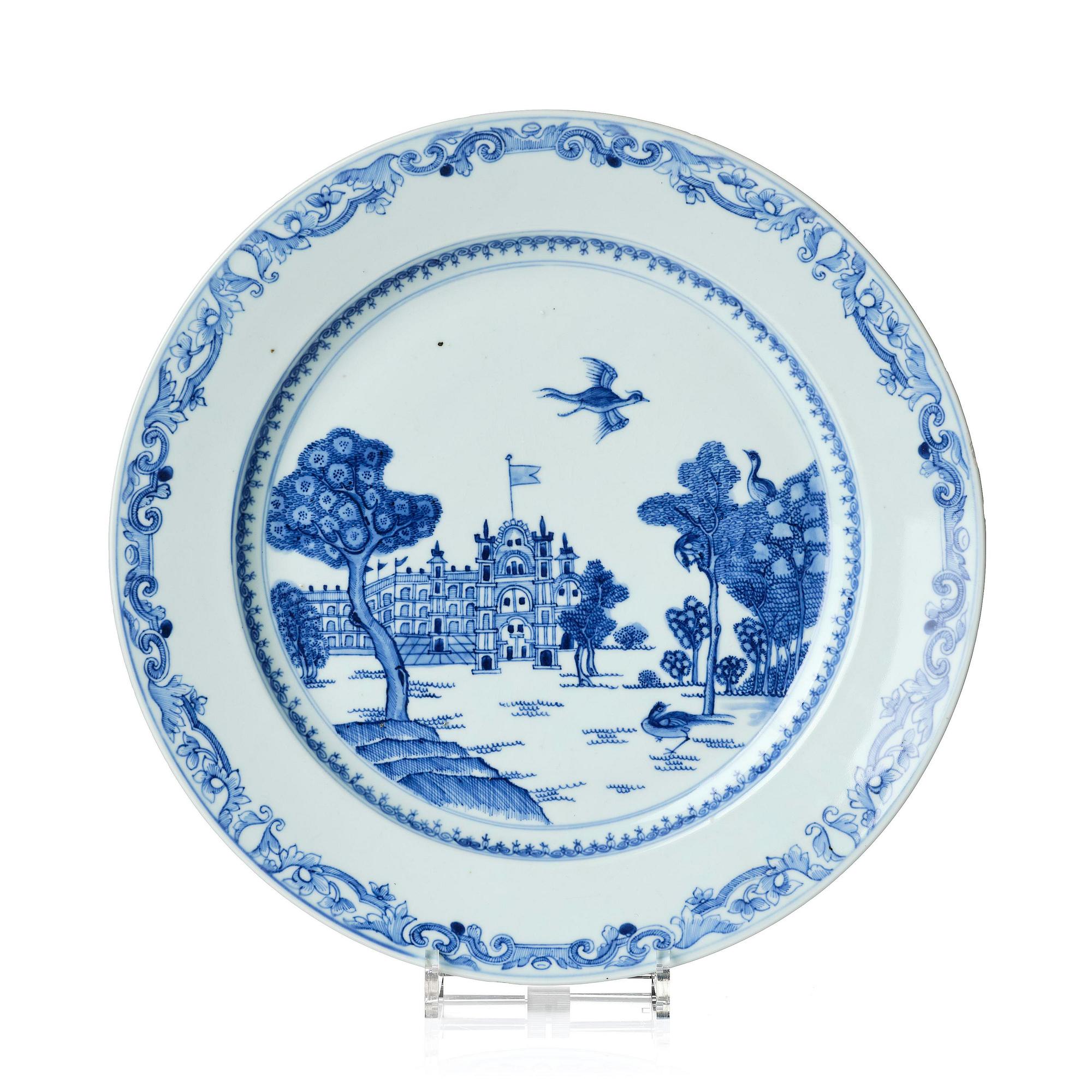
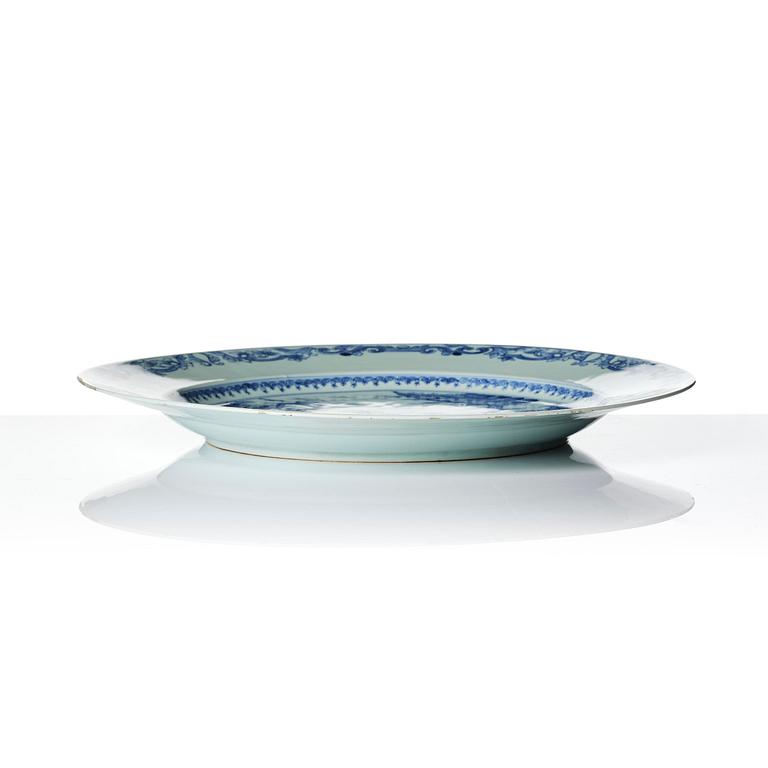
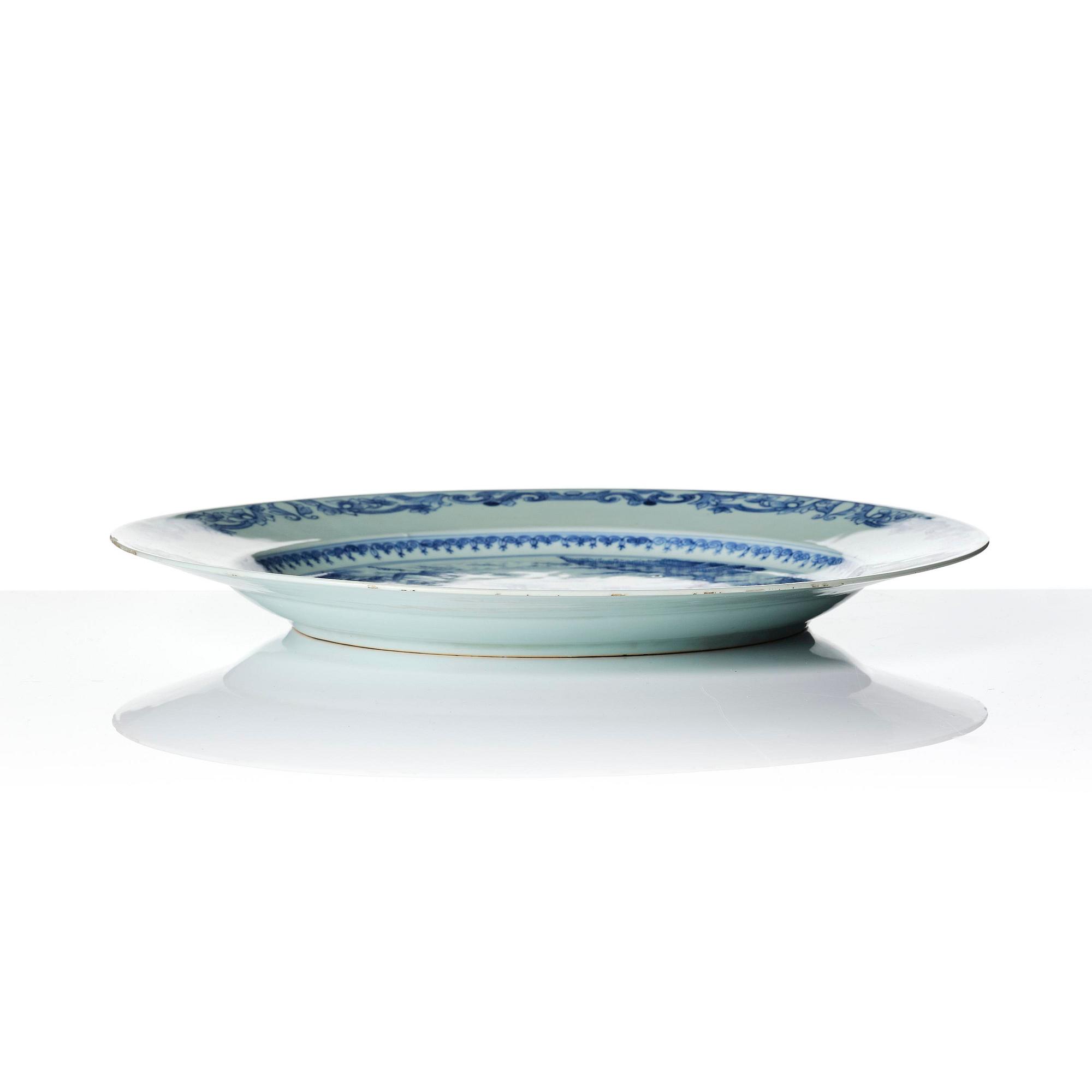
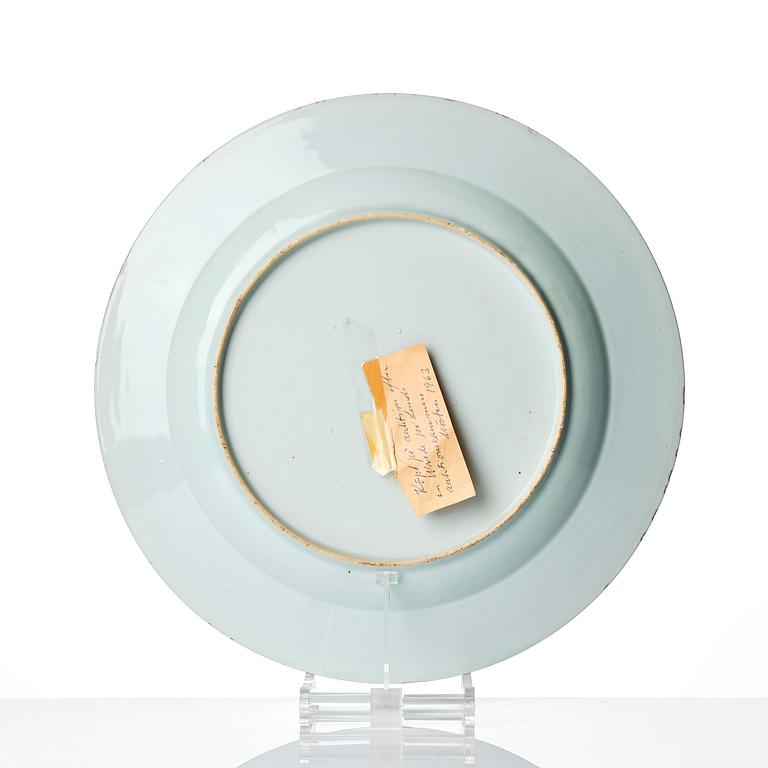
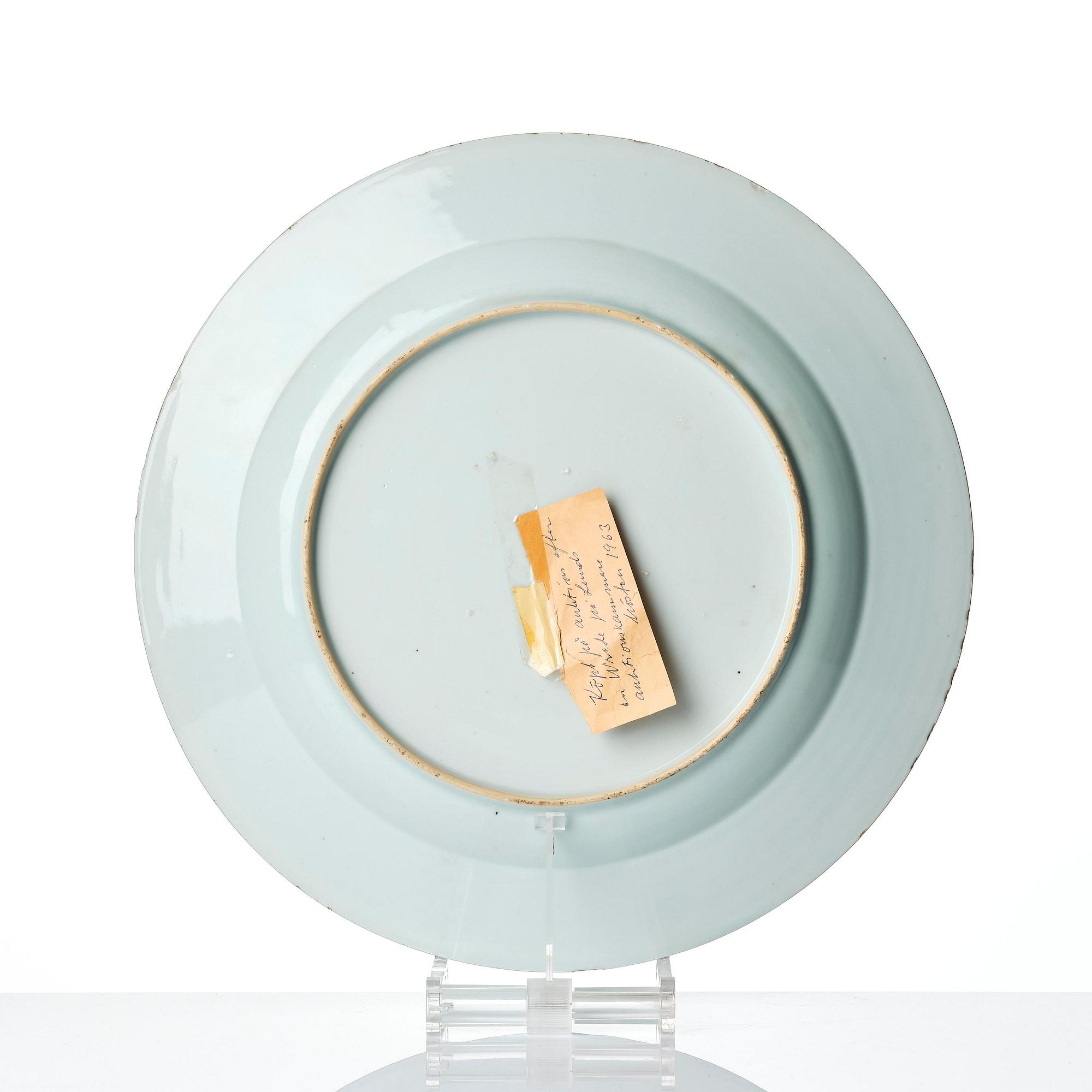
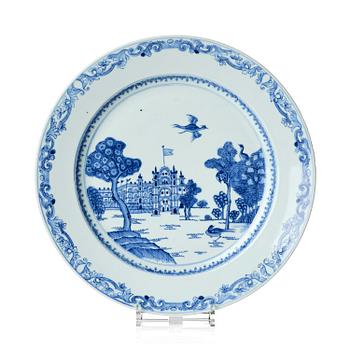
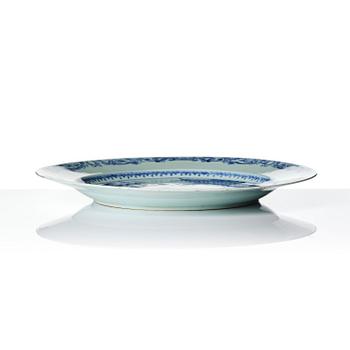
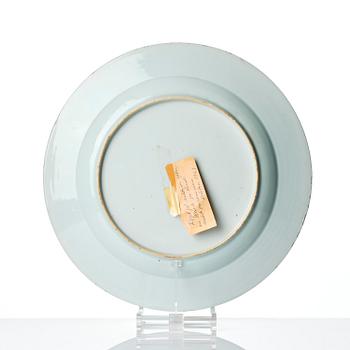
A blue and white 'Burghley House' dish, Qing dynasty, circa 1745.
Painted to the interior with a medallion enclosing a detailed view of Burghley House with peacocks in the garden, all encircled by a floral strapwork band at the rim. Diameter 38.5 cm,
Kantnötning.
Provenance
Property of a private Swedish Estate.
Exhibitions
For other Chinese export porcelain wares of this design, see one sold at Sotheby's, London, 19 May 2021, lot 272; a pair from the collection of the Visconde de Lançada sold in the same rooms, 18 January 2023, lot 73; and one from the Pierre Durand Collection sold at Christie's, New York, 27 January 2022, lot 220.
Literature
For a museum example see two oval platters with this motif: in the collection of the Peabody Essex Museum, Salem (inv. no. E81797) illustrated by William R. Sargent in Treasures of Chinese Export Ceramics From the Peabody Essex Museum, New Haven, 2012, p. 139, cat. no. 47
More information
Burghley House was constructed between 1555 and 1587 for William Cecil, 1st Baron Burghley (1520-1598), the chief advisor to Queen Elizabeth I (r. 1558-1603). He also served as Secretary of State twice (1550–1553 and 1558–1572) and as Lord High Treasurer in 1572. The home itself is considered a masterpiece of Tudor architecture and houses a renowned art collection with particular depth in Chinese and Japanese export porcelains, as well as European and English ceramics. Images of Burghley House also appear on English delftware with a composition resembling the Chinese examples, although lacking the birds or a decorative border. The designs for these plates are thought to derive from a print by Johannes Kip (1653-1722) in Nouveau Théater de la Grande Bretagne (1715), after a drawing by Leonard Knyff (1650-1722).
For condition report contact specialist

What will the transport cost?
Others have also viewed