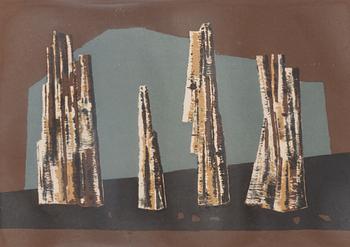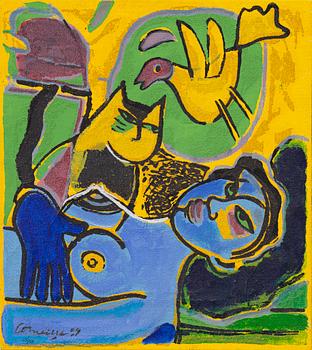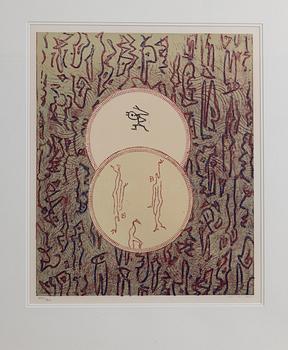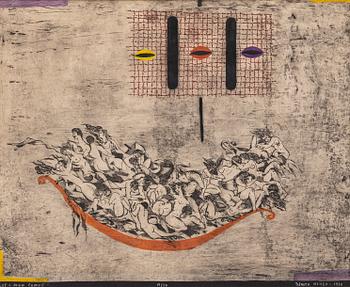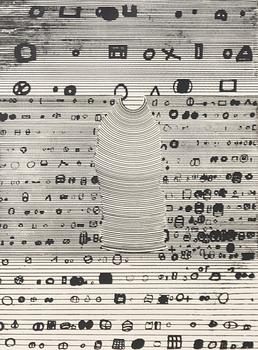
Concetto Spaziale (from XXe Siècle)
Pochoir, from the magazine XX:e siècle nr 12 1959, printed by Daniel Jacomet, Paris, from an edition of 1500. Image area 31 x 24 cm.
Minor crease in one corner. Not examined out of frame. Good condition.
More information
XXe siècle was one of the most influential Paris art journals of the mid-20th century. The magazine quickly became a central forum for modern art, emphasizing dialogue between visual art and critical writing, and publishing original prints by leading avant-garde artists.
In 1959, XXe siècle no. 12 appeared as part of this long-running series. The work "Concetto Spaziale" in this auction is a pochoir — with the text and original binding included. The printing was handled by Daniel Jacomet et Cie in Paris, a well-respected atelier known for high-quality lithographic and pochoir printing — a crucial factor in the publication’s visual and material significance.
More about Lucio Fontana
Up until the 1940s, Lucio Fontana lived and worked in Italy and France, but at the wake of the Second World War he fled to Argentina. In Buenos Aires at the Academia of Altamira, his idea of Spazialismo was born, a artist movement grounded by Fontana which came to define the majority of his career. In his manifesto from 1946, Manifesto Blanco, the artist challenged his peers to steer away from the tranditional and academic elements of art, urging them to include new techniques and darw to create art into the fourth dimension.
A great reasoning behind Fontana's popularity was his ability to combine sculpture and painting. His choice of forms was inconsistent during the entirity of his career, from geometirc perfections to more undefinable forms. It didn't matter so much about the end result, but rather the process it took to get there. Fontana's art was a product of its time, no matter the medium or technique.
Already in 1947, Fontana began working with the concept Concetto Spaziale. A few years later his Pietre series was added where he seemlessly combines sculpture and painting by applying thick layers of paint on a canvas and thereafter adding a collage of colourful glass chips. Not long after that Fontana entered a period with Buchi, where he made holes in the canvas to break up the two dimensionality of the composition in search for the space behind the painting. At the end of the 1950s he began his work with Tagli, whereby he sliced his canvas which continuously applying his Buchi technique, a style which he continued with up until his death in 1968. Through Concetto Spaziale, Fontana managed to blurr the lines between painting and sculpture.
His first Tagli was created at the end of the summer and early autumn of 1958 when Fontana was almost 60 years old. His canvases were filled with small diagonal incisions which he grouped together. Fontana experimented with size and form, and with time the slices became less and more powerful. To reach the right effect, Fontana was incredibally precise with the surface of the canvas, coating it first with a matt, often water based, monochrome colour. His pieces with only one slice are marked as "Attesa" and the canvases with multiple slices are marked with the plural form, "Arrese". The meaning "expectation or hope" gives an additional dimension to the work. Fontana covered the back piece with "telleta," strips of deep black fabric to create the illusion of an empty space behind the canvas. In Tagli, destruction and creation merge. Every slice is formulated through a definitive and irreversable gesture. Every action which results in a wound upon the canvas simultaneously allows for a new sculptural perspective out into the black neverending space behind the canvas. Fontana's artistic journey with Tagli and Buchi happened correspondingly with the 1960s space race.
"As an artist, when I work with one of my perforated canvases, I have no desire to create a painting; I want to create an opening for space, to give art a new dimension, to bind it to the cosmos, as it endlessly continues beyond the boundaries of the painting. With my innovation of holes drilled through the canvas in repeated formations, I do not wish to decorate a surface, but rather to break up its dimensional limitations. Behind the perforations lies a newfound freedom for interpretation, but also, just as inevitably, an end to art." (Lucio Fontana, 1966)
Fontana came and had several exhibitions in Sweden during the 1960s. One of his greatest admirers was the gallerist Pierre Lundholm at Galerie Pierre in Stockholm who not only arraned exhibitions in 1964, 1967, and after Fontana's death in 1971, but also stored and sold Fontana's work. Fontana even managed to exhibit at the Swedish French Art Gallery in 1965 as well as have a large exhibition at Moderna Museet in 1967 in Stockholm through the initiative of Pontus Hultén. His paintings were admired by the most asteemed collectors, and with the wider public, his works were preceived as bizzar and incomprehensible. Today Lucio Fontana is praised for his art that stood as a testament beyond his time.
Read moreFor condition report contact specialist

Covered by droit de suite
Image rights
The artworks in this database are protected by copyright and may not be reproduced without the permission of the rights holders. The artworks are reproduced in this database with a license from Bildupphovsrätt.