Important Spring Sale presents An Ushak Saf Fragment | June 10–12
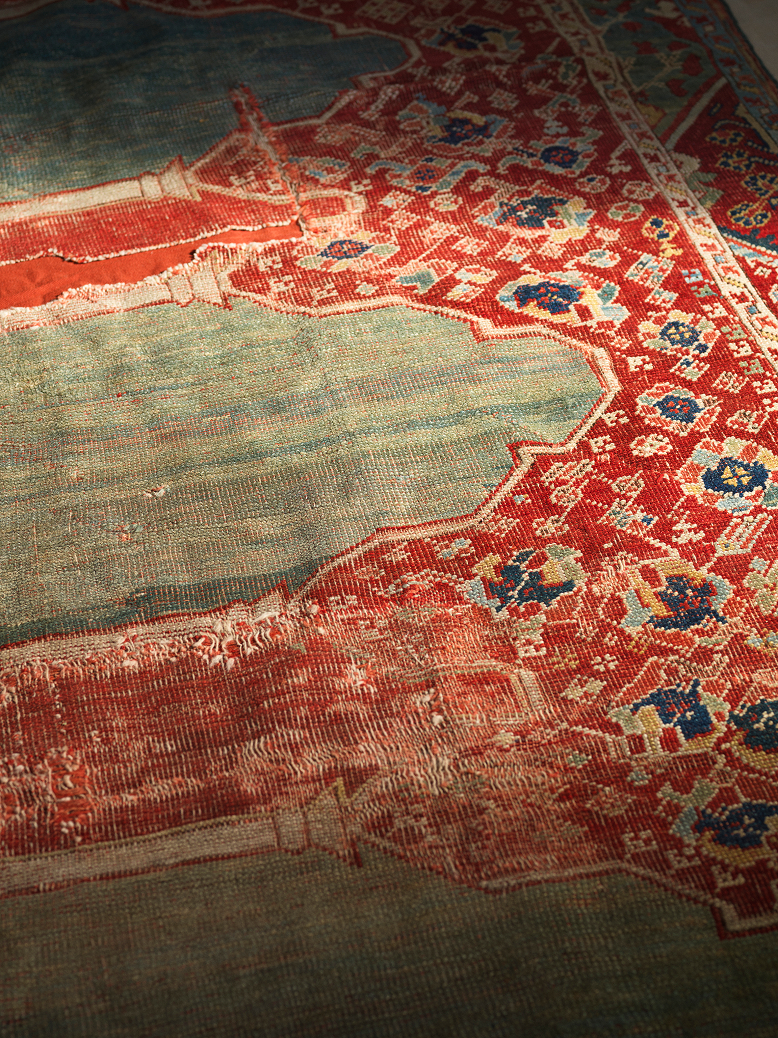
This fragment from a multi-tiered saph carpet belongs to a small and well-known group of Anatolian fragments traditionally associated with the Ulu Cami (Great Mosque) of Bursa in western Anatolia. Today the surviving pieces are dispersed among museums and private collections and are thought to represent the remains of one or more monumental congregational prayer carpets.
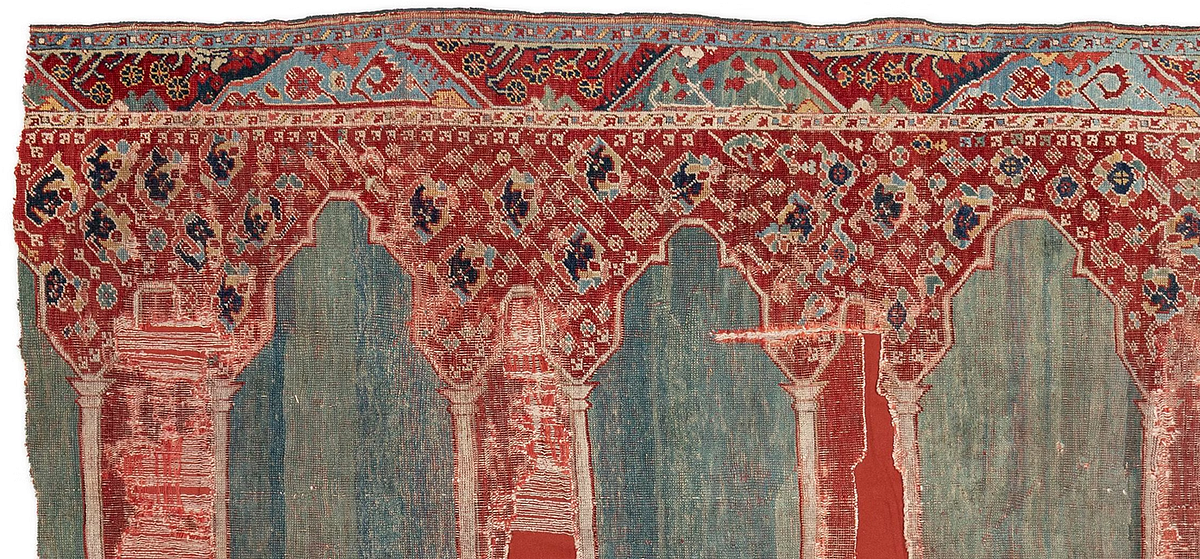
Saph carpets are characterised by rows of repeating niches arranged in horizontal tiers, each niche marking an individual prayer space for a worshipper. The architectural rhythm created by these arcaded forms reflects the ordered alignment of congregants during communal prayer. The present fragment appears to derive from an inner rank of niches and may be closely compared with a related fragment formerly in the Christopher Alexander Collection, sold at Christie’s London in 2008.
All fragments belonging to this group share a distinctive curled-vine divisional border separating the rows of niches. Variations occur, however, in the treatment of the spandrels and in certain border details. Such differences may suggest that very large carpets of this type were woven in separate sections and later joined together on site, a practice documented in other large-scale Ottoman workshop productions.
Estimate: 100 000 - 150 000 SEK
Weekdays 11 AM – 6 PM
Weekends 11 AM – 4 PM
Closely related fragments are preserved in several important collections, including The David Collection, Copenhagen, The Linden-Museum, Stuttgart, The Textile Museum, Washington D.C., and the Marshall and Marilyn R. Wolf Collection. Taken together, these surviving pieces offer valuable insight into the original appearance of what must once have been an impressive and sophisticated textile.
The present fragment possesses a particularly distinctive feature: a canted border with a hooked vine guard stripe cutting across the upper right corner. This unusual element may mark the junction between woven sections or reflect a structural transition within the original carpet’s design.
Despite its fragmentary state, the piece retains the elegance and compositional clarity that characterise classical Ottoman carpet design. The decoration of the spandrels also shows close affinities with that found in certain so-called Transylvanian niche rugs, underscoring the broader artistic connections within Anatolian weaving during the sixteenth and seventeenth centuries.
Fragments from this rare group seldom appear on the market today and remain of considerable importance to both collectors and scholars of early Ottoman carpets.
To Be Sold at Important Spring Sale
Enquiries and Condition Reports