Important Spring Sale presents Anders Zorn | June 10–12
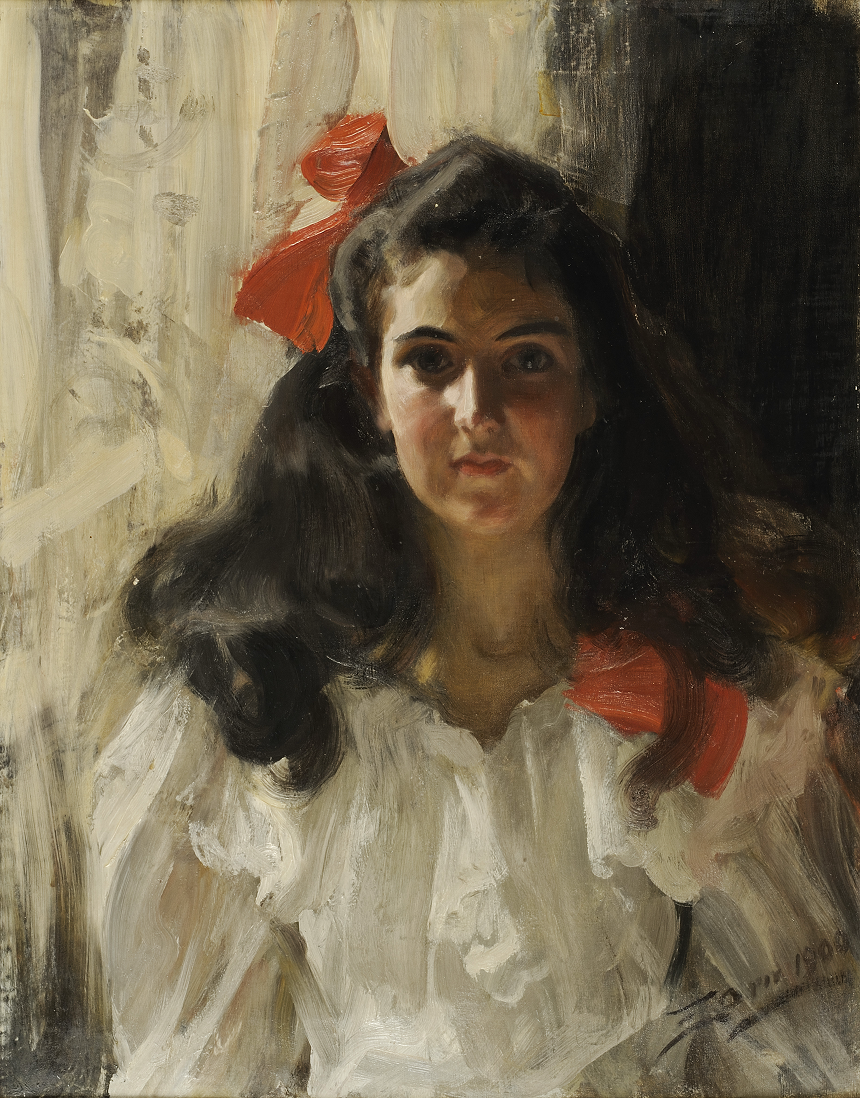
"Marie Cohn"
At the turn of the twentieth century, Anders Zorn was at the height of his international career. Following his breakthrough years in Paris and extensive travels throughout Europe and the United States, he had established himself as one of the most sought-after portrait painters of his age, admired for his ability to capture his sitters with both technical virtuosity and psychological acuity.
The painting Marie Cohn, executed in Berlin in the autumn of 1900, belongs to this cosmopolitan phase of Zorn’s oeuvre — a period during which he moved effortlessly between Europe’s cultural capitals, portraying an international bourgeoisie characterised by self-assured modernity and social ambition.
For nearly a century, the painting was known as Miss Cohen or Fräulein Cohen, and the identity of the young teenage girl had faded into obscurity. Then, in the early 2000s, her four children recognised their mother’s portrait in a reproduction of the painting and were able to identify her. Their mother’s maiden name was Marie Cohn (1887–1967), and she was the daughter of the owner of a private bank in Berlin. She later studied history and received her doctorate in Heidelberg in 1913, before marrying the Member of Parliament Dr August Weber the following year.
The thirteen-year-old Marie Cohn appears in the portrait with striking presence and an intelligent gaze. Zorn avoids every form of excessive attributive detail, instead allowing the sitter’s posture, expression and body language to carry the emotional weight of the portrait. The restrained elegance of the composition — in which costume, light and background interact without dominating — is characteristic of the artist’s portraiture. Zorn’s great strength lay in his ability to unite representation with intimacy. In his hands, the commissioned portrait became a study of individual character, and this is equally true of Marie Cohn. Tor Hedberg observed that “the portrait of Miss Cohen, painted in 1900 during a brief stay in Berlin, is evidently to be counted among his finest portraits of children.”
Estimate: 1 500 000 - 2 000 000 SEK
Weekdays 11 AM – 6 PM
Weekends 11 AM – 4 PM
At the time the painting was executed, Berlin was a centre of finance, industry and culture, as well as a meeting place for a growing Jewish and international bourgeoisie — the very circles in which many of Zorn’s patrons moved, alongside his art dealer Paul Cassirer. Here, his Nordic sensibility encountered an urban and cosmopolitan milieu, contributing to a refinement of his portrait style. Zorn’s international success rested to a considerable extent on his social ease and his ability to navigate these environments. His clientele included aristocracy, financiers and political figures alike, and his portraits came to serve as visual markers of a global elite at the turn of the century.
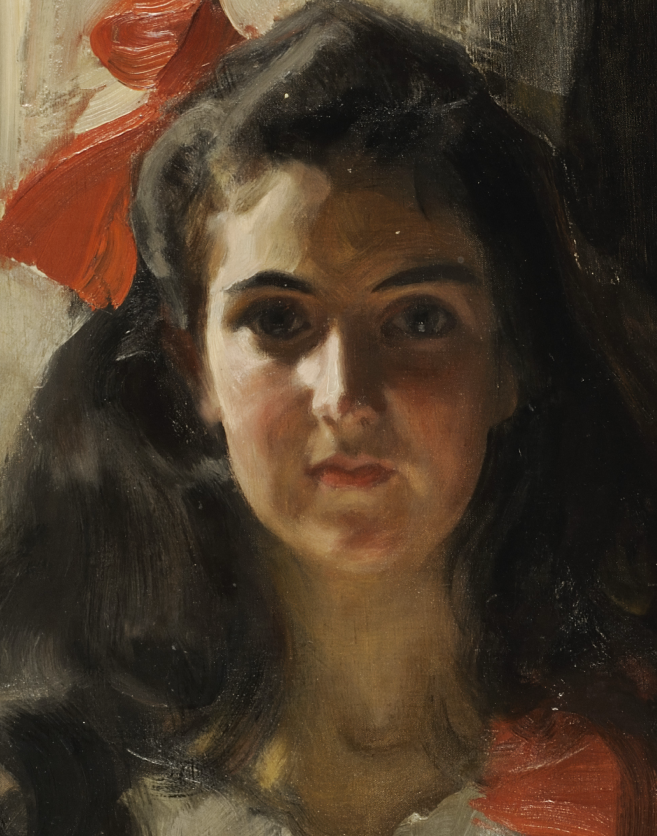
In Marie Cohn, Zorn demonstrates his technical virtuosity in oil painting. His celebrated limited palette — often reduced to only a handful of colours — produces a remarkable richness of tone and value, lending the skin its vitality and the textures their convincing materiality. Her white dress and the white curtain stand in contrast to her dark hair, which he crowns with a vivid red ribbon in characteristically Zornian fashion. He plays masterfully with chiaroscuro, modelling her features through the use of side lighting.
The brushwork is at once precise and expressive. Viewed at close range, the painting appears as an interplay of free and assured brushstrokes; from a distance, these merge into an illusion of immediate presence. The light models the face with almost photographic precision, while preserving a painterly vitality.
Zorn occupies a unique position in art history: his work is neither wholly academic nor fully modernist, but instead characterised by a pragmatic virtuosity in which craftsmanship and immediate visual impact remain central. It was precisely this synthesis that made him one of the most successful portraitists of his era. The work unites technical brilliance with psychological insight and bears witness to the artist’s ability to combine social representation with individual presence within a single image. With an extensive exhibition history beginning as early as 1901, when it was shown in Berlin, and continuing as recently as this spring in Madrid, Zorn’s exquisite Marie Cohn reveals the Swedish virtuoso painter at his finest, brilliantly capturing her on canvas in the autumn of 1900.
Anders Zorn at Important Spring Sale
Enquiries and Condition Reports