Important Winter Sale presents Lucio Fontana | December 9–11
"Crocifisso"
Lucio Fontana is today best known for his minimalist paintings featuring bold cuts and punctures, but his early sculptural work would prove highly significant to his later painting.
Already in the 1930s and 1940s, Fontana began developing a more experimental and scientific approach to art, exploring space, light and other dimensions. In his sculptures, he investigated these ideas through cuts, perforations and openings in the material – a visual language that would later become central to his paintings.
Lucio Fontana was born in Rosario, Argentina, in 1899, the son of Italian immigrants. He moved back to Milan with his family at the age of six. As a young man, he studied at an engineering school, but his passion for art proved too strong. In 1922, he returned to Argentina, where he worked in his father’s sculpture studio before opening his own in 1924. Towards the end of the 1920s, he returned to Italy to study at the Accademia di Brera, where he spent two years as a student of the sculptor Adolfo Wildt.
Weekdays 11 AM – 6 PM
Weekends 11 AM – 4 PM
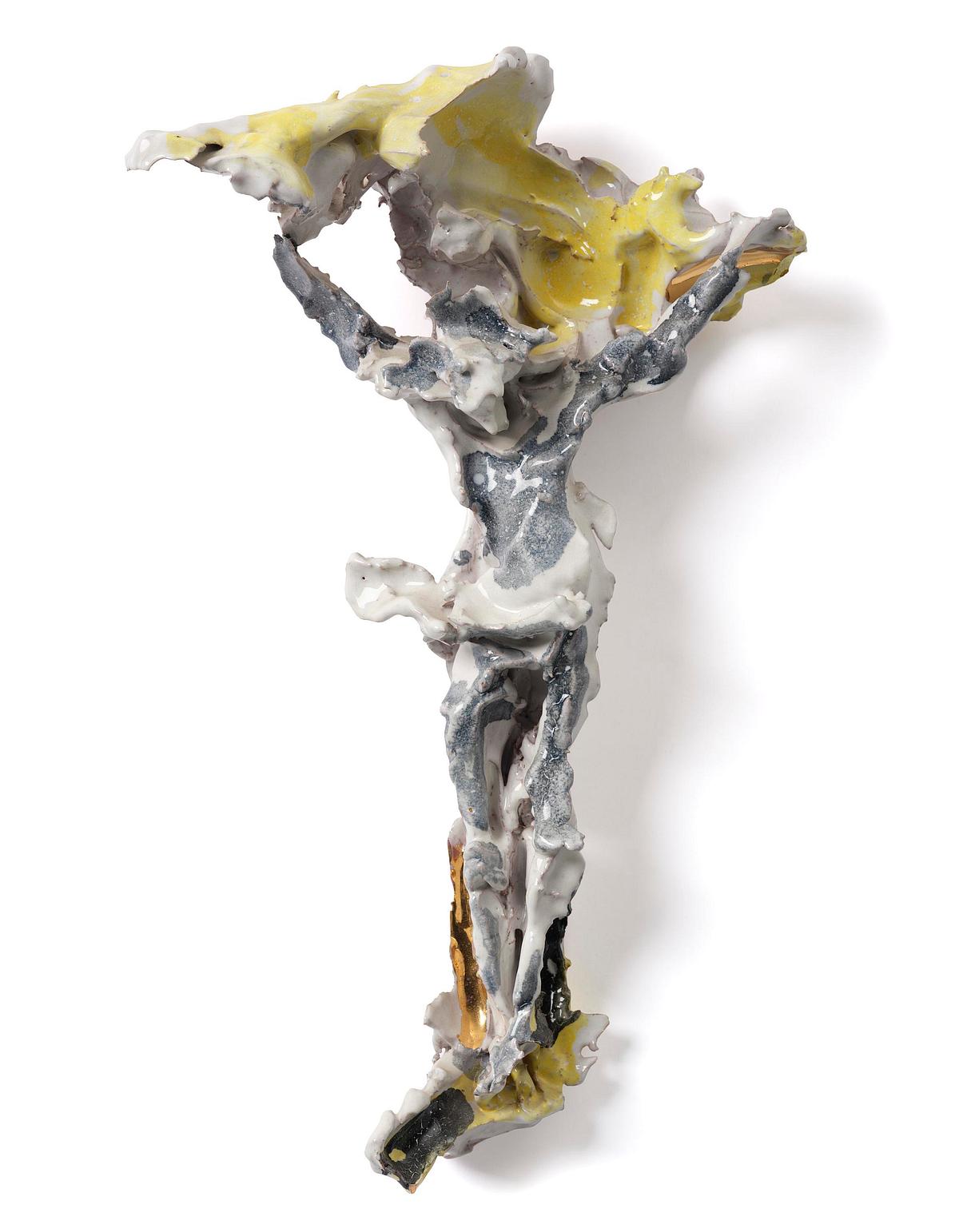
In 1934 and 1936, Lucio Fontana worked periodically in the renowned ceramic workshops of Albisola. There, he created remarkable amorphous sculptures inspired by animal life and marine fauna, including sea snails, octopuses and crocodiles. From 1936 onwards, when Fontana returned to a more figurative sculptural approach, glazed ceramic works came to dominate his production. During a period working at the Sèvres porcelain factory outside Paris in 1937, he created heads, figures, animals and still lifes characterised by expressive dynamism, textured surfaces and opalescent colours. Among the polychrome ceramic sculptures Fontana produced during this period are terracotta works whose dancing forms seem almost to dissolve into movement.
From 1939 to 1947, he once again lived in Argentina. During this period, he worked on the Manifiesto Blanco (White Manifesto), in which he advocated a synthesis of the arts and the abandonment of conventional materials, while emphasising the dimensions of time and movement in space. After returning to Milan, he founded the artists’ group Movimento spaziale and published two manifestos for Spazialismo (Spatialism). He gradually became one of the leading avant-garde artists of the first post-war generation, serving as a pioneer and source of inspiration for many of today's most prominent artists.
Following his return to Italy in 1947, Fontana created his first works based on his conception of space, which he had articulated for the first time in his theoretical manifesto. He also began giving his works the title Concetto spaziale (Spatial Concept). His exploration of spatiality through expressive and dynamic forms is particularly evident in the upward-reaching movement of the figures in the groups of works Crocifissi (Crucifixes) and Crocifissioni (Crucifixions). As can be seen in the draped loincloth and flowing folds of the figure of Christ, Fontana worked the clay with the aim of achieving a spatial expansion imbued with the visual language of the Baroque. These ceramic works are particularly fascinating because they allow viewers to experience Fontana’s concept of space in an immediate and sensual way.
Lucio Fontana at Important Winter Sale
Enquiries and Condition Reports