Modern Art & Design presents Erik Olson | November 18–19
At the beginning of 1924, Erik Olson and his cousin Waldemar Lorentzon arrived in Paris.
They became part of the very first group of students at what was then the most modern art school on the European continent: Fernand Léger’s Académie Moderne in Montparnasse. In Paris, Erik spent time with his close friend, the artist Otto Carlsund. Together, they visited Amédée Ozenfant’s ultramodern studio, designed by the architect Le Corbusier.
Estimate: 1 200 000–1 500 000 SEK
Weekdays 11 AM – 6 PM
Weekends 11 AM – 4 PM
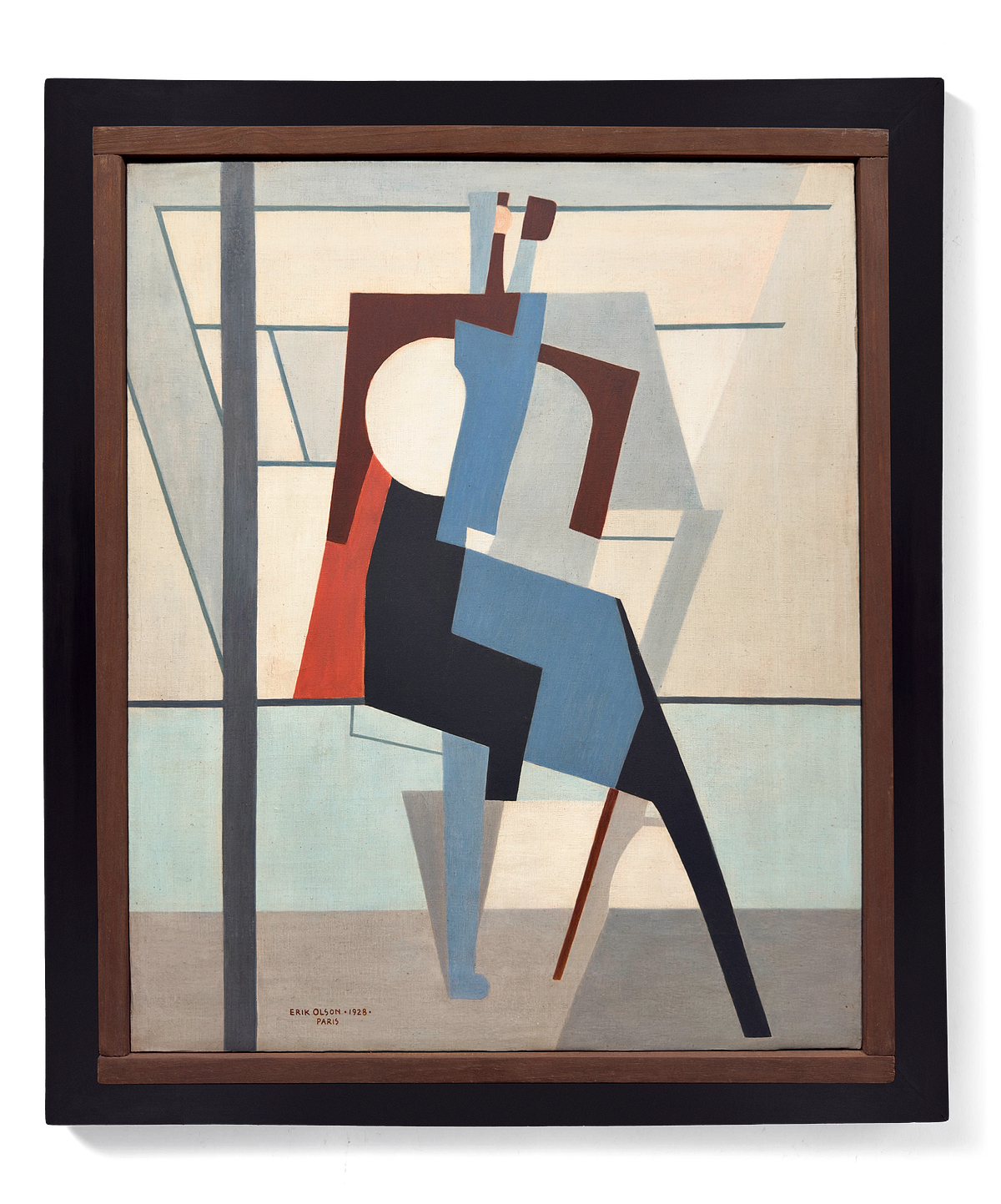
In the painting "Ritare" (1928), offered at auction, the lines are straight, the colours vivid, and the various surfaces puristically flat, without any shading. The individual elements interact to form a unified whole in an almost musical composition. The painting encapsulates Erik Olson’s distinctive personal style, rooted in the artistic climate of late-1920s Paris – the tension between the figurative and the concrete, the development of post-Cubism, the search for new directions, and the artist’s departure from Léger’s use of modeled forms.
Sven Uno Forthmeiier worked as an architect in Halmstad during the 1920s and designed, among other buildings, Schönbeckska huset (1923) and the extension to Hotel Tylösand (1927). He was also responsible for the architectural design of the 1929 Exhibition of Art, Crafts and Industry in Halmstad. Several of the artists who would shortly afterwards form the Halmstad Group exhibited in the exhibition’s modern art section.
Davis Brewster Allen (1916–1999) was an American interior designer who studied at the Royal Institute of Technology (KTH) in Stockholm during the 1930s. From 1959 onwards, he worked on selecting and assembling art collections for major corporate clients and private patrons, in collaboration with, among others, Alfred H. Barr Jr.
Erik Olson at Modern Art & Design
Enquiries and Condition Reports