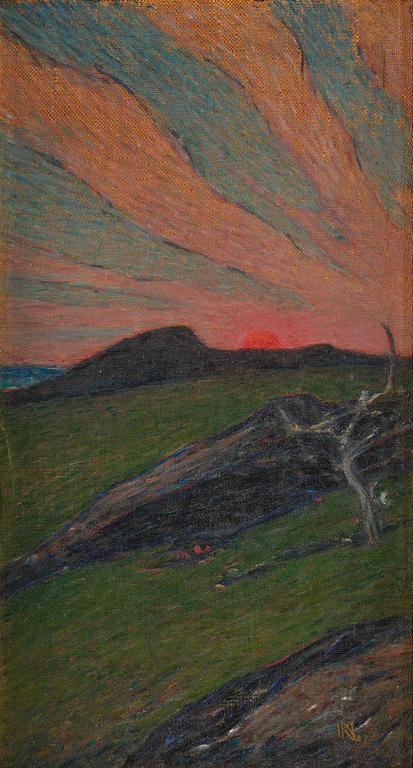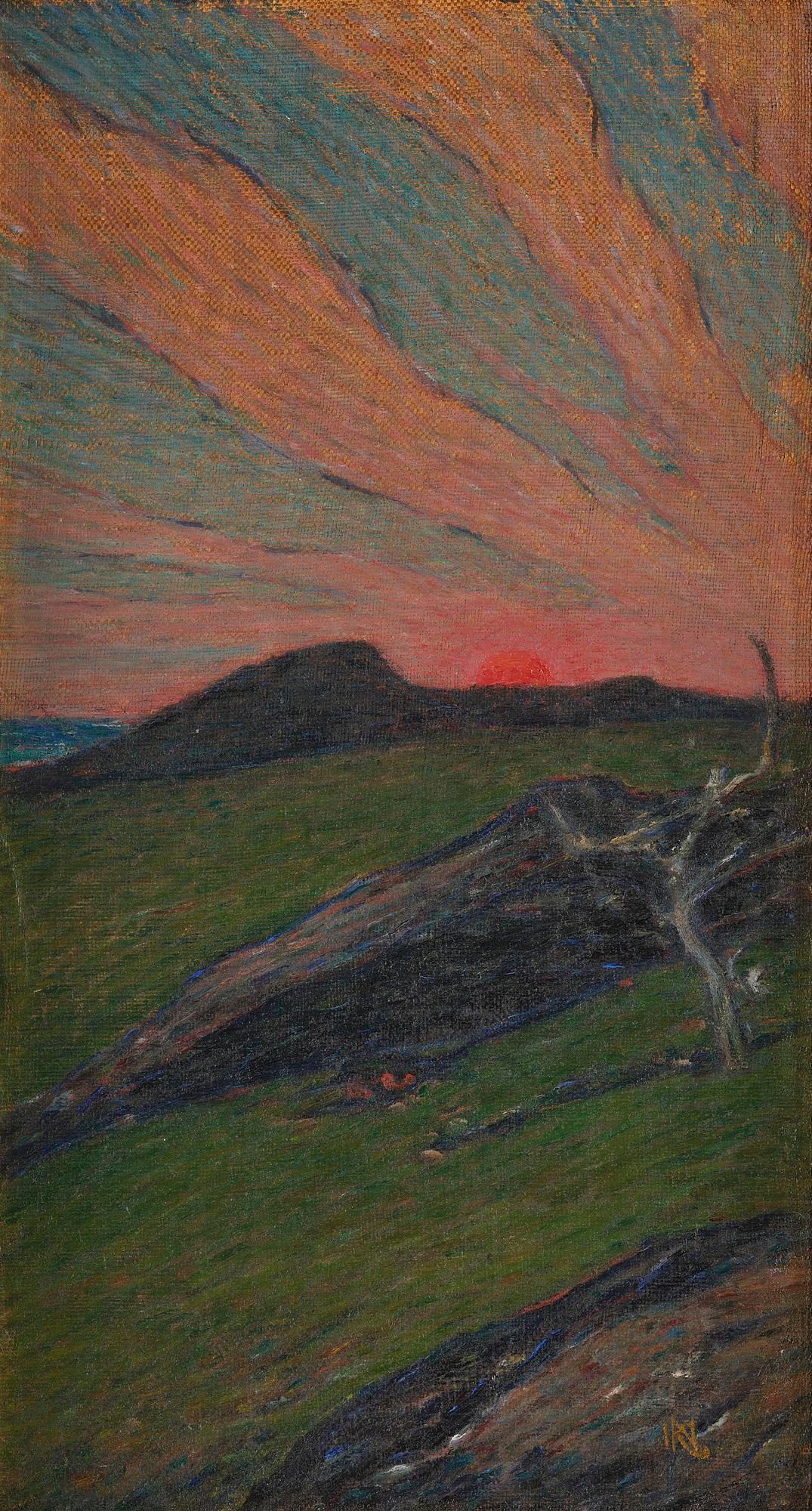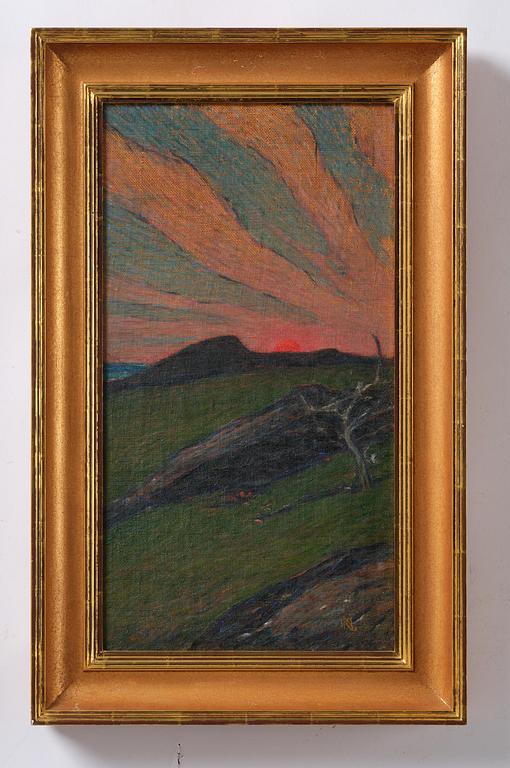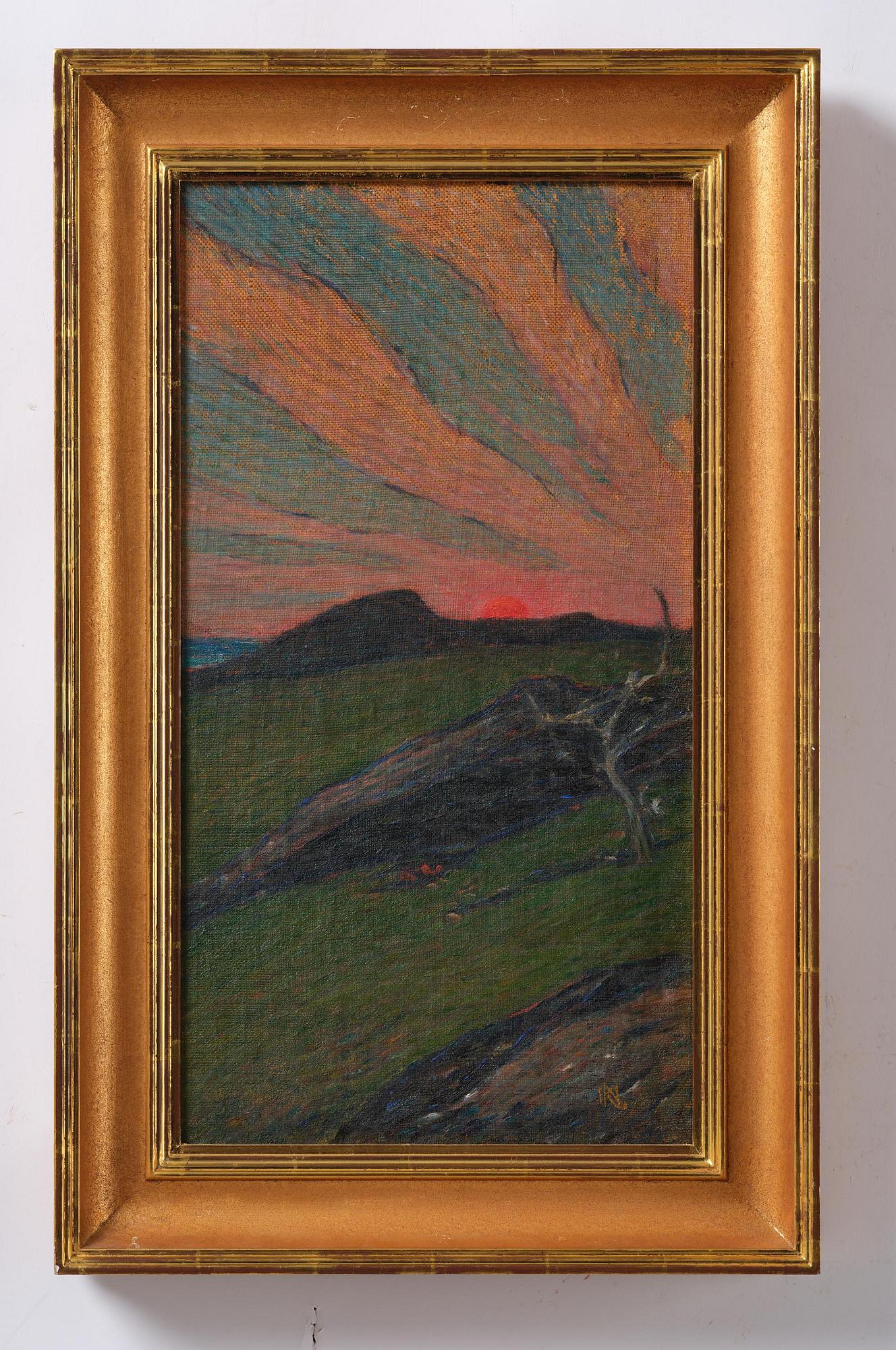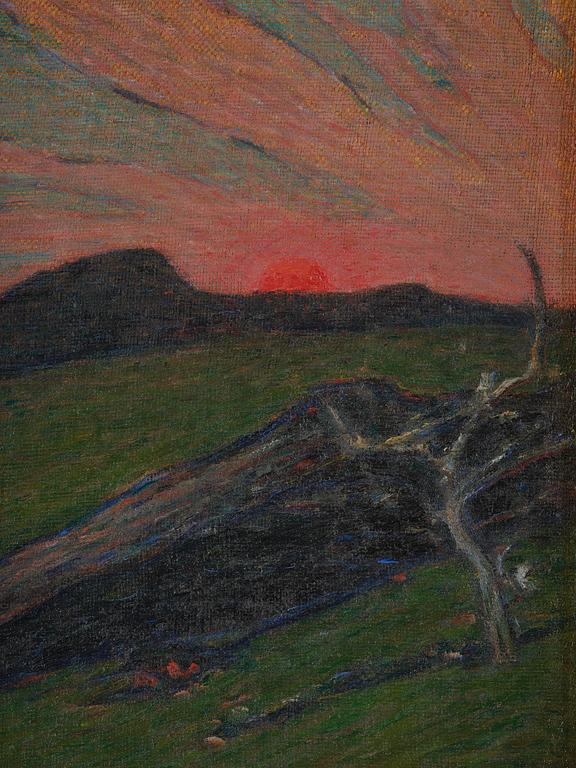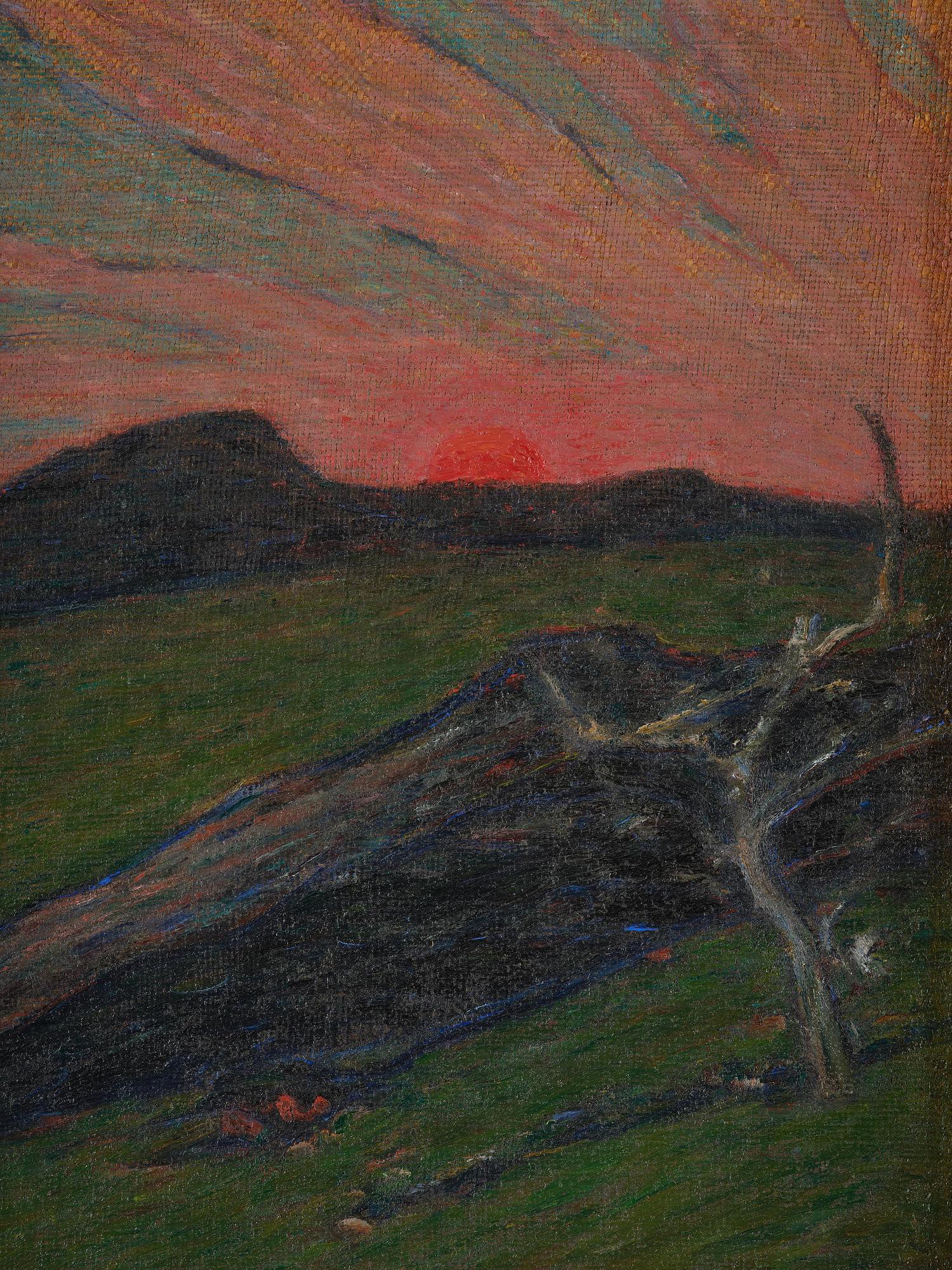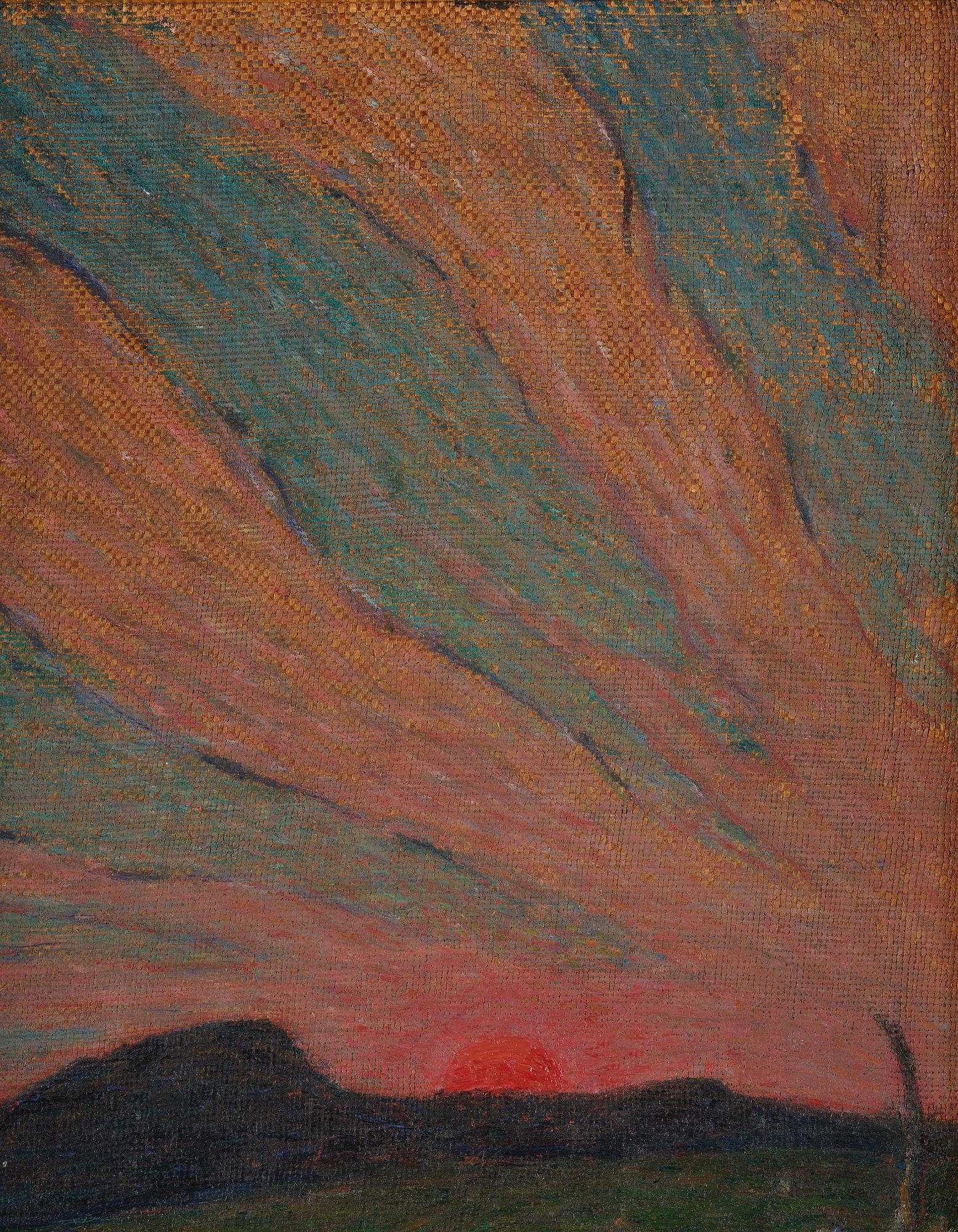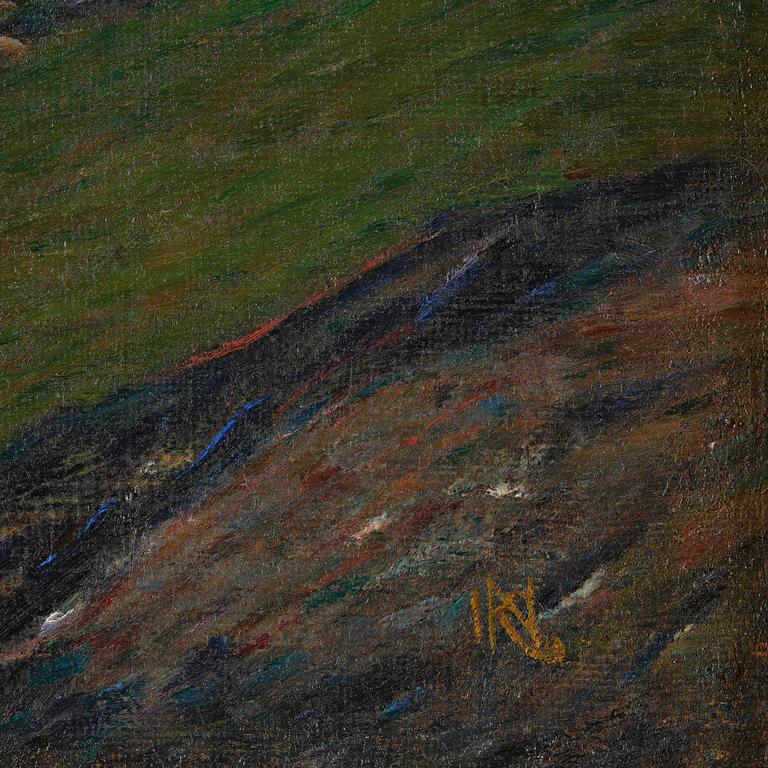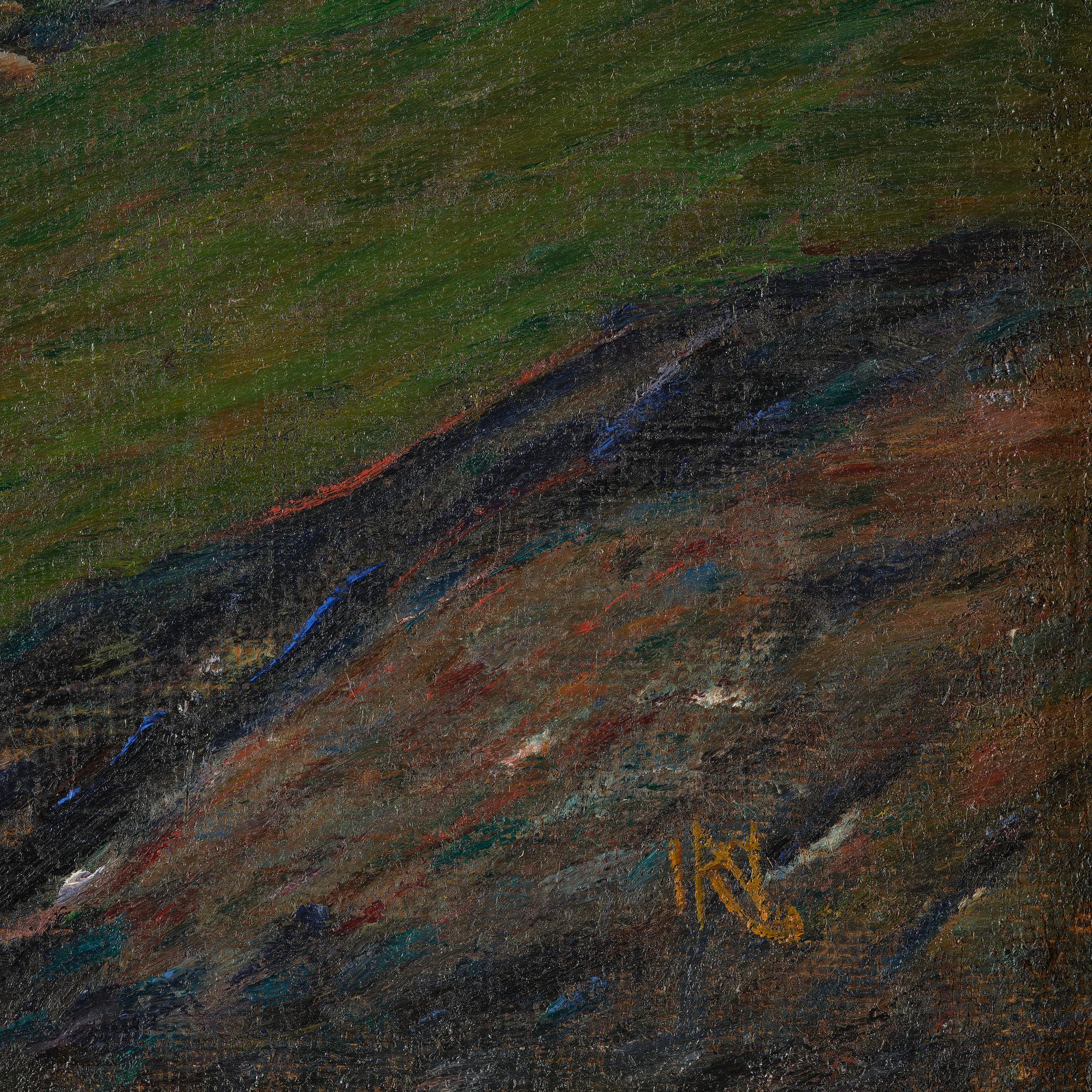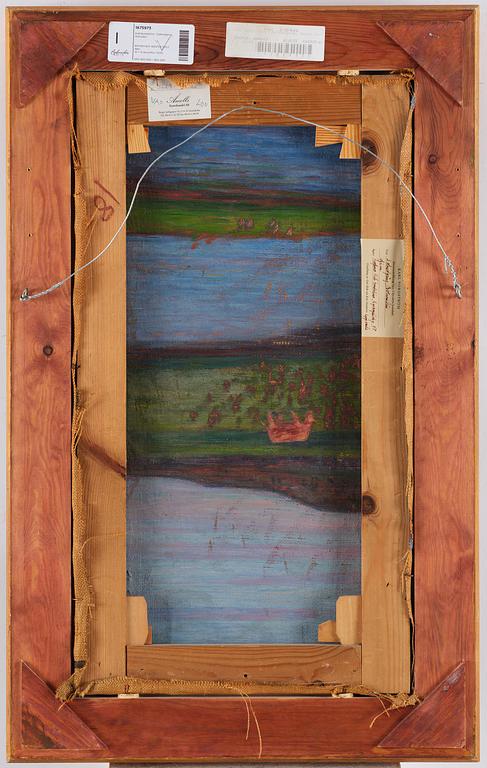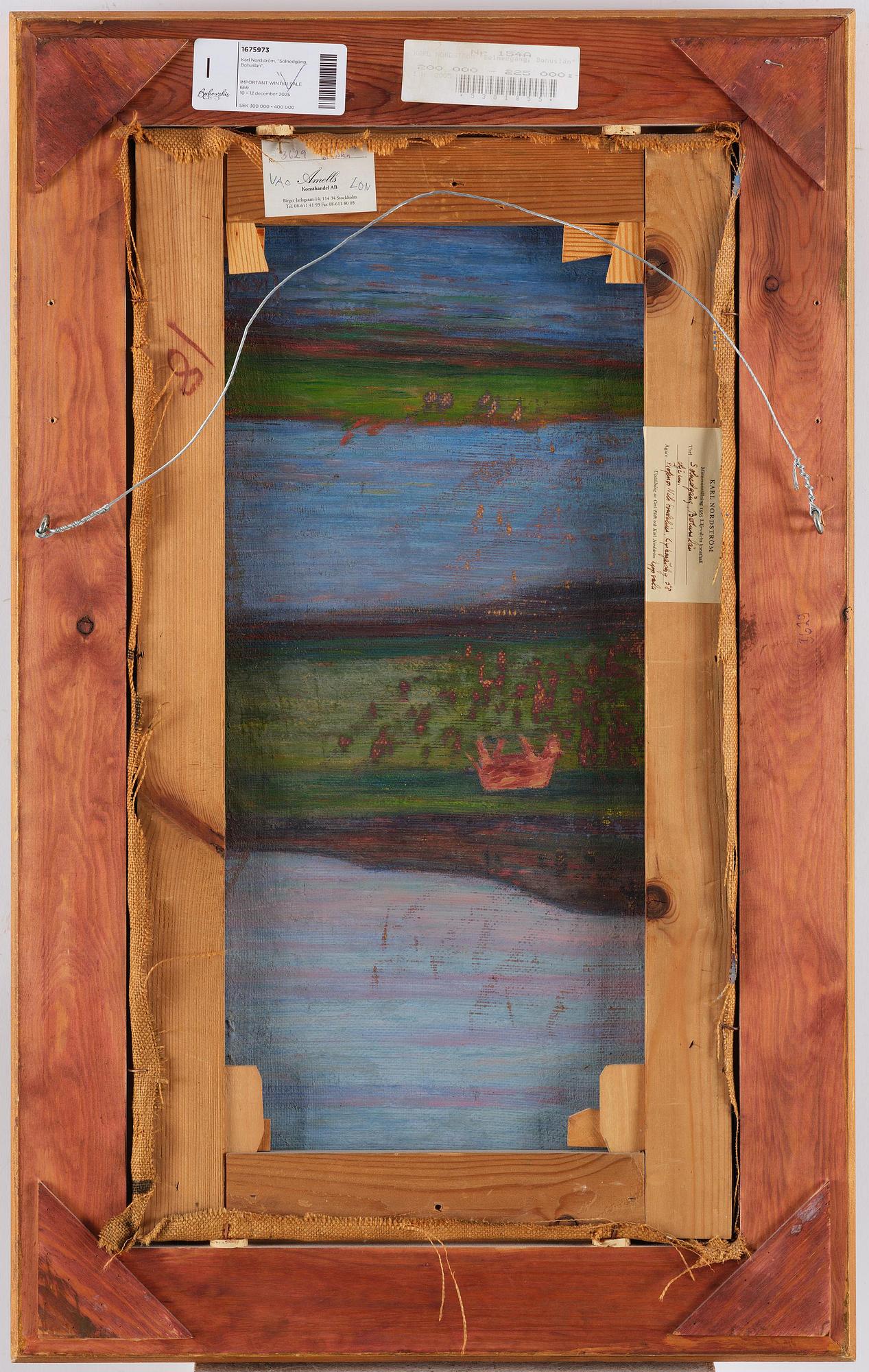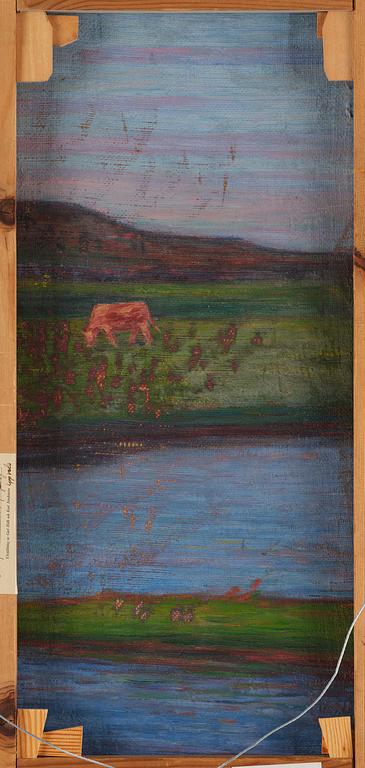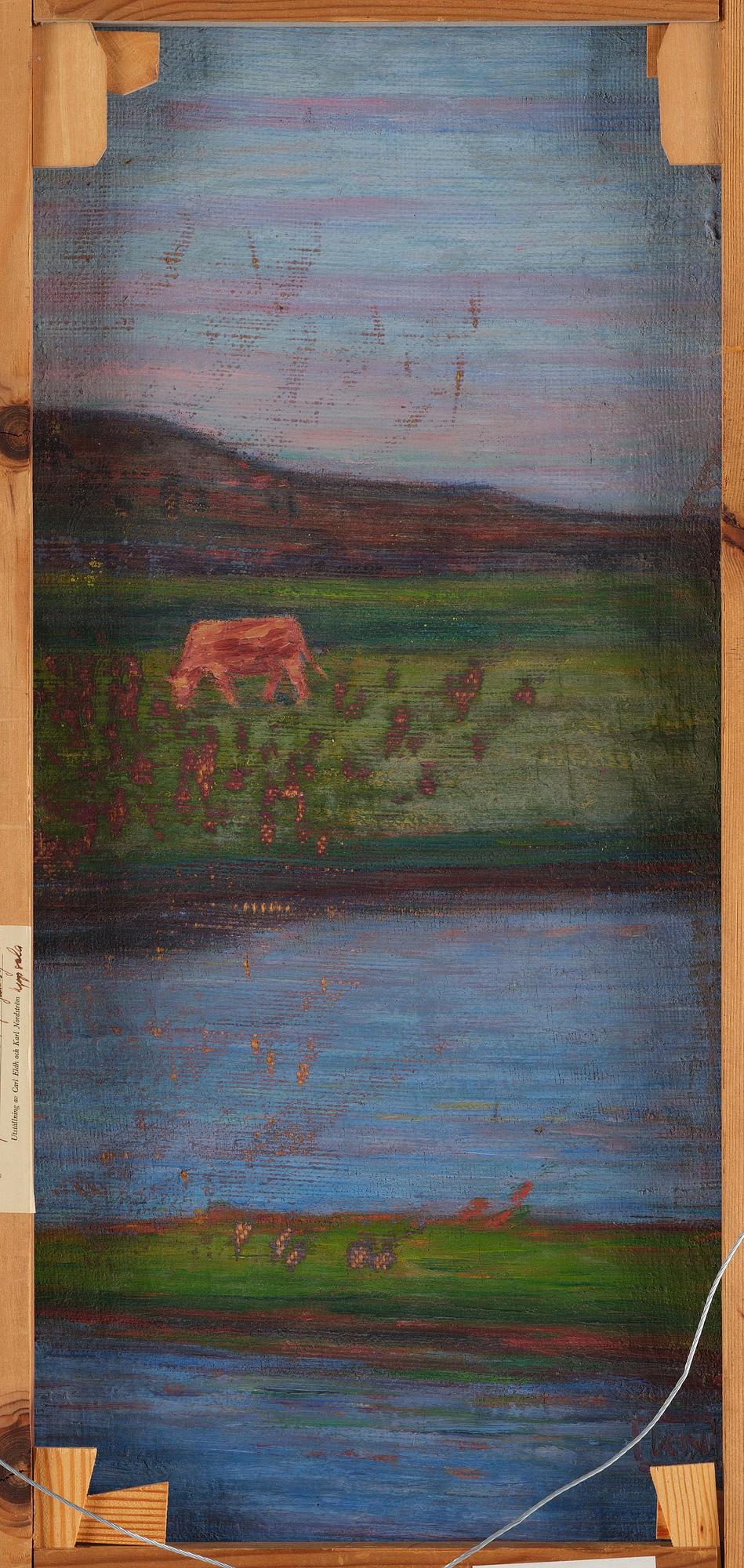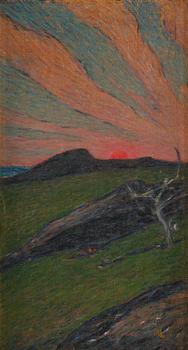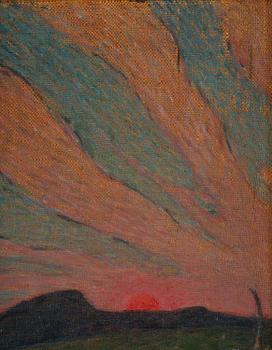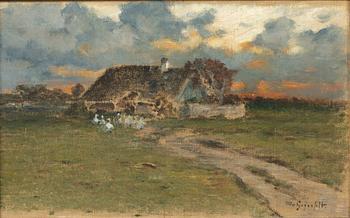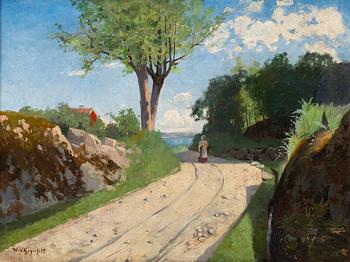
"Sunset, Bohuslän"
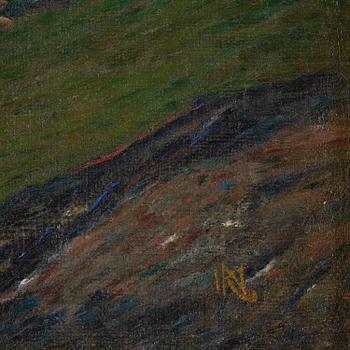
Signed KN. Executed in 1893. Oil on canvas 64.5 x 34.5 cm.
Täydennyslista
Exhibition addition: Prince Eugen's Waldemarsudde, Stockholm, "Karl Nordström", Karl Nordström, 15 February - 25 May 2014, cat. no. 31, listed as executed in 1899.
Alkuperä - Provenienssi
Professor Nils E Svedelius, Uppsala.
Bukowski Auctions, International Spring Auction 520, 29 - 31 May 2001, cat. no. 135.
Bukowski Auctions, International Autumn Auction, 29 November - 2 December 2005, cat. no. 154.
Näyttelyt
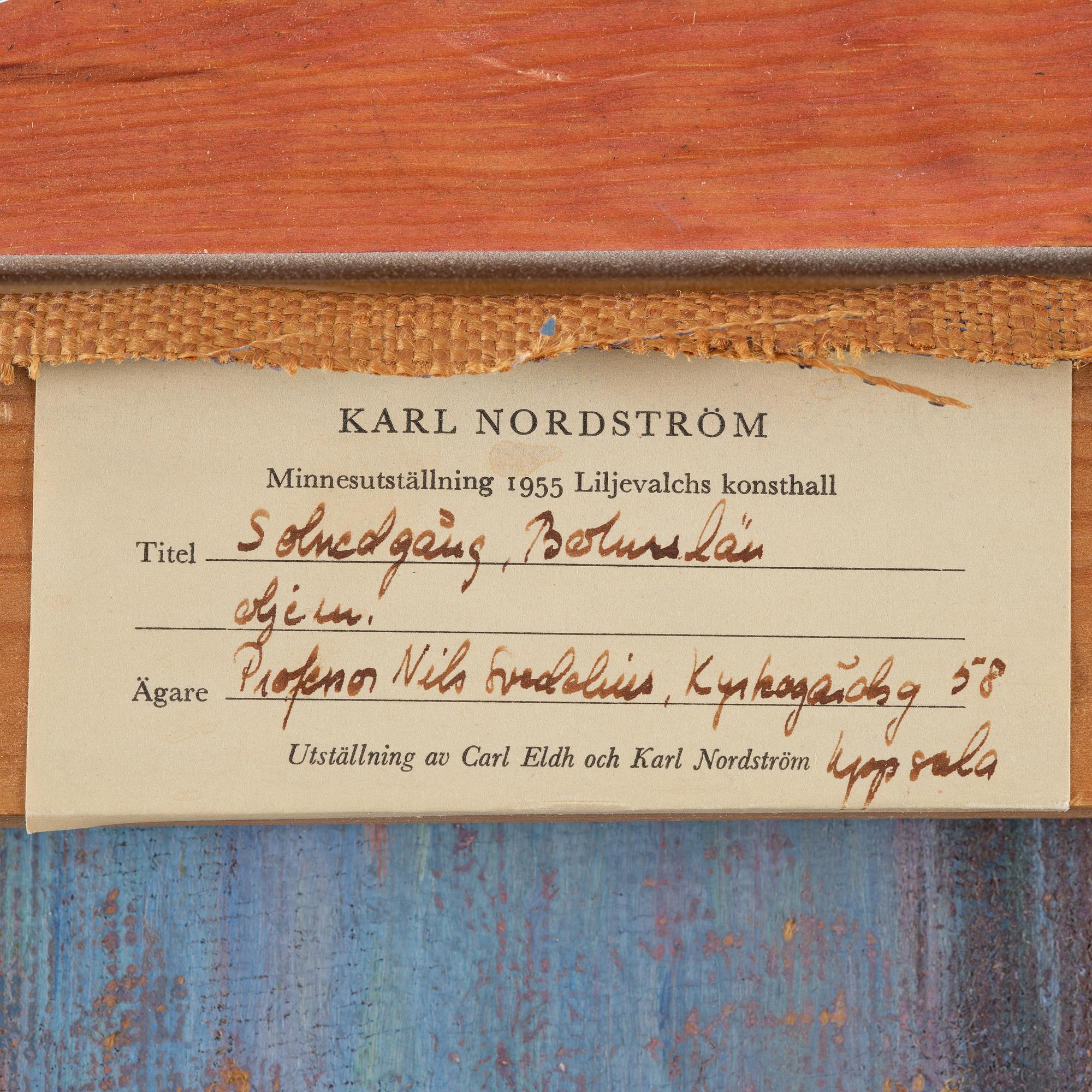
Liljevalchs konsthall, Stockholm, "Karl Nordström, Carl Eldh - Memorial Exhibition", 1955, under the year 1893, cat. no. 73.
Prince Eugen's Waldemarsudde, Stockholm, "Karl Nordström", Karl Nordström, 15 February - 25 May 2014, cat. no. 31, listed as executed in 1899.
Muut tiedot
In "Sunset, Bohuslän," we can clearly see the stylistic development Karl Nordström underwent in the 1880s and early 1890s towards a, in his own words, "symbolist-synthetic" style that was said to be so innovative in Sweden that even the great art patron Pontus Fürstenberg reportedly needed several days to recover. As a young artist in the 1880s, Nordström was influenced by French plein air painting. He was one of the first Swedish artists to be genuinely captivated by the delicate French light that rested over the regions around the village of Grez-sur-Loing. The year before, in January 1881, he had arrived in the city that was then considered the source of art: Paris. Here, he created perhaps his first significant painting, "Garden at Buttes Montmartre" (oil on canvas, 81 x 65 cm, private collection) – a Parisian spring atmosphere, captured in a sensitive study of grey tones, with all details meticulously rendered. But it was here in Grez that Nordström devoted himself to a truly in-depth and inspired study of nature. Nordström arrived in April 1882 and immediately found numerous enticing motifs; everything here seemed to be directly created for a painter.
In 1886, Nordström returned to his parental home in Tjörn in Bohuslän with his wife Tekla. He now applied his learnings from France to the Swedish landscape, which initially proved to be no easy task. Nordström writes: "One does not transfer a technique, born on French soil, to Swedish ground without effort and struggle, nor does one apply it there immediately with the desired success."
After having two children, Karl and Tekla moved to Stockholm in 1889, where they settled in the so-called "Yellow House" in the Skansen area, which had not yet become an open-air museum. Here followed several years of poverty for the family, as they scraped by on the sale of Tekla's wood engravings. During these years, Karl developed a mood painting style and produced several views of Stockholm shrouded in the Nordic twilight. It was during these years in the early 1890s that the national romantic and symbolist movements left their mark on Sweden's art scene. Landscape painting became not only a depiction of nature but also a reflection of the human inner self.
In 1892, Nordström began to seek new paths in his artistic expression. During a trip to Copenhagen, he had the opportunity to study works by Paul Gauguin and Vincent van Gogh, and he was noticeably influenced. Fellow artists Richard Bergh and Nils Kreuger also engaged with the works, and together they decided, along with Nordström, to form what became known as the Varberg School. The painting now drew inspiration from decorative synthetism with interconnected fields of colour. Unlike other artist colonies at this time, this one was closed from the start, as the three artists felt that no more members were needed. Nordström writes: "The colony is now full – Fürstenberg and Hasselberg were down here and looked at our symbolist-synthetic paintings some time ago and were both so startled that they probably needed several days to recover."
Lisätietoja ja kuntoraportit
Tietoa ostamisesta