Modern Art & Design presents Gösta Adrian-Nilsson | May 20–22
Composition
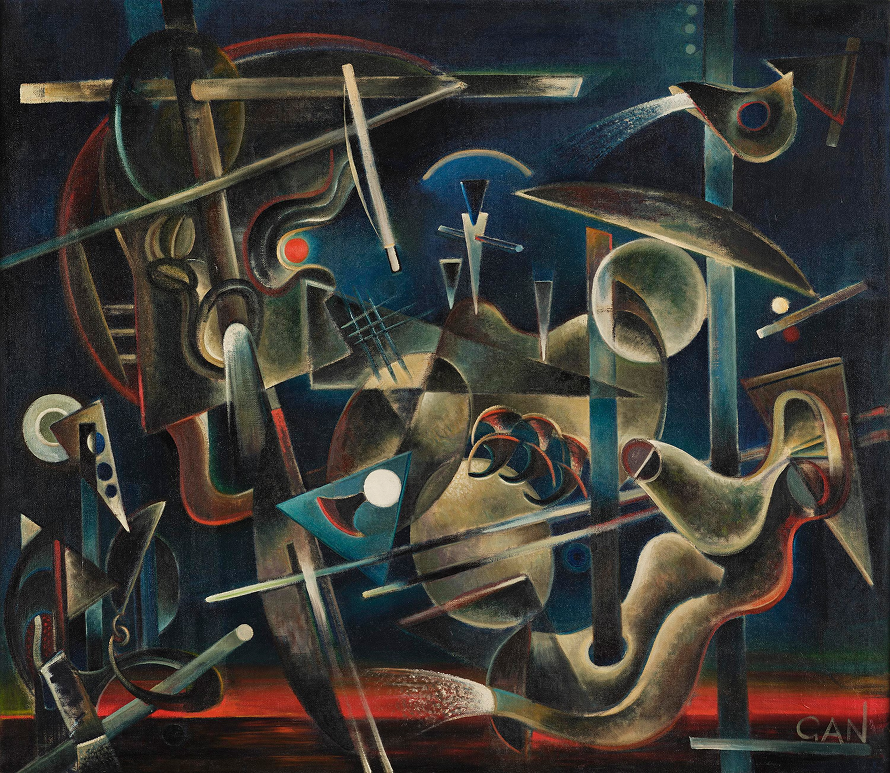
Gösta Adrian-Nilsson (GAN) was one of the few Swedish artists to study in Berlin before the outbreak of the First World War. In cosmopolitan Berlin, he encountered Italian Futurism, French Cubism and Russian Expressionism for the first time.
GAN had the opportunity to study contemporary European art at first hand, and he quickly adopted the formal principles of Cubism. After a stay in Cologne in connection with the Werkbund Exhibition, he returned to Lund in August 1914. Artistically renewed, he then embarked on a determined effort to develop his own artistic practice. Towards the end of the decade, GAN’s kaleidoscopic Cubism evolved into more cohesive forms, and after coming into contact with Fernand Léger in Paris, his orientation towards Synthetic Cubism was further strengthened. Among his contemporaries in Sweden, GAN lacked kindred spirits and is therefore regarded as a pioneer of modern Swedish art.
During the 1930s, when the monumental work in this auction was executed, Gösta Adrian-Nilsson lived periodically in Stockholm, Copenhagen and Lund, working intensively with painting, drawing and writing. Artistically, he moved towards a more poetic visual language, combining impulses from Cubism and Futurism with an increasingly free and expressive use of colour.
The painting in this auction is an excellent example of how GAN continually developed his artistic practice. He employs overlapping forms and simultaneous perspectives—a theme that relates both to the language of film and to the era’s fascination with modern technology and movement. The monumental composition offers multiple viewpoints, and as a viewer you discover new elements and details that become ever more compelling the longer you contemplate the work.
Estimate: 1 000 000 - 1 200 000 SEK
Weekdays 11 AM – 6 PM
Weekends 11 AM – 4 PM
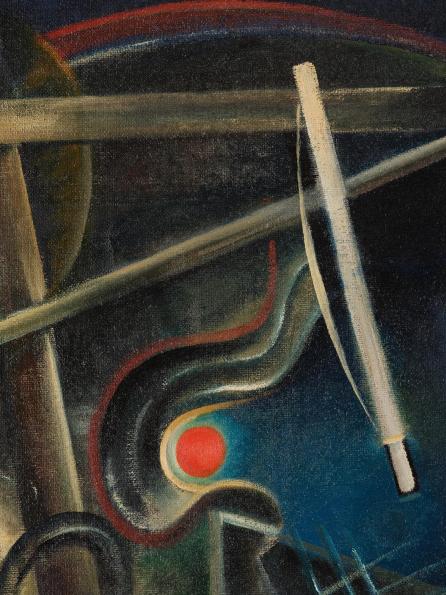
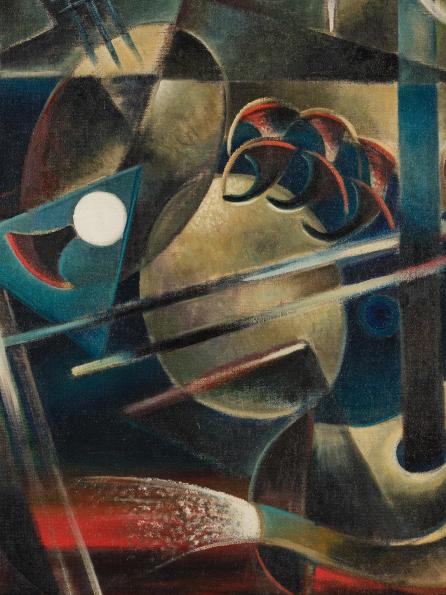
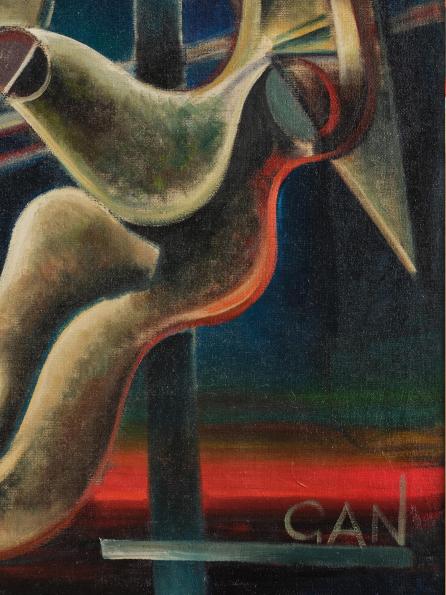
“The favourable reviews from the exhibitions in Stockholm and Gothenburg eventually brought GAN a level of recognition that extended beyond his immediate circle of admirers. He was better able to provide for his family, and he could afford to purchase new, unused canvases from the frame-maker, no longer having to laboriously clean and prepare ones previously used by others. After the Art Concret exhibition in 1930, he moved to Stockholm to be closer to the centre of events. High up on the Söder heights, at Bastugatan, he created a home for himself, where he has lived ever since. The view over the whole of Stockholm is magnificent, but he has never painted it, apart from a few chimney hoods outside the window, which for a time strongly captured his interest.” (Nils Lundgren, the present work illustrated in black and white on p. 183 from the artist’s studio at Bastugatan 25.)
Today, GAN’s oeuvre clearly appears as something that resists conventional categorisation and can only be understood on its own terms. The museum director Jan-Torsten Ahlstrand has rightly called him “the modernist pioneer from Lund”.
GAN’s confidence in the future, despite recurring setbacks, is expressed in the closing lines of his preface: “For if a new beauty may be won by breaking an inherited prejudice, then that prejudice must be broken; for such is the law to which recalcitrant humanity in all ages has been compelled to listen and—ultimately—to acknowledge with gratitude as a gift.”
Gösta Adrian-Nilsson at Modern Art & Design
Enquiries and Condition Reports