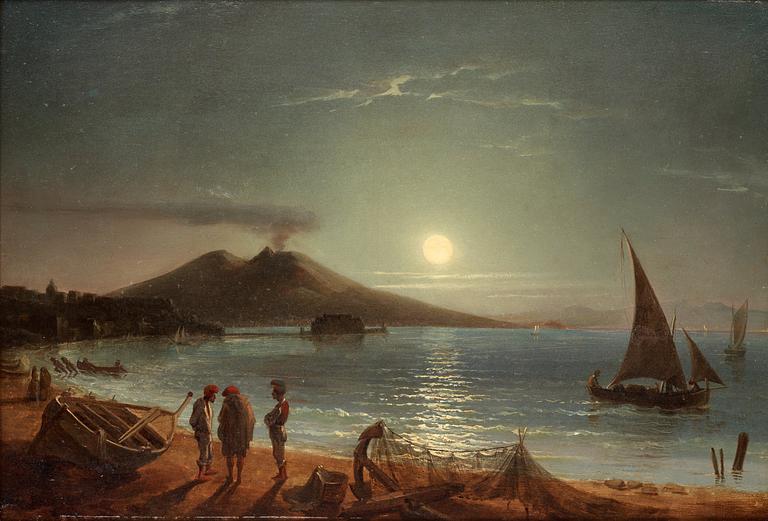
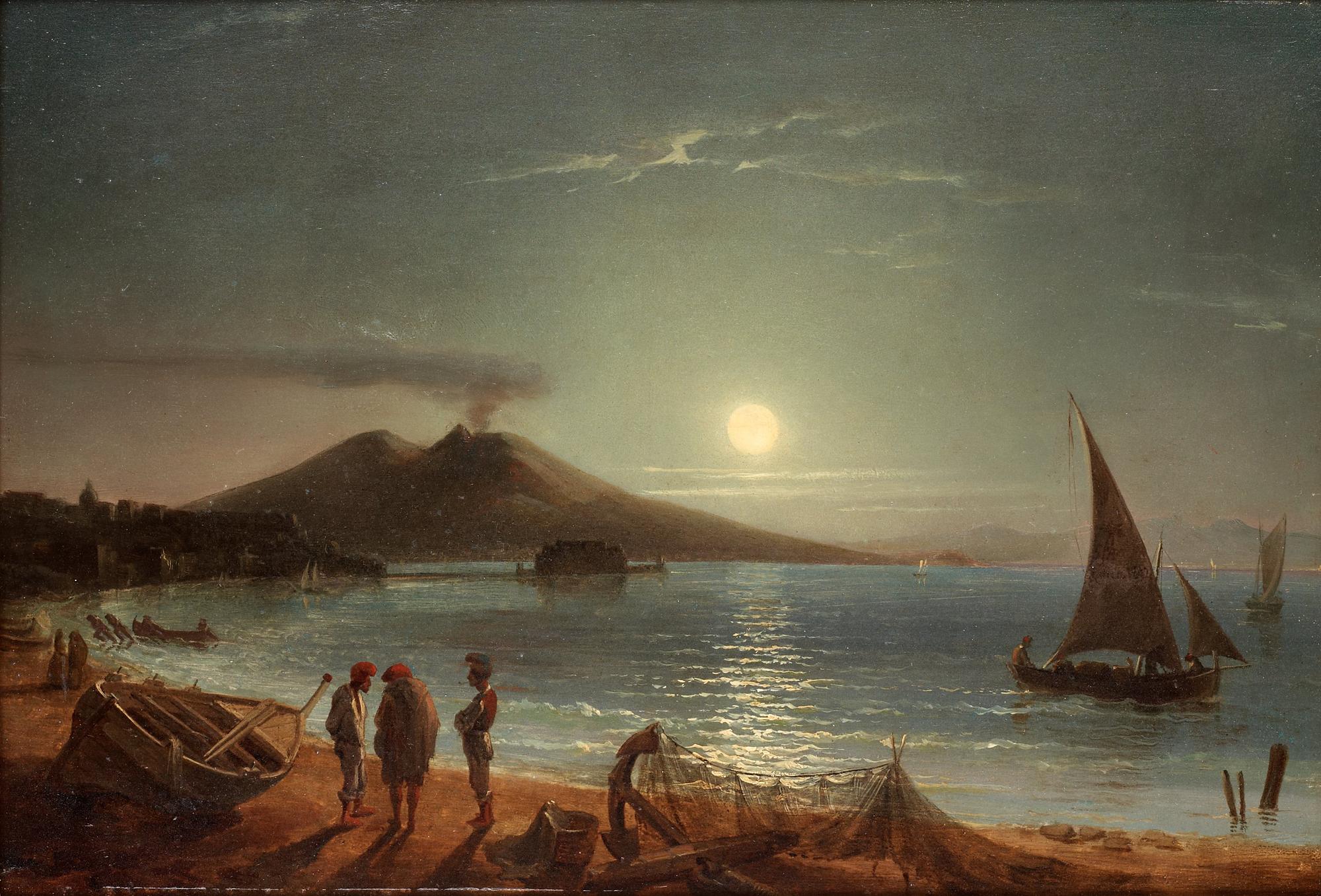
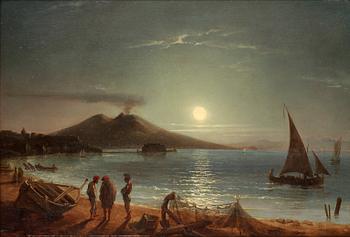
Vesuvius in moonshine
Signed and dated ´G (a palmtree) W Roma 1842´
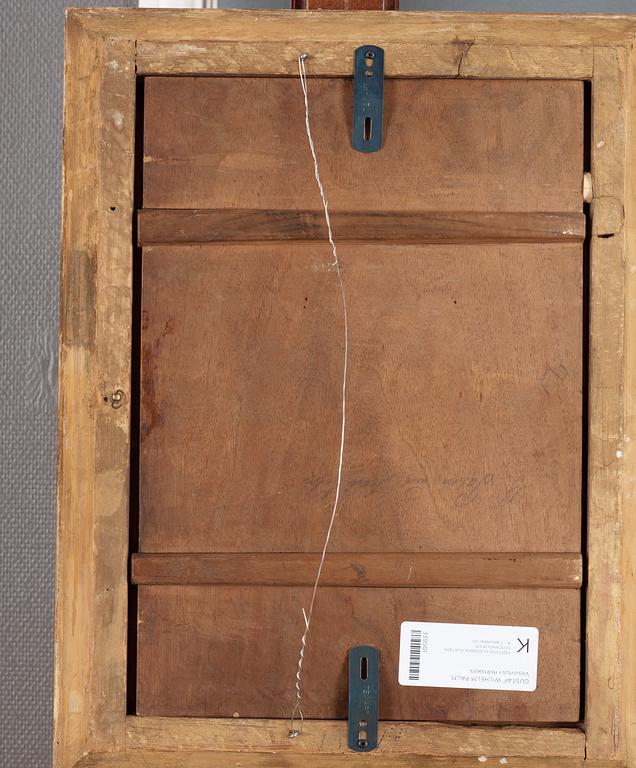
Oil on panel inscribed ´G. Palm aus Stockholm´, in pencil on the reverse 41.5 x 28.5 cm. Period Italian frame.
Exhibitions
Wien, Austrian Academy, 1844, no. 157 as ´Der Vesuf bei Mondbeleuchtung´
Literature
G. Lindgren, Landskapsmålaren G. W. Palm 1810-1890, 1934, p. 132, 246 note 21, 279 under 1844 no. 106
More information
This newly discovered picture is the only known picture by Palm of the pictures he is known to have exhibited at the Austrian Academy in Vienna. Palm had strong links to Vienna where he lived between 22 Augusti 1838 to September 1840. From Vienna he travelled to Italy where he reamained for about 10 years.
The picture show strong influence from the works by the two German romanticist painters Caspar David Friedrich (1774-1840) and Carl Gustaf Carus 1789-1869). Carus executed several pictures from Naples including pictures depicting Naples in moonshine.
Friedrich´s work are imbued with symbolism. As a pupil of Friedrich, Carus was surely aware of this. In Friedrich´s work basic decorative or naturalistic elements have strong Christian religious connotations. An anchor for example, symbolize hope and faith, and a barrier of fishing nets set out on poles, the difference between earthly life and heavenly life beyond. A fullmoon is a symbol of the presence of Christ. Boats on the sea symbolise mans transient passage through life and boats on the shore, the end of life. A foreboding mountain peak beyond a valley or the sea is a device frequently adopted to suggests the gulf between life and death, between the now and the hereafter (see Colin J. Billey, Religious symbolism in Caspar David Friedrich. in Bulletin of the John Rylands University library,).
In Palm´s picture, however, the incorporation of similar elements, is probably coincidental, and simply only served a decorative purpose. Palm most certainly must have been acquainted with Friedrich´s work already during his stay in Berlin between October 1837 and July 1838, where he moved in the circles of Karl Friedrich Schinkel (1781-1841) and Johan Christian Dahl (1788-1841), the latter a close friend of Friedrich (Lindgren, op. cit, pp. 47-48). From what we know of Palm as a person, however, there are no reasons to believe that he - in line with Friedrich and Carus – would have intended a symbolic reading of his work.
For condition report contact specialist