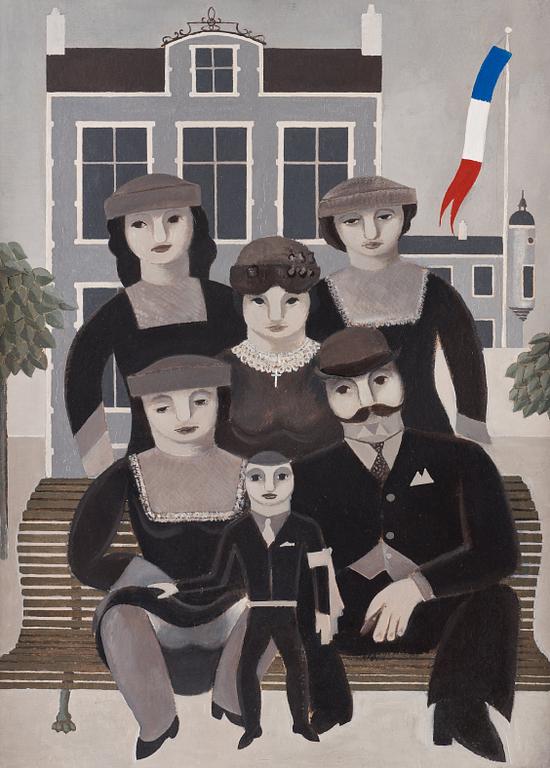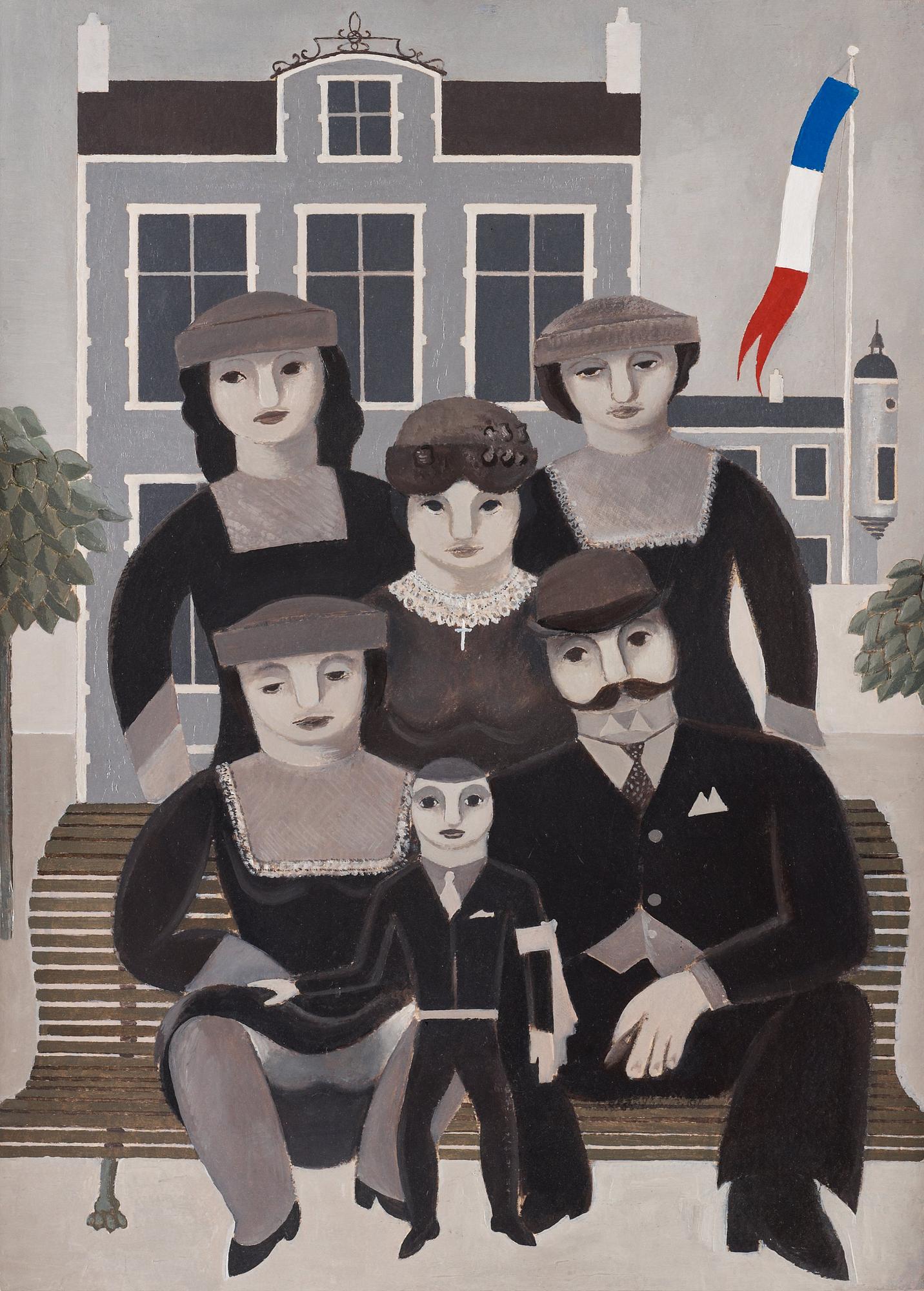
"Den lycklige familjen I"
Executed in 1929. Paper glued on panel 68 x 49 cm.
Provenance
Nordén Auktioner, Stockholm, auction no 3, November 24, 1992, cat no 107.
Exhibitions
Oscar Reutersvärd, "Otto G Carlsund", 1988, avbildad sid 136.
Literature
Oscar Reutersvärd, "Otto G Carlsund i fjärrperspektiv", 1988, avbildad i färg sid 136: "I denna gruppbild, utförd i Paris våren 1929, demonstrerar Carlsund sin suveräna stilkänsla och tecknarförmåga. Scenen återger den lille konfirmanden på sin stora dag uppställd i centrum och omgiven av föräldrar och systrar".
More about Otto G Carlsund
Otto G Carlsund was a Swedish painter, theorist and critic. Whilst in Paris in 1924, he formed a friendship with Fernand Léger, Ozenfant and Piet Mondrian and became the representative of Swedish synthetic cubism, purism, and neoplasticism. It was between the years of 1932 – 45 when Carlsund was the most active as a critic, but rediscovered his passion for nonfigurative painting in his last years. His paintings were often intended as preliminary studies for wall paintings. In 1929, he co-founded the group Art Concret in Paris with van Doesburg and Hélion, publishing its manifesto.
Read moreCovered by droit de suite