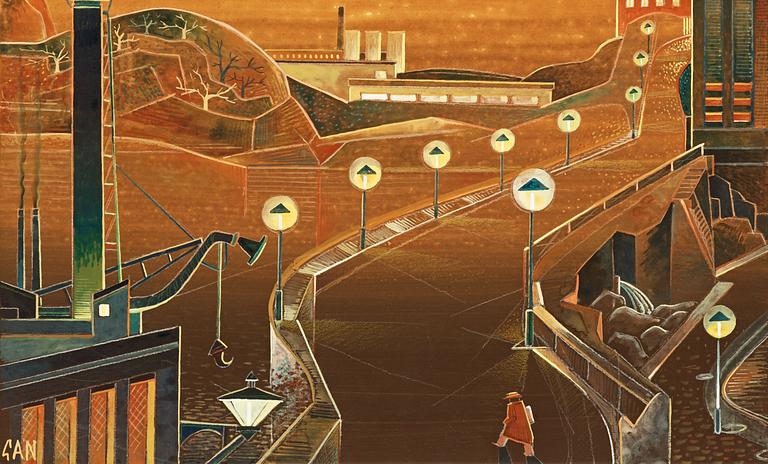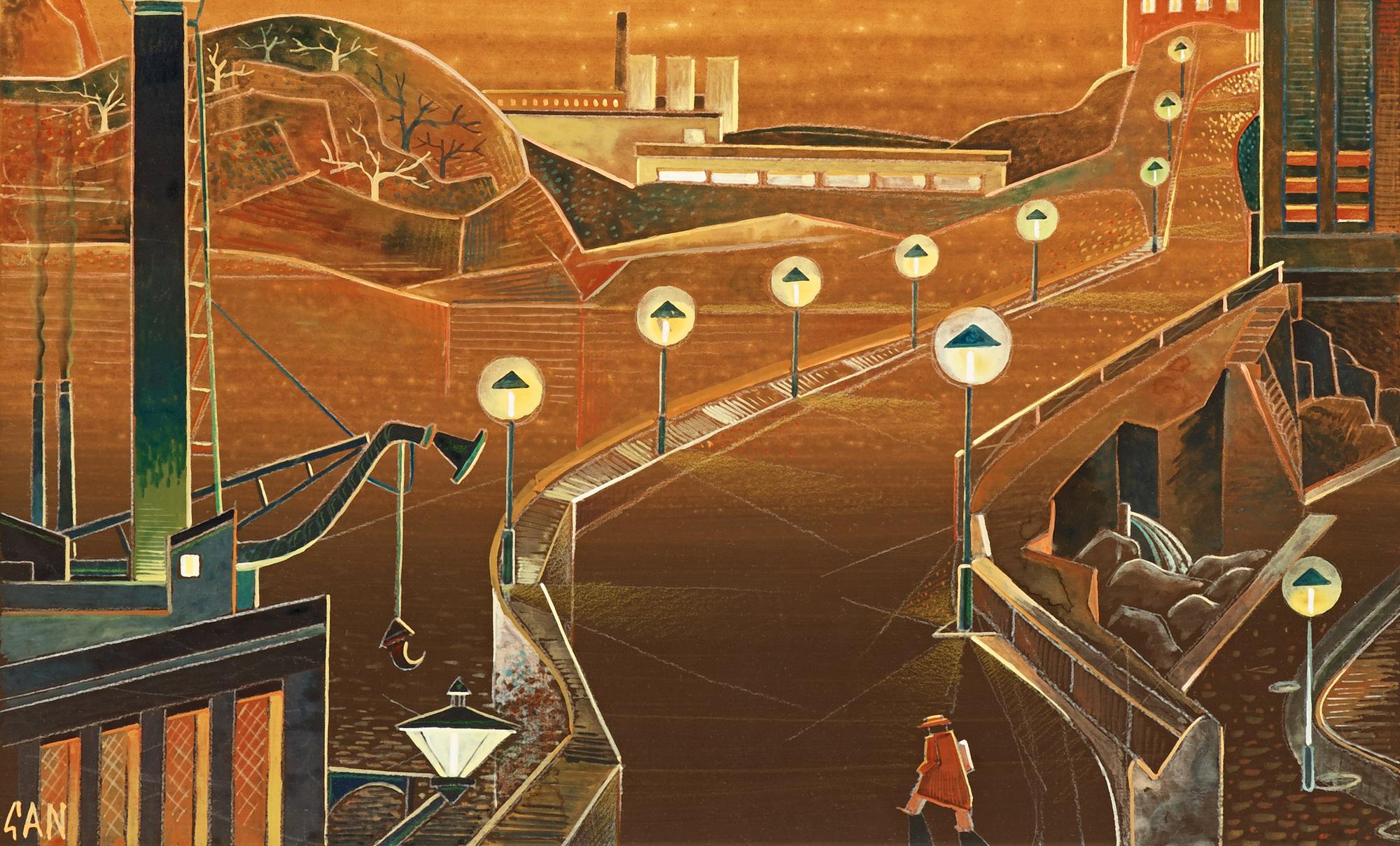
"Uppfartsväg"
Signed GAN. Mixed media 27 x 45 cm.
Provenance
Bukowski Auktioner, Stockholm, Sale 529, "Bukowskis Moderna + Contemporary & Design", 4 Nov 2003, lot 147 (under the title Gatlyktor).
Private collection.
More about Gösta Adrian-Nilsson
Gösta Adrian-Nilsson is most notable as a visual artist, and he is a pioneer of Swedish modernism. He studied at the Tekniske Selskabs Skole in Copenhagen and later for Johan Rohde at Zahrtmann’s school in Copenhagen. As an avant-gardist, Nilsson was constantly searching for new influences. In Berlin, he was influenced by the circle around the radical magazine Der Sturm, through Kandinsky and och Franz Marc. In Paris through Fernand Legér and the artists in his circle. GAN was an eclectic in the positive sense of the word. He took the the artist styles of the 1900s and created new impressions. Symbolism, cubism, futurism, expressionism, constructivim and Theosophy were the colours occupying his internal pallet. He had a sharp eye for the masculine and his painting was often energized by the vitality of modern technology, vibrant eroticism, and echoes of tyrants. No other Swedish modern artist exhibits such a unique style.
Read moreCovered by droit de suite
Image rights
The artworks in this database are protected by copyright and may not be reproduced without the permission of the rights holders. The artworks are reproduced in this database with a license from Bildupphovsrätt.