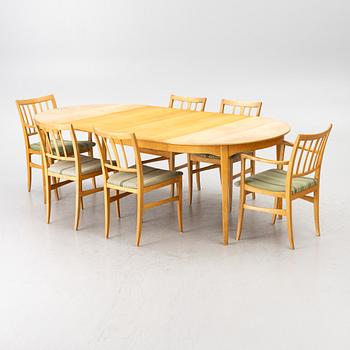
A Swedish Grace dining table, 1920s.
Oval form on curved legs, black lacquered. Length 176 cm, width 104 cm, height 76 cm. Total length 290 cm including two extension leaves of 38 cm each.
Wear, minor damages and repairs. Later overpainted.
Provenance
Rakel Evelina Gerholm, née Lind (1902-1975), a gift from Uno Åhrén during the first half of the 1920s.
Thence by descent to the present owner.
More information
The dining suite presented in this sale, consisting of a two-part cabinet, a dining table and eight chairs, has a design language that is typical for Åhrén during the first half of the 1920s, and bears similarities to the glossy black furniture designed by him, executed by Gemla and exhibited by David Blomberg at the Gothenburg Exhibition in 1923. Also worth noting is the structure of the upper cabinet in six fields, which recurs in the magnificent intarsia cabinet that was part of Åhrén's ladies' salon at the Paris Exhibition in 1925, today in the collections of Nationalmuseum in Stockholm (NMK 1/2018). Furniture designed by Uno Åhrén and executed during the first half of the 1920s is exceptionally rare, and the present pieces carries a story about a past youthful love that was highly personal to the architect. Read more about Uno Åhrén and the dining suite
Bukowskis wishes to thank Tom Åhrén for valuable insights cataloguing the present lot.
More about Uno Åhrén
Uno Åhrén was a significant Swedish architect and urban planner who graduated from Stockholm's Tekniska Högskolan (Royal Institute of Technology) in 1919 and made his debut with an interior design at the Hemutställningen (the Home Exhibition) exhibition at Liljevalchs in Stockholm 1917. Åhrén, who initially drew inspiration from Neoclassicism and Swedish Grace, subsequently became one of the leading advocates of Functionalism, with a focus on the social aspects of housing. He was one of the earliest designers to collaborate with Estrid Ericson at Firma Svenskt Tenn, where he designed both furniture and more luxurious pewter objects.
From the late 1910s onwards, Åhrén participated in a number of exhibitions, including, in addition to the aforementioned Hemutställningen in 1917, the Gothenburg Exhibition in 1923, the World’s Fair in Paris in 1925, the Stockholm Exhibition in 1930 and the World’s Fair in Chicago in 1933. After 1930, Åhrén devoted himself primarily to urban architecture and town planning, serving, among other positions, as city planning architect in Gothenburg from 1932 to 1943 and as head of Svenska Riksbyggen during the 1940s.
Read moreFor condition report contact specialist

Image rights
The artworks in this database are protected by copyright and may not be reproduced without the permission of the rights holders. The artworks are reproduced in this database with a license from Bildupphovsrätt.


Others have also viewed