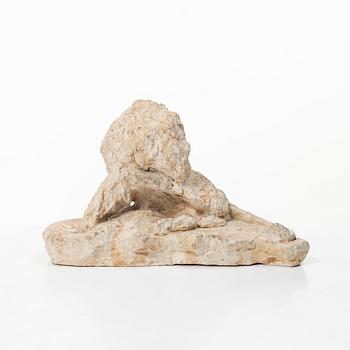
"Reclining Figure Curved: Smooth"
Signed Moore and numbered 2/9. Conceived in 1976. Bronze. Dimensions including metal base: height 12 cm, length 21 cm. Underside marked: R.F. (R) 76. The work is registered with the Henry Moore Foundation, cat. no. LH 688 cast 2.
Provenance
Acquired from Birger Wågberg in Örnsköldsvik in 1978.
Thereafter inherited by the current owner.
Literature
Alan Bowness (ed.), "Henry Moore Complete Sculpture Volume 5". 1974-1980, 1994, another copy illustrated.
More information
Henry Moore "Reclining Figure Curved: Smooth" (1976) is a late work in Henry Moore’s production and a clear example of his continued engagement with the reclining figure, a motif he returned to throughout his entire career. The sculpture is cast in bronze with a dark green patina, signed, and produced in an edition of 9 casts. During the 1970s, Moore worked almost exclusively through models in plaster or clay that were later cast in bronze and individually patinated, meaning that each cast has subtle variations in surface, light, and tone.
The reclining figure was central to Moore’s practice. He himself described this position as the most free of the basic human poses, since it is not dependent on vertical balance or a fixed support in the same way as the standing figure. In this work, the motif has been pushed far towards abstraction. The body is no longer constructed as anatomy, but as a system of interconnected volumes in which proportion, weight, and direction define the form.
The sculpture is built on a clear interplay between mass and void. The pierced openings are not secondary details but essential parts of the composition. They break up the overall structure and allow light to pass through the work, causing the sculpture to change depending on the viewer’s position. From some angles it appears dense and unified, from others more open and fragmented.
This approach to form has its roots in Moore’s early education at the Royal College of Art, as well as in his interest in modernism and earlier sculptural traditions. He drew influence from artists such as Pablo Picasso and Constantin Brancusi, particularly their methods of simplifying and reducing form. At the same time, he was strongly influenced by pre-Columbian sculpture, especially the Chac Mool figure, in which the reclining body functions as a stable yet symbolically charged form. Nature was also a constant reference point - especially stones, bones, and the soft forms of landscapes.
From the 1950s onward, bronze became Moore’s primary material. It allowed him to work on a larger scale and to produce works in editions, which contributed to the wide distribution of his sculptures in public spaces around the world. His international breakthrough came after the exhibition at the Museum of Modern Art in 1946, and he was awarded the International Sculpture Prize at the Venice Biennale in 1948. Today, his work is represented in major collections such as the Tate, the Guggenheim Museum, and the Art Gallery of Ontario.
"Reclining Figure Curved: Smooth" can be seen as a concentration of this entire artistic practice. The form is reduced to a few fundamental principles: balance between mass and void, between open and closed, between body and space. The sculpture does not depict a body in the traditional sense, but instead explores how a figure can be transformed into an autonomous form in space - a form that continuously changes in relation to light, surroundings, and the viewer.
More about Henry Moore
Henry Moore (1898-1986) was a prominent British sculptor and artist who played a crucial role in the development of modern sculpture. His contributions to the art world are exceptional, and his works have had a lasting impact on art history.
Henry Moore was born in Castleford, Yorkshire, and showed an early passion for art. After serving in World War I, he studied at the Leeds School of Art and later at the Royal College of Art in London. It was here that he began exploring forms and materials that would define his artistic career.
Moore was strongly influenced by artists such as Pablo Picasso and Constantin Brancusi. He was also interested in non-Western art and sculpture traditions, particularly African and Oceanic art. These influences shaped Moore's unique style and his interest in exploring abstract forms and the representation of the human body.
One of the most prominent features of Moore's work is his fascination with the human figure. He experimented with abstracting and distorting the body to create sculptures that express a sense of movement, balance, and harmony. His sculptures often display rounded and organic forms, drawn from nature and the landscape around him.
Moore used a range of materials for his works, including stone, bronze, and wood. He was skilled at harnessing the properties of these materials, giving them a sense of life and movement. His sculptures often have a monumental scale and a presence that impacts the surrounding environment.
Throughout his career, Henry Moore also created many public artworks and monuments around the world. His works can be found in parks, museums, and urban environments worldwide, becoming icons of modern art. One example is his famous sculpture "Reclining Figure" (1951) located in The Art Institute of Chicago. This work has become a symbol of Moore's style and his contribution to the world of sculpture.
Henry Moore's influence extends far beyond his own work. He taught at several art institutions, inspiring an entire generation of young artists. His vision that sculpture can be both abstract and emotionally powerful continues to influence the art world.
Read moreFor condition report contact specialist
Covered by droit de suite
Image rights
The artworks in this database are protected by copyright and may not be reproduced without the permission of the rights holders. The artworks are reproduced in this database with a license from Bildupphovsrätt.