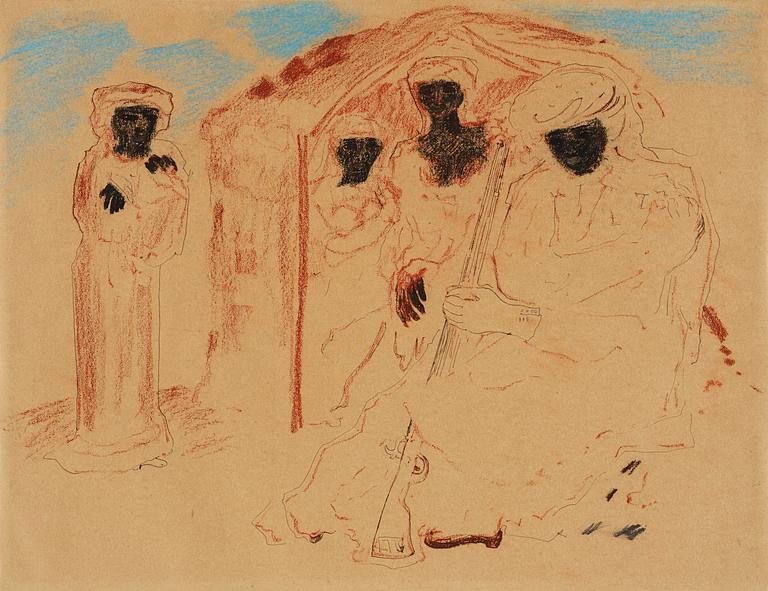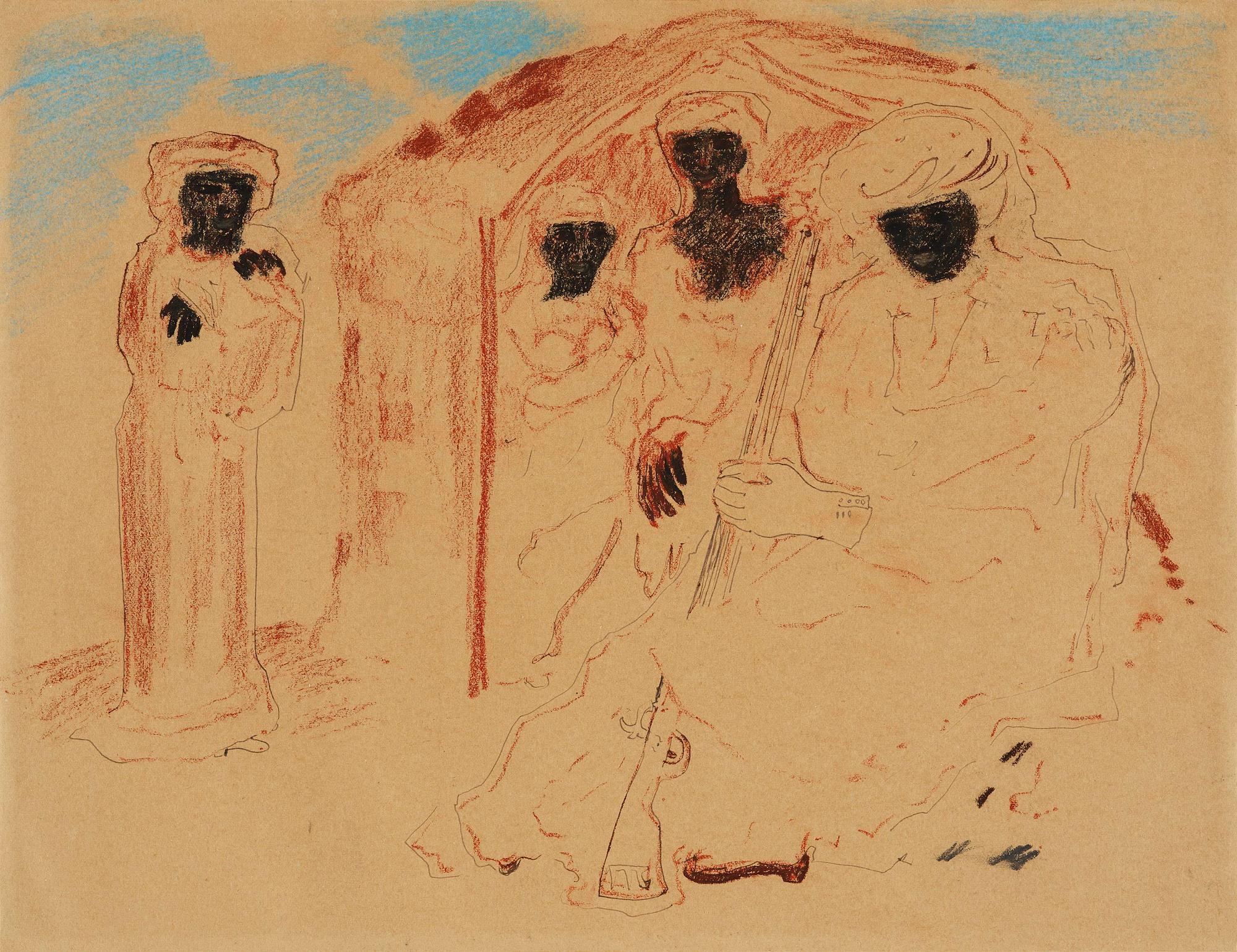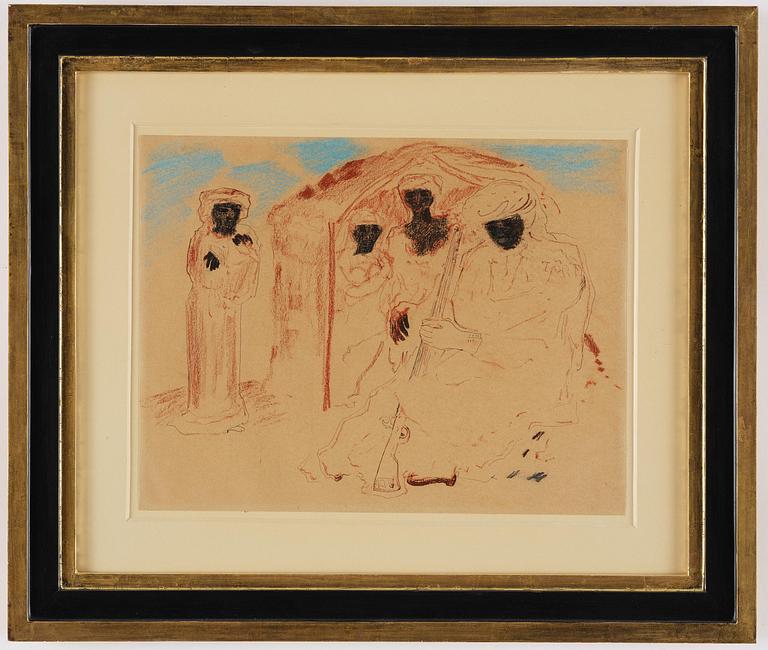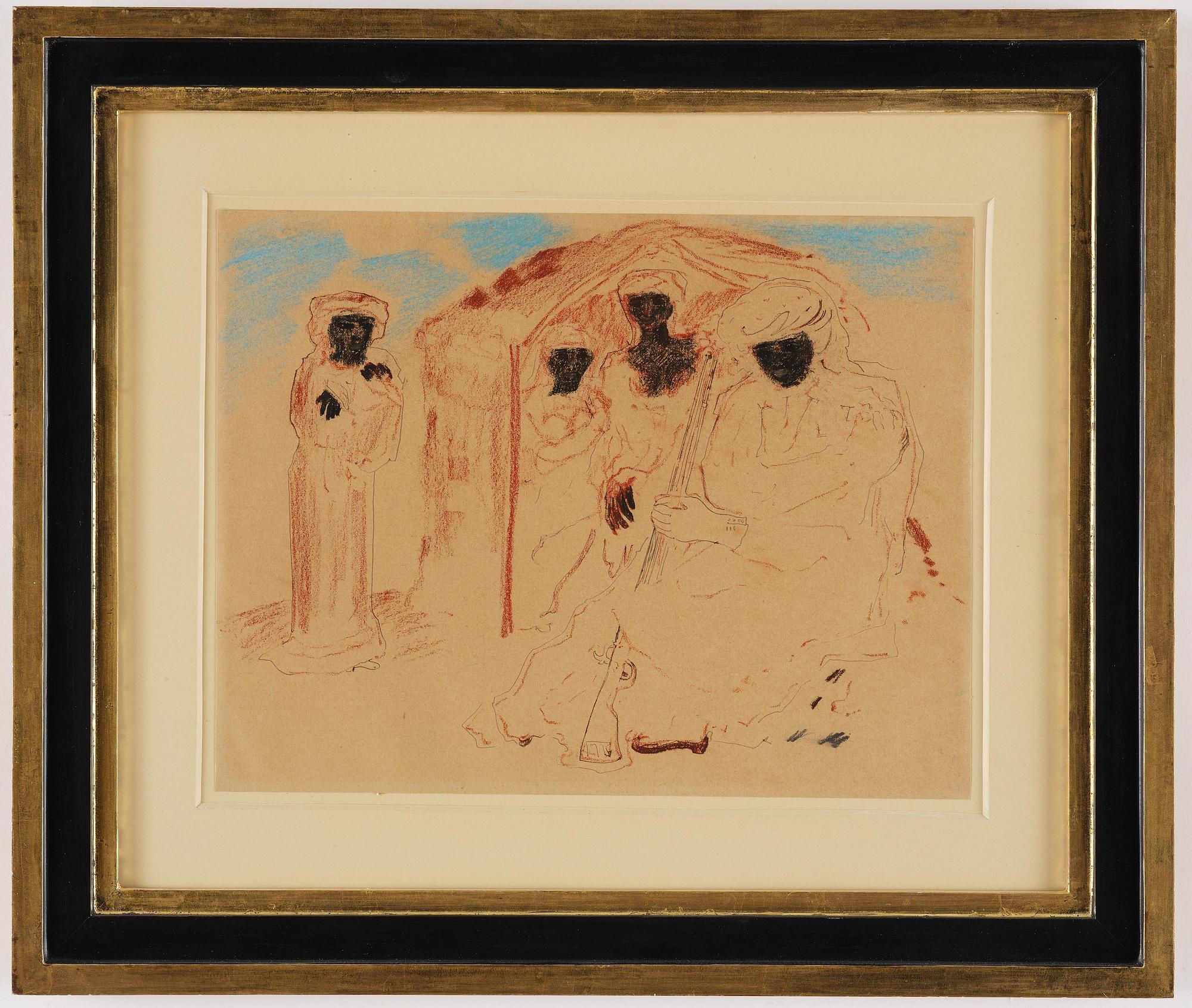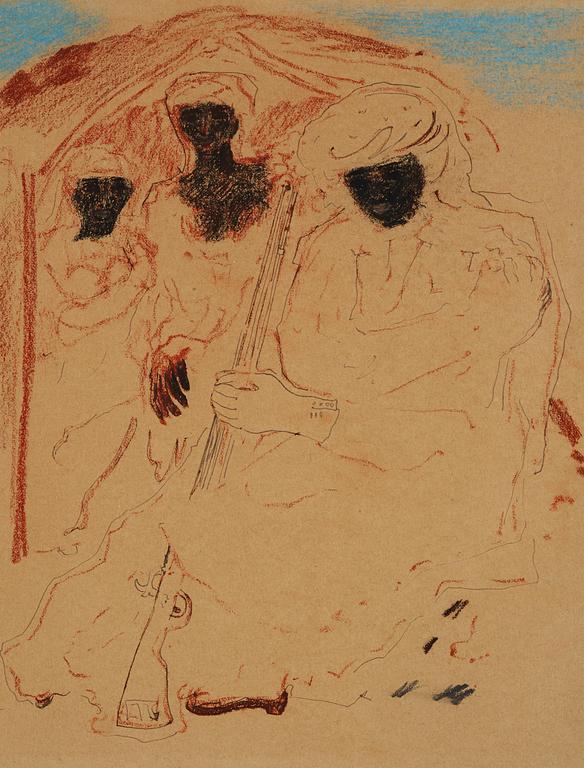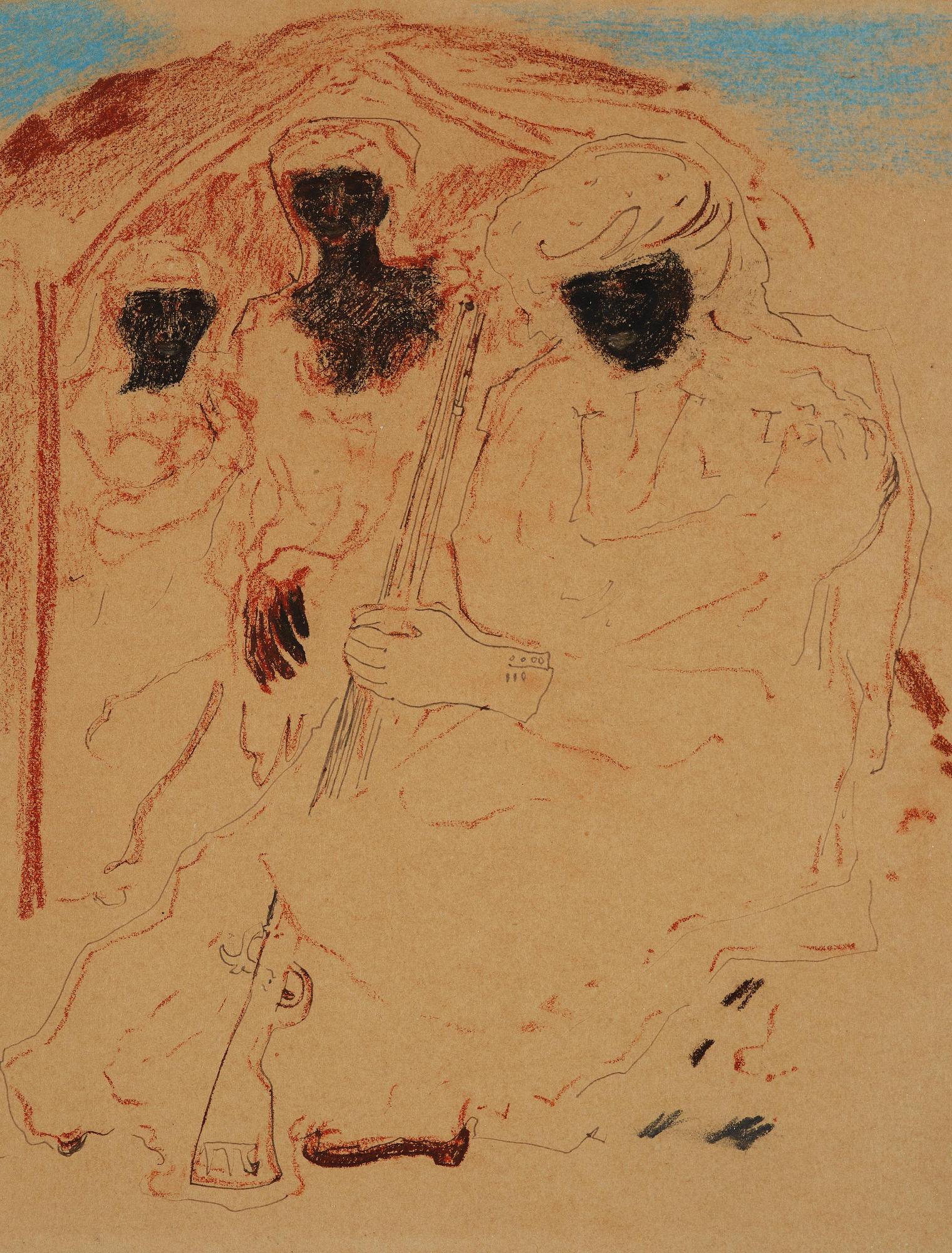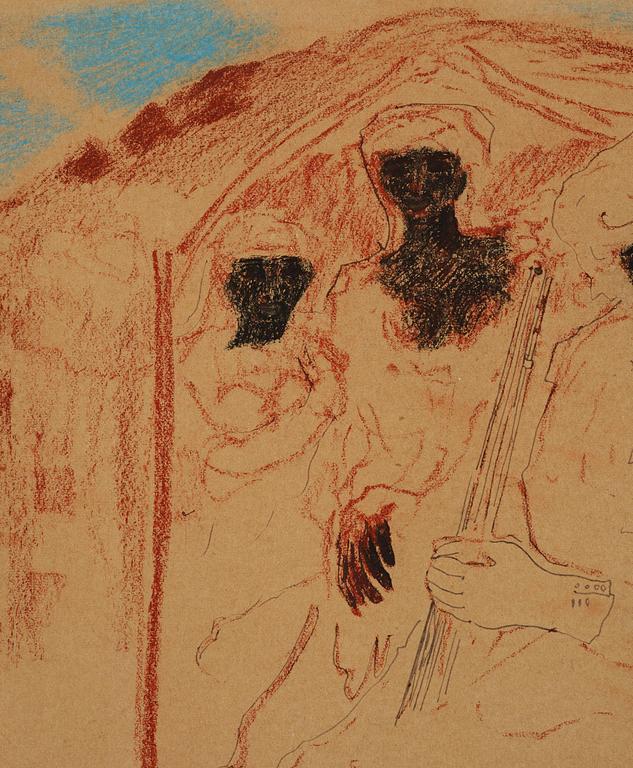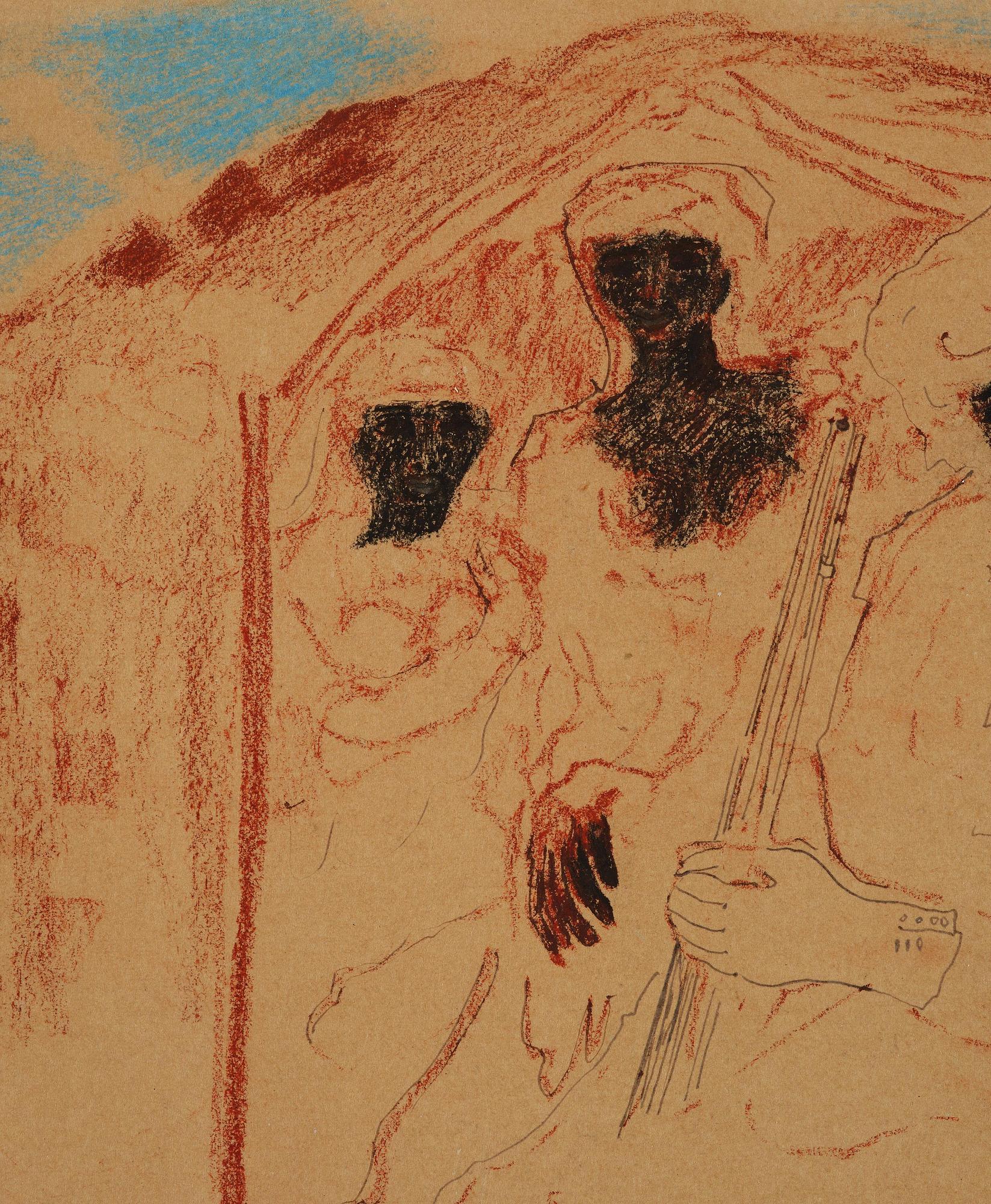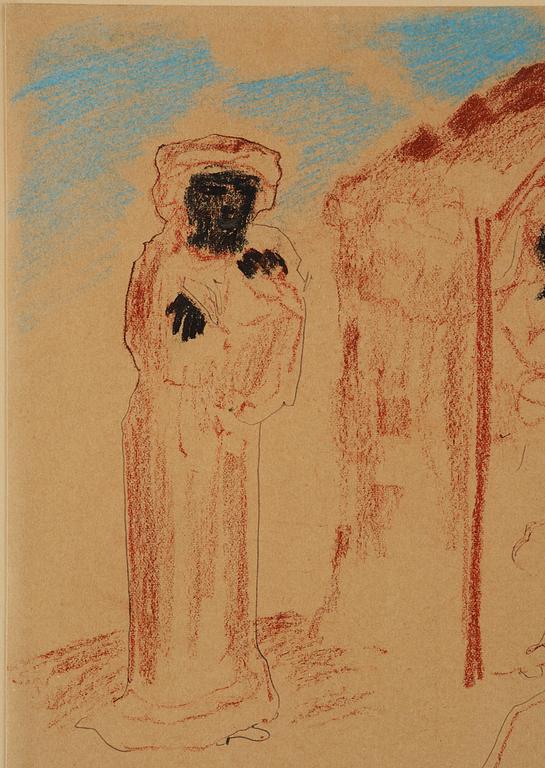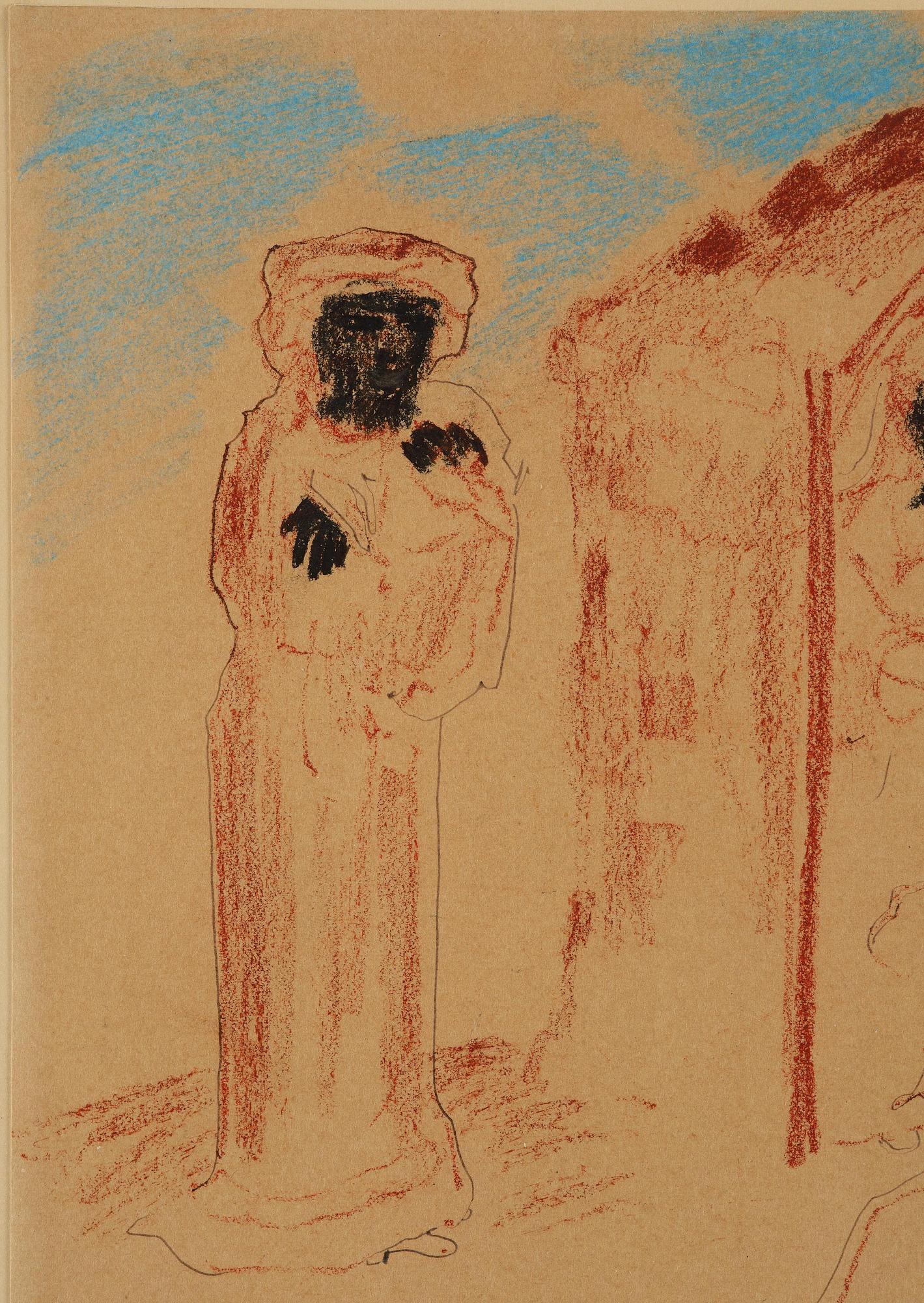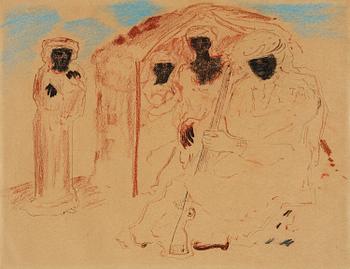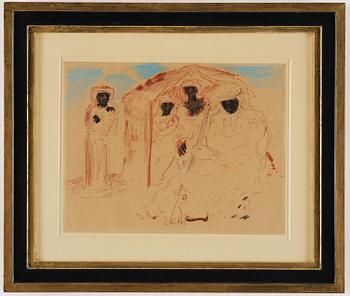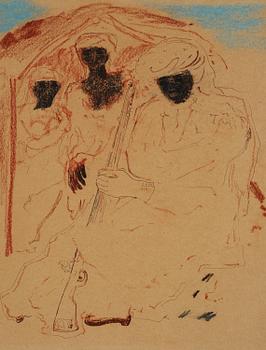
Figures by a tent
Crayon on paper 24 x 31.5 cm.
More information
Carl Fredrik Hill's drawing "Orientaler" in the collections of the Malmö Konstmuseum, just like the auction's drawing "Figures by a tent," are examples of the artist's interest in "exotic" motifs. Lennart Hagerf writes in a section of Adolf Andersberg's volume "Carl Hill. Hans liv och verk" that Hill undoubtedly drew inspiration from Eugène Delacroix's and A. G. Decamps' Orientalist painting, but that he then translated these impressions, both in colour chalk and in black and white, into his own artistic language. Hagerf writes:
"In a suite of drawings, he [Hill] has with unfailing artistry depicted oriental figures and allowed the dark skin tones of hands and faces to effectively contrast with light garments and backgrounds, arranging the figures so that the dark accents are rhythmically distributed across the entire picture surface." (Anderberg 1951, pp. 297–98)
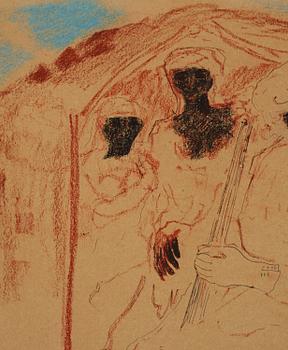
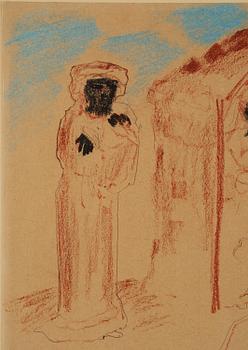
"Figures by a tent" is reminiscent of "Orientaler", but is considerably more elaborate and detailed. Here, Hill has drawn a group of four figures – two men and two women – who stand and sit in front of a tent. All four are dressed in ankle-length tunics and have turbans wrapped around their heads. The nearest figure also wears gloves and holds a long rifle in his left hand. Behind the figures, an opening of some kind can be discerned. Perhaps it is the tent fabric that has been pulled aside to allow entry into the dwelling. At the same time, the shape of the tent recalls Hill's way of drawing mountains, further enhancing the association with stark mountain and desert landscapes.
More about Carl Fredrik Hill
Carl Fredrik Hill was a Swedish artist born in Lund. Hill is considered one of Sweden's formost landscape painters. His fate and artistry are perhaps the strangest but most interesting in Swedish art history. Born in an academic home in Lund, despite his father's protests, he managed to begin studies at the Art Academy in Stockholm and then traveled to France, where he came in contact with Corot's landscape painting. He found his inspiration in Barbizon and later on the River Oise, in Luc-sur-Mer and Bois-le-Roi. He painted frantically with the hope of being accepted into the Salon de Paris. Already during his student years, he struggled with an incipient mental illness and at the age of 28 he was taken to the mental hospital in Passy. During the hospital stay he began his rich production of drawings and then continued with the production after his return to Lund, where he was cared for by his family for the rest of his life. In thousands drawings, a fantasy world of figures scenes appears. Today, Hill's river landscape and flowering fruit trees from the years in France, together with the visionary drawings from the period of illness in Lund, have received great recognition. His art depicts a loneliness and longing that is easy to get caught up in. He is mainly represented at the Malmö Museum and at the National Museum in Stockholm.
Read moreFor condition report contact specialist