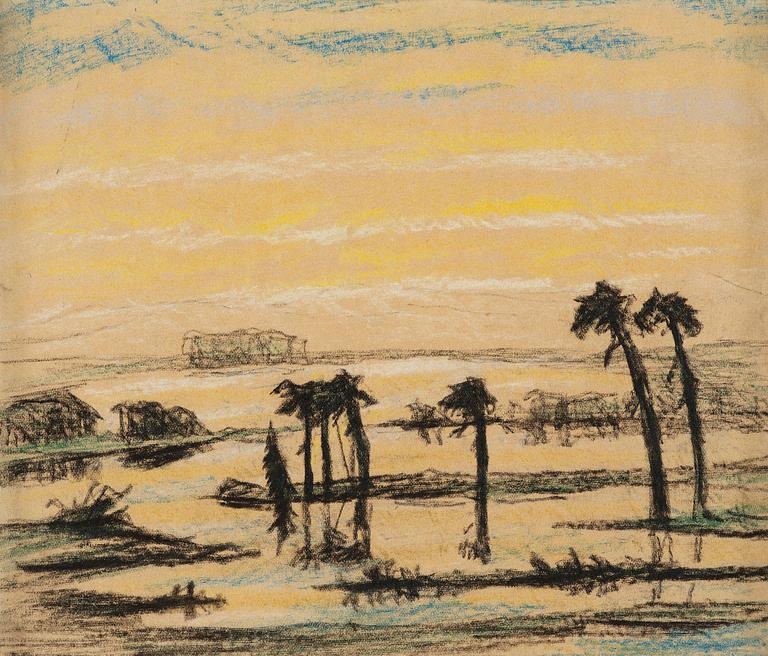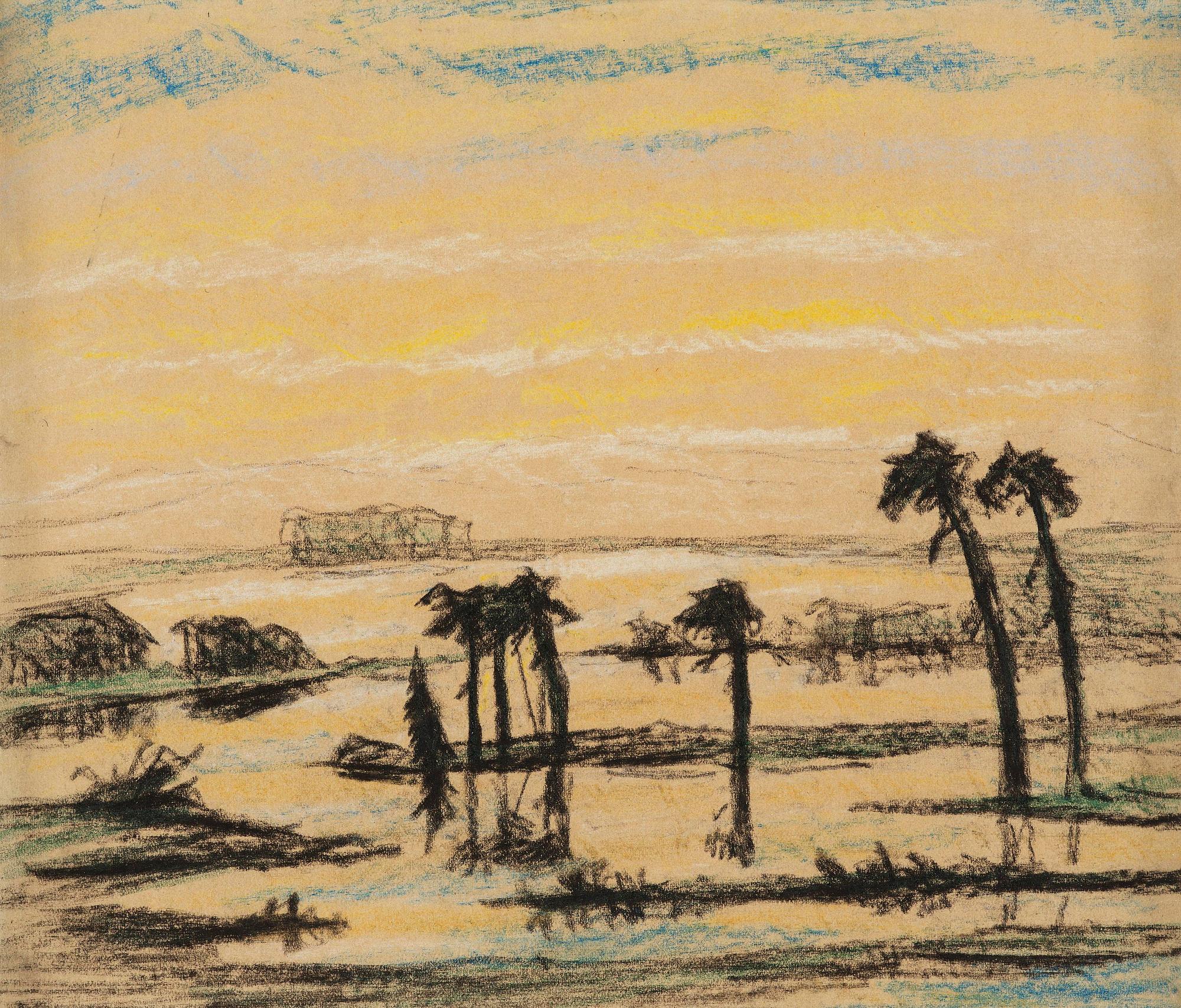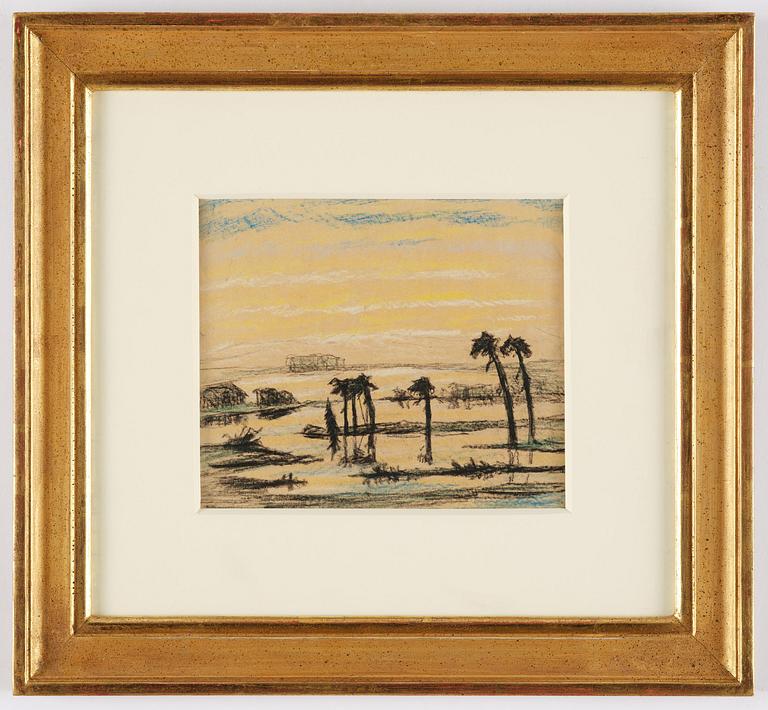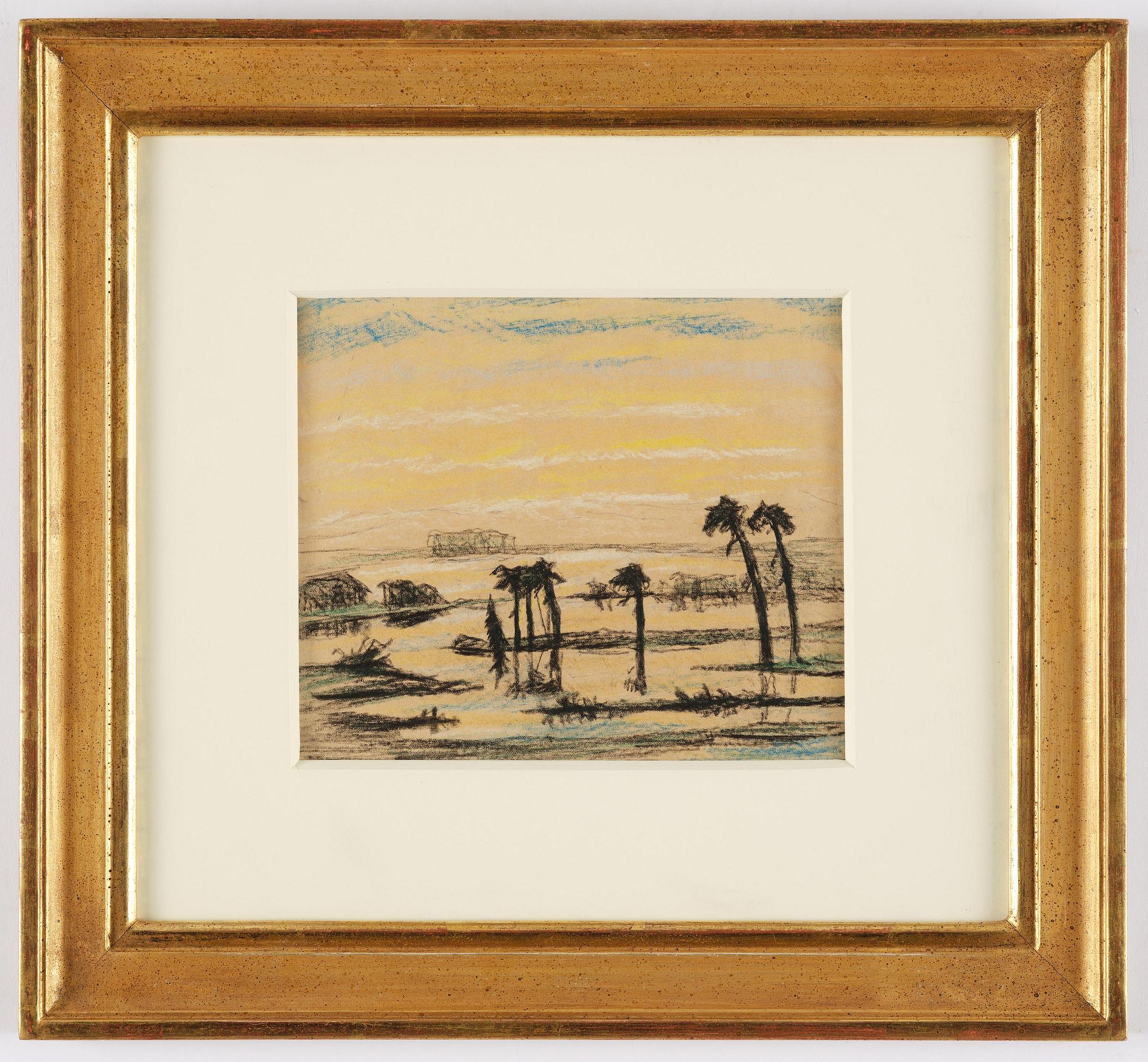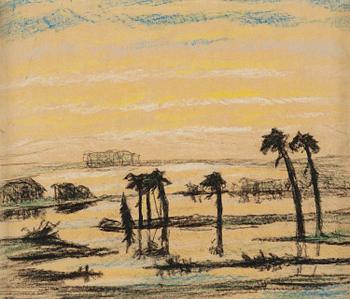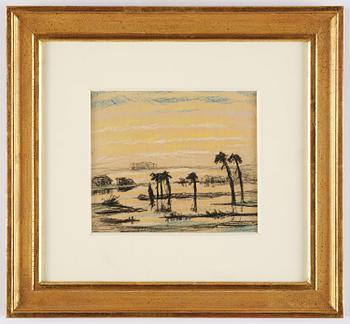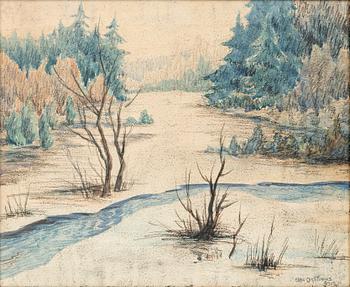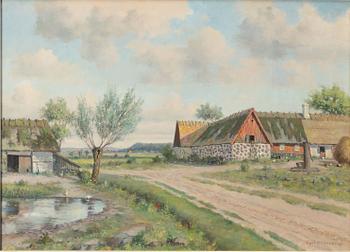
Landscape with palms and a tree
Crayon on paper 17 x 20.5 cm.
Provenance
The collection of Mr. Uno Otterstedt Ph.D., Lund, Sweden.
The collection of Managing director Jackie Neuman, Stockholm.
Exhibitions
Galleri Färg och Form, Stockholm, "Carl Fredrik Hill (1849-1911). Akvareller, färgkritor och teckningar från sjukdomstiden", April-May 1943, no. 26(?), based on stamp and inscription on the backboard.
More information
That Carl Fredrik Hill so often includes palms and other exotic plants and animals in his landscape images has been linked by some art historians to his general interest in the stories of the Bible. Nils Lindhagen sees the first sign of Hill placing the palm, “the special attribute of orientalism,” in a biblical context already in the so-called Flood series (Lindhagen 1976, ill. 85:1). He also writes that “even through its extreme verticality, this tree points upwards” and refers to the fact that the palm can also be interpreted as a sign of resurrection (ibid, p. 227).
“Landskap med palmer och en gran” seems to reflect a completely different and significantly calmer state of mind than the aforementioned sheet in the Flood series, but the two drawings do have one thing in common: next to the exotic palms grows a solitary, slightly leaning spruce. The spruce is a recurring and strongly significant element in Hill's pictorial world. Sophie Allgårdh has interpreted it as an expression of the artist's perceived vulnerability, while Nils Lindhagen has generally spoken of leaning, wind-torn trees as metaphors for Hill's own solitude and struggle against fate. Specifically regarding the spruce, the latter has also written that “The spruce is for Hill, as a Nordic counterpart to the classical oak, the symbol above all for what he values most in nature and thus also for his art.” (Nils Lindhagen, Carl Fredrik Hill. Sjukdomsårens konst, 1976, p. 261).
More about Carl Fredrik Hill
Carl Fredrik Hill was a Swedish artist born in Lund. Hill is considered one of Sweden's formost landscape painters. His fate and artistry are perhaps the strangest but most interesting in Swedish art history. Born in an academic home in Lund, despite his father's protests, he managed to begin studies at the Art Academy in Stockholm and then traveled to France, where he came in contact with Corot's landscape painting. He found his inspiration in Barbizon and later on the River Oise, in Luc-sur-Mer and Bois-le-Roi. He painted frantically with the hope of being accepted into the Salon de Paris. Already during his student years, he struggled with an incipient mental illness and at the age of 28 he was taken to the mental hospital in Passy. During the hospital stay he began his rich production of drawings and then continued with the production after his return to Lund, where he was cared for by his family for the rest of his life. In thousands drawings, a fantasy world of figures scenes appears. Today, Hill's river landscape and flowering fruit trees from the years in France, together with the visionary drawings from the period of illness in Lund, have received great recognition. His art depicts a loneliness and longing that is easy to get caught up in. He is mainly represented at the Malmö Museum and at the National Museum in Stockholm.
Read moreFor condition report contact specialist